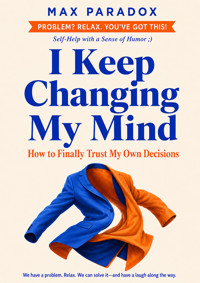
Uzyskaj dostęp do tej i ponad 240000 książek od 14,99 zł miesięcznie
- Wydawca: ALL-IN Rafał Płonkowski
- Kategoria: Biznes, rozwój, prawo•Biznes, rozwój
- Język: angielski
You make a decision.
Then you reconsider it.
Then you ask someone else.
Then you research again.
Then the option you rejected suddenly looks better.
Then you wonder whether the fact that you are still wondering means you made the wrong choice.
Welcome to the exhausting world of changing your mind.
I Keep Changing My Mind: How to Finally Trust My Own Decisions is a practical, funny guide for anyone who can turn a normal choice into a private investigation. Whether you are deciding about work, money, relationships, purchases, travel, plans, or what to order for dinner, Max Paradox shows why the real problem is often not making the decision-it is refusing to let the decision end.
This book will help you understand why uncertainty feels like evidence, why rejected options become more attractive after you choose, why asking too many people usually makes things worse, and why more research eventually creates less clarity.
More importantly, it gives you a concrete system for doing something about it.
You will learn how to:
define the real decision instead of accidentally deciding the rest of your life;
separate requirements from preferences;
choose the few criteria that actually matter;
stop searching once you have enough information;
distinguish useful advice from reassurance seeking;
use deadlines, defaults, decision rules, and review dates;
evaluate realistic downside without writing a disaster movie in your head;
stop reopening decisions just because discomfort appears;
recover from genuinely bad choices without destroying your trust in yourself;
recognize when changing your mind is intelligent and when it is simply anxiety wearing business casual.
This is not a book about becoming stubborn.
It is not about ignoring evidence, never asking for advice, or forcing yourself to stay with decisions that no longer make sense.
It is about building a decision process you can respect.
A process that works even when certainty is unavailable-which is inconveniently often.
You will not become a person who always chooses perfectly. No book can promise that, and any book that does should probably be reconsidered.
You can, however, become someone who chooses with enough information, accepts normal trade-offs, notices when something truly changes, adjusts when necessary, and stops treating every doubt like an emergency meeting.
If your brain currently keeps decisions alive long after they should have retired, this book will help you close the case.
Preferably before you open another seventeen tabs.
This publication was prepared with the assistance of tools that support the creative process, including artificial intelligence-based solutions. The final concept, structure, and editing belong to the author.
Ebooka przeczytasz w aplikacjach Legimi na:
Liczba stron: 198
Rok wydania: 2026
Odsłuch ebooka (TTS) dostepny w abonamencie „ebooki+audiobooki bez limitu” w aplikacjach Legimi na:
Podobne














INTRO
You are standing in a grocery store holding two nearly identical jars of pasta sauce. One says “traditional.” The other says “classic.” Both contain tomatoes, herbs, and enough sodium to preserve a small civilization. You choose the classic one, put the traditional one back, walk three steps, stop, return, switch them, and then stare at the shelf as if a third jar might descend from the ceiling and explain who you really are as a person.
This is not about pasta sauce.
Maybe you do it with clothes. You buy the blue shirt, then spend the drive home wondering whether the gray one made you look more competent. You accept a job, then suddenly become fascinated by every flaw in the company you joined and every advantage of the company you rejected. You pick a restaurant, open the menu, see someone else’s plate, and immediately begin an internal investigation into why you have once again ruined dinner.
Your decisions are rarely allowed to retire.
They get recalled for questioning.
A choice that seemed perfectly reasonable at 2:15 p.m. can be treated like evidence of catastrophic judgment by 4:40. You replay what you knew, what you did not know, what your friend said, what your other friend would probably say if consulted, and what some stranger online once wrote under a video titled “7 Signs You’re Making the Wrong Decision.” By evening, the original decision has acquired witnesses, expert testimony, and a documentary series.
The exhausting part is not simply changing your mind. Changing your mind can be smart. New information appears. Circumstances change. You learn something. You discover that the “quiet apartment” is directly above a man whose hobby is moving furniture at 1:30 a.m. Reconsidering that decision is not weakness. That is called receiving evidence.
The problem begins when your mind changes without new evidence because discomfort has shown up.
You decide, and then uncertainty arrives. Instead of treating uncertainty as a normal companion to decisions, you treat it as proof that the decision must be wrong. So you reopen the case. Then you reopen it again because reopening it did not make you feel certain enough. Soon you are no longer making decisions. You are trying to purchase a level of certainty that life does not sell.
The store is closed.
This can look like careful thinking from the outside. You compare options. You make lists. You ask smart questions. You research. You sleep on it. Then you research what “sleeping on it” is supposed to feel like. You might even call yourself thorough, which sounds much better than “I have been comparing the same three laptops for nine days and now know more about processor architecture than the man who designed my kitchen.”
Careful thinking is useful until it stops producing clarity and starts producing new reasons to doubt whatever clarity you already had.
That is the trap. The more you revisit a decision, the more flaws you can find. Every option has weaknesses when examined long enough. You can ruin a vacation by reading enough one-star reviews. You can talk yourself out of a good relationship by comparing it with an imaginary one that contains no bad moods, no boring Tuesdays, and apparently no actual human being. You can make a decent career choice feel reckless simply by spending three hours imagining the career you did not choose going perfectly.
The road not taken has excellent marketing.
It has no traffic, no bad manager, no delayed flight, no annoying neighbor, no awkward first month, and no unexpected bill because your brain does not have to live there. It only has to produce the brochure. Meanwhile, the option you actually chose must survive contact with reality, which is deeply unfair but apparently standard procedure.
Then comes another problem: every reversal weakens your trust in yourself.
You tell yourself you cannot decide until you feel confident, but confidence often arrives after you decide and live with the choice for a while. It grows when you see that you can handle consequences, adjust when necessary, and survive the shocking discovery that no decision comes with a ceremonial guarantee certificate. If you repeatedly choose, panic, reverse, reconsider, ask five people, reverse again, and finally let exhaustion pick for you, your brain learns a different lesson: “We cannot be trusted with buttons. Someone please find an adult.”
You are the adult.
Terrible system, I know.
The goal of this book is not to turn you into a person who never changes their mind. That would be stubbornness wearing a confidence costume. The goal is to help you know the difference between a decision that genuinely needs revision and a decision that merely feels uncomfortable because you cannot see the future.
You will learn how to make choices with enough information instead of infinite information. You will learn when more research is useful and when it is just anxiety with Wi-Fi. You will learn how to stop asking everyone for advice when the real purpose of asking is not insight but emotional insurance. And you will learn what to do after you choose, because many people think decision-making ends when the decision is made. For chronic mind-changers, that is often when the second season begins.
Most importantly, you will build trust in your own process.
That phrase matters. Trusting yourself does not mean believing every instinct is brilliant. Your instincts are capable of many things, including ordering dessert because “we earned it” after answering four emails. Self-trust means knowing that you have a reasonable way to decide, that you can tolerate some uncertainty afterward, and that you can correct course without interpreting every correction as proof that you are hopeless at life.
A good decision is not one that guarantees a good outcome.
That would be convenient. We would all like to select “excellent future, no complications” from a drop-down menu.
A good decision is one made with the information reasonably available at the time, using criteria that matter to you, without demanding supernatural certainty. Sometimes it will work beautifully. Sometimes it will be merely fine. Occasionally it will turn out badly because life contains variables, other people, weather, timing, economics, biology, luck, and companies that redesign perfectly good apps for no reason.
Your job is not to control all of that.
Your job is to stop putting yourself on trial every time reality fails to behave exactly as predicted.
So if you keep changing your mind about work, relationships, purchases, plans, conversations, goals, where to live, what to study, what to wear, or whether you should send that perfectly normal message that has now been rewritten eleven times, you are in the right place. We are going to make your decisions clearer, faster, calmer, and much harder to reopen without a legitimate reason.
You may still occasionally stand in a grocery aisle comparing two jars of sauce.
But ideally, you will pick one and continue living.
Radical, I know.
Wklejony tekst
Chapter 1 - The Decision Is Not the Problem
You order dinner at 7:04 p.m. At 7:07, you are looking at the restaurant’s menu again.
Not because the order failed. Not because the restaurant called to say they have run out of food and replaced your meal with a decorative napkin. Nothing has happened. Your order is accepted, the driver is being assigned, civilization continues.
You are simply wondering whether you should have chosen the other thing.
The burger suddenly looks too heavy. The salad now seems depressing. The pasta you ignored has acquired an almost spiritual glow. Somewhere in the back of your mind, the decision you made three minutes ago is being reviewed by a committee that was not invited and apparently has no other work.
This tiny scene contains most of the problem.
You think you struggle to make decisions. Often, you actually struggle to stop making them.
Those are different problems.
A person who genuinely cannot decide stays stuck before the choice. A chronic mind-changer may get stuck before the choice, but even after choosing, the decision remains mentally active. Instead of moving from “Should I?” to “I did,” the brain moves from “Should I?” to “Did I choose correctly?” and then opens a whole new department.
Congratulations.
You have completed Level One and unlocked Post-Decision Doubt.
That doubt feels important because the brain treats unresolved possibilities differently from closed ones. As long as you keep an alternative mentally available, you continue comparing the real choice with the imagined choice. The real one develops drawbacks because you are living with it. The imagined one remains suspiciously clean.
You take the job you chose and encounter meetings, deadlines, awkward conversations, and a printer that behaves as if it has unresolved trauma. The job you rejected has none of these problems in your imagination. In the imaginary version, your manager is supportive, the commute is effortless, the salary somehow increases, and nobody has ever scheduled a meeting called “Quick Sync” that lasts fifty-eight minutes.
Reality has disadvantages.
Fantasy has a public-relations team.
This is why your mind can turn perfectly reasonable decisions into evidence of terrible judgment. It compares a lived option with an edited alternative.
That is not a fair comparison.
Why Doubt Feels Like Information
Suppose you decide to go on a weekend trip with friends. The hotel is booked. The train tickets are purchased. Everyone is excited.
Two days later, you feel slightly reluctant.
Your brain immediately asks, “Does this mean I don’t really want to go?”
Maybe.
Or maybe you slept badly, have a busy week, spent too much money yesterday, dislike packing, and currently find the idea of wearing sweatpants at home more appealing than all known forms of tourism.
A feeling appeared.
That does not automatically make it a verdict.
One of the biggest mistakes chronic reconsiderers make is treating every emotional change as new evidence. Yesterday you were excited, so the decision seemed correct. Today you are tired, so the same decision seems suspicious. Tomorrow you may be excited again, at which point the investigation will presumably be suspended until further emotional developments.
This is an unstable way to make choices because feelings are real but variable.
They matter.
They are not always instructions.
You can feel nervous before doing something you genuinely want. You can feel relief after avoiding something you genuinely need. You can feel excited about a bad idea because it is new. You can feel bored with a good idea because it is no longer new.
If emotion alone could reliably identify the correct decision, nobody would ever text an ex after midnight.
History suggests otherwise.
The useful question is not:
“How do I feel about this decision right now?”
The useful question is:
“Has anything important changed since I made it?”
That one question removes an enormous amount of noise.
If important facts have changed, reconsidering may be intelligent. If nothing meaningful has changed except your mood, discomfort, boredom, or exposure to someone else’s opinion, you may not have a new decision. You may simply have an old decision plus fresh anxiety.
The Three Reasons You Reopen a Choice
Most unnecessary reconsideration comes from three places.
The first is new discomfort.
You made the choice, but now it feels uncomfortable. Maybe you sent the email and immediately want it back. Maybe you bought the ticket and suddenly feel trapped. Maybe you said no to someone and now guilt has arrived carrying a clipboard.
You interpret discomfort as evidence that the choice was wrong.
But discomfort often means only that the choice had a cost.
Saying no may create guilt.
Leaving a bad job may create fear.
Choosing one path means losing access to another.
Committing creates limits.
Limits feel uncomfortable, particularly if your brain prefers keeping seventeen doors open just in case Door Twelve leads to a better life, cheaper rent, perfect weather, and excellent skin.
The second reason is alternative inflation.
Once you choose Option A, your brain starts advertising Option B.
Before the decision, you saw the flaws in both. After the decision, something strange happens: the rejected option becomes more attractive because you no longer have to deal with its real-life disadvantages.
You buy Apartment A.
Suddenly Apartment B had “better light.”
Yes.
It also had a bathroom approximately the size of a laptop sleeve, which you seem to have forgotten.
The third reason is fear of self-blame.
This one is powerful.
Sometimes you are not afraid of making the wrong choice. You are afraid of what you will say to yourself if the choice goes badly.
“If I take this job and hate it, I’ll feel stupid.”
“If I move and regret it, I’ll blame myself.”
“If I end the relationship and miss them, I’ll think I ruined everything.”
So you try to eliminate regret before deciding.
Unfortunately, regret is not available for elimination.
It is available for management.
A choice can be reasonable and still lead to disappointment. A choice can be imperfect and still be the best one available. Sometimes you choose well and get unlucky. Sometimes you choose badly and get lucky.
Life is extremely inconsiderate about maintaining clean spreadsheets.
Stop Asking the Wrong Question
Chronic mind-changing is often powered by one impossible question:
“What is the right decision?”
It sounds sensible.
The problem is that many decisions do not have one objectively correct answer.
Which city should you live in?
Which reasonable job offer should you take?
Should you spend money on the trip or save it?
Should you buy the smaller house in the better location or the larger one farther out?
Should you go to the party or stay home?
Sometimes one choice is clearly better. Often, however, you are choosing between different packages of advantages and disadvantages.
There is no magical option that contains all benefits and politely declines all costs.
The better question is:
“Which trade-offs am I more willing to live with?”
That moves you from fantasy to reality.
Instead of asking whether Job A or Job B is perfect, ask which disadvantages you would rather tolerate.
Job A pays more but requires commuting.
Job B pays less but gives you flexibility.
Now you are choosing between costs, not searching for heaven’s HR department.
This is important because a large percentage of indecision disappears when you stop demanding an option without drawbacks.
There usually isn’t one.
Even free cake has consequences if you accept enough of it.
A Simple Test: Fact or Friction?
When you notice yourself reopening a decision, use a quick test.
Ask:
Did I learn something, or did I merely become uncomfortable?
New information might include:
the salary is different from what was promised;
the apartment has a problem you were not told about;
the schedule changed significantly;
the person crossed a boundary you had not previously seen;
the actual cost is much higher than expected.
Those are facts.
Friction sounds more like:
“Now I’m nervous.”
“My friend sounded surprised.”
“The other option suddenly seems better.”
“I’m scared I’ll regret it.”
“This feels very final.”
“I saw someone online doing something else.”
Those experiences may deserve attention, but they do not automatically justify reopening the choice.
Your first job is classification.
Fact?
Or friction?
That small pause matters because without it, every emotion gets promoted to breaking news.
Do Not Debate Yourself While Activated
There is another common mistake: trying to reevaluate a decision at the exact moment anxiety is highest.
You send an important message.
Thirty seconds later:
“Was that too direct?”
You read it again.
Now it seems aggressive.
You read it again.
Now the word “Thanks” looks passive-aggressive.
You consider sending a second message explaining the first message.
Do not.
Nothing improves communication like a follow-up paragraph explaining that the previous normal paragraph should not be interpreted as the declaration of a small war.
When you are highly activated, your evaluation becomes distorted. You search for danger, flaws, social mistakes, and escape routes. This is useful when a tiger is running toward you. It is less useful when you have written, “Thursday works for me.”
Create a delay.
For ordinary reversible decisions, give yourself a rule such as:
“I do not reconsider for two hours unless new information appears.”
For larger decisions:
“I do not reopen this today unless something materially changes.”
The purpose is not to force yourself to stay with a bad choice. It is to prevent momentary discomfort from pretending to be analysis.
The First Practical Rule
From now on, whenever you feel the urge to change your mind, do not immediately ask whether you should reverse the choice.
Ask four questions:
What exactly changed?
Is this new information or a new feeling?
Does the new information affect one of the reasons I originally chose this?
If nothing changed, what discomfort am I trying to escape?
That is enough.
Do not create a nineteen-column decision matrix every time you choose between two restaurants. We are trying to reduce reconsideration, not establish the Department of Sauce Selection.
If the answer is “nothing changed; I just feel uncertain,” your task is usually not to decide again.
Your task is to tolerate the fact that a decision has been made.
That may feel strange at first because your brain has learned that discomfort triggers review. You are teaching it a different sequence:
Decision.
Discomfort.
Pause.
No automatic reopening.
This is the first piece of self-trust.
Not certainty.
Not perfect judgment.
The ability to leave a reasonable choice alone long enough to find out what actually happens.
Today, pick one minor decision you have already made and refuse to review it unless genuinely new information appears.
Dinner counts.
Please let the pasta sauce live in peace.
Chapter 2 - You Are Trying to Eliminate Regret
You are booking a vacation.
At first, the process is pleasant. You look at a few hotels, compare prices, check the beach, read about the neighborhood, and begin imagining yourself sitting somewhere sunny with a drink that costs nine dollars because someone put a leaf in it.
Then research continues.
Hotel A has the better pool.
Hotel B has better rooms.
Hotel C is closer to town.
Hotel D has breakfast included.
Hotel E has a review saying, “Best hotel ever!!!”
Hotel E also has another review saying, “WORST EXPERIENCE OF MY LIFE,” written by someone whose primary complaint appears to involve the breakfast toaster.
Now you have twenty-three tabs open.
The vacation has not started, and you already need recovery time.
This is what happens when decision-making quietly changes jobs. It begins as an attempt to choose a good option and turns into an attempt to guarantee that future you will never think:
“I wish I had chosen differently.”
That guarantee does not exist.
But your brain is willing to spend Tuesday evening looking for it.
Regret Is Not Proof of a Bad Decision
Imagine you accept a job offer.
Six months later, you dislike the job.
Your immediate conclusion may be:
“I made the wrong decision.”
Possibly.
But slow down.
At the time you accepted it, perhaps the salary was better, the role matched your goals, the company seemed stable, and the manager appeared reasonable. You evaluated what you could. Later, the company reorganized, your manager left, the workload changed, and someone decided that every project now requires a dashboard.
Was the original decision foolish?
Not necessarily.
You did not choose the outcome.
You chose based on available information.
This distinction is critical because chronic mind-changers often judge old decisions using information that did not exist when the decisions were made.
That is intellectual cheating.
Very sophisticated cheating, but still cheating.
You look backward with today’s knowledge and say, “I should have known.”
No.
Sometimes you could have known.
Sometimes you ignored obvious warning signs because optimism was driving the car.
But sometimes you genuinely could not know.
A good decision process does not create a perfect future.
It creates a reasonable choice under uncertainty.
If you do not understand that, you will keep trying to improve your decisions until they become impossible to make.
The Fantasy of the Regret-Free Option
You may believe that if you compare long enough, ask enough people, read enough reviews, and consider enough scenarios, you can identify the option that future you will never question.
This is attractive because regret feels personal.
If the weather is bad, that is unfortunate.
If you choose the “wrong” hotel, suddenly you are an idiot.
At least that is how the internal narration tends to go.
You are standing in a perfectly decent hotel room thinking:
“This is fine, but the other place had balconies.”
And there it is.
The balcony.
A completely hypothetical balcony has defeated your actual vacation.
The problem is not that you should ignore alternatives. The problem is expecting your chosen option to make all alternatives stop having advantages.
It cannot.
If you choose one thing, the unchosen thing may still have benefits.
That is normal.
Marriage does not make every other person unattractive.
Buying one home does not make all other homes inferior.
Choosing a career does not erase all interesting careers.
Ordering tacos does not prove pizza has been morally defeated.
A choice is not a court ruling against every alternative.
It is simply a commitment to one option for now.
The Two Types of Regret
It helps to separate regret into two categories.
The first is useful regret.
Useful regret teaches you something specific.
“I accepted the job without asking enough about travel requirements.”
“I spent too much because I was trying to impress people.”
“I ignored a pattern because I wanted the relationship to work.”
“I booked a forty-five-minute connection through a giant airport because the ticket was eighteen dollars cheaper, and I now understand that I am not an Olympic sprinter.”
Good.
Painful, perhaps.
But useful.
Useful regret produces a lesson that can change future behavior.
The second is fantasy regret.
Fantasy regret says:
“Maybe the other option would have been better.”
That is often impossible to verify.
You did not live both lives.
You do not know what would have happened if you had chosen the other job, apartment, partner, city, major, flight, couch, or brand of dishwasher.
Your mind fills the missing reality with an optimistic simulation.
The other path becomes better because you are imagining its benefits while forgetting that it would also have contained inconveniences, trade-offs, bad Tuesdays, unexpected expenses, delays, and at least one person who replies to emails with “Thoughts?”
Fantasy regret produces no usable lesson.
It simply makes you suspicious of yourself.
Stop Using Outcomes to Grade Every Decision
Here is a better way to evaluate a past choice.
Instead of asking:
“Did this turn out well?”
ask:
“Was my decision process reasonable based on what I knew?”
Those are not the same question.
You can make a poor decision and get a good result.
You can make a good decision and get a poor result.
Suppose you drive home after drinking far too much and nothing happens.
Good outcome.
Bad decision.
Suppose you carefully choose a highly rated flight with a comfortable connection and the airline cancels it because of severe weather.
Bad outcome.
Reasonable decision.
We understand this easily in obvious examples, then forget it when evaluating our own lives.
If something goes badly, we assume the choice was bad.
That encourages endless pre-decision analysis because you begin believing that enough thinking can protect you from bad outcomes.
It cannot.
Thinking reduces some risks.
It does not abolish reality.
Make Decisions You Can Defend, Not Predict
A powerful shift is to stop trying to predict the future perfectly and start making decisions you can reasonably defend.
Before a meaningful choice, write down three things:
What matters most?
Choose two or three criteria.
Not seventeen.
If you are choosing a job, perhaps they are salary, flexibility, and growth.
If you are choosing a place to live, perhaps location, monthly cost, and space.