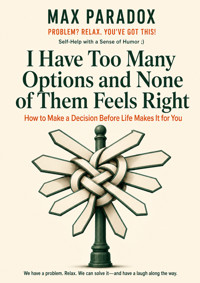
I Have Too Many Options and None of Them Feels Right - How to Make a Decision Before Life Makes It for You ebook
Max Paradox
Uzyskaj dostęp do tej i ponad 240000 książek od 14,99 zł miesięcznie
- Wydawca: ALL-IN Rafał Płonkowski
- Kategoria: Biznes, rozwój, prawo•Biznes, rozwój
- Język: angielski
You have compared the options.
Then compared the comparisons.
Then watched three reviews, asked four people, opened twelve tabs, built a spreadsheet, and somehow become less certain than when you started.
Welcome to modern decision-making.
I Have Too Many Options and None of Them Feels Right is a practical, funny guide for anyone who can turn a perfectly ordinary choice into a private research institute. Whether you are choosing a job, apartment, purchase, vacation, project, career direction, or simply wondering why two decent options can consume an entire weekend, this book will help you stop searching for impossible certainty and start making decisions you can actually live with.
Max Paradox explains why more information eventually creates more doubt, why imaginary alternatives always look suspiciously perfect, why discomfort after choosing does not automatically mean you chose badly, and why “keeping your options open” can quietly become another way of doing nothing.
More importantly, the book gives you a practical system.
You will learn how to define the few criteria that genuinely matter, eliminate options before comparing them, separate reversible choices from expensive mistakes, set useful research limits, identify the failure conditions that deserve attention, and use decision deadlines without turning your life into a panic-driven game show.
You will also discover what to do when two options are both good, when no option feels good enough, when your energy is low, when the method seems to stop working, and when you make a choice that turns out badly.
Because bad decisions happen.
The goal is not to become a human prediction machine.
The goal is to make reasonable choices, recover intelligently, and stop treating every uncertainty like evidence that another twelve hours of research are required.
This is self-help for normal people: busy, tired, occasionally chaotic, and fully capable of spending forty minutes choosing a $25 product while ignoring a much larger decision because the larger one feels unpleasant.
Expect practical methods, realistic examples, dry humor, useful fallback plans, and no advice requiring you to “simply trust the universe.”
The universe has not provided sufficient documentation.
If you have too many options, too much doubt, and too many tabs open, this book will show you how to narrow the field, choose with less stress, and move on before life quietly chooses for you.
This publication was prepared with the assistance of tools that support the creative process, including artificial intelligence-based solutions. The final concept, structure, and editing belong to the author.
Ebooka przeczytasz w aplikacjach Legimi na:
Liczba stron: 208
Rok wydania: 2026
Odsłuch ebooka (TTS) dostepny w abonamencie „ebooki+audiobooki bez limitu” w aplikacjach Legimi na:
Podobne
















INTRO
You have twelve tabs open, four reviews bookmarked, three people waiting for your answer, and one decision that should have taken approximately seven minutes.
Instead, it has become a research project.
Maybe you are choosing a new laptop. At first, the job seems simple: buy a laptop. Then you discover processors, screen types, battery tests, keyboard travel, ports you did not know existed, and a man on YouTube who appears genuinely furious about the placement of a charging socket. Two hours later, you have learned that Model A has a slightly better screen, Model B is cheaper, Model C has longer battery life, and Model D is apparently “the obvious choice” according to someone whose entire personality is benchmarking computers.
You do not feel better informed.
You feel like you have accidentally joined a committee.
This happens with bigger decisions too. Which job should you take? Should you move? Stay? Break up? Try again? Buy now or wait? Start the course? Change careers? Go with the safe option or the exciting one? Every path seems to contain something good, something annoying, and at least one future version of you standing in the distance saying, “Interesting choice.”
So you wait.
Not because you do not care, but because you care so much that you want to make the right decision. Ideally, the perfect decision. The one that gives you the advantages of Option A, the excitement of Option B, the security of Option C, and none of the irritating parts of any of them.
This option is usually called “not available.”
Unfortunately, the modern world has not accepted this limitation. It keeps offering alternatives. You can compare almost anything with almost anything else. Before buying a toaster, you can read 847 reviews written by people who apparently consider toast a matter of national infrastructure. Before booking a hotel, you can examine every bathroom tile from six angles. Before choosing a restaurant, you can compare menus, photos, ratings, parking, noise levels, table spacing, and whether someone named Greg thought the risotto was “underwhelming” in March 2023.
Greg has moved on.
You have not.
The problem is not simply that there are too many options. Sometimes there are only two, and you can still spend three weeks pacing between them like a judge on the final episode of a talent show. The deeper problem is that we often expect a decision to remove uncertainty before we make it.
We want to know how the job will feel six months from now. We want proof that the relationship will work. We want certainty that the expensive purchase will not go on sale next Thursday. We want confirmation that choosing one city will not make us miss another. We want the future to fax us a signed document saying, “Yes, excellent choice. No regrets expected.”
The future has terrible customer service.
So the brain tries another strategy: more information. Maybe one more review will settle it. One more spreadsheet. One more conversation. One more comparison. One more night to sleep on it, although at this point you have slept on it so many times the decision technically qualifies as furniture.
Sometimes more information helps. Often, however, you eventually cross an invisible line. Before that line, research reduces uncertainty. After it, research produces new uncertainty faster than it removes the old kind. Every new fact creates another angle. Every new opinion introduces another standard. Every option that looked good five minutes ago develops a small defect, and your brain immediately zooms in on it like a detective in a crime drama.
“Enhance.”
There it is.
The hotel is perfect except for one review mentioning slow elevators. The job is excellent except that another company offers two more vacation days. The apartment has everything except a slightly smaller kitchen. The phone is exactly what you need except another model has a camera feature you have never used and may never use but now suddenly feel entitled to.
This is how a choice stops being a choice and becomes an audition for perfection.
The stakes also grow in your imagination. A decision about what to buy becomes a test of whether you are financially responsible. A career choice becomes a referendum on your entire future. Choosing where to live becomes evidence about who you are as a person. Even ordering dinner can become strangely philosophical when you are tired enough.
“Do I want Thai food, or am I merely trying to become the kind of person who orders Thai food on a Wednesday?”
Please order something. You are hungry.
Another reason decisions become difficult is that choosing something means not choosing something else. This sounds obvious until you actually have to do it. We enjoy having options because options feel like freedom. The moment we choose one, the others disappear—or at least become less available. Suddenly the restaurant you did not choose looks charming. The job you rejected develops excellent qualities. The vacation destination you skipped appears on Instagram under suspiciously perfect lighting.
Your brain compares the real choice, with all its imperfections, to imaginary alternatives that never had to survive contact with reality.
Imaginary options are extremely competitive.
They never have delayed flights, difficult bosses, maintenance costs, awkward first weeks, annoying neighbors, or Wi-Fi problems. They exist in premium condition inside your head, where no one has yet spilled coffee on them.
That makes regret feel dangerous. You start trying to avoid not just a bad decision, but the possibility of ever wondering whether another choice might have been better. This is an impossible standard. You can make a good decision and still occasionally wonder about the road not taken. You can choose wisely and still discover disadvantages later. You can even make the best decision available with the information you had and then watch circumstances change.
That does not automatically mean the decision was wrong.
It means you made it while living in time, which is currently the only package available.
This book is about getting out of that trap without becoming reckless, indifferent, or the kind of person who decides major financial matters by flipping a coin over the sink. You do not need to stop thinking. You need to know when thinking is helping and when it has quietly put on a fake mustache and become procrastination.
We are going to separate decisions that deserve serious analysis from decisions that merely enjoy the attention. We will look at why more options often make choosing harder, why searching for certainty keeps you stuck, why “keeping every door open” eventually leaves you standing in a hallway, and why the fear of regret can make you create the exact outcome you were trying to avoid: no decision at all.
More importantly, we will build practical ways to choose.
Not mystical ways. Not “listen to the universe.” The universe is busy.
You will learn how to reduce the number of meaningful options, decide what actually matters before comparison begins, set a stopping point for research, distinguish reversible choices from expensive ones, use deadlines without turning them into panic, and make a good-enough decision without spending the following month conducting an internal appeal.
You will also learn what to do when no option feels right.
Because sometimes that is the real problem. Not “Which one is perfect?” but “Why do all of these make me slightly miserable?” Occasionally the correct answer is not choosing better from the existing menu. It is changing the menu.
And when there really is no perfect answer, you will learn how to choose anyway.
That may sound less comforting than a promise that every decision can become obvious if you analyze it correctly. It is also much more useful. Life rarely hands you Option A marked “CORRECT” in green and Option B surrounded by cartoon skulls. More often, it gives you two reasonable possibilities, incomplete information, limited time, competing priorities, and a brain that has suddenly decided both choices require a twelve-part documentary series.
You do not need certainty.
You need a decision process you can trust.
Then you choose, move, adjust, and continue living instead of standing at the crossroads comparing road surfaces.
Because eventually, refusing to decide becomes a decision too.
And annoyingly, it is often the one you researched least.
Wklejony tekst
Chapter 1 - The Problem Is Not the Options
You are standing in front of a shelf holding twenty-seven versions of basically the same thing.
Maybe it is coffee. Maybe toothpaste. Maybe headphones. Maybe a streaming service. Maybe a retirement plan, which is admittedly a slightly more consequential shelf.
You pick one up.
Then another.
Then the first one again because it suddenly looks more trustworthy now that you have met its competitors.
Five minutes later, you are comparing ingredients, features, reviews, pricing tiers, hidden fees, cancellation policies, and whether the blue package feels more competent than the white one.
This is not decision-making.
This is an hostage negotiation with packaging.
The natural conclusion is that your problem is too many options. And sometimes that is true. Twenty-seven nearly identical products can make a simple decision harder than it needs to be. But the number of choices is only the visible part of the problem.
The deeper issue is what happens after the options enter your head.
You start comparing them without first deciding what matters.
That is where the trouble begins.
Suppose you are choosing between three jobs. Job A pays the most. Job B offers the best work-life balance. Job C seems the most interesting. If you do not know which of those things matters most to you right now, you can compare forever.
A wins on money.
B wins on time.
C wins on meaning.
Then A becomes tempting again because money pays bills, which have shown remarkably little interest in meaning.
Then B looks better because exhaustion is not technically a career strategy.
Then C makes a comeback because you imagine yourself doing something interesting instead of dying slowly inside a spreadsheet named FINAL_v7_REAL_FINAL.xlsx.
Now you are not deciding.
You are rotating priorities.
Each option gets judged according to whatever criterion happens to feel most important in that particular minute. This creates the illusion that the decision is impossible, when the real problem is that the scoreboard keeps changing during the game.
Imagine watching a basketball match where points count differently every possession.
“Excellent shot. Two points.”
“Actually, today we value defensive positioning. Minus four.”
“That player has a nice attitude. Add seven.”
Eventually everyone goes home confused, including the ball.
This is what many difficult decisions feel like internally. You do have standards, but you have not ranked them. So every option wins and loses at the same time.
The first useful shift is simple:
Stop asking, “Which option is best?”
Ask, “Best for what?”
There is no universally best apartment, job, vacation, laptop, city, partner, schedule, or career move. There is only an option that fits your current priorities better than the alternatives.
That sounds obvious until you notice how often people shop for “the best.”
The best phone.
The best investment.
The best diet.
The best city to live in.
The best mattress.
This usually produces a large amount of content and very little peace.
“Best” is a useless word without criteria.
A sports car may be excellent unless you have three children, a large dog, and a weekly relationship with IKEA.
A tiny city-center apartment may be fantastic if you value location and terrible if you own a drum kit.
A high-paying job may be perfect when you are building savings and miserable when you are already working sixty hours a week and have started treating Saturday like a rumor.
Context decides.
This also explains why advice from other people can be both sincere and useless.
Your friend may genuinely love Option A because it fits their priorities. Your brother may prefer Option B because he values something else. A stranger online may insist that only idiots choose Option C because strangers online are legally required to express preferences as moral judgments.
None of these people are necessarily wrong.
They are just not you.
This is why asking too many people often makes a hard decision harder. Each person quietly imports their own priorities into your problem.
“You should take the job with better pay.”
“You should choose the one with more freedom.”
“You should think about long-term growth.”
“You should follow your passion.”
“You should buy property.”
“You should rent.”
“You should move abroad.”
“You should stay close to family.”
By the end of the conversation, you are not choosing between three options anymore.
You are choosing between six different philosophies of life.
Very efficient.
The solution is not to ignore advice. It is to separate information from preference.
Someone may know something useful about an industry, neighborhood, product, company, or financial issue. Excellent. Take the information.
But when they say, “I would definitely choose this,” mentally add:
“…because I am me.”
That small sentence can save you enormous confusion.
Before comparing options, identify the decision criteria.
Not twenty.
Three to five.
If everything matters, nothing has priority.
Let us say you are choosing an apartment. Your criteria might be:
total monthly cost;
commute time;
neighborhood;
amount of space;
condition of the property.
Already, the decision becomes clearer.
But there is one more step people often skip.
Rank them.
Maybe monthly cost is most important. Then commute. Then neighborhood. Then space. Then condition.
Now a beautiful apartment with a forty-five-minute commute and a rent that requires you to monetize your kidneys loses some of its charm.
You are not pretending it is bad.
You are recognizing that it is bad for your priorities.
That distinction matters.
People often get stuck because they believe rejecting an option means proving it is objectively inferior. It does not.
You can say:
“This is a good option, but not the best fit for me.”
That sentence is adult decision-making in comfortable shoes.
It also reduces guilt.
Many choices feel difficult because every option has a compelling advantage. The expensive apartment is gorgeous. The cheaper one is practical. The distant one has a garden. The central one has restaurants downstairs. You can appreciate all of that without creating a legal obligation to choose each one.
You are allowed to admire something and still walk away.
This is particularly useful when the option is impressive in a way that does not matter much to your daily life.
For example, people routinely pay for features they love in theory and ignore in practice.
A giant kitchen for someone who mostly reheats food.
A powerful car for city traffic.
A premium camera system for photos of receipts and a cat.
A home gym that slowly becomes a wardrobe with ambitions.
Before paying for an advantage, ask:
“How often will I actually benefit from this?”
That question is ruthless in the best possible way.
It converts fantasy value into practical value.
A feature you use twice a year should not beat a benefit you experience every day.
This is also true beyond purchases.
One job may offer exciting international travel. Sounds glamorous. How much travel? Ten days a year? Eighty? Are you excited by airports after the tenth delay, or only by the phrase “international travel” in a job description?
Another role may advertise flexibility. What does flexibility mean? Can you actually choose your hours, or does it mean the company is flexible about when they contact you at night?
Words are cheap.
Translate them into behavior.
When comparing any important choice, ask:
“What will this actually look like on a normal Tuesday?”
Normal Tuesday is one of the best decision tools available.
Not launch day.
Not vacation week.
Not the first month.
Not the glossy brochure version.
Tuesday.
You wake up.
You go to work.
You commute.
You cook.
You use the device.
You live in the apartment.
You deal with the consequences.
How does the option perform there?
This helps because the brain is naturally attracted to standout features. The exciting salary. The balcony. The title. The new technology. The view. The prestige. The dramatic possibility of reinventing your life.
Daily life, however, is mostly repeated ordinary things.
A decision that improves Tuesday is often more valuable than one that impresses Saturday night.
That does not mean you should become brutally practical and remove joy from every choice. Please do not choose your partner using a weighted spreadsheet called RELATIONSHIP_MATRIX_FINAL.
The point is not to reduce life to numbers.
The point is to stop pretending all benefits matter equally.
Some decisions can use numbers. Others require judgment. Most use both.
If you are choosing between options, try this simple method:
Write down the actual decision in one sentence.
List no more than five criteria that genuinely matter.
Rank them.
Eliminate any option that fails a non-negotiable requirement.
Compare what remains using the same criteria.
That fourth step is important.
A non-negotiable is not “I prefer this.”
It is “If this is missing, the option does not work.”
For an apartment, that may be affordability.
For a job, it may be location.
For a car, it may be space.
For a relationship, it may be respect, trust, or compatible life goals.
For headphones, it may be whether they stay inside your ears instead of launching themselves across the gym.
Once an option fails a true requirement, stop trying to rescue it because it has one attractive feature.
This is how people end up saying things like:
“Yes, the rent is financially irresponsible, but look at the windows.”
The windows will not pay the rent.
Another common mistake is turning preferences into non-negotiables.
You would like a balcony.
Fine.
You would prefer three bedrooms.
Fine.
You would love a certain neighborhood.
Fine.
But if every preference becomes mandatory, you have created a fictional option that may not exist.
Then reality keeps disappointing you for failing to offer it.
This is where decision-making becomes less about finding perfection and more about accepting trade-offs.
Every real option costs something.
Money.
Time.
Convenience.
Freedom.
Security.
Excitement.
Status.
Energy.
Opportunity.
A decision is often not “Which one has no downside?”
It is:
“Which downside am I most willing to live with?”
That question is much more powerful.
Suppose one job pays less but gives you evenings back. Another pays more but demands long hours. Neither is perfect.
Which cost bothers you more right now?
Less income?
Or less time?
There is no correct answer independent of your life.
The mature part of the decision is not discovering an option without sacrifice.
It is choosing your sacrifice deliberately.
That may sound grim, but it is actually freeing.
Once you stop demanding that every option win on every criterion, choices become easier.
You no longer need the apartment to be cheap, huge, central, silent, renovated, bright, available immediately, pet-friendly, and mysteriously overlooked by everyone else in the city.
You need it to meet your important needs well enough.
The same goes for many life choices.
Enough is not failure.
Enough is often the point at which you can stop researching and start living.
Your action for this chapter is simple.
Take one decision you are currently circling around and write down your top three criteria before you compare anything else.
Not what sounds impressive.
Not what someone else values.
Not what makes the option easier to defend at dinner.
What matters to you.
Then rank them.
You may discover that the choice was never impossible.
The scoreboard was just broken.
Chapter 2 - You Are Trying to Eliminate Regret
You make a decision.
For three glorious minutes, everything is fine.
Then your brain opens a second shift.
“What if the other option was better?”
Ah.
There it is.
The post-decision department.
This department has one employee, no supervision, and unlimited access to imaginary scenarios.
You choose Restaurant A.
Immediately, Restaurant B looks more interesting.
You buy the black shoes.
The brown ones now appear sophisticated, timeless, and possibly endorsed by European architects.
You accept the job.
Suddenly, the job you rejected becomes a paradise of balance, opportunity, supportive leadership, and free pastries.
You have no evidence for the pastries.
That is the beauty of the imaginary alternative.
It cannot disappoint you because you never chose it.
This is one of the main reasons decisions become exhausting: you are not only trying to choose well.
You are trying to avoid future regret.
That sounds reasonable. Regret is unpleasant. Nobody orders it on purpose.
The problem is that we often define successful decision-making as:
“I will never wonder whether another choice might have been better.”
That standard is impossible.
You can make an excellent decision and still wonder.
You can choose a great career and occasionally imagine another one.
You can love the city where you live and still think about what life might have been like somewhere else.
You can buy a very good laptop and then watch a review of another model two days later because apparently you enjoy self-harm with benchmarks.
Wondering does not prove you chose badly.
It proves you can imagine alternatives.
Your brain is excellent at this.
Too excellent.
It can generate a complete parallel life in under thirty seconds.
“If I had taken that job, I would probably have moved to Seattle. Then I would have joined that climbing gym, met different people, started a side business, and somehow learned Italian.”
Based on what?
Nothing.
The brain does not require evidence before producing director’s-cut editions of your unlived life.
This becomes especially dangerous when the real option develops normal imperfections.
You choose a job.
Three months later, you have a difficult week.
Now the rejected offer starts glowing in your memory.
You forget its weaker salary, uncertain manager, longer commute, and vague role description.
You remember only the possibility.
The option you chose has reality.
The option you rejected has marketing.
This is an unfair competition.
Real life includes annoying meetings, laundry, delays, unexpected expenses, bad moods, sick days, traffic, misunderstandings, and Wi-Fi that works beautifully until someone says, “Can you see my screen?”
Imaginary life includes none of this.
It is professionally edited.
The first thing to understand is that regret is not always evidence.
Sometimes regret contains information.
Maybe you ignored an important warning sign.
Maybe you violated your own priorities.
Maybe the decision genuinely turned out badly.
Fine. Learn from it.
But sometimes regret is simply the emotional cost of closing other doors.
That is different.
Imagine choosing between two good vacation destinations.
You pick Hawaii.
You have a great trip.
Then you see photos from Italy and feel a small pang.
Was Hawaii a mistake?
Of course not.
You are experiencing the fact that choosing one good thing meant temporarily not choosing another good thing.
This is normal.
Humans are greedy in a very understandable way.
We would like all the good versions.
We want the beach and the mountains.
High salary and low stress.
Freedom and security.
Excitement and predictability.
A large house and a five-minute commute.
An impressive career and abundant free time.
A phone with every feature and a battery that lasts until retirement.
Reality keeps refusing to bundle these things properly.
So a major part of good decision-making is learning to tolerate the feeling that another option also had value.
That feeling does not need to be solved.
Sometimes it just needs to be allowed.
This is hard because many people use regret avoidance as a decision rule.
They ask:
“Which choice am I least likely to regret?”
This sounds smart, but it can backfire.
Why?
Because the answer is often unknowable.
You do not know future you well enough.
You do not know what circumstances will change.
You do not know which option will work out exactly as expected.
And when you try to predict regret, your imagination usually focuses on dramatic visible losses.
“What if I leave this job and regret it?”
“What if I move and hate it?”
“What if I buy this and the price drops?”
“What if I end the relationship and later realize I made a mistake?”
These are real possibilities.
But there is another kind of regret people often ignore:
regret from not acting.
“What if I stay for five more years and nothing changes?”
“What if I never try?”
“What if I keep delaying because I want certainty that does not exist?”
“What if I spend three months comparing and the opportunity disappears?”
Inaction has consequences too.
It simply hides them better.
Doing nothing feels neutral because there is no dramatic moment.
You do not sign anything.
You do not leave.
You do not buy.
You do not commit.
You just continue.
But continuing is still a choice.
A quiet one.
A decision with excellent camouflage.
This is why “I have not decided yet” can sometimes mean:
“I have decided to preserve the current situation for another week.”
That wording is useful because it reveals the cost.
If you are unhappy in a job and postpone deciding for six months, you have chosen six more months of that job.