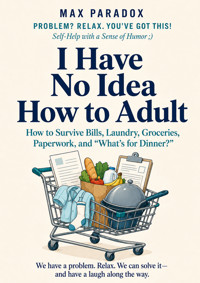
I Have No Idea How to Adult - How to Survive Bills, Laundry, Groceries, Paperwork, and “What's for Dinner?” ebook
Max Paradox
Uzyskaj dostęp do tej i ponad 240000 książek od 14,99 zł miesięcznie
- Wydawca: ALL-IN Rafał Płonkowski
- Kategoria: Biznes, rozwój, prawo•Biznes, rozwój
- Język: angielski
Adulthood was supposed to mean freedom.
Nobody mentioned that freedom apparently includes remembering to buy detergent, deciding what to eat every single evening, paying bills before they become emotionally interesting, keeping enough clean clothes available, returning packages on time, understanding mysterious forms, and knowing why there are suddenly no trash bags.
If ordinary life feels like a collection of tiny responsibilities constantly requesting your attention, I Have No Idea How to Adult is for you.
Max Paradox takes the boring machinery of everyday adulthood-bills, laundry, groceries, paperwork, phone calls, household supplies, appointments, dinner, and the endless small tasks that regenerate the moment you finish them-and turns it into something manageable, practical, and considerably funnier.
This is not a book about becoming perfectly organized.
It is about making normal life require less mental energy.
Inside, you will learn how to:
• stop using stress and last-minute panic as your main management system;
• reduce repeated decisions with simple defaults;
• create a bill routine that prevents monthly financial jump scares;
• build a grocery and dinner system that survives tired Wednesdays;
• stop trusting your memory with responsibilities it was never designed to manage;
• make laundry happen before your final clean shirt becomes a national emergency;
• handle paperwork, forms, and phone calls without carrying them around in your head for nine days;
• create a weekly reset that does not consume your entire Sunday;
• recognize what is genuinely urgent and what merely looks annoying;
• build low-power versions of your routines for bad weeks;
• catch household chaos while it is still cheap to fix;
• recover from disruption without redesigning your entire life.
The methods are deliberately simple. No 4:30 a.m. routines. No thirty-tab spreadsheets. No requirement to become passionate about filing systems.
You will build practical triggers, backups, minimum versions, visible next actions, and small buffers that make normal responsibilities easier to start and harder to forget.
Most importantly, you will stop treating every forgotten grocery item, unfolded laundry basket, or unopened envelope as evidence that you are somehow failing adulthood.
You probably do not need more discipline.
You need fewer decisions, clearer systems, and a Plan B for the days when your energy level is approximately potato.
Adulthood will still involve laundry.
Unfortunately, no book has solved that.
But it can involve much less panic.
This publication was prepared with the assistance of tools that support the creative process, including artificial intelligence-based solutions. The final concept, structure, and editing belong to the author.
Ebooka przeczytasz w aplikacjach Legimi na:
Liczba stron: 213
Rok wydania: 2026
Odsłuch ebooka (TTS) dostepny w abonamencie „ebooki+audiobooki bez limitu” w aplikacjach Legimi na:
Podobne




















INTRO
At 6:42 p.m., you open the refrigerator and stare into it as if dinner might appear through a delayed software update. There is half a lemon, three sauces, something in a plastic container whose origin is now legally unclear, and a bag of spinach that has reached the “use immediately or apologize to it” stage. You close the door. Five minutes later, you open it again.
Nothing has changed.
This would be easier if adulthood came with a dashboard. Green light: bills paid. Green light: laundry under control. Yellow light: one important form has been sitting on the kitchen table for six days. Red light: cereal is beginning to look less like breakfast and more like a lifestyle.
Instead, adulthood arrives as a collection of small responsibilities that all seem individually manageable and collectively suspicious. Pay the electric bill. Buy toilet paper. Make a dentist appointment. Wash the towels. Reply to the email. Return the package. Figure out why the insurance company has sent you a document containing seventeen words you recognize and forty-three that seem to belong to maritime law. None of these tasks should defeat a reasonably functional adult. And yet, by Thursday, you may be buying detergent, batteries, and a frozen pizza because civilization now depends on you personally.
Nobody warned us about the maintenance.
As a child, adulthood looked like freedom. You could stay up late. Eat what you wanted. Buy things without asking permission. Nobody mentioned that freedom also means noticing you are almost out of dish soap and realizing nobody else is coming to replace it. You are the purchasing department now. Also accounting, scheduling, food services, and the person who has to call customer service when the internet bill suddenly develops ambitions.
The problem is usually not that you are incapable of doing basic things. The problem is that basic things do not arrive one at a time. They overlap. They repeat. They create follow-up tasks. Laundry is sorting, washing, drying, folding, putting away, and eventually discovering one wet sock clinging to the washing machine drum like a survivor of an expedition. Groceries require deciding what to eat, remembering what you already have, buying what you need, storing it, cooking some of it, and preventing the cilantro from becoming liquid before Wednesday.
Meanwhile, your brain prefers tasks with a clear finish line. “Send this email” is satisfying. Done. “Maintain a household forever” is less motivating. There is no victory screen. Nobody releases balloons because you kept enough toilet paper in the apartment for three months. The reward for doing the dishes is that tomorrow you get to use dishes again.
A surprisingly large part of adulthood is completing tasks that regenerate.
That is one reason people fall into two traps. The first is chaos: deal with everything when it becomes urgent. You do laundry when you run out of clean underwear. You buy groceries when the refrigerator contains mustard and optimism. You open the bill after receiving the second email with words like “reminder” and “important.” This works in the same sense that driving everywhere with the gas light on works. You can do it. You will simply live with a permanent background soundtrack of unnecessary stress.
The second trap looks more respectable because it owns labels. You create a budgeting spreadsheet with twelve tabs. You research meal-planning systems. You buy matching storage containers. You download an app for household tasks, an app for bills, and an app to remind you to check the other apps. For forty-eight glorious hours, you are no longer a person. You are a small Scandinavian municipality.
Then real life happens.
You work late. You get tired. You forget to thaw the chicken. One ambitious Tuesday destroys the entire system, and now you are behind on chores and have also failed your beautiful new life-management method. Excellent. We have added shame to laundry.
This book is not going to turn you into a person who color-codes utility statements for recreational purposes. If you already enjoy that, I respect your hobby and fear your filing cabinet. The goal is simpler: make ordinary responsibilities require less mental energy, create fewer emergencies, and take up less space in your head.
We are going to reduce decisions, not build a personal bureaucracy.
That means making recurring tasks boring in the best possible way. Bills should not be monthly suspense stories. Groceries should not require standing in aisle seven while searching “easy dinners for people who have given up.” Paperwork should have a place to go before it becomes an archaeological layer under old receipts. Laundry should happen before your last acceptable shirt becomes a hostage situation. Dinner should be solvable on a tired Wednesday without a strategic review.
Sometimes the problem is memory. Sometimes it is too many decisions. Sometimes you avoid a task because it feels vague, annoying, expensive, embarrassing, or likely to involve a phone menu that says, “Please listen carefully, as our options have recently changed,” even though they have apparently been changing since 2009. Different problems need different fixes. A reminder will not solve a task you are actively avoiding. A prettier planner will not help if the real issue is that you do not know the first step.
So we will use simple systems, but only where a system earns its keep. We will automate what can be automated, batch what can be batched, simplify what can be simplified, and create backup options for the days when your energy level is somewhere between “tired” and “I have considered eating shredded cheese over the sink.”
There will be no requirement to become an entirely new person.
You do not need to love administration. You do not need to become passionate about meal planning. You do not need to experience spiritual growth while folding fitted sheets. Frankly, anyone who claims to have discovered inner peace through fitted sheets should be studied carefully.
You need a few reliable defaults: a place for paperwork, a basic bill routine, a grocery method that survives busy weeks, a short list of automatic meals, a laundry rhythm that prevents textile emergencies, and a way to handle annoying calls and forms before they expand in your imagination into federal investigations.
Most importantly, stop treating every domestic failure as evidence that you are bad at adulthood. Forgetting to buy milk is not a character flaw. Having an unopened envelope on your desk does not mean society should revoke your right to operate a toaster. These are usually system problems, attention problems, timing problems, or plain old “there was too much going on this week” problems.
Those can be fixed.
Not perfectly. Not forever. Life will still occasionally produce a week in which the laundry is everywhere, dinner is toast, and you discover a bill five minutes before midnight. The goal is not flawless adulthood. The goal is fewer avoidable fires, faster recovery, and a home life that mostly runs without requiring a daily summit meeting.
You are not trying to become the CEO of your apartment.
You are trying to know where the clean towels are, what is for dinner, and whether the electric bill has been paid.
That is plenty.
Tekst
Chapter 1 - The Maintenance Problem
There is a specific kind of betrayal that happens when you clean the kitchen at night and then walk into it the next morning to discover that somebody has used it.
Unfortunately, that somebody is you.
There is a mug in the sink, crumbs on the counter, a pan from breakfast, and a suspicious amount of coffee on a surface that was definitely clean ten hours ago. You look around with the wounded expression of a hotel manager who has just discovered that guests have been staying in the rooms.
This is one of the first unpleasant truths about adulthood: most of the work is not project work. It is maintenance.
Projects have endings. You assemble the shelf, submit the form, paint the wall, replace the broken toaster, and eventually get to stand back and think, Done. Maintenance does not give you that satisfaction. You buy groceries, eat them, and now apparently you need more groceries. You wash your clothes, wear them, and somehow the clothes have become dirty again. You empty the trash, and your household immediately begins a coordinated effort to refill it.
Rude.
A great deal of adult frustration comes from expecting maintenance to behave like a project. We want to “get on top of everything,” finish the household, catch up permanently, and reach a magical state where nothing needs attention. This state does not exist unless you move into an empty apartment with no utilities, clothing, food, possessions, relationships, or bodily functions.
The rent might still be due.
The better goal is not to finish adulthood. It is to make recurring responsibilities predictable enough that they stop surprising you.
That sounds obvious, but many people run their lives according to a different system: notice, delay, worry, rescue.
You notice the laundry basket is getting full.
You delay because you still have clean clothes.
You worry when the clean-clothes population drops to one shirt and a pair of socks with questionable elasticity.
Then you rescue the situation by running two loads at 10:30 p.m. while muttering things normally heard during emergency flood response.
This pattern works. That is exactly why it survives.
If a bad system failed immediately, we would replace it. But crisis-based adulthood usually succeeds just enough to continue. The bill gets paid before the late fee. The groceries get purchased before starvation. The form is submitted on the last possible day. The laundry gets done before anyone has to attend a meeting in a bathrobe.
You escape each emergency and conclude, consciously or not, that the system works.
It does not.
The emergency works.
You are using stress as a management tool.
Stress can be remarkably effective in short bursts. A deadline appears, adrenaline arrives, priorities become obvious, and suddenly the task you avoided for eleven days takes seventeen minutes. This can create the impression that pressure improves your performance.
Sometimes it does.
It also means you spent eleven days carrying a seventeen-minute task around in your head like an unpaid intern who refuses to leave the office.
The actual cost of a small responsibility is therefore not just the time required to complete it. It is completion time plus avoidance time plus mental reminders plus guilt plus whatever strange side activities you perform while pretending the task is not there.
A three-minute phone call can occupy two hours of emotional real estate.
Very expensive neighborhood.
The first useful shift is to stop judging recurring responsibilities by difficulty and start judging them by frequency.
Laundry is not difficult. That is why people underestimate it. Grocery shopping is not intellectually advanced. Paying routine bills is not a puzzle. Deciding what to eat should not require a graduate seminar.
But frequent tasks create friction because they return.
A task that takes twenty minutes once is easier to tolerate than a task that takes five minutes every day. Your brain does not care that the math is favorable. It sees repetition and files a complaint.
This is why tiny inefficiencies matter. If you spend fifteen minutes deciding what to cook six times a week, the problem is not dinner. The problem is repeatedly making the same category of decision from scratch.
If every grocery trip begins with, “What do normal adults buy?” you are rebuilding civilization every Saturday.
Please stop.
Adult life becomes easier when recurring decisions become defaults.
A default is not a rule carved into stone. It is the answer you use unless there is a reason to choose something else.
You might have a default laundry day. A default time for handling paperwork. A default grocery list containing the things you nearly always need. A default set of six or seven dinners that require little thought. A default place for documents that need action.
Defaults reduce the number of moments in which you must negotiate with yourself.
That matters because self-negotiation is surprisingly exhausting.
“I should probably do laundry.”
“Maybe tomorrow.”
“But tomorrow I’m busy.”
“I could do it now.”
“There isn’t enough for a full load.”
“There almost is.”
“I’ll wait.”
Excellent meeting. No decision was reached. Attendance was mandatory.
The goal is not extreme efficiency. You do not need to optimize your detergent transfer rate. You need fewer repeated negotiations over ordinary tasks.
Start by identifying what I call your maintenance loops: responsibilities that keep coming back whether or not you find this arrangement emotionally acceptable.
Common loops include:
food and groceries;
laundry;
dishes and basic cleaning;
bills and subscriptions;
mail and paperwork;
appointments;
household supplies;
trash and recycling;
basic car or transportation tasks;
replies, forms, and small administrative obligations.
Your list may be longer or shorter. Do not make this into a twenty-seven-category life audit with conditional formatting. We are trying to reduce administration, not open a consultancy.
Choose the five recurring areas that create the most friction.
Then ask one question about each:
What tells me it is time to act?
This is more useful than asking, “When should I be more responsible?”
“Be more responsible” is not a trigger. It is an insult wearing business casual.
A trigger should be visible or predictable.
Laundry: every Saturday morning, or when the basket reaches a marked level.
Bills: autopay where appropriate, plus one scheduled monthly review.
Groceries: Thursday evening list, Friday purchase.
Paperwork: anything requiring action goes immediately into one tray or folder, reviewed twice a week.
Household supplies: add the item to a shared or personal shopping list the moment you open the last backup.
The trigger removes the need to keep deciding whether the task is officially important enough yet.
This sounds almost too simple, which creates a common problem: people assume simple systems cannot solve complicated feelings.
But the feelings are often caused by the absence of a system.
Imagine that every document entering your home can land in one of six places: kitchen counter, desk, backpack, car, bedside table, or inside an unopened envelope leaning against a fruit bowl. You do not have a paperwork problem yet. You have a location problem.
Three weeks later, when you need the document, the location problem develops into an emotional event.
The same thing happens with groceries. If you do not have a reliable way to capture missing items, grocery planning becomes memory roulette.
You enter the store knowing you need “a few things.”
You leave with sparkling water, olives, cereal, expensive crackers, three yogurts, and absolutely no dish soap.
The dish soap was the reason you went.
A maintenance system does not need to be impressive. It needs to intercept predictable failure.
Consider household supplies. The ineffective system is: notice you are nearly out, assume you will remember, forget, discover the shortage at the worst possible moment.
The better system is: once you open the final backup, add the item to the list.
Not when you use the last drop.
Not when civilization collapses.
When you open the backup.
That gives you a buffer. Buffers are one of adulthood’s least glamorous superpowers.
You do not need fourteen rolls of paper towels, a survival bunker, and eighteen pounds of pasta. You need enough margin that one busy day does not instantly become a small domestic crisis.
The same principle applies to time.
If a form is due Friday, your personal deadline can be Wednesday.
Not because you are pretending to be a superior person who finishes everything early. Because Thursday may contain a sick child, an emergency at work, a broken printer, a forgotten password, or a website that suddenly decides your perfectly normal PDF is “an unsupported format.”
Administrative systems smell fear.
A buffer gives real life somewhere to happen.
Now, there is an obvious objection: “This all sounds good, but I have tried routines before. They fall apart.”
Of course they do.
A routine is not a marriage vow.
The mistake is assuming that if you miss the routine once, the routine has failed. You planned laundry for Saturday, but Saturday became chaos. Fine. The system now needs a recovery rule.
That is Plan B.
A useful maintenance loop has three parts:
Trigger: when does the task normally happen?
Minimum version: what is the smallest version that keeps things from getting worse?
Recovery rule: what happens if the normal plan fails?
For laundry, this might be:
Trigger: Saturday morning.
Minimum version: wash only essentials.
Recovery rule: if Saturday fails, run one load Sunday evening.
For groceries:
Trigger: Friday afternoon.
Minimum version: buy enough for three simple dinners, breakfast, and basics.
Recovery rule: use delivery, pickup, or a ten-item emergency shop.
For paperwork:
Trigger: Tuesday and Friday.
Minimum version: handle only anything due within seven days.
Recovery rule: schedule a thirty-minute catch-up block on the next available evening.
Notice what is missing.
Punishment.
There is no rule saying that if you fail to process paperwork on Tuesday, you must feel guilty for forty-eight hours before touching it again.
Guilt is not a sorting method.
The most effective household systems assume that you will occasionally be tired, distracted, busy, sick, traveling, overwhelmed, or simply uninterested in participating in your own plan.
That is not pessimism. It is engineering.
Bridges are not designed under the assumption that there will never be wind. Your laundry routine should receive at least the same level of realism.
There is another reason maintenance feels harder than it “should”: much of it is invisible.
Nobody notices that you remembered to buy dishwasher tablets before they ran out. Nobody sends you a medal because the insurance payment went through. Most successful adulting looks like nothing happened.
Nothing happened because you handled it.
This can make maintenance feel unrewarding. The better you are at preventing problems, the fewer dramatic victories you experience.
Your reward is the absence of disaster.
Very cinematic.
So it helps to redefine success. Success is not a perfectly clean home, a zero-inbox existence, or always knowing what dinner will be three days from now. Success is fewer recurring surprises.
Did the bills get paid without panic?
Did you have something reasonably edible in the house?
Did the laundry happen before the emergency underwear stage?
Did important paperwork stay findable?
That counts.
You are not trying to make adult life elegant. You are making it less expensive in attention.
That is the real resource being wasted.
Money matters. Time matters. But attention is what gets quietly drained when twenty tiny responsibilities are floating around without clear next steps.
“Buy cat food.”
“Call insurance.”
“Need toothpaste.”
“Where is that form?”
“Did I pay the internet bill?”
“Must return package.”
“Need dinner.”
Each item is small. Together they behave like twenty browser tabs playing audio.
Close a few.
Today, do not redesign your entire life. Pick your three most annoying maintenance loops. For each one, choose one trigger, one minimum version, and one recovery rule.
That is enough.
Your apartment does not need a chief operating officer.
It just needs someone who knows when to buy detergent.
Chapter 2 - The Decision Tax
You are standing in a supermarket at 6:17 p.m. holding a package of chicken in one hand and staring at pasta with the expression of someone being asked to choose a new constitution.
What do you want for dinner?
You do not know.
What will you want tomorrow?
An outrageous question.
Do you have rice at home?
Possibly.
Do you need milk?
Probably.
Is there already cheese?
There was cheese. The current status of the cheese is classified.
You came in for groceries and somehow ended up conducting an inventory audit using memory, intuition, and a blurry mental image of the refrigerator door.
This is not a food problem.
It is a decision problem.
A large part of adulthood feels exhausting because the work arrives disguised as dozens of tiny choices. What should I cook? When should I do laundry? Which bill do I handle first? Is this letter important? Do I keep this receipt? Should I make the appointment now? What day works? Which detergent do I buy? Do I have enough coffee? Can this shirt go in the dryer? Why does this form want the same information I entered on the previous page?
No single decision is difficult.
That is the trap.
Because each decision is small, we assume the total mental cost should also be small. But a hundred tiny choices can drain more energy than one large obvious task. You are not tired because selecting yogurt is intellectually demanding. You are tired because yogurt has joined a committee containing work, family, bills, messages, meals, schedules, and whether you are supposed to replace the furnace filter this month.
Somewhere in there, your brain resigns.
This is why adults sometimes behave strangely at the end of the day. At 10:00 a.m., you can compare project priorities, solve problems, and make sensible decisions involving serious consequences.
At 7:00 p.m., somebody asks, “What should we eat?”
You stare at them.
“Food.”
Leadership has left the building.
The solution is not to become better at making endless decisions. The solution is to stop making the same low-value decisions repeatedly.
This is one of the most powerful ideas in practical adulthood: save your decision-making for things that deserve it.
Dinner on an ordinary Tuesday probably does not.
That does not mean eating the same meal forever while living in a beige room. It means building a small collection of default answers.
For example, instead of asking every evening, “What could I possibly cook in the entire known universe?” you can choose from a limited rotation:
pasta night;
tacos or wraps;
sheet-pan chicken and vegetables;
rice bowl;
soup and sandwiches;
eggs or breakfast-for-dinner;
freezer rescue meal.
You can still eat something else. Nobody arrives with a clipboard if Thursday becomes curry night.
The purpose of a rotation is not control.
It is reducing the search area.
When the question changes from “What should I make?” to “Which of these six easy options fits tonight?” the task becomes lighter.
Restaurants understand this. They give you menus.
They do not seat you and say, “Please imagine all food.”
You can use the same principle elsewhere.
Take clothing.
Some people spend several minutes each morning assembling an outfit from everything they own. Fine, if they enjoy it. If they do not, the closet becomes another daily decision machine.
A simpler system might be five reliable work combinations, a small number of casual defaults, and clothes stored in a way that makes those combinations obvious.
You are not surrendering personal expression.
You are refusing to hold a wardrobe summit at 7:12 a.m.
The same idea works with household purchasing. There is rarely a reason to reconsider your entire detergent philosophy every time the bottle empties. If the current product works, buy it again.
Marketing departments dislike this advice.
They have prepared sixteen lavender-related arguments.
Default purchasing is wonderfully boring. Pick a toilet paper. Pick a detergent. Pick basic pantry items. Pick the toothpaste that has not caused you distress. Rebuy them unless there is a reason not to.
Every recurring decision you eliminate creates a little mental space.
Do not use that space to compare twelve kinds of paper towels.
The decision tax becomes particularly expensive when tasks are vague.
“Handle finances” is not a task.
“Do paperwork” is not a task.
“Get the apartment under control” is not a task.
Those are categories wearing trench coats.
Your brain resists them because it cannot clearly see the finish line.
Consider “deal with insurance.” That could mean finding a policy document, checking coverage, calling customer service, comparing options, uploading a form, paying something, or staring at the website while becoming increasingly convinced that every button was designed by a committee that hates you.
A vague task creates multiple hidden decisions.
Where do I start?
What do I need?
How long will this take?
Can I finish now?
What happens if I call?
Which document do they want?
Maybe I should research this first.
Two hours later you know a lot about insurance terminology and have accomplished nothing that the insurance company can detect.
The fix is to convert categories into next actions.
Not “paperwork.”
“Open the envelope from the bank and identify what they want.”
Not “groceries.”
“Check fridge, write ten-item list, place pickup order.”
Not “laundry.”
“Put dark clothes in machine and start one load.”
Not “appointment.”
“Call dentist and ask for next available cleaning after 4:00 p.m.”
A good next action is visible.
You can imagine yourself doing it.
This matters because starting vague tasks requires your brain to plan while already tired. Clear tasks reduce the planning burden.
Think of it as leaving instructions for your future self.
Current you may feel intelligent and organized. Future you at 6:30 p.m. may be holding a grocery bag, answering a message, and wondering whether frozen pizza qualifies as meal preparation.
Be kind to that person.
The best systems are not built for your best days.
They are built for average Wednesdays.
Another major source of decision fatigue is keeping too many options.
More choice feels like more freedom until you are standing in front of forty-seven nearly identical bottles of olive oil.
Extra virgin.
Organic.
Cold pressed.
Single origin.
Robust.
Smooth.
Mediterranean blend.
One bottle appears to have a biography.
You wanted oil.
This same problem appears in digital life. You might have three apps for notes, two grocery lists, reminders in your phone, tasks in email, a paper planner, screenshots of things you must remember, and one deeply optimistic sticky note on your monitor.
The information technically exists.
Good luck finding it.
Every extra system creates another decision: where should this go?
Choose fewer homes for recurring information.
For most people, a basic setup can be very small: