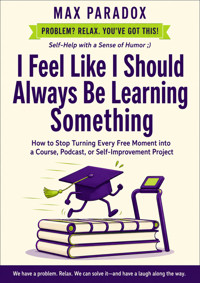
I Feel Like I Should Always Be Learning Something - How to Stop Turning Every Free Moment into a Course, Podcast, or Self-Improvement Project ebook
Max Paradox
Uzyskaj dostęp do tej i ponad 240000 książek od 14,99 zł miesięcznie
- Wydawca: ALL-IN Rafał Płonkowski
- Kategoria: Biznes, rozwój, prawo•Biznes, rozwój
- Język: angielski
You finally have an hour to yourself.
So naturally, you open a podcast.
Or a course.
Or a book about becoming better at something you were not worried about until fifteen minutes ago.
Welcome to the strange modern problem of turning every free moment into professional development.
I Feel Like I Should Always Be Learning Something is a practical, funny guide for people who love learning but are tired of feeling guilty whenever they are not improving. If your podcast queue looks like a graduate program, your saved articles have formed a small government, or relaxing without educational content makes you wonder whether you are wasting your potential, this book is for you.
Max Paradox takes apart the pressure to constantly know more, stay current, acquire new skills, finish every course, read every useful book, and somehow prepare for every possible version of the future before bedtime.
The problem is not curiosity.
The problem is when curiosity becomes obligation.
Inside, you will learn how to separate genuine interest from anxiety-driven learning, choose what is actually relevant to your life, stop collecting educational backlogs, and recognize when “research” has quietly become procrastination wearing respectable glasses.
You will discover practical ways to:
choose one useful learning priority instead of twelve;
stop turning every interest into a project;
create clear stopping rules before learning expands indefinitely;
use what you already know before consuming more;
decide when a course, book, or skill is no longer worth finishing;
protect free time from constant self-improvement;
avoid letting algorithms, coworkers, trends, and other people’s achievements choose your curriculum;
handle low motivation, missed sessions, and overloaded weeks without creating learning debt;
know when you are competent enough to stop;
build a simple long-term system that keeps learning useful instead of exhausting.
This is not an argument for becoming less ambitious.
It is an argument for becoming more selective.
You do not need to understand everything. You need to know what matters, learn it well enough to use it, and then occasionally close the laptop without immediately enrolling in something else.
There are no 5:00 a.m. enlightenment routines here. No demand to optimize every hobby. No twelve-step framework for enjoying a sandwich more efficiently.
Just practical methods, normal-life examples, and enough uncomfortable recognition to make you occasionally think:
“Oh no. That is exactly what I do.”
Because personal development should improve your life.
It should not eat all the free parts.
This publication was prepared with the assistance of tools that support the creative process, including artificial intelligence-based solutions. The final concept, structure, and editing belong to the author.
Ebooka przeczytasz w aplikacjach Legimi na:
Liczba stron: 188
Rok wydania: 2026
Odsłuch ebooka (TTS) dostepny w abonamencie „ebooki+audiobooki bez limitu” w aplikacjach Legimi na:
Podobne
















INTRO
You have twenty-three minutes before you need to leave the house.
A normal person might make coffee, sit down, stare out the window, perhaps wonder why a pigeon is walking across the parking lot with the confidence of a regional manager. You, however, notice that twenty-three minutes is enough for almost half an episode of a podcast called How High Performers Use Their Mornings. Excellent. No sense wasting perfectly usable time on something reckless like existing.
You press play.
Seven minutes later, the host mentions a book about decision-making. You pause the podcast and add the book to your reading list. While doing that, you see another book you saved last month about attention. This reminds you of the online course you bought about deep work, which reminds you that you still have four modules left in the course about time management, which is somewhat awkward because apparently your current method of managing time involves buying courses you do not have time to finish.
Still, progress is progress.
You leave the house having learned that successful people protect their attention, wake up intentionally, journal strategically, read constantly, exercise before breakfast, reflect after breakfast, and possibly negotiate international treaties before 8:15 a.m.
You have also forgotten your keys.
This book is for people who have accidentally turned curiosity into an unpaid second job.
You like learning. That is not the problem. Learning is wonderful. It can make your work easier, your conversations more interesting, your decisions better, and your brain slightly less dependent on remembering the names of actors by saying, “You know, the guy from that thing.”
The problem begins when learning stops being something you enjoy and becomes something you feel guilty for not doing.
You finish work and think, I should use this evening well. You could watch a movie, go for a walk, cook something, call somebody, sit on the couch, or perform the ancient human ritual of doing absolutely nothing useful for forty-five minutes. Instead, a quiet managerial voice appears in your head.
You could be improving.
That voice has plans.
Perhaps there is a language you should finally learn. A professional certificate that might be useful. A podcast everyone seems to recommend. A book about communication. Another book about money. A video explaining artificial intelligence. A newsletter about longevity. A masterclass about creativity. A twelve-part series on how to build better habits, which you will watch while avoiding the habit of going to bed on time.
Suddenly leisure needs a business case.
You no longer take a walk. You listen to an educational podcast while walking.
You no longer cook dinner. You watch a lecture while chopping onions.
You no longer drive somewhere. You complete Module Three.
You no longer clean the bathroom. You absorb an audiobook at 1.7× speed while scrubbing the sink, because apparently even removing toothpaste from ceramic must now contribute to your intellectual development.
If you shower without learning anything, did the shower even count?
This can look admirable from the outside. You are curious. Ambitious. Engaged. You want to grow. Nobody stages an intervention because you bought another nonfiction book.
“Please, we’re worried about you.”
“Why?”
“You highlighted fifty-eight pages of The Psychology of Focus and then ordered three more books before reaching Chapter Four.”
It sounds ridiculous because it is ridiculous. It is also extremely common among people who care about doing well.
There is always something else you could know. That is the trap.
For most of human history, your ignorance had practical limits. You did not spend Tuesday evening worrying that you had failed to understand behavioral economics, Korean skincare, negotiation theory, metabolic health, generative AI, personal branding, attachment styles, retirement planning, and the Roman Empire before bedtime. Now your phone can present all of those deficiencies before you have finished breakfast.
The supply of potentially useful knowledge has become infinite.
Your time has not.
This creates a strange psychological problem. When there are ten useful things you could learn, choosing one feels sensible. When there are ten thousand, choosing one can feel irresponsible. What about all the others? What if the course you skip contains the idea that would have changed your career? What if everyone else is learning faster? What if the future arrives on Thursday and you are the only person who did not watch the webinar?
So you collect.
You save articles. Subscribe to newsletters. Download samples. Create playlists. Bookmark tutorials. Buy courses during forty-eight-hour discounts that appear to occur every seventy-two hours. Your digital shelves slowly become a warehouse of future intelligence.
Future you is going to be extraordinary.
Future you is also extremely busy.
This is where learning begins to imitate productivity without always producing much. Consuming information feels responsible because it is adjacent to action. You are preparing, researching, understanding, expanding your perspective. All respectable activities. But preparation can become a hiding place, especially when applying what you already know feels harder, riskier, or less exciting than acquiring one more idea.
You can learn about exercise instead of exercising.
You can study communication instead of having the uncomfortable conversation.
You can watch videos about investing instead of finally organizing your actual finances.
You can read seventeen books about focus while checking your phone every four minutes.
At some point, the library begins eating the librarian.
There is another reason the habit becomes exhausting: self-improvement quietly changes the emotional meaning of free time. Rest starts to feel like lost potential. Entertainment feels slightly embarrassing. Sitting still produces the sensation that somewhere, someone with better discipline is learning Python.
You watch one episode of a comedy and enjoy it.
Then your brain opens the annual performance review.
Interesting use of fifty-two minutes.
Nothing ruins relaxation quite like an internal middle manager carrying a clipboard.
Eventually, even learning becomes less enjoyable because you are no longer following interest. You are servicing an obligation. Books become assignments. Podcasts become nutritional supplements for the brain. Courses pile up like unopened mail. You may even start consuming information faster—not because you are fascinated, but because you want to get through it.
Two-times speed.
Skip introduction.
Skip examples.
Skip story.
Excellent. You have now efficiently removed most of the reasons anyone made the content understandable.
This book is not going to tell you to stop learning. That would be a strange solution, like treating an overflowing closet by becoming a nudist.
The goal is to put learning back in its proper place.
You will learn how to tell the difference between genuine curiosity and anxiety wearing glasses. You will see why collecting information can feel safer than using it, why unfinished courses create mental clutter, and why the belief that every spare moment should improve you eventually makes ordinary life feel suspiciously unproductive.
More importantly, we are going to make this practical.
We will build a way to decide what deserves your attention and what can remain beautifully unknown. You will learn how to choose fewer things without feeling that civilization is advancing without you, how to finish or deliberately abandon what you start, how to create free time that does not require educational justification, and how to use what you already know before importing another truckload of advice.
There will also be a plan for the inevitable moment when you open YouTube “just to look up one thing” and emerge forty-five minutes later considering a certification in marine biology.
Because the goal is not to become less curious.
It is to stop treating your entire life like orientation week for a job that never starts.
You are allowed to learn because something fascinates you. You are allowed to learn because it helps solve a real problem. You are also allowed to close the book, remove the headphones, ignore the course, and spend an evening doing something that produces no measurable improvement whatsoever.
Your brain does not need continuing education credits for watching a sunset.
And if that sentence made you think, Actually, I wonder whether there’s a good podcast about the neuroscience of sunsets, we have some work to do.
Chapter 1 - When Curiosity Gets a Timesheet
You sit down on Saturday morning with coffee and no urgent responsibilities for the next hour. This should be pleasant.
Instead, your brain notices the vacancy.
We could learn something.
Not because there is a specific problem to solve. Not because you are fascinated by anything in particular. The hour is simply empty, and empty time has started making you nervous. Within minutes you are scrolling through saved videos with titles like 10 Skills Everyone Will Need by 2030, The Morning Routine That Changed My Life, and Why You’re Learning Wrong.
That last one feels especially threatening.
Apparently you have even been failing at learning.
You choose a forty-minute video about how to learn more effectively. Fifteen minutes in, the speaker recommends a note-taking system, so you pause the video to research note-taking systems. One article recommends an app. The app has seventeen templates. You watch a tutorial about the templates.
By lunchtime, you have learned nothing you originally intended to learn, but your infrastructure for future learning could support a small university.
This is the first thing to understand: the problem is not curiosity.
Curiosity says, “That looks interesting.”
Compulsion says, “I should know this.”
Those sentences can lead to the same podcast, book, course, or video, but psychologically they are very different. Curiosity creates energy. Obligation consumes it. Curiosity pulls you toward something. Obligation stands behind you holding a clipboard and asking why you have not completed Module Six.
Learning becomes exhausting when it stops being an activity and starts becoming evidence that you are using your life correctly.
That shift is easy to miss because learning has excellent public relations. Nobody feels guilty about buying a book about negotiation. Nobody hides an educational podcast when someone enters the room. If you spend an evening watching documentaries, you can still tell yourself the evening was “productive.”
Try saying, “I watched three episodes of a cooking competition because I enjoyed it.”
Fine.
Now say, “I listened to a podcast about cognitive performance while cleaning the oven.”
Much more respectable.
The oven is equally clean.
The strange prestige attached to constant learning can make ordinary leisure feel inferior. Reading about leadership appears more serious than reading a mystery novel. Watching a lecture appears more defensible than watching a sitcom. A walk with an audiobook seems better than a walk with birds, traffic, and your own deeply unmonetizable thoughts.
Gradually, you stop asking, “What do I want to do?”
You ask, “What would be the best use of this time?”
That sounds sensible. It can also turn your life into an airport lounge where every outlet is occupied and nobody is relaxed.
The Productivity Costume
One reason constant learning is seductive is that it feels like progress without demanding the same vulnerability as action.
Suppose you want to become better at public speaking. There are two broad options.
You can volunteer to give a presentation.
Or you can watch nine videos about presenting.
The first option involves possible embarrassment, sweating, forgetting a sentence, and discovering that your hand gestures make you look like you are directing aircraft onto a runway.
The second option can be completed privately while eating chips.
Your brain is not stupid.
It notices the difference.
Learning often gives you the emotional reward of moving forward while protecting you from the uncomfortable part of moving forward. You are doing something related to the goal, which feels responsible. But you are not yet risking failure, rejection, confusion, or the discovery that you are a beginner.
This is why people can remain “in preparation” for astonishing periods of time.
They research businesses instead of launching one.
They study dating psychology instead of going on a date.
They consume fitness content instead of establishing a three-day walking habit.
They read productivity books instead of finishing the report that is currently open on the laptop beneath the productivity book.
Preparation is useful.
Preparation without a stopping rule is interior decoration for procrastination.
The difficult part is that the preparation can be genuinely valuable. The ninth video may contain something useful. The fourth book may explain one idea more clearly. Another course may improve your understanding.
That does not mean you need it now.
The question is not, “Could this information be useful?”
Almost everything could be useful.
A six-hour course about home plumbing could be useful if your sink explodes in 2029. That does not mean Tuesday evening should be dedicated to preventive faucet scholarship.
A better question is:
What will I do differently because I learned this?
If you cannot answer that, the learning may still be enjoyable—and enjoyment is a perfectly good reason. But stop calling it necessary preparation.
That distinction matters.
Your Brain Loves Open Loops
There is another reason unfinished learning piles up so easily: starting creates psychological weight.
You enroll in a course. Now it exists.
You save a twenty-page article. Now it exists.
You buy a book. Now it exists.
None of these items can physically shout at you, which is fortunate, because your bookshelf would sound like a crowded train station.
But unfinished material still occupies mental space. Every saved item contains a tiny implied future task.
Read me.
Finish me.
Return to me.
You paid $49.99 for me during a limited-time offer, you idiot.
The more unfinished learning you collect, the more your leisure begins to resemble a backlog.
You may not consciously think about all of it, but you feel its presence. You open your reading app and see twelve unfinished books. Your podcast queue contains ninety-seven episodes. Your browser bookmarks include folders with optimistic names like “Read Soon,” “Important,” and, in a moment of accidental honesty, “Later.”
Later has become a continent.
The natural response is often to create a better system.
This is how you end up spending Sunday afternoon organizing material you already do not have time to consume.
Folders.
Tags.
Colors.
Priorities.
A database.
A second database to track the first database.
For one beautiful hour, your problem appears solved.
Nothing has been learned, applied, abandoned, or deleted, but it is now categorized with breathtaking professionalism.
Organization can reduce friction. It cannot solve overcommitment.
If you have thirty hours of discretionary time this month and you have saved eighty hours of learning, no folder structure can negotiate with arithmetic.
Arithmetic is notoriously inflexible.
The Identity Problem
Constant learning can also become part of how you see yourself.
You are someone who grows.
Someone who stays informed.
Someone who develops.
Someone who does not want to become one of those people who stopped learning in 2007 and still refers to every app as “the Facebook.”
There is nothing wrong with that identity. The problem appears when it becomes rigid.
If “I am a person who keeps learning” quietly turns into “I am a person who must always be learning,” rest begins to threaten your self-image.
An evening with no educational content feels lazy.
A vacation with no books feels wasteful.
A commute with no podcast feels empty.
You may even experience a peculiar guilt while enjoying something nonproductive.
You are watching a movie.
The movie is good.
Then your brain whispers:
You still haven’t finished that course.
Thank you, brain.
Perhaps you would also like to remind me about taxes during the car chase.
This is not discipline. It is a loss of boundaries.
A healthy identity gives direction. An unhealthy one demands constant proof.
You do not need to demonstrate your commitment to growth every hour.
A runner is still a runner while sleeping.
A musician is still a musician while buying toothpaste.
You can be curious and ambitious while spending Sunday afternoon doing something magnificently useless.
The First Filter: Purpose, Pleasure, or Pressure?
Before you start your next learning activity, ask one simple question:
Why am I doing this?
Most learning falls into one of three categories:
Purpose: I need this for a real goal or problem.
Pleasure: I am genuinely interested and want to explore it.
Pressure: I feel that I should know this, keep up, improve, or avoid wasting time.
Purpose is useful.
Pleasure is healthy.
Pressure deserves inspection.
Notice that “pressure” does not automatically mean “do not do it.” Sometimes necessary learning feels unpleasant. You may need to understand new software for work. You may need to learn basic financial concepts because ignoring them is becoming expensive.
The key is whether there is a concrete reason.
Compare:
“I am taking this Excel course because I use Excel every day and I want to automate a weekly report.”
Clear.
“I am taking this artificial intelligence course because everyone is talking about AI and I have a vague feeling that if I do not understand every new tool immediately, I will eventually be living under a bridge.”
Less clear.
The bridge is probably premature.
For one week, do not try to change your habits dramatically. Just label your learning before you begin.
Purpose.
Pleasure.
Pressure.
That tiny pause reveals more than another productivity system.
You may discover that much of your “self-development” is actually anxiety management. Learning makes you feel temporarily safer because you are doing something. The future remains uncertain, but at least you have opened a webinar.
The webinar cannot guarantee the future.
It can, however, send seventeen reminder emails.
Stop Making Every Interest a Project
Another common mistake is turning curiosity into commitment too quickly.
You hear someone speak Italian and think, That sounds beautiful.
Three minutes later you are comparing language apps.
By dinner, you have chosen a course.
By Wednesday, you own flashcards.
By Friday, Italian has become another item you are failing to maintain.
This is how pleasant interests get murdered by project management.
You are allowed to be interested in something without becoming good at it.
You can watch one astronomy documentary without buying a telescope.
You can read an article about architecture without beginning an online degree.
You can enjoy a podcast about psychology without creating a six-month curriculum titled “Understanding the Human Mind.”
Sometimes an interest is just an interest.
Let it visit.
Do not immediately give it a desk and health insurance.
A useful rule is the three-touch rule. Before turning a new interest into a formal commitment, encounter it casually three times.
Watch a video.
Read an article.
Try a free lesson.
If the interest survives three separate encounters and still pulls you back naturally, consider investing more time or money.
This protects you from the enthusiasm spike—the period in which every new subject appears to be the missing piece of your life.
We have all met this version of ourselves.
Sunday: “I should learn photography.”
Monday: watches camera reviews.
Tuesday: researches lenses.
Wednesday: discovers cameras cost approximately one kidney.
Thursday: returns to normal life.
Nothing is wrong with this. Curiosity is allowed to be temporary.
The mistake is buying the kidney-level equipment on Monday.
The Practical Action
Today, choose one place where your educational backlog lives: your saved videos, unread books, courses, podcast queue, browser bookmarks, or reading app.
Do not organize it.
Do not create categories.
Do not purchase a premium productivity tool with animated progress bars.
Look at the first ten items and label each one:
Purpose. Pleasure. Pressure.
Then make one decision about each item.
Purpose gets a specific next action.
Pleasure gets permission to remain optional.
Pressure gets challenged.
Ask:
“If I never consume this, what actually happens?”
Sometimes the answer is serious.
You remain unqualified for something you want.
You make poorer decisions.
You cannot complete a real task.
Fine. Keep it.
But often the answer is:
Nothing.
Nothing happens.
No sirens.
No government agency arrives to confiscate your potential.
The article remains unread and civilization continues.
That is useful information.
Your job is not to consume everything that might improve you.
Your job is to learn what serves your life—and then return to having one.
Start with ten items.
Not the whole backlog.
We are trying to reduce unnecessary projects, not launch one called Operation Fix My Entire Brain by Sunday.
Chapter 2 - The Fear of Falling Behind
At 9:14 p.m., you open LinkedIn for reasons nobody fully understands.
Three minutes later, you discover that Daniel has completed a certificate in data analytics.
You do not know Daniel well.
You worked with him briefly four years ago. You remember that he owned several blue shirts and once microwaved fish in the office kitchen, which should probably remain the most important fact about him.
But now Daniel is certified.
This information enters your nervous system like a weather warning.
Should I learn data analytics?
You work in marketing.
Never mind.
Data is important.
You scroll.
Someone has completed an AI course. Someone else is learning Spanish. A former coworker has posted a photograph of seven business books with the caption “Weekend fuel.”
Your weekend fuel was pancakes.
Until now, this seemed sufficient.
Within ten minutes, you have moved from reasonably content to academically endangered.
This is the second major engine behind compulsive learning: the fear that other people are advancing while you are standing still.
The modern world gives this fear unlimited material.
You can now observe thousands of people publicly announcing promotions, certificates, reading lists, courses, side projects, degrees, language streaks, and “five lessons I learned from waking up at 5:00 a.m. for thirty days.”
Nobody posts:
“Spent Saturday lying on the couch and briefly considered doing laundry.”
Yet statistically, somebody must be.
The Invisible Race
Once learning becomes tied to competition, information stops feeling optional.
Every new subject becomes another lane in a race you did not consciously enter.
AI.
Investing.
Communication.
Leadership.
Coding.
Writing.
Health.
Nutrition.
Psychology.
Personal finance.
Public speaking.
Negotiation.
A second language.
Perhaps a third, because apparently one day you may need to order coffee confidently in Lisbon.
The problem is not that these subjects are useless.
The problem is that usefulness has no natural ceiling.
If you ask, “Would understanding this improve my life?” the answer will often be yes.
Would you benefit from learning to negotiate better?
Probably.
Would you benefit from understanding basic economics?
Sure.
Would you benefit from knowing more about nutrition?
Likely.
Would you benefit from learning first aid?
Absolutely.
Would you benefit from understanding your retirement plan, artificial intelligence, home maintenance, emotional regulation, cybersecurity, cooking, sleep, taxes, communication, investing, and why your washing machine occasionally makes the sound of a helicopter preparing for takeoff?
Yes.
Congratulations.
Your curriculum now lasts until death.
This is why the standard “learn useful things” is useless as a filter. Too many things are useful.