Uzyskaj dostęp do tej i ponad 240000 książek od 14,99 zł miesięcznie
- Wydawca: ALL-IN Rafał Płonkowski
- Kategoria: Biznes, rozwój, prawo•Biznes, rozwój
- Język: angielski
Do you apologize when someone bumps into you?
Feel guilty for saying no?
Replay normal conversations like your brain has been hired by the FBI to investigate whether “Thanks” sounded passive-aggressive?
Then your conscience may be working overtime.
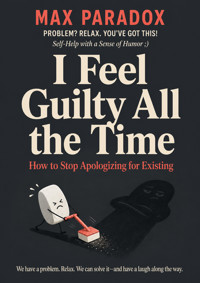
I Feel Guilty All the Time is a practical, funny guide for people who feel responsible for everyone’s moods, disappointment, expectations, and occasional raised eyebrow. Max Paradox explains why guilt can keep showing up even when you have done nothing wrong-and, more importantly, what to do when it does.
This is not a book about becoming selfish, cold, or magically indifferent to other people. A useful conscience matters. Real apologies matter. Responsibility matters.
The problem begins when every uncomfortable feeling starts looking like evidence against you.
Inside, you will learn how to separate real responsibility from imagined responsibility, tell justified guilt from automatic guilt, stop apologizing for ordinary needs, and set boundaries without delivering a twelve-minute legal defense. You will learn how to handle other people’s disappointment without immediately changing your decision, how to stop carrying problems that belong to capable adults, and how to repair genuine mistakes without turning them into lifelong character indictments.
You will also learn practical methods such as the Guilt Test, the Twenty-Four-Hour Apology Rule, the Two-Minute Repair, simple scripts for saying no, strategies for handling pushback, and minimum versions for the days when your emotional energy is approximately potato.
There are no slogans about “just letting go.”
There is no requirement to become fearless.
And nobody is asking you to meditate under a waterfall at sunrise.
Instead, the book gives you concrete ways to pause, check the facts, identify what is actually yours, repair what needs repairing, and tolerate the discomfort that remains when nothing is wrong.
Because someone can be disappointed in you without you being guilty.
Someone can dislike your boundary without your boundary being wrong.
You can make a mistake without becoming a mistake.
And you can care deeply about people without becoming the unpaid emergency department for every emotion in the building.
If you are tired of saying “sorry” before you have even figured out what crime you supposedly committed, this book will help you build a more accurate conscience, clearer boundaries, healthier relationships, and a life with far fewer imaginary court proceedings.
You can keep your empathy.
You can keep your kindness.
You can even keep apologizing.
Just preferably when there is actually something to apologize for.
This publication was prepared with the assistance of tools that support the creative process, including artificial intelligence-based solutions. The final concept, structure, and editing belong to the author.
Ebooka przeczytasz w aplikacjach Legimi na:
Liczba stron: 195
Rok wydania: 2026
Odsłuch ebooka (TTS) dostepny w abonamencie „ebooki+audiobooki bez limitu” w aplikacjach Legimi na:
Podobne




















INTRO
You send a perfectly normal email at 9:14 a.m. At 9:16, you reread it and discover that “Thanks” may have sounded cold. At 9:18, you consider sending another message to explain that you were not angry, disappointed, emotionally unavailable, or secretly planning a corporate coup. By 9:23, you have apologized to someone who has not complained, for a tone they may not have noticed, in a situation where nothing actually happened.
Excellent. Another crisis successfully manufactured from office punctuation.
Maybe your version is different. You say sorry when someone bumps into you. You apologize for asking a question, needing help, being tired, changing your mind, taking five minutes to reply, saying no, saying yes too slowly, being too quiet, being too talkative, ordering the “complicated” coffee, taking the last seat, having feelings in public, or existing at a volume slightly above decorative houseplant. Someone says, “Can we talk?” and your brain immediately opens a criminal investigation.
What did I do?
The fascinating part is that guilt can show up even when you have done nothing wrong. You can be sitting on your own couch, eating cereal, technically causing no international incidents, and still feel vaguely as if you have disappointed somebody. There is no charge, no evidence, no witness, and no known victim. Your internal court proceeds anyway.
For people who feel guilty all the time, guilt often stops being a useful signal and becomes background music. Sometimes it points to something real: you hurt someone, broke an agreement, acted against your values, or behaved badly and need to repair it. That kind of guilt has a job. It says, “Look here. Something needs attention.” But constant guilt is different. It can start reacting to ordinary needs, boundaries, preferences, mistakes, other people’s disappointment, and even situations that were never yours to manage in the first place.
Then apologizing becomes less about accountability and more about emotional insurance.
You say sorry because you want the tension to disappear. You say sorry because someone looks irritated and your nervous system has decided irritation is a fire alarm. You say sorry because another person is disappointed, and disappointment feels suspiciously like proof that you have committed a moral offense. Sometimes you even apologize before you say what you actually think, like a lawyer entering a disclaimer before presenting Exhibit A.
“Sorry, but I can’t come Saturday.”
“Sorry, I just wanted to ask…”
“Sorry, this may sound stupid…”
“Sorry to bother you…”
At some point, “sorry” stops being a word and becomes punctuation.
The problem is not politeness. Politeness is useful. Real apologies are useful too. If you step on someone’s foot, forget an important promise, or accidentally send your mother a message intended for your group chat, an apology may be an excellent opening move. The problem begins when you use apology language to soften your existence: your needs, your limits, your opinions, your schedule, your body, your emotions, your right to take up ordinary human space.
That can create a strange life. You become extremely skilled at preventing everyone else from experiencing three seconds of discomfort while quietly collecting your own discomfort by the truckload. You agree when you want to decline. You explain decisions that do not require a defense. You volunteer for things because saying “I can’t” feels selfish. You replay conversations because maybe you sounded rude when you said, “I’ll check and get back to you,” which, in most jurisdictions, remains legal.
Meanwhile, other people often have no idea this entire internal drama is happening.
They ask, “Can you cover Friday?”
You say, “I’m so sorry, I have an appointment. I feel terrible. I wish I could. I hope this doesn’t cause a problem.”
They think, Okay, I’ll ask Jordan.
You think, I have destroyed morale.
This book is about closing that gap.
Not by turning you into a person who never feels guilty. That would be neither realistic nor particularly desirable. A functioning conscience is useful. We are not trying to replace yours with the emotional range of a parking garage. The goal is to become better at telling the difference between guilt that deserves action and guilt that merely demands surrender.
We will look at why some people become unusually sensitive to other people’s moods, disappointment, expectations, and approval. We will also look at the habits that keep the cycle alive: overexplaining, automatic apologizing, mind-reading, taking responsibility for feelings you did not create, and treating every boundary as if it needs a 14-slide presentation with supporting data. Most importantly, we will turn all of that into practical choices you can use in real conversations, not only while sitting peacefully with a book and feeling very emotionally evolved.
Because the real test does not happen while reading.
It happens when your mother says, “Oh, that’s fine. Don’t worry about me,” in a tone capable of powering a small city.
It happens when your boss asks, “Do you have a minute?”
It happens when a friend says, “I guess I’ll go alone.”
It happens when somebody is disappointed and you have to resist the ancient reflex to immediately offer your time, money, weekend, sleep, kidneys, and a handwritten apology.
You will learn how to pause before accepting blame, how to apologize without collapsing into self-punishment, how to say no without submitting a legal brief, and how to let another person have a feeling without treating that feeling as your emergency. You will learn what to do when guilt is justified, what to do when it is not, and what to do when you cannot tell the difference because your internal warning system appears to have been installed by someone who believed everything was a Category 5 event.
There will also be a simpler standard running through this book: responsibility is specific.
If you did something wrong, identify it. Repair what can be repaired. Learn from it. Then stop carrying the event around like a court exhibit. If you did not do something wrong, discomfort alone is not evidence. Someone can be annoyed with you and you can still be acting reasonably. Someone can dislike your decision and the decision can still be yours to make. Someone can want more from you without automatically being entitled to receive it.
These distinctions sound obvious when written calmly on a page.
They become much less obvious when Aunt Linda sighs.
So we are going to make them usable.
You do not need to become colder, tougher, less caring, or magically immune to awkward conversations. You do not need to stop considering other people. You only need to stop treating yourself as the default defendant whenever somebody nearby has an emotion.
That is the work ahead: keeping your conscience, losing the constant courtroom.
And perhaps, eventually, sending an email that says “Thanks” without conducting forensic analysis afterward.
Wklejony tekst
Chapter 1 - The Crime Nobody Reported
You leave a restaurant after dinner with friends and realize you talked more than usual. Nothing dramatic happened. Nobody stormed out, nobody threw a bread roll, and the police have not issued a statement. Still, while brushing your teeth that night, your brain quietly begins reviewing the footage.
Maybe I talked too much.
Maybe I interrupted Sarah.
Was that story annoying?
Why did I tell them about the dishwasher?
Nobody needs that much dishwasher information.
By midnight, a pleasant dinner has somehow become evidence in a case against your personality.
This is one of the strange features of chronic guilt: it does not require an actual offense. It can build a complete prosecution from tone, facial expressions, pauses, delayed replies, mild disappointment, or the horrifying fact that you occupied thirty-seven percent more conversational space than usual.
Real guilt normally has an object. You lied. You broke a promise. You treated someone badly. You forgot something important. There is a reasonably clear connection between what you did and why you feel bad.
Chronic guilt often works backward.
First comes the uncomfortable feeling.
Then your brain searches for the crime.
That distinction matters because feelings are information, but they are not court verdicts. Anxiety can make a safe situation feel dangerous. Embarrassment can make an ordinary mistake feel catastrophic. Guilt can make a reasonable decision feel selfish.
The emotion is real.
The accusation may be nonsense.
Suppose you tell a coworker you cannot cover their Saturday shift because you already have plans. They look disappointed and say, “Okay.” Your logical brain has enough information to close the file. They asked. You answered. End of administrative procedure.
Your guilt brain, however, notices the disappointment.
Interesting.
Why are they disappointed?
Because of you.
Why because of you?
Because you said no.
Why did you say no?
Because apparently you have become a terrible person who values lunch with your sister above corporate operational continuity.
Within seconds, the issue is no longer whether you can work Saturday. The issue is whether you are fundamentally good.
That is an absurd promotion.
A scheduling decision has become a moral referendum.
When guilt works this way, you stop evaluating behavior and start evaluating identity. Instead of asking, “Did I handle that well?” you ask, “Am I selfish?” Instead of, “Should I apologize for what I said?” you ask, “Am I a bad friend?” The question becomes enormous, vague, and impossible to resolve.
And enormous vague questions are catnip for overthinking.
There is no final answer to “Am I a good person?” that your brain can frame, stamp, and keep permanently on file. You can behave generously for ten years and still feel guilty because you declined one airport pickup at 4:40 a.m.
Apparently moral character is now assessed by transportation availability.
A better question is specific:
What exactly did I do?
Not what did somebody feel.
Not what might somebody think.
Not what horrible meaning could theoretically be extracted from my facial expression by a panel of experts.
What did I actually do?
This is the first skill in reducing unnecessary guilt: separate the event from the emotional fog around the event.
Take a common example. You cancel dinner because you are exhausted. Your friend replies, “No problem.”
Event: you canceled dinner.
Relevant details: perhaps you gave reasonable notice. Perhaps you cancel constantly. Perhaps your friend had rearranged their evening. Perhaps this was an important occasion. Those details matter because responsibility depends on context.
But your first instinct may be to skip them entirely and jump straight to:
I let them down.
I always do this.
They probably think I do not care.
I am unreliable.
I am awful.
One canceled dinner has now acquired a documentary series.
Instead, perform what I call the boring report.
Describe the situation in language so dull that a government filing clerk would approve.
“I agreed to dinner. I was very tired. I canceled four hours beforehand. My friend replied, ‘No problem.’”
That is it.
Notice what disappears when you describe the event this way: motives you cannot know, judgments nobody expressed, predictions about the future, and sweeping conclusions about your character.
Boring facts are extremely inconvenient for unnecessary guilt.
They have terrible dramatic instincts.
The boring report does not automatically prove you did nothing wrong. Sometimes the facts reveal that you do need to fix something.
“I agreed to dinner, forgot about it completely, and texted twenty minutes after we were supposed to meet.”
Different situation.
Now guilt has useful information behind it. You made a mistake. The solution is not to spend the next forty-eight hours emotionally whipping yourself with a charging cable. The solution is specific:
Acknowledge the mistake.
Apologize clearly.
Repair what you can.
Change whatever system caused the mistake if needed.
Then stop performing guilt as if suffering is an installment payment on morality.
This is important because many chronic apologizers confuse feeling worse with being more responsible.
They are not the same thing.
If you damage someone’s car, paying for the repair is responsibility. Spending six months whispering “I am garbage” every time you see a Toyota is not.
One fixes something.
The other is theater with terrible lighting.
The same principle applies to smaller situations. If you snapped at your partner because you were stressed, saying, “I’m sorry I spoke to you like that. You didn’t deserve it,” is useful. Explaining for forty minutes that you are the worst partner in civilization may actually create extra work for them because now they have to comfort you.
Congratulations. Your apology has acquired customer-service responsibilities.
Useful guilt points outward toward repair.
Unnecessary guilt circles inward toward punishment.
That gives you a practical test. When guilt arrives, ask three questions:
What specific action am I feeling guilty about?
Did that action violate a reasonable agreement, value, boundary, or responsibility?
Is there something concrete I should repair?
If you cannot answer the first question clearly, slow down.
“I feel guilty because she seemed quiet” is not an action.
“I feel guilty because he looked disappointed” is not an action.
“I feel guilty because they may think I’m selfish” is definitely not an action. That is speculative fiction.
Sometimes the answer will be uncomfortable. Perhaps you did promise something and failed to deliver. Perhaps you avoided a conversation, behaved carelessly, or said something cruel because you were angry.
Good.
Not good that it happened. Good that you found something specific.
Specific problems can be solved.
“I am a disappointing human being” cannot.
This is where people often make another mistake: they believe that questioning guilt means escaping accountability. They worry that if they stop feeling bad, they will become inconsiderate.
As if guilt is the only thin barrier preventing them from turning into a person who eats other people’s labeled lunches from the office refrigerator.
But healthy responsibility does not require constant self-accusation. In fact, chronic guilt can make responsibility harder because everything feels equally serious. Canceling coffee, forgetting a birthday, disappointing your father, making a typo, declining overtime, and genuinely hurting someone can all trigger the same internal siren.
When every situation gets a five-alarm response, your moral alarm system becomes useless.
A smoke detector that screams every time you make toast is not extra safe.
It is just exhausting.
The goal is calibration.
You want guilt to become more precise. If you did something wrong, pay attention. If someone merely dislikes your choice, that is different. If you made a normal mistake, repair it without turning the mistake into an identity. If you simply cannot meet someone’s preference, there may be nothing to repair at all.
Consider four situations:
Your friend asks to borrow $500 and you say no.
Your friend lent you $500 and you repeatedly avoid paying it back despite being able to.
These are not morally equivalent.
Your colleague asks you to finish their work because they want to leave early, and you decline.
You promise your colleague you will finish one section of a shared project and then disappear without warning.
Again: different.
Your mother wants you to visit Sunday and you already have plans.
You promised months ago to drive your mother to an important medical appointment Sunday, forgot, and booked brunch instead.
Different.
Chronic guilt blurs these distinctions because its main question is not, “What responsibility exists here?”
Its question is, “Is someone unhappy with me?”
That is a terrible moral system.
Other people’s emotions matter, but they cannot be your only compass. People can be disappointed when you act reasonably. They can be angry because you stopped doing something convenient for them. They can dislike your boundary without the boundary being wrong.
A toddler can also be devastated because you refused to let them lick a power outlet.
Disappointment alone proves very little.
So here is your first practice for this book. The next time guilt appears, do not immediately apologize. Give yourself sixty seconds.
Write or mentally state:
“The fact is…”
Then describe only what happened.
“The story I am adding is…”
Name the interpretation.
“The responsibility is…”
State what is actually yours.
For example:
“The fact is: I declined a last-minute invitation because I was tired.”
“The story I am adding is: they now think I am a boring and selfish friend.”
“The responsibility is: I answered honestly and politely. I do not need to repair anything.”
Or:
“The fact is: I forgot to call when I promised I would.”
“The story I am adding is: I am unreliable and nobody can count on me.”
“The responsibility is: I should apologize, make the call, and use a reminder next time.”
This may feel almost suspiciously simple.
Good.
Complicated guilt loves complicated rituals. It wants reviewing, replaying, analyzing, drafting apologies, deleting apologies, rewriting apologies, asking another person whether you should apologize, and eventually apologizing to that person for making them discuss your apology.
We are going in another direction.
Specific event.
Specific responsibility.
Specific repair, if needed.
Then release.
Your action for today is to catch one guilt episode and write a boring report about it. No character judgment. No mind-reading. No dramatic soundtrack.
Just the facts.
Your internal prosecutor will hate this.
That is encouraging.
Chapter 2 - When Disappointment Feels Dangerous
You tell someone no, and then something happens to their face.
Maybe the smile disappears.
Maybe their voice gets flatter.
Maybe they say, “Sure. It’s fine.”
It is never “fine” in the tone your nervous system recognizes as fine.
Suddenly, the room feels different. You know intellectually that you have merely declined a request, but your body behaves as if you have violated a peace treaty between two heavily armed nations.
So you begin negotiations.
“I mean, maybe I could…”
And there it is.
The retreat.
For many people who feel guilty constantly, the real problem is not guilt itself. The deeper problem is that another person’s disappointment feels dangerous. Not necessarily physically dangerous. More often it feels emotionally dangerous: rejection, conflict, criticism, withdrawal, tension, being seen as selfish, or becoming “the bad one.”
If you learned that keeping people happy keeps relationships calm, you may have become very efficient at scanning for dissatisfaction.
A sigh.
A pause.
A short text.
A missing smile.
A “K” instead of “Okay.”
Modern civilization has built satellites, gene-editing technology, and machines that can translate speech instantly, yet millions of adults remain emotionally destabilized by one letter.
K.
The brain notices tiny social signals because relationships matter. That is normal. The problem begins when you interpret every negative reaction as an instruction.
Someone is disappointed.
Therefore I should change my decision.
Someone is irritated.
Therefore I must have done something wrong.
Someone disagrees.
Therefore I should explain more.
Someone is quiet.
Emergency meeting.
This creates a hidden rule:
Other people are allowed to have comfortable emotions.
You are responsible for producing them.
That job is impossible.
You can be thoughtful, honest, reliable, generous, and kind, and people will still sometimes be disappointed in you. Not because you failed, but because two people can want different things.
Your friend wants you at the party.
You want to stay home.
Your boss wants you to finish something tonight.
You want to see your children before they become adults.
Your parents want Christmas at their house.
Your partner’s parents have somehow also developed Christmas.
Already, logistics have defeated morality.
Many guilt-prone people accidentally convert conflicts of preference into questions of right and wrong. If one person wants A and you want B, someone must be selfish.
Usually, according to your internal system, it is you.
But adult life contains constant preference collisions. They are not evidence of wrongdoing. They are the basic traffic system of relationships.
Two people can want different weekends.
Two relatives can want the same holiday.
Two coworkers can both prefer not to work late.
Two partners can need different amounts of social time.
Nobody has to be the villain.
This sounds obvious until someone is unhappy with the outcome.
Then your nervous system opens PowerPoint.
Slide one: Why My Boundary May Be Unreasonable.
Slide two: Historical Evidence That I Am Occasionally Difficult.
Slide three: Proposed Concessions, Including Several Nobody Requested.
This is where you need a new distinction:
Discomfort is not damage.
When you say no, someone may feel disappointed. That is discomfort.
When you tell your partner you need an evening alone, they may feel a little rejected. That is discomfort.
When you tell a coworker you cannot take on another task, they may feel stressed. Also discomfort.
Damage is different. Damage involves mistreatment, neglect of legitimate responsibility, deception, cruelty, manipulation, or some other meaningful harm.
These categories can overlap, but they are not identical.
Imagine your brother asks whether he can stay at your home for three weeks. You say, “I love you, but I can’t host for that long.”
He is disappointed.
Have you harmed him?
Not necessarily.
You have prevented him from receiving something he wanted from you.
Those are not the same thing.
People who overexperience guilt often treat another person’s unmet desire as evidence of harm. This creates an impossible standard because every choice excludes alternatives.
If you spend Saturday with your partner, you are not spending it with your parents.
If you rest Sunday morning, you are not helping a friend move.
If you use your bonus for savings, you are not lending it to your cousin.
If you eat the final cookie, someone else is not eating the final cookie.
We should remain civilized about the cookie, but the principle stands.
Every boundary creates a limit.
A limit means someone may not get what they hoped for.
That is not automatically wrongdoing.
The skill you need is the ability to let disappointment exist without rushing to eliminate it.
This sounds almost rude when you are used to emotional cleanup duty.
Let them be disappointed?
Yes.
Not mockingly.
Not with contempt.
Not while playing a tiny violin.
Just without immediately treating their feeling as proof that your decision must change.
Suppose you say:
“I can’t help with the move Saturday.”
Your friend replies:
“Oh. I thought you’d be there.”
Old pattern:
“Oh God, sorry. I completely understand. I should be there. Maybe I can come in the morning. I have something at noon, but I could move it, probably. Let me check. Sorry.”
New pattern:
“I know. I’m sorry I can’t make it. I hope it goes smoothly.”
Then stop.
This stop is important.
Many people set a reasonable boundary and then talk themselves out of it.
The first sentence is healthy.
The next eight sentences are the escape tunnel.
Overexplaining often feels like kindness, but frequently it is an attempt to manage the other person’s judgment. You are trying to build a case so airtight that they cannot possibly think badly of you.
Unfortunately, people remain legally permitted to think whatever they want.
Terrible system.
Your goal is not to make every person approve of every boundary.
Your goal is to communicate clearly enough that the relationship can survive ordinary differences.
That usually requires fewer words, not more.
Try this structure:
Acknowledge.
State.
Stop.
“I know this is inconvenient. I can’t stay late tonight.”
“I understand you were hoping I’d come. I’m going to sit this one out.”
“I know you’d prefer an answer now. I need until tomorrow.”
Notice what is missing.
A childhood history.
A medical chart.
A spreadsheet.
A sworn statement from three character witnesses confirming that you are generally lovely.
When you remove overexplaining, guilt may temporarily increase. That does not mean you are doing it wrong. It means you are no longer performing the old ritual that used to reduce anxiety.
This is important.