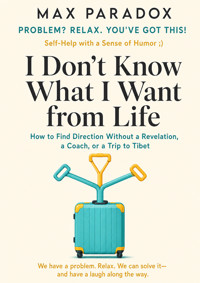
I Don't Know What I Want from Life - How to Find Direction Without a Revelation, a Coach, or a Trip to Tibet ebook
Max Paradox
Uzyskaj dostęp do tej i ponad 240000 książek od 14,99 zł miesięcznie
- Wydawca: ALL-IN Rafał Płonkowski
- Kategoria: Biznes, rozwój, prawo•Biznes, rozwój
- Język: angielski
What do you want from life?
Excellent question.
Unfortunately, it contains your career, relationships, money, location, identity, priorities, lifestyle, ambitions, fears, future plans, and possibly whether you should move somewhere sunny and start making artisanal bread.
No wonder the answer is taking a while.
I Don't Know What I Want from Life is a practical, funny guide for anyone who feels directionless-not because they have no options, but because they have too many, have inherited goals they are not sure they actually want, or are waiting for a level of certainty that real life rarely provides.
Max Paradox takes apart the fantasy that everyone has one hidden purpose waiting to be discovered. Instead, this book shows you how to create direction from evidence: what energizes you, what drains you, which trade-offs you can live with, what kind of ordinary Tuesday you actually want, and which possibilities deserve a real-world test.
Inside, you will learn how to:
stop asking questions so enormous that your brain immediately files for administrative leave;
separate genuine goals from expectations borrowed from family, colleagues, social media, and the global competitive sport known as “keeping up”;
choose between several good options without searching for the mythical perfect one;
make decisions without waiting for complete certainty;
distinguish passion from curiosity, skill, and lifestyle fit;
reduce option overload and create a useful shortlist;
build a practical Direction Sentence instead of a five-year prophecy;
run low-risk experiments before making expensive changes;
know when to persist, pivot, pause, or stop;
protect yourself from drift, comparison, overcommitment, and endless optimization;
build enough financial, professional, and personal flexibility to change direction later without detonating your entire life.
This is not a book about “manifesting your destiny.”
There will be no instruction to wake at 4:30 a.m., journal beneath a waterfall, or wait until the universe sends a sign.
The method is less dramatic.
It also works considerably better.
You do not need to know exactly what you want from the rest of your life. You need to know what is worth testing next, what you want more and less of, which costs you are willing to accept, and what evidence would justify continuing.
Direction is not a revelation.
It is a process.
And fortunately, the process does not require a trip to Tibet.
This publication was prepared with the assistance of tools that support the creative process, including artificial intelligence-based solutions. The final concept, structure, and editing belong to the author.
Ebooka przeczytasz w aplikacjach Legimi na:
Liczba stron: 202
Rok wydania: 2026
Odsłuch ebooka (TTS) dostepny w abonamencie „ebooki+audiobooki bez limitu” w aplikacjach Legimi na:
Podobne




















INTRO
At some point, usually on a Sunday evening, a dangerous question appears: What am I actually doing with my life?
This question rarely arrives politely. It kicks open the door while you are brushing your teeth, driving home, scrolling through someone else’s vacation photos, or staring at a spreadsheet called FINAL_v7_REAL_FINAL. Suddenly, your perfectly functional Tuesday is being cross-examined. Do I like my job? Do I want to live here? Should I move? Start a business? Go back to school? Have children? Learn pottery? Become the kind of person who owns linen pants and says things like “I’m spending this season in Portugal”?
Within ten minutes, you are no longer choosing what to watch on Netflix. You are conducting a strategic review of your entire existence.
This is usually where the panic begins, because we have been sold a dramatic idea about direction: somewhere inside you, allegedly, there is one true path. Your job is to discover it. Preferably during a sunrise, after a profound conversation, while standing near a mountain. Once found, this path will make everything click into place, and you will become one of those calm people who answer, “I’ve always known,” when asked what they wanted from life.
Some people do seem to know. At twelve, they wanted to be doctors. At eighteen, they studied medicine. At thirty-five, they are doctors. Very efficient. The rest of us wanted to be an astronaut, then a musician, then someone who owns a coffee shop, then “something in marketing,” and now we would mainly like a job that does not require pretending to be excited about quarterly alignment.
Not knowing what you want does not mean you are lazy or secretly wasting your life. More often, it means you are trying to answer a question that is too large, vague, and loaded to produce a useful answer.
“What do I want from life?” sounds important because it is enormous. That is also why it is terrible as a working question. You might as well ask, “What should my entire future be?” and then become concerned when your brain responds with a loading symbol.
The problem gets worse because we confuse direction with certainty. We think we should know not only what we want next, but what we will want in five, ten, or twenty years. We want a permanent answer from a temporary version of ourselves. This is ambitious considering you can currently change your mind about dinner three times while standing in front of an open refrigerator.
So we search for certainty in the usual places. We take personality tests. We watch videos titled “How I Found My Purpose at 29.” We read about people who quit corporate jobs to open bakeries in small coastal towns. We imagine quitting our own job, despite having no interest in bread and getting irritated when flour gets on the counter. We ask friends what they think we should do, then reject their answers because somehow we want advice and complete independence at the same time.
If confusion continues, we may start shopping for a revelation. Perhaps the right podcast will reveal it. Perhaps a coach will ask the magical question. Perhaps journaling at 5:45 a.m. will uncover a hidden calling beneath several layers of sleep deprivation. Perhaps a solo trip to Tibet will finally explain why you hate your current job.
Tibet has enough to deal with. It does not also need to organize your career.
The good news is that you do not need a revelation. You need a better process.
Direction is not usually discovered as a complete answer. It is built from smaller pieces of evidence: what gives you energy, what drains you, what you care about enough to tolerate difficulty for, what kind of problems you like solving, what trade-offs you can live with, what you keep returning to, and what kind of ordinary Tuesday you would actually like to have.
That last part matters. We often choose futures by imagining highlight reels. We picture the promotion, the new city, the business launch, the creative career, the applause, the freedom, the house with clean windows. We do not picture the emails, paperwork, boring practice, uncertainty, taxes, deadlines, or the fact that every dream eventually develops administrative tasks.
A useful direction has to survive contact with Tuesday.
This book will not ask you to identify your one sacred purpose and tattoo it somewhere visible. It will help you narrow the field, test possibilities, stop treating every decision as a lifetime contract, and build enough clarity to take the next meaningful step. We will separate what you genuinely want from what merely looks impressive, what other people expect, what you think you “should” want, and what the internet has convinced you is essential for a successful human existence.
We will also deal with a particularly annoying truth: you may not feel certain before you act.
This is inconvenient because many of us have been waiting for certainty as if it were a bus. We stand at the stop, checking the road. Maybe clarity is coming. Maybe one more week. One more article. One more conversation. One more spreadsheet with columns labeled PROS, CONS, RISK, UPSIDE, VIBE, and MISCELLANEOUS EXISTENTIAL CONCERNS.
Meanwhile, life keeps moving.
The goal here is not to rush you into a giant decision. It is the opposite. When you stop demanding a giant answer, you can make smaller decisions intelligently. Instead of “What career should I choose forever?” you can ask, “What kind of work would I like to test for the next six months?” Instead of “Where should I live for the rest of my life?” you can ask, “What environment seems to suit me better right now, and how can I gather evidence before moving everything I own across the country?”
Smaller questions are not less serious. They are more useful.
You will learn how to identify false goals, spot inherited expectations, use dissatisfaction without letting it run the meeting, distinguish curiosity from fantasy, run low-risk experiments, make decisions with incomplete information, and create a personal definition of “better” that does not require everyone else to approve it. You will also learn what to do when several options seem equally good, when nothing feels exciting, and when the plan that looked brilliant in your notebook turns out to be terrible in real life.
That will happen occasionally.
Real life has no respect for notebooks.
Most importantly, you will stop treating uncertainty as proof that you are lost. You can be uncertain and still be moving in a useful direction. You can change course without declaring your previous choice a failure. You can want something for three years and then want something else. This is not necessarily inconsistency. Sometimes it is simply new information arriving.
You do not need to know exactly what you want from life.
You need to know what is worth trying next, what is worth stopping, and what evidence you will pay attention to along the way.
That is much less cinematic than a revelation on a mountain.
It is also far more likely to work.
Chapter 1 - The Question Is Too Big
You are sitting somewhere perfectly ordinary when your brain decides it would like an answer to a completely unreasonable question.
“What do I want from life?”
Excellent.
Perhaps you were making coffee. Perhaps you were answering an email. Perhaps you were trying to decide whether the chicken in the refrigerator was still legally food. None of this matters now, because your brain has opened a strategic planning session covering approximately the next forty years.
What career do you want? Where should you live? Who should you become? What should matter to you? Do you want more money, more freedom, more meaning, more stability, more travel, more family, more creativity, more peace, or one of those kitchens with an island large enough to have its own municipal government?
You do what any sensible person would do.
You attempt to solve everything simultaneously.
This is the first reason people feel directionless: the question they are asking is too big to answer usefully.
“What do I want from life?” combines career, relationships, money, geography, lifestyle, identity, values, health, family, status, leisure, purpose, and probably whether you should finally learn Spanish. It is not one question. It is fifteen questions wearing a trench coat.
No wonder your brain freezes.
Imagine walking into a restaurant and the waiter saying, “What do you want?”
You ask for the menu.
“There is no menu.”
What are the options?
“All food.”
Excellent system.
This is what we do to ourselves when we demand one grand answer about life. We remove categories, time frames, constraints, and realistic options, then become concerned that clarity does not immediately descend from the ceiling.
The solution begins by making the question smaller.
Not trivial.
Smaller.
There is a difference.
Instead of asking what you want from your entire life, ask what you want more of and less of in the next one or two years. That is a question your brain can actually work with because it has edges. It does not require you to predict the personality, responsibilities, health, income, family situation, and strange new interests of your future self in 2041.
You barely know what present you wants for lunch.
Future you deserves less pressure.
Stop Asking for a Lifetime Contract
One of the most damaging assumptions about direction is that choosing something now means choosing it forever.
This turns ordinary decisions into constitutional amendments.
Maybe you are thinking about changing careers. Instead of asking, “Would I prefer this kind of work for the next three years?” your brain immediately jumps to, “Could I still see myself doing this at sixty-two?”
You have not even done it at thirty-eight.
Calm down, forecasting department.
The same thing happens with cities, relationships, hobbies, businesses, and education. We demand lifetime certainty before making medium-term experiments. The result is predictable: we avoid moving because every move feels permanent.
But very few life decisions are genuinely permanent.
Some are expensive to reverse. Some are painful. Some require time. Some should be taken very seriously. But most still contain more flexibility than your anxious imagination admits.
You can move cities again.
You can leave a profession.
You can stop running a business.
You can return to employment.
You can discover that rock climbing was apparently not your calling despite buying the shoes.
A decision does not have to be permanent to be valuable.
It only has to be good enough for the period you are actually choosing.
That period might be six months.
It might be two years.
It might be the next project.
It might simply be long enough to gather better information.
This changes the question from:
“What should I do with my life?”
to:
“What direction deserves a serious test next?”
That is a much better question.
It is also considerably less likely to make you stare at the ceiling at 1:17 a.m.
You Need Coordinates, Not Destiny
Imagine opening a map application and typing only:
“Take me somewhere good.”
The app would have questions.
Where are you now?
What kind of place?
How far?
By car or on foot?
Do you want food, nature, shopping, an airport, or a quiet location where nobody can schedule a Zoom call?
Direction works the same way. Before you decide where to go, you need a rough location.
This is where many people skip a step. They start searching for the perfect destination without understanding what is currently wrong.
Suppose you say, “I need a new career.”
Maybe.
But perhaps the actual problem is your boss.
Or your schedule.
Or the commute.
Or your company.
Or the fact that you work in a role where you spend six hours a day doing tasks you hate and two hours pretending those six hours were “strategic.”
If you misdiagnose the problem, you can make a dramatic change and bring the original problem with you.
You leave the company.
New company.
New logo.
New laptop.
New password policy.
Same misery.
Congratulations on the rebrand.
Before deciding what you want, identify what you do not want to keep.
Take the main areas of your life and ask two simple questions:
What is working well enough that I would keep it?
What regularly drains, irritates, limits, or disappoints me?
Do not demand philosophical brilliance. You are collecting evidence.
For work, you might discover:
“I like solving problems, working with smart people, earning well, and having independence. I dislike constant meetings, political games, being available after hours, and spending most of my day coordinating instead of creating.”
That is useful.
“I do not know my purpose” is not useful.
One can lead to better choices.
The other mainly leads to podcasts.
Your Irritations Are Data
People often underestimate dissatisfaction because it does not look inspirational.
We expect direction to come from passion.
Sometimes it comes from annoyance.
This is less cinematic, but very efficient.
You may not know exactly what you want from work, but you may know you cannot tolerate having every hour scheduled.
You may not know your ideal city, but you know you hate spending ninety minutes commuting.
You may not know what kind of relationship you want long term, but you know you are done with guessing whether the other person is actually in the relationship.
These are not complete answers.
They are boundaries.
Boundaries narrow the field.
If you know you hate unpredictable income, a business model based entirely on commission may be a poor experiment, even if a man on YouTube says it changed his life.
If you know you need solitude to function, building a lifestyle involving constant networking may eventually make you consider faking your own disappearance.
If you value stability more than novelty, that matters.
If you value autonomy more than status, that matters.
If you need your evenings, that matters.
Not every preference needs to become a noble value statement.
Sometimes “I do not want people calling me after 6 p.m.” is enough.
Separate Problems from Fantasies
When people feel stuck, almost any alternative can look attractive because they compare the boring reality of their current life with the edited trailer of another one.
Your current job contains meetings, deadlines, difficult colleagues, taxes, software bugs, and someone writing “gentle reminder” in an email that does not feel gentle at all.
Your fantasy job contains sunlight.
This is not a fair comparison.
Perhaps you dream of owning a coffee shop. You imagine the smell of fresh coffee, regular customers, beautiful interiors, and writing the daily specials on a chalkboard.
You may not imagine arriving at 5:15 a.m. because the refrigerator has stopped working and your employee has texted, “hey sorry can’t make it today.”
The dream has inventory now.
Direction improves when you compare reality with reality.
If you are considering an option, ask:
“What does an ordinary Tuesday look like?”
Not the launch day.
Not the vacation photo.
Not the LinkedIn announcement.
Tuesday.
What time do you wake up?
What kind of work fills most of the day?
Who do you deal with?
What problems repeat?
How much control do you have?
How much does it pay?
What is stressful?
What is boring?
What is still attractive after you include the boring parts?
This question eliminates many fantasies quickly.
It also makes good options stronger.
If the Tuesday still looks appealing, now we have something.
Use the “More, Less, Same” Test
Here is one of the simplest ways to create direction without discovering the meaning of existence.
Take a sheet of paper and make three columns:
MORE
LESS
SAME
Now fill them with specific features of your life.
Not abstract words such as “happiness” unless you can define what produces it.
Write things like:
MORE:
uninterrupted time;
work I can finish and see;
evenings with no work messages;
time outdoors;
travel;
learning;
conversations with interesting people.
LESS:
commuting;
meetings with no decision;
financial uncertainty;
obligations accepted out of guilt;
doomscrolling;
pretending to enjoy networking breakfasts.
SAME:
current income level;
city;
close relationships;
two days working from home;
weekend routines.
Now you have the beginning of a direction.
Not destiny.
Direction.
Suppose an opportunity offers 25 percent more money but also doubles your travel, adds evening calls, and reduces your autonomy. If your MORE list contains freedom and your LESS list contains work invading your evenings, the higher salary may not actually move you in the direction you want.
Without criteria, money wins because money is easy to measure.
So is job title.
So is square footage.
So are Instagram followers.
The dangerous things in life are often measurable.
Your nervous system is less cooperative.
Do Not Confuse “Interesting” with “I Want It”
Another source of confusion is that many things are attractive from a distance.
You might love watching renovation videos.
This does not necessarily mean you should renovate houses.
You may enjoy business podcasts.
This does not mean you want employees.
You may find psychology fascinating.
This does not automatically mean you want to become a therapist.
Interest is evidence.
It is not a contract.
People sometimes make enormous decisions because they mistake curiosity for commitment. They like the idea of something, therefore they assume the next logical step is to restructure their entire life around it.
There is another option.
Try a smaller version.
If you think you want to write, write regularly for a month.
If you think you want to work in a particular field, talk to three people who actually work in it.
If you think you want to run a business, sell something before designing the logo.
Especially before designing the logo.
Many businesses have died with excellent branding.
The point of small experiments is not merely to reduce risk. It is to replace imagination with evidence.
You learn whether you like doing the thing rather than liking the image of yourself doing the thing.
These can be very different hobbies.
Direction Comes from Contact
You cannot think your way into complete clarity because some information exists only after action.
You do not know how a city feels until you spend time there.
You do not know whether you like managing people until you manage people.
You do not know whether freelance freedom feels liberating or like being permanently unemployed in a nice chair until you experience some version of it.
Thinking is useful.
Thinking forever is not.
At some point, thought becomes a very sophisticated hiding place.
You tell yourself you are researching.
Comparing.
Reflecting.
Preparing.
You have twelve tabs open.
A spreadsheet.
Three YouTube videos.
Two saved articles.
A note titled POSSIBLE FUTURE OPTIONS.
Nothing has actually happened.
Your research department is thriving.
Operations has been closed since March.
When you reach that point, stop asking what you think and create contact with reality.
Send the email.
Take the class.
Spend the weekend in the city.
Do the freelance project.
Volunteer.
Shadow someone.
Build the tiny version.
Apply for the role.
Run the experiment.
You are not committing your life.
You are buying information.
What to Do This Week
Do not create a five-year plan.
For now, do something much smaller.
Choose one area where you feel most directionless: work, location, relationships, lifestyle, money, creative life, or something else.
Then write:
What do I want more of?
What do I want less of?
What do I definitely want to keep?
What am I currently idealizing without enough evidence?
What small experiment could give me better information within thirty days?
Your experiment should be cheap enough, small enough, and reversible enough that you can actually do it.
Do not write:
“Completely reinvent career.”
Write:
“Talk to two people doing work I am considering.”
Do not write:
“Move to California.”
Write:
“Spend five normal weekdays there and work from the area if possible.”
Do not write:
“Become a writer.”
Write:
“Write 500 words four times a week for one month.”
Evidence first.
Identity crisis later.
If you cannot answer the big question, stop asking the big question. Build a smaller one that produces movement.
You do not need the route to the rest of your life.
You need the next useful coordinate.
Chapter 2 - Borrowed Wants
Imagine that you have finally decided what you want.
You want a bigger house.
Excellent.
Why?
Because you need more space.
Why?
Because the current place feels too small.
Why?
Because everyone you know seems to have upgraded recently, and your kitchen suddenly looks suspiciously inadequate despite performing exactly the same kitchen-related functions it performed last year.
Ah.
We may have found something.
One reason it is difficult to know what you want from life is that your mind is not operating in a sealed laboratory. It is surrounded by other people’s choices, expectations, success stories, opinions, advertisements, family traditions, algorithms, and photographs of aggressively beautiful breakfasts.
You are constantly receiving suggestions about what a good life should look like.
Some of them are useful.
Some are nonsense.
Most arrive without labeling.
This makes it easy to mistake a borrowed desire for your own.
The Default Package
Every culture has some version of the Standard Successful Human Package.
The exact contents vary, but it often includes a respectable career, rising income, property, a relationship, perhaps children, travel, good health, attractive furniture, hobbies that photograph well, and enough confidence to announce that you have “set boundaries” while still answering emails from bed.
None of these things are automatically bad.
The problem begins when you want them primarily because they are what successful people are apparently supposed to want.
You may genuinely want a large house.
You may also want one because at some point “more house” became evidence that life was progressing correctly.
You may genuinely want to become a senior executive.
Or you may want the title because it gives an externally recognizable answer to the question, “How are you doing?”
Very well.
Look.
Vice president.
No further questions.
External markers are comforting because they are easy to explain. If you say you want a promotion, people understand. If you say you want a less prestigious role with more freedom, someone may look at you as if you have left a perfectly good sandwich on the sidewalk.
We are trained to move upward.
We receive considerably less guidance about moving toward.
Who Put That Goal There?
Take one goal you currently have.
Maybe it is earning $200,000 a year.
Maybe it is buying a particular house.
Maybe it is becoming a director.
Maybe it is moving abroad.
Maybe it is getting married.
Maybe it is becoming self-employed.
Now ask:
“If nobody else could ever know I achieved this, would I still want it?”
This question is surprisingly rude.
It removes applause.
No announcement.
No photo.
No title update.
No impressed friend.
No relative suddenly deciding you have “done well.”
You still get the actual result, but nobody sees it.
Would you still choose it?
If yes, that is strong evidence the goal is yours.
If the desire becomes strangely weaker, do not panic. It does not mean the goal is fake. Humans are social creatures. Recognition matters. Status matters. Belonging matters. Pretending otherwise is another form of performance, usually done by people who have already achieved enough status to say status does not matter.
The point is not to become immune to other people.
The point is to know how much of the goal is the thing itself and how much is the audience.
That distinction matters because applause is brief.
The lifestyle remains.
The Career Trap
Careers are particularly good at producing borrowed goals because organizations conveniently provide ladders.
Here is Level 1.
Here is Level 2.
Here is Senior.
Here is Manager.
Here is Director.
Here is Vice President.
Here is a larger meeting where everyone appears equally tired but has more expensive laptops.
The existence of the ladder quietly creates the assumption that climbing it is the goal.
Maybe it is.
But ask what actually changes at each level.
Do you want the work?
Or the promotion?
These are not identical.