Uzyskaj dostęp do tej i ponad 240000 książek od 14,99 zł miesięcznie
- Wydawca: ALL-IN Rafał Płonkowski
- Kategoria: Biznes, rozwój, prawo•Biznes, rozwój
- Język: angielski
You finally have free time.
So why are you checking email, reorganizing a drawer, scrolling through your phone, planning tomorrow, researching something you do not need, and feeling guilty because you are “doing nothing”?
If resting feels strangely difficult, you are not alone-and the answer is not another seven-step evening routine.
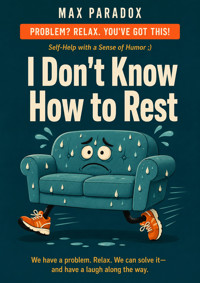
I Don't Know How to Rest is a practical, funny guide for people who are tired but somehow still cannot stop. Max Paradox takes apart the habits that turn evenings, weekends, and vacations into disguised forms of work and shows how to build recovery into normal life without becoming a meditation guru, deleting the internet, or moving to a cabin in the woods.
Inside, you will learn how to recognize the difference between genuine rest and passive overstimulation, why free time can trigger guilt, why constant availability keeps your brain on duty, and why scrolling for an hour can leave you more tired than before.
More importantly, you will learn what to do instead.
The book shows you how to match recovery to the type of fatigue you are experiencing, create low-demand transitions after work, stop before complete exhaustion, reduce unnecessary stimulation, protect your evenings from work and other people, build realistic boundaries, leave space in your calendar, and create a minimum version of rest that still works during difficult weeks.
You will also learn how to stop turning recovery into another self-improvement project.
No perfect morning routine.
No obligation to meditate under a waterfall.
No requirement to buy a special journal, candle, blanket, app, chair, tea collection, or Scandinavian lamp.
The methods are deliberately practical and designed for real people with jobs, families, errands, phones, messy homes, unpredictable schedules, and energy levels that occasionally resemble a potato.
You will discover how to create a simple recovery system that survives ordinary life, what to do when rest does not seem to work, how to recognize when your overall load is the real problem, and how to prevent old patterns from quietly taking over again.
This is self-help for people who want useful solutions without being lectured for 200 pages.
You do not need to stop caring about your work, goals, family, or ambitions.
You simply need to stop living as if every available minute belongs to the next task.
The laundry can wait.
The inbox can wait.
The group chat can definitely wait.
This publication was prepared with the assistance of tools that support the creative process, including artificial intelligence-based solutions. The final concept, structure, and editing belong to the author.
Ebooka przeczytasz w aplikacjach Legimi na:
Liczba stron: 202
Rok wydania: 2026
Odsłuch ebooka (TTS) dostepny w abonamencie „ebooki+audiobooki bez limitu” w aplikacjach Legimi na:
Podobne




















INTRO
You finally have nothing to do.
This should be excellent news.
No meeting. No urgent email. No grocery run. No person asking whether you “have a quick minute,” which is one of civilization’s most reliable ways to lose forty-five minutes. The laundry is reasonably under control, nobody needs to be driven anywhere, and for once your calendar contains a beautiful empty rectangle.
So you sit down.
And immediately feel uncomfortable.
Maybe you should answer that message first. It will only take a second. Then perhaps check tomorrow’s schedule so you can relax properly. While you are there, you might as well look at the weather. Then you remember the cabinet hinge that has been slightly crooked since March. You do not fix it, obviously, but you do spend seven minutes watching a video called “5 Signs Your Kitchen Cabinets Are Installed Wrong.”
Excellent.
Rest has begun.
Twenty minutes later you are holding your phone, mentally reorganizing next week, thinking about a bill you already paid, wondering whether you should finally start exercising more seriously, and feeling strangely guilty because you are “doing nothing.”
This is a very special talent: turning free time into unpaid administrative work.
Some people can sit on a porch with a drink and stare at absolutely nothing. They seem fine. Suspiciously fine. Meanwhile, you sit down for five minutes and your brain opens twenty-three internal browser tabs.
Did I reply to Mark?
I should really clean the garage.
What if I’m wasting the weekend?
Maybe I should read something useful.
I haven’t called my mother.
I need new socks.
Why do I need new socks?
Should I become the kind of person who buys better socks?
Suddenly, what was supposed to be twenty minutes of rest has become a strategic review of your entire existence.
The problem is not always that you do too much. Sometimes the problem is that you no longer know how to stop doing.
There is a difference.
You may physically stop working while your mind continues running the company. You may lie on the couch while mentally preparing Tuesday’s conversation with someone who has not yet said the thing you are already preparing to answer. You may take a day off and spend half of it trying to make the day off productive.
This is how people end up creating a checklist titled “Relax.”
And then feeling disappointed because they only completed four out of seven relaxation activities.
If this sounds ridiculous, that is because it is.
It is also extremely common behavior for people whose brains have learned that being useful, busy, prepared, responsive, improving, organizing, fixing, producing, or planning is the normal state. After enough time, inactivity begins to feel less like recovery and more like negligence.
You are not resting.
You are failing to perform tasks.
At least that is how your nervous system may interpret it.
This explains one of the stranger experiences of modern adulthood: being exhausted and still resisting rest.
You complain all week that you need a break. Friday arrives. You finally have one.
Then you fill it.
You clean something. Check something. Research something. Compare something. Open social media “for a minute.” Watch eight short videos. Decide you should optimize your insurance. Look at vacation destinations you are not currently planning to visit. Read a review of a coffee grinder you do not need.
Your body has stopped working.
Your attention has not.
And attention matters because rest is not simply the absence of paid labor. If your brain is consuming information, solving tiny problems, switching between apps, monitoring messages, making decisions, and evaluating whether it is resting correctly, you may technically be off work while remaining mentally on duty.
That is why some “breaks” leave you feeling worse.
You finish the evening having done almost nothing meaningful, yet somehow you feel as if you have been operating airport ground control during a thunderstorm.
The obvious response is often: “Fine. I need better discipline.”
Of course.
The traditional solution to being unable to relax is apparently to give yourself another responsibility.
Now you must become good at resting.
Preferably by Monday.
This is where many well-intentioned solutions become another project. You buy the meditation app. You create the perfect evening routine. You order a candle that smells like Scandinavian emotional stability. You decide that every night you will journal, stretch, drink herbal tea, read thirty pages, avoid screens, practice gratitude, and be asleep by 10:15.
On the first evening, you complete the whole routine.
On the second, you get through half.
On the third, you fall asleep while holding your phone six inches above your face.
The phone eventually lands on your nose.
Wellness has consequences.
This book will not ask you to turn rest into a new profession.
You do not need to become a meditation expert, disappear into the mountains, delete the internet, buy linen clothing, or develop a passionate relationship with herbal tea. You also do not need to earn your rest by becoming exhausted enough to justify it.
Rest is not a reward for reaching the point where your personality has become “tired.”
It is maintenance.
The difficulty is that maintenance is rarely dramatic. There is no applause when you stop before exhaustion. Nobody gives you a trophy for going to bed instead of answering one more email. Your phone does not send a notification saying:
“Congratulations. You have successfully done nothing for seventeen minutes.”
Although, to be fair, if it did, checking the notification would ruin the streak.
Learning to rest means learning several smaller skills. You need to notice what keeps your system activated. You need to understand why boredom can feel uncomfortable. You need to separate genuine recovery from passive overstimulation. You need to stop treating every empty space like a hole that must immediately be filled with content, chores, messages, errands, improvement, or a documentary about organized refrigerators.
You also need practical ways to rest when your brain is not cooperating.
Because sometimes telling yourself to “just relax” works approximately as well as telling yourself to “just sleep.”
Wonderful suggestion.
Thank you, brain.
Hadn’t considered it.
Real rest often begins before you feel naturally ready for it. You may need to reduce stimulation before your mind stops demanding stimulation. You may need to tolerate a few uncomfortable minutes before doing nothing stops feeling like something is wrong. You may need to learn which activities genuinely restore you and which ones merely anesthetize you until bedtime.
And yes, there is a difference between watching a good movie because you enjoy it and staring at forty-seven short videos because your thumb has apparently taken control of the household.
We will deal with that.
We will also deal with guilt, unfinished tasks, weekends that mysteriously become second jobs, vacations that require recovery afterward, the strange pressure to use free time “well,” and the common belief that rest only counts when it looks peaceful, healthy, photogenic, and preferably happens near a lake.
Sometimes good rest is a walk.
Sometimes it is music.
Sometimes it is lying on the couch with no educational objective whatsoever.
Sometimes it is leaving one completely nonurgent thing unfinished and discovering that civilization continues.
The goal is not to become less ambitious, less responsible, or less active.
The goal is to stop living as if every moment must produce something.
Because if every empty minute becomes an opportunity to catch up, improve, consume, organize, respond, prepare, or optimize, then eventually there are no empty minutes.
There is only work wearing casual clothes.
By the end of this book, you will know how to recognize what actually restores you, how to build rest into normal life without turning it into another complicated system, how to deal with the guilt that appears when you stop, and how to create a version of recovery that still works when life is busy, messy, noisy, and not cooperating.
You will not need the perfect routine.
You will need a few reliable ways to stop.
That sounds simple.
Which is fortunate, because you are already tired.
Chapter 1 - Why Rest Feels Wrong
Saturday morning arrives with no alarm.
This is supposed to be one of life’s better arrangements.
You wake up, look at the clock, and realize nobody expects anything from you for several hours. There is no meeting, no commute, no urgent errand, and no reason to put on pants that contain buttons.
For approximately thirty seconds, peace exists.
Then your brain checks the premises.
You should probably get up.
Sleeping too long will ruin the day.
Maybe you should clean the kitchen first.
You have been meaning to sort that drawer.
There are emails you could answer.
You could get ahead on Monday.
And suddenly you are not resting. You are being audited by an invisible supervisor who appears to have gained access to your bedroom.
This supervisor has no salary, no office, and no legal authority whatsoever.
Unfortunately, it lives in your head.
For many people, rest feels uncomfortable not because they dislike comfort, but because stopping triggers a strange internal alarm. Something feels unfinished. Something could be done. Somewhere, theoretically, a more productive version of you is already awake, hydrated, stretching, meal-prepping, learning Spanish, and reviewing retirement contributions.
You are still in bed.
Clearly, civilization is in danger.
The first thing to understand is that your inability to rest is often not a lack of knowledge. You already know what rest looks like. You have seen chairs. You understand couches. Nobody needs to explain the mechanical principles of lying down.
The problem is what happens emotionally and mentally when you stop.
Rest can feel like losing control
Activity gives you something useful: a sense that you are handling life.
Answer the message.
Done.
Pay the bill.
Done.
Clean the counter.
Done.
Fix the appointment.
Done.
Small actions produce closure. They reassure you that things are moving in the correct direction.
Rest does not give you the same immediate feedback.
You sit down.
Nothing gets crossed off.
The kitchen remains exactly as kitchen-like as before.
The unanswered message continues existing with remarkable confidence.
Your brain sees all this inactivity and starts filing complaints.
This is especially common if you have spent years being the responsible one. Maybe you are the person who remembers birthdays, books appointments, responds quickly, plans ahead, solves problems, checks details, and knows where the spare batteries are.
You became competent.
Excellent.
Then competence expanded until it became permanent duty.
Now your brain treats every unclaimed minute as available inventory.
Ten free minutes?
Great. We can use those.
Twenty minutes before dinner?
Perfect. Let us reorganize something.
A quiet Sunday afternoon?
Wonderful. We can finally deal with the documents folder.
The documents folder has been waiting.
It has lawyers now.
The problem is not productivity itself. Productivity is useful. The problem begins when your mind stops recognizing a category called “enough.”
There is always one more useful thing.
You can always improve something.
You can always prepare better.
You can always reply faster, tidy more, plan further, read another article, check another account, compare another option, or finally research whether you are using your dishwasher correctly.
There are people online who will explain that you are not.
The internet can make loading a dishwasher feel like failing an entrance exam.
Your brain may have linked worth with usefulness
This is where rest becomes emotionally expensive.
If part of your self-worth comes from being useful, competent, reliable, productive, or available, stopping can feel strangely threatening. You may not consciously think:
“If I am not doing something, I have no value.”
That would be obvious.
Brains prefer subtle nonsense.
Instead, the thought arrives disguised as practicality.
“I might as well do this now.”
“It’ll only take a minute.”
“I’ll relax afterward.”
“I don’t want to waste the day.”
“I’ll feel better once everything is done.”
That final sentence is particularly ambitious.
Everything?
Everything has never been done.
Humanity has had several thousand years and is still adding tasks.
The promise “I’ll rest once everything is finished” sounds responsible, but it creates an impossible condition. Your inbox regenerates. The house gets dirty again. Work produces more work. People continue sending messages despite repeated evidence that you would prefer they did not.
If rest requires total completion, you have designed a system in which rest never officially begins.
You keep pushing it into the future.
After this project.
After this week.
After the holidays.
After the move.
After the busy season.
After things settle down.
Things have no intention of settling down.
Things have a full schedule.
You may be waiting to feel permission
Some people do not decide to rest.
They wait until rest becomes undeniable.
They need to be exhausted enough.
Ill enough.
Finished enough.
Late enough.
They wait for a condition that makes stopping morally acceptable.
This is why someone can spend three hours complaining about being tired and still decide at 10:30 p.m. that now would be an excellent time to reorganize a closet.
At 11:40, they are sitting on the floor surrounded by winter scarves and deeply questioning their choices.
The closet did not ask for this.
A useful shift is to stop treating rest as a verdict.
You do not need to prove that you deserve it.
Instead, treat rest the way you treat charging a phone.
You do not wait until your phone reaches zero percent, catches fire, and whispers goodbye to its family.
You charge it before that.
You do this because maintaining function is easier than recovering from collapse.
The same logic applies to you, although you are slightly more complicated and generally worse at following instructions.
The first distinction: tired versus activated
This is one of the most useful things to notice.
You can be tired and activated at the same time.
That combination confuses people because they assume tiredness should automatically produce rest.
It does not.
You can be physically exhausted while mentally revved up.
Your body says:
“Please stop.”
Your brain says:
“Excellent point. Let’s think about every unresolved issue since 2016.”
Activation can come from work pressure, constant notifications, emotional tension, unfinished tasks, caffeine, decision overload, doomscrolling, family conflict, or simply spending all day switching attention from one thing to another.
When you finally stop, your system may not immediately become calm.
It may remain on alert.
This is why you sometimes sit on the couch and feel restless.
You are not doing anything, but you do not feel rested.
So you reach for your phone.
Now something is happening again.
Messages.
Videos.
News.
Shopping.
Opinions.
A man reviewing vacuum cleaners with the intensity of a war correspondent.
The stimulation feels better than the awkward stillness.
But it also keeps you activated.
This creates a loop:
You feel too restless to rest.
You use stimulation to avoid the restless feeling.
The stimulation prevents your system from settling.
You conclude that you are “bad at resting.”
A very elegant trap.
Do not force calm
One of the worst responses is to demand that you immediately feel relaxed.
You sit down.
You take a breath.
You expect peace.
Peace does not report for duty.
Now you are irritated.
“This isn’t working.”
Of course it is not working.
You have been resting for ninety seconds.
Your brain spent the previous nine hours jumping between deadlines, conversations, screens, decisions, and mild emergencies. It is not a hotel lobby where somebody presses a button and the background music changes.
Rest often has a transition period.
That transition may feel boring, restless, guilty, or slightly pointless.
This does not mean you are failing.
It means you are transitioning.
Think about driving on the highway and then exiting into a residential neighborhood. You do not go from seventy miles per hour to parked in one second unless something has gone badly wrong.
Your mind also needs a ramp.
Preferably one without police.
Try a landing routine
Not a seventeen-step evening ritual.
Not a spreadsheet.
A landing routine.
The purpose is simple: create a short bridge between activity and rest.
Choose two or three actions that tell your brain:
“We are not solving anything for the next little while.”
For example:
put the phone somewhere out of reach for fifteen minutes;
make a drink;
change clothes;
take a short walk;
shower;
sit somewhere different from where you work;
play music without simultaneously doing six other things.
That is enough.
Do not improve the routine.
Do not research the optimal transition beverage.
Do not order a special chair.
You are landing, not opening a wellness franchise.
The key is consistency, not complexity. If you repeat the same simple transition often enough, it becomes easier for your system to recognize that work mode is ending.
The unfinished-task problem
One reason people cannot rest is that unfinished tasks keep floating around in their heads.
You are trying to watch television, but somewhere behind the dialogue your brain is saying:
Dentist.
Insurance.
Reply to Lisa.
Printer ink.
Dentist.
You do not need to complete every task before resting.
You do need somewhere safe to put them.
Use one external list.
Not three apps, a notebook, a sticky note on the refrigerator, and two messages sent to yourself.
One place.
Before resting, spend two or three minutes writing down whatever your brain keeps rehearsing. Do not solve it. Capture it.
“Call dentist Monday.”
“Send file to Lisa.”
“Buy printer ink.”
Your mind often repeats unfinished tasks because it is trying not to forget them. Once the task is stored somewhere trustworthy, the brain has less reason to hold it in working memory.
Less reason.
Not zero reason.
Your brain may still remind you about printer ink while you are brushing your teeth because apparently it does not trust the system yet.
Fine.
Write it down and return.
The goal is not mental silence. The goal is fewer open loops screaming for attention.
A simple experiment
Today, choose fifteen minutes.
Not an hour.
Not an entire Sunday.
Fifteen minutes.
Before those fifteen minutes, write down anything urgent that you are afraid you will forget. Then choose one low-stimulation activity: sit outside, drink coffee, walk, listen to music, stretch, lie down, or simply stare out a window like a person in an independent film.
During those fifteen minutes, notice what your mind tries to do.
Does it create chores?
Does it demand the phone?
Does it produce guilt?
Does it tell you this is a waste of time?
Do not argue with every thought.
Just notice the pattern.
You are collecting evidence.
Maybe your main obstacle is unfinished tasks.
Maybe it is boredom.
Maybe it is guilt.
Maybe it is constant stimulation.
Maybe you are so used to activity that quiet feels suspicious.
That distinction matters because the solution depends on the obstacle.
Telling yourself to “rest more” is too vague.
You need to know what interrupts rest.
That is your first job.
Ironically.
When fifteen minutes feels impossible
Make it five.
Seriously.
If five quiet minutes feel absurdly uncomfortable, that is useful information.
Start there.
A minimum version that happens is better than a perfect routine that exists only in your imagination alongside your future six-pack, organized garage, and excellent French.
If sitting still makes you restless, use active rest instead. Walk without listening to anything. Fold laundry slowly without a podcast. Water plants. Cook something simple. Stretch.
The point is to reduce demand and stimulation.
Rest does not have to mean becoming furniture.
For some people, gentle movement is easier than stillness.
Good.
Use that.
You are not trying to pass a test.
You are trying to recover.
What to stop doing
Stop waiting until you feel completely justified.
Stop requiring every task to be finished.
Stop turning rest into another performance metric.
And stop assuming discomfort means the rest is not working.
Sometimes discomfort is simply the first five minutes of slowing down.
Your practical action for this chapter is simple: identify what makes stopping difficult for you, then create a fifteen-minute landing zone with fewer demands and fewer inputs.
Do not optimize it.
Do not score it.
Do not post about it.
Just stop for a while.
The world can survive fifteen minutes without your active supervision.
It has been taking that risk for years.
Chapter 2 - Fake Rest Is Still Work
You have had a long day.
You are tired.
You decide to relax.
So you sit down and open your phone.
Twenty-five minutes later you have watched a dog steal a sandwich, read about an argument between two celebrities you do not follow, checked the weather in a city you do not live in, seen three advertisements for products you had never considered buying, and learned that somebody online is extremely angry about the correct way to store onions.
You look up.
You are still tired.
Possibly more tired.
But at least you now have onion-related concerns.
This is one of the central problems with modern rest: many activities look like rest because they do not involve obvious effort.
You are sitting down.
You are not at work.
Nobody is asking you to produce a quarterly report.
Therefore, your brain concludes:
“Rest.”
Unfortunately, your attention may be doing unpaid overtime.
Passive does not always mean restorative
Rest is not defined only by what your body is doing.
A person can lie motionless while absorbing a nonstop stream of novelty, emotion, comparison, information, decisions, and interruptions.
That may be entertaining.
It may be enjoyable.
It may even be exactly what you want.
But it is not automatically restorative.
Consider what happens during twenty minutes of scrolling. Your attention shifts repeatedly. Every few seconds, something new appears. A joke. A tragedy. A recipe. A political argument. A vacation. A body transformation. A product. A stranger’s career achievement. A raccoon washing grapes.
Your brain keeps changing context.
Laugh.
Compare.
React.
Worry.
Swipe.
Judge.
Remember.
Swipe.
Want.
Swipe.
Forget.
This does not mean social media is evil.
It means your nervous system does not necessarily interpret rapid-fire novelty as rest.
Your thumb is relaxed.
The rest of you is attending a very chaotic conference.
Entertainment is not the enemy
This is where self-help often becomes annoying.
Someone notices that screens can be overstimulating and suddenly recommends replacing all entertainment with breathing exercises and a quiet appreciation of lentils.
No.
You are allowed to watch television.
You are allowed to play games.
You are allowed to scroll.
You are allowed to spend Saturday evening watching a movie in which extremely attractive people solve crimes in houses nobody can afford.
Enjoyment matters.
The issue is not whether an activity is “healthy-looking.”
The issue is what it does to you.
Some entertainment leaves you pleasantly settled.
Some leaves you wired, fragmented, irritated, or weirdly empty.
The same activity can even affect you differently depending on your state.
A good movie on Friday night may feel restorative.
Three hours of jumping between clips because you are too tired to decide what else to do may not.
The question is not:
“Is this officially rest?”
The question is:
“How do I feel afterward?”
Simple.
Annoyingly useful.
The aftereffect test
Start judging leisure by its aftereffect.
Not by how passive it looks.
After an activity, ask:
“Do I feel more settled, the same, or more depleted?”
That is enough.
You do not need a wellness dashboard.
If reading a novel for thirty minutes leaves you calmer, good.
If gaming with friends leaves you laughing and mentally refreshed, good.
If scrolling for forty minutes leaves you irritable and unable to focus, that is useful information.
If cleaning the kitchen while listening to music leaves you strangely peaceful, that may function as rest for you even though a lifestyle influencer would not photograph it under the caption “deep restoration.”
Your recovery does not need to be visually convincing.
It needs to work.
The attention tax
Certain kinds of leisure are tiring because they keep asking your attention to reset.
Open one video.
Half-watch it.
Check a message.
Return.
Open another app.
Read comments.
See a link.
Open the link.
Remember you meant to look something up.
Search.
Find a product.
Compare prices.
Check reviews.
Wonder whether you need the product.
You did not need the product twelve minutes ago.
Now you are researching warranties.
This is not a moral failure.
It is an attention problem.