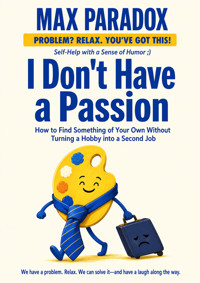
I Don't Have a Passion - How to Find Something of Your Own Without Turning a Hobby into a Second Job ebook
Max Paradox
Uzyskaj dostęp do tej i ponad 240000 książek od 14,99 zł miesięcznie
- Wydawca: ALL-IN Rafał Płonkowski
- Kategoria: Biznes, rozwój, prawo•Biznes, rozwój
- Język: angielski
What if the problem is not that you have no passion?
What if the problem is that you have been told passion should arrive like a lightning bolt, immediately reveal your true identity, stay exciting forever, make you interesting at dinner parties, and preferably become a profitable side hustle before next Tuesday?
That is a lot of responsibility for pottery.
I Don't Have a Passion is a practical, funny guide for people who look at everyone else's hobbies and quietly wonder why they do not seem to have “a thing” of their own.
Max Paradox takes apart the myth that everyone needs one giant, lifelong calling and replaces it with something far more useful: curiosity, small experiments, realistic expectations, and activities that actually fit your life.
Inside, you will learn how to:
identify interests you may already be overlooking;
distinguish genuine curiosity from liking the image of a hobby;
test hobbies without buying an entirely new personality first;
stop abandoning activities simply because being a beginner feels awkward;
find the type of enjoyment that actually works for you;
choose between several interests without treating the decision like marriage;
create small projects that make hobbies easier to continue;
use classes, groups, and other people without turning leisure into networking;
keep motivation alive when the initial excitement disappears;
simplify hobbies that have become too complicated;
avoid optimizing the fun out of everything;
decide whether monetizing an interest will improve it-or quietly destroy it;
maintain several interests without feeling inconsistent;
recognize when an activity is becoming genuinely yours;
know when to continue, modify, pause, or let something go.
This is not a book about “finding your purpose.”
It will not instruct you to wake at 5:00 a.m., journal under moonlight, discover your inner calling, and launch an online course by Friday.
It is about something more practical.
Finding activities that make ordinary life better.
Maybe you will discover one long-term passion.
Maybe you will discover five rotating interests.
Maybe you will finally realize that walking, cooking, reading strange history books, taking photos, gaming, or searching for the best tacos in town already count.
Your free time does not need to become another performance review.
It needs to feel like yours.
If you have ever thought, Everyone seems passionate about something except me, this book will help you stop searching for a dramatic answer and start building a recreational life that actually fits the person living it.
With concrete experiments, realistic Plan B options, and Max Paradox's observational humor, I Don't Have a Passion shows you how to explore, choose, start, stick with something long enough to know, and walk away without guilt when it is time.
No destiny required.
No personal brand required.
And absolutely no business model required for your sourdough.
This publication was prepared with the assistance of tools that support the creative process, including artificial intelligence-based solutions. The final concept, structure, and editing belong to the author.
Ebooka przeczytasz w aplikacjach Legimi na:
Liczba stron: 214
Rok wydania: 2026
Odsłuch ebooka (TTS) dostepny w abonamencie „ebooki+audiobooki bez limitu” w aplikacjach Legimi na:
Podobne




















INTRO
At some point, usually while scrolling past a thirty-two-year-old ceramic artist who apparently discovered her “calling” at age six, you begin to suspect that something may be wrong with you.
She has a studio full of beautiful mugs, twelve thousand followers, and a sentence in her bio that says, Clay chose me.
You have Netflix.
You have a half-finished jigsaw puzzle under the couch, a guitar you bought during a particularly optimistic February, and possibly some baking equipment that briefly convinced you sourdough would become a meaningful part of your identity. You also have several interests that seemed promising until they required effort on a Tuesday evening.
None of them chose you.
Apparently clay had other plans.
This is when the panic starts. You look around and notice that everyone seems to have a Thing. One friend runs marathons. Another restores old furniture. Someone you vaguely know from college now photographs mushrooms in forests and somehow makes the whole operation look spiritually important. Meanwhile, if somebody asks what you do for fun, your brain produces the same blank expression as a printer that has just been asked to work immediately.
“Well… I like movies.”
Excellent. A personality has been located.
The strange idea that every adult should have one powerful, recognizable passion has become surprisingly difficult to escape. We are encouraged to find our passion, follow our passion, monetize our passion, build a personal brand around our passion, wake up early for our passion, and presumably create a newsletter so strangers can receive weekly updates about it.
A hobby can no longer simply be a hobby.
Apparently it needs a growth strategy.
You start drawing because drawing seems relaxing. Three weeks later, the internet suggests opening an Etsy shop. You learn to bake bread because it makes Sunday pleasant. Somebody asks whether you have considered selling it. You enjoy taking photographs, and before you have figured out how aperture works, a cheerful online entrepreneur is explaining how to turn your photography into six figures of passive income.
Nothing says relaxation like immediately assigning revenue targets to the thing you started doing to escape revenue targets.
And if you do not have even that hobby yet, things can feel worse. There is an unpleasant little suspicion that everyone else received a brochure called Things That Make Life Interesting, while yours was lost in the mail. Other people seem energized by gardening, cycling, woodworking, dancing, painting, cooking, collecting vinyl, climbing rocks voluntarily, or traveling three hours to look at a bird.
You are sitting on the couch thinking:
Do I… like anything?
Yes.
Probably.
Give me a minute.
The problem is not necessarily that you lack passion. The problem is that you may be using an absurd definition of it.
We tend to imagine passion as something dramatic. You discover an activity, lightning strikes, violins begin playing somewhere, and suddenly you know exactly how you are supposed to spend every Saturday for the next forty years.
Real interest is usually much less theatrical.
It often begins with something closer to, “Huh. That was kind of enjoyable.”
That is not a disappointing beginning. That is how most real interests begin. Curiosity comes first. Repetition comes later. Skill may arrive eventually, assuming you do not frighten the hobby to death by asking where the business plan is.
One reason people believe they have no passion is that they expect passion to arrive fully developed. They try pottery once and do not immediately feel called to establish a relationship with clay. They go running twice and mostly discover that lungs are capable of filing complaints. They buy watercolor paints, produce something that resembles a weather emergency, and conclude that painting is not “their thing.”
Of course it is not your thing yet.
You did it once.
Imagine applying the same standard elsewhere. You cook one disappointing omelet and announce that food has rejected you personally. You speak three sentences of Spanish and conclude that languages are incompatible with your soul. You go bowling once, score forty-seven, and formally withdraw from athletics.
We give new hobbies approximately the same probation period as spoiled milk.
Then there is another problem: comparison.
You decide you might enjoy photography, so naturally you search for photography online. This seems sensible until your phone immediately introduces you to someone who photographs Icelandic waterfalls using equipment worth more than your car.
You take a picture of your coffee.
His photograph wins an international award.
The experiment is going extremely well.
The internet makes beginners feel strangely late. Whatever you want to try, somebody has already been doing it for fourteen years, owns professional equipment, has perfect lighting, and has made a thirty-minute video titled 10 Mistakes Every Beginner Makes.
You have not even made mistake number one yet.
Give yourself a chance.
The purpose of this book is not to help you identify your One True Passion, because I do not think life works like a game show where one correct hobby is hidden behind Door Number Three. You may have several interests. They may change. One may last twenty years. Another may survive four weekends and quietly disappear.
That is allowed.
You are not signing a mortgage with watercolor.
You also do not need to become good enough for anyone to be impressed. This deserves emphasis because adults are remarkably uncomfortable being bad at things. Children draw terrible horses and proudly bring them to everyone in the building. Adults draw one terrible horse and begin researching whether perhaps they are more suited to podcasts.
Being bad at something is not evidence that you should stop.
It is often evidence that you have just started.
We are going to make this easier. Instead of asking the enormous and slightly melodramatic question, “What is my passion?” you will learn to ask smaller questions that can actually be answered. What makes you curious? What kind of activity leaves you feeling better afterward? What do you keep returning to without needing to force yourself? What would you still enjoy if nobody saw it, praised it, followed it, bought it, or asked you to create a course about it?
That last question removes quite a lot of nonsense.
We will also separate hobbies from achievement. You do not need measurable progress every week. You do not need a certificate. You do not need to post evidence that the activity occurred. You certainly do not need to turn every pleasant interest into a second job that sends invoices.
Sometimes the correct business model is zero dollars.
The hobby pays you in enjoyment.
Tax-free.
You will learn how to test interests without buying an entire new identity first, because human beings have a charming habit of purchasing equipment for the person they hope to become. Want to start running? Naturally, you need shoes, a watch, wireless headphones, performance socks, three apps, and possibly sunglasses designed to survive atmospheric reentry.
You have not run around the block yet.
Equipment is easier to buy than habits.
We will deal with that.
You will learn how to experiment cheaply, how long to give something before judging it, how to distinguish genuine boredom from beginner frustration, and how to notice when you like the idea of an activity more than the activity itself. This is useful because there are hobbies that look magnificent in photographs and feel remarkably similar to unpaid manual labor when you actually do them.
You will also learn what to do if nothing grabs you immediately.
That part matters.
You are not required to emerge from Chapter Three shouting, “BEEKEEPING! OF COURSE!” and ordering protective clothing before lunch. Finding something of your own is usually a process of trying, noticing, adjusting, and trying again.
A small interest is enough to begin.
Not passion.
Not destiny.
Not a five-year plan.
Interest.
That is much easier to find because it does not demand fireworks. It only asks you to notice what makes life slightly more engaging than scrolling through other people’s lives while wondering why they appear to be having more interesting ones.
And perhaps the most important thing we are going to remove is pressure.
Your hobby does not have to improve you.
It does not have to make you fitter, richer, smarter, calmer, more cultured, more employable, or more impressive at dinner parties. You are already allowed to do something because you enjoy doing it.
This is apparently a radical concept.
So if you currently feel as though you have no passion, do not panic. You are not missing a vital human component. You may simply be expecting a thunderbolt when what you actually need is a small experiment.
We are going to stop looking for the magical Thing that instantly explains who you are.
We are going to find things worth trying.
Some will be boring.
Some will be ridiculous.
One or two may stay.
And if none of them become a side hustle, a personal brand, or a six-figure online business?
Excellent.
You may have accidentally found a hobby.
Chapter 1 - The Passion Myth
You are at dinner with six people, and somehow the conversation has moved from normal subjects like work, rent, and whether anybody actually understands how airline pricing works to hobbies.
“I climb.”
“I make pottery.”
“I restore motorcycles.”
“I run half-marathons.”
Then everyone looks at you.
You consider saying, “I watch documentaries while simultaneously looking at my phone.”
Technically, that is a recurring activity.
Instead, you mumble something about reading, even though the last book you finished was eight months ago and half of your current reading consists of opening articles, saving them for later, and creating a digital retirement home for information you will never see again.
The conversation moves on. Nobody cares.
You do.
For the rest of the evening, a small administrative department in your brain begins reviewing your entire personality.
Why don’t I have a thing?
Other people seem to have things. They own specialized shoes. They know terminology. They say sentences such as, “I’m working on a new glaze,” or, “I’m training for Denver,” or, “I finally upgraded my table saw.”
You own chargers.
Several.
This is where the first mistake begins: you assume that a passion is something other people possess and you somehow failed to receive.
You did not fail.
You may simply be looking at the finished version of somebody else’s interest and comparing it with the blank beginning of your own.
The climber did not emerge from the womb asking for chalk. The person restoring motorcycles probably did not experience a spiritual awakening at the sight of a carburetor. Most long-term interests start quietly, almost embarrassingly quietly. Someone tried something. They liked part of it. They did it again. They got a little better. That made it more enjoyable, so they continued.
Years later, you meet them at dinner and think:
Wow. A person with a passion.
You missed the twelve years in the middle.
Passion usually comes after interest
We talk about passion as if it must appear first.
First comes passion.
Then effort.
Then skill.
Then identity.
In reality, the order is often almost the reverse.
First comes curiosity.
Then a few attempts.
Then enough competence to stop feeling completely useless.
Then enjoyment.
Then repetition.
Eventually, somebody asks why you spend every Saturday doing that thing, and you say, “I don’t know. I just love it.”
Congratulations.
A passion has been reverse-engineered.
This matters because waiting to feel passionate before you begin creates a perfect trap. You need passion to start, but passion often grows because you started. So you wait for the emotional certainty that usually arrives only after repeated experience.
It is like refusing to go on a second date because you did not immediately know where to hold the wedding.
Perhaps coffee first.
A useful interest does not need to make your heart explode with purpose. It needs to be interesting enough for you to try again.
That is the threshold.
Not love.
Not destiny.
Not “I can see myself doing this for the rest of my life.”
Just:
“I wouldn’t mind doing that again.”
This may sound almost disappointingly ordinary, but ordinary is useful. Ordinary allows experimentation. Destiny demands commitment before evidence.
Destiny is very high-maintenance.
You are probably asking the wrong question
“What is my passion?” sounds meaningful.
Unfortunately, it is also a terrible search question.
It assumes several things you do not know:
that you have one main passion;
that it already exists somewhere inside you;
that you should recognize it immediately;
that it should remain stable;
that it should be important enough to shape your identity.
That is a lot of responsibility for recreational knitting.
Try a smaller question:
What am I curious enough to explore?
That question has room.
Maybe you are curious about cooking food from different countries. Maybe you keep watching videos about restoring old furniture. Maybe you like maps. Maybe you enjoy walking around unfamiliar neighborhoods. Maybe you have always wanted to understand astronomy but assumed this would require owning a telescope powerful enough to contact Saturn personally.
Curiosity does not guarantee a hobby.
It gives you a direction.
That is enough.
You are not choosing a spouse.
You are choosing something to try on Saturday.
Stop demanding immediate chemistry
Adults often judge hobbies with astonishing speed.
You attend one beginner salsa class. You are uncomfortable, your feet seem to have joined separate political parties, and another beginner called Eric somehow looks natural.
Conclusion:
Salsa is not for me.
Maybe.
Or perhaps you have been doing salsa for forty-seven minutes.
The first phase of almost any skill is awkward because you have no automatic behavior yet. You have to think about everything. Where do my hands go? What am I supposed to look at? Why is everyone else turning left? Was that instructor talking to me? Have I accidentally joined the advanced group?
Beginner discomfort is not the same thing as dislike.
That distinction will save you from abandoning activities too early.
Imagine three experiences.
In the first, you try something and think, “Absolutely not. I hate the activity itself.”
Fine. Stop.
In the second, you think, “I like this, but I hate being terrible at it.”
That deserves another attempt.
In the third, you think, “I’m not sure yet.”
That also deserves another attempt.
Most people collapse all three into one category:
“No spark.”
The spark is busy.
Try again.
The competence problem
There is a reason some hobbies become more enjoyable once you improve.
Competence reduces friction.
A complete beginner learning guitar has to think about where every finger goes while producing sounds that may cause nearby pets to reconsider the relationship. Someone who has played for three years can sit down and play a song.
Those are not the same experience.
The beginner experiences effort.
The experienced player experiences music.
This creates a cruel little illusion: if an activity is difficult now, you assume it will always feel like this.
Often it will not.
The first time you cook something complicated, your kitchen looks like an incident report. Every burner is occupied, three timers are going off, the recipe contains the phrase “meanwhile,” and whoever invented that word deserves questioning.
Six attempts later, much of it is automatic.
You begin enjoying the process because your brain is no longer performing emergency management.
This does not mean you should force yourself through months of misery. It means you should not confuse initial friction with permanent dislike.
Give an activity enough time for the beginner tax to decrease.
Use the Three-Try Rule
For low-cost, low-risk hobbies, use a simple rule:
Try it three times before deciding.
Not three months.
Not three hundred dollars.
Three real attempts.
Attempt one is mostly orientation. You are figuring out what is happening.
Attempt two is more informative because the environment is no longer completely new.
Attempt three begins to reveal whether there is something you genuinely enjoy beneath the awkwardness.
After the third attempt, ask:
Did any part of this feel satisfying?
Did time pass faster than expected?
Was I curious about improving?
Did I think about doing it again afterward?
Did I dislike the activity, or just dislike being bad at it?
Would I do it again if nobody ever saw the result?
That final question is important.
Social approval can disguise itself as interest.
You may enjoy the idea of becoming a photographer because photographers look interesting. You may enjoy imagining yourself as a runner because runners have impressive watches and casually mention distances before breakfast.
But do you like running?
A devastating question.
The hobby costume
One of the easiest ways to avoid actually discovering what you enjoy is to spend all your time buying the costume.
Every hobby has a costume.
Cycling has bikes, glasses, shorts, computers, bottles, gloves, shoes, tools, and enough specialized equipment to suggest that you are preparing to cross a continent rather than ride twelve miles to a coffee shop.
Painting has brushes, paper, paints, easels, storage systems, aprons, palettes, and online reviews debating pigments with the intensity of constitutional law.
Coffee becomes a grinder, scale, kettle, brewer, filters, beans, water chemistry, and eventually a person explaining extraction percentages while everybody else quietly wants caffeine.
Equipment can be fun.
Equipment can also simulate progress.
You feel as if you are becoming a person who does the activity because you are researching what that person buys.
The brain loves this arrangement.
Very little embarrassment.
Very little effort.
Excellent shipping notifications.
Before investing heavily, use what I call the Ugly First Version.
Want to draw? Use a cheap pencil and ordinary paper.
Want to hike? Start with an easy local trail using normal comfortable clothes.
Want to cook? Choose one dish that does not require twelve appliances and a kitchen torch.
Want to try photography? Use your phone intentionally before financing a small documentary production.
The question at the beginning is not:
“What equipment should a serious person own?”
It is:
“Do I like doing this?”
Seriousness can wait.
Amazon will still be there.
Do not confuse admiration with desire
You can admire an activity without wanting to do it.
This seems obvious until you notice how often people choose hobbies based on what looks appealing from the outside.
You watch somebody build a beautiful wooden table.
You want to build furniture.
Maybe.
Or maybe you want the table.
There is a difference.
You watch a travel photographer hiking through Patagonia at sunrise.
You think, “That life looks incredible.”
Possibly.
But what do you actually like?
The hiking?
The photography?
The scenery?
The travel?
The fact that nobody appears to be responding to emails?
We often copy the entire package when only one ingredient attracts us.
This is why it helps to break admiration into pieces.
Suppose you envy a friend who gardens. Ask what specifically appeals to you.
Is it working with your hands?
Being outdoors?
Watching something grow?
Having a quiet routine?
Producing food?
The aesthetic?
An excuse not to speak to anyone for two hours?
All legitimate.
Once you identify the appealing ingredient, you have more options. If you like being outside and working with your hands but have no interest in keeping plants alive, gardening may not be the answer.
You may prefer hiking, woodworking outdoors, volunteering on a community project, or aggressively cleaning your patio.
Do not adopt the whole hobby when you only want one part.
Your hobby does not need to become your identity
There is another unnecessary pressure: once you start something, you may feel expected to become “a person who does it.”
You start running.
Now you are a runner.
You begin baking.
Now you are a baker.
You take one ceramics class.
Apparently clay has finally chosen someone.
Identity can help habits because people like behaving consistently with how they see themselves. But early on, identity can create pressure. If you decide, “I am a cyclist,” then losing interest in cycling feels like failure rather than information.
Keep new hobbies light.
Say:
“I’m trying cycling.”
“I’ve been learning guitar.”
“I’ve started doing some photography.”
That language leaves the door open.
You are exploring.
Nothing has been notarized.
Interests change because people change. A hobby that fits you at twenty-eight may feel irritating at thirty-eight. Something you abandoned years ago may become appealing later because you now have more patience, money, time, confidence, or tolerance for tiny screws.
You are allowed to evolve.
Your hobby is not entitled to lifelong custody.
Your first practical step
For the next week, stop trying to identify your passion.
Instead, create a list called:
Things I Am Mildly Curious About
“Mildly” is deliberate. We are lowering the entrance requirement.
Write down ten things.
Not ten things you are committed to learning.
Not ten things that could make money.
Not ten things that would look impressive.
Ten things that make you think:
“That might be interesting.”
They can be ordinary:
cooking Thai food;
drawing;
astronomy;
gardening;
swimming;
local history;
chess;
hiking;
photography;
dancing;
making bread;
learning basic piano;
fixing old electronics;
birdwatching;
writing short stories;
making cocktails;
volunteering with animals;
learning how cars work.
Then choose one that can be tested cheaply within seven days.
Do not research twenty hobbies for six weeks.
Pick one.
Try it.
Your minimum version should be small enough that laziness has difficulty building a legal case against it.
Thirty minutes is enough.
A beginner class is enough.
A borrowed tool is enough.
A YouTube tutorial followed by actually doing the thing is enough.
Yes, the second part matters.
Watching somebody paint is not painting.
Watching fitness videos is not exercise.
Watching a documentary about mountaineering definitely does not mean you climbed Everest, although your couch may now have excellent base-camp morale.
If nothing interests you
Some people reach this point and think:
Fine.
Nothing makes the list.
Do not panic.
Use your past.
Think back to things you enjoyed at different ages, before you became efficient, busy, tired, and suspicious of activities that did not produce measurable outcomes.
What did you do when nobody told you to do it?
Build things?
Draw?
Read about strange subjects?
Explore?
Collect?
Organize?
Write?
Take things apart?
Play music?
Cook?
Compete?
Spend time with animals?
Tell stories?
Learn random facts?
You do not need to restart the exact childhood activity. Look for the pattern behind it.
Maybe you collected rocks because you liked classification.
Maybe you drew imaginary cities because you liked design.
Maybe you took apart radios because you liked understanding systems.
Maybe you wrote ridiculous stories because, fortunately for society, nobody had yet told you to optimize your personal brand.
The pattern gives you clues.
Not answers.
Clues are enough.
Your action for this chapter is simple: make the curiosity list, choose one low-cost experiment, and try it three times before deciding unless you clearly hate the activity itself.
Do not search for passion.
Search for the next thing worth another attempt.
Passion can catch up later.
Chapter 2 - You Are Not Bored by Everything
It is Saturday afternoon.
You have free time.
This was what you wanted all week.
On Wednesday, while answering emails, you imagined Saturday as a magnificent open landscape of possibility. You would do something enjoyable. Something interesting. Something for yourself.
Saturday arrives.
You stand in the kitchen.
You open the refrigerator.
Nothing new has appeared.
You close it.
Ten minutes later, apparently concerned that conditions may have changed, you check again.
Still yogurt.
Eventually you sit down, pick up your phone, and spend ninety minutes watching other people cook, travel, exercise, renovate houses, paint, camp, play instruments, and organize garages.
Then you think:
I have no interests.
This conclusion may be premature.
You just consumed fourteen of them.
One reason people feel they have no passion is not lack of interest but lack of attention to their own interest. Their curiosity appears briefly, gets buried under convenience, distraction, tiredness, or self-judgment, and disappears before becoming action.
Interest whispers.
Your phone has notifications.
Guess who wins.
Look at what already pulls you
You do not need to invent curiosity from nothing.
Start by examining where your attention already goes voluntarily.
Not where you think it should go.
Where it actually goes.
What videos do you keep watching?
What articles do you click?
What stores do you wander into without needing anything?
What subjects make you ask follow-up questions?
What activities make you think, “I wish I knew how to do that”?
What do you notice when other people do it well?
Your browsing history may know more about your interests than your personality tests.
This can be slightly embarrassing.
You may discover that you have spent eleven hours this month watching people clean old rugs.
Fine.
Do not immediately become a professional rug cleaner.
Ask what attracts you.
Transformation?
Satisfying visual progress?
Working with your hands?
Restoration?
Watching dirt lose?
The content itself is not always the clue. Sometimes the underlying appeal matters more.
Use the Attraction Breakdown
When something repeatedly gets your attention, break it into components.
Suppose you keep watching cooking videos.
Possible attractions include:
creativity;
working with your hands;
food;
technique;
learning;
presentation;
caring for other people;
the satisfaction of producing something tangible.
Now suppose you hate actually cooking.
Useful information.
Maybe the part you like is food culture, not food preparation. You might enjoy restaurant exploration, writing reviews, learning about regional cuisines, food photography, or being the person who knows where to find excellent dumplings within a twenty-mile radius.
A socially valuable position.
The same method works everywhere.
You admire musicians.
Do you want to perform, create, understand music, collect it, attend concerts, or simply be near people wearing black T-shirts and discussing amplifiers?
You admire gardeners.