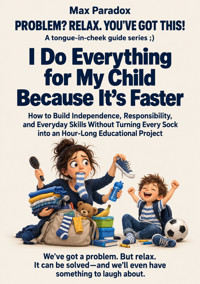
I Do Everything for My Child Because It’s Faster - How to Build Independence, Responsibility, and Everyday Skills Without Turning Every Sock into an Hour-Long Educational Project ebook
Max Paradox
29,99 zł
19,90 zł
Najniższa cena z 30 dni przed obniżką: 29,99 zł
19,90 zł
Najniższa cena z 30 dni przed obniżką: 29,99 zł
Dowiedz się więcej.
- Wydawca: ALL-IN Rafał Płonkowski
- Kategoria: Poradniki
- Język: angielski
You love your child. You want to help. You also know that if you do it yourself, the shoes get found, the bag gets packed, the mess disappears, and everyone leaves the house before the sun burns out. The problem is that small acts of rescue can quietly turn into a family system in which the parent remembers, checks, carries, finishes, fixes and organizes everything - while wondering why the child still needs so much help.
I Do Everything for My Child Because It’s Faster is a practical, funny guide to building independence without turning home into a training camp or every missing sock into a forty-minute character-building workshop. Max Paradox looks at the everyday mechanics behind dependence: taking over too quickly, giving vague instructions, reminding endlessly, rescuing harmless mistakes, rewarding every ordinary responsibility, and keeping all the planning in the adult’s head.
The book shows how to hand over responsibility in manageable pieces, define what “done” actually means, teach children to ask for useful help, create routines they can run themselves, and let safe mistakes become practice rather than emergencies. You’ll learn how to give real choices without creating endless negotiations, how to separate support from takeover, how to build self-checking into ordinary tasks, and how to design the home so independence is physically possible instead of requiring an adult to reach, open, remember, locate and approve everything.
It also deals with the harder moments: when a child suddenly “can’t” do something they did last week, when one sibling needs more support than another, when the problem is not ability but simple unwillingness, and when the parent quietly starts doing everything again because life got busy. The aim is not to produce a miniature adult who never needs anyone. It is to help a child become increasingly able to notice, start, decide, recover from mistakes and ask for specific support when needed.
This is a book for parents who are tired of being the family’s alarm clock, search engine, logistics department and emergency backup plan - but who also do not want to replace warmth with rigid rules or make childhood feel like a productivity course. The approach is practical, flexible and realistic: more ownership where the child can handle it, more support where it is genuinely needed, and fewer unnecessary rescues in between.
If you have ever said, “Give it to me, I’ll do it,” and then wondered why nobody else does anything without asking, this book is for you. Not because you need more guilt. Because you need a better handover.
This publication was prepared using tools that support the creative process, including artificial intelligence solutions. The final concept, structure and editing are the responsibility of the author.
Ebooka przeczytasz w aplikacjach Legimi lub dowolnej aplikacji obsługującej format:
Liczba stron: 206
Rok wydania: 2026
Podobne




















Max Paradox
I Do Everything for My Child Because It’s Faster
How to Build Independence, Responsibility, and Everyday Skills Without Turning Every Sock into an Hour-Long Educational Project
ALL-IN Rafał Płonkowski
2026
ISBN 9788384833681
Table of contents
Title page
INTRO
Chapter 1 - When Help Quietly Becomes Doing It for Them
Chapter 2 - The Faster Trap
Chapter 3 - “Sort It Out” Is Not an Instruction
Chapter 4 - Reminding Can Be Another Form of Doing It for Them
Chapter 5 - Stop Rescuing Problems That Are Still Small
Chapter 6 - Mess Is Part of the Training
Chapter 7 - Not Every Sock Needs a Life Lesson
Chapter 8 - Stop Buying Cooperation
Chapter 9 - Hand Over the Whole Job, Not Just the Motions
Chapter 10 - Make Independence Easier by Design
Chapter 11 - Give Real Choices, Not Decorative Ones
Chapter 12 - Teach Them to Check Their Own Work
Chapter 13 - Teach Them to Ask for Help Without Handing Over the Whole Problem
Chapter 14 - Let Them Repair Their Own Mistakes
Chapter 15 - When They Suddenly “Can’t” Anymore
Chapter 16 - Different Children Need Different Kinds of Help
Chapter 17 - When They Simply Do Not Want To
Chapter 18 - Notice When You Start Taking Everything Back
Chapter 19 - Take Independence Beyond the Safe Territory of Home
Chapter 20 - Success Is When You Are No Longer Needed for Every Little Thing
Landmarks
Cover
Title page
Table of contents
Start of content
INTRO
It is 7:18 in the morning, and your child is standing in the hallway wearing one shoe, holding the other shoe, and somehow doing absolutely nothing that could reasonably be described as putting it on. The backpack is open. The water bottle is empty. A sweatshirt has disappeared despite having existed on a chair approximately forty seconds ago. You say, "Come on, we need to go," with the hopeful optimism of someone who has apparently forgotten every previous weekday morning. Your child looks at the shoe, looks at you, adjusts one sock, notices something interesting on the floor, and enters a time zone in which thirty seconds can comfortably contain an entire documentary. So you do what experienced adults do when civilization is four minutes behind schedule: you take over. Shoe on. Bottle filled. Sweatshirt located. Backpack zipped. Missing item recovered from a place your child claims to have checked "literally everywhere." At 7:24 you are finally outside, carrying two bags, one jacket, and the invisible administrative burden of a medium-sized country. Efficient? Absolutely. Educational? Well.
Nobody decides to raise a child who cannot function without technical support. You do not look at a three-year-old and think, "My long-term goal is to be called from another city in fifteen years because this person cannot find a clean towel." You help because children genuinely need help, because you love them, because you have more experience, and because sometimes you would like to leave the house before everyone involved qualifies for a later appointment. Adults are faster at ordinary tasks for a very unfair reason: we have been practicing them for decades. We can pack a bag while answering a message, remembering a dentist appointment, locating a permission slip, and wondering why there are always three bananas until the exact moment someone wants a banana, at which point there are none. A child may need several minutes to complete what you could do before the kettle boils. When time is tight, doing it yourself is not irrational. It is often the most rational decision available in the next sixty seconds. The problem is that family life contains a lot of next sixty seconds.
That is how "I'll do it because it's faster" quietly becomes less of an emergency measure and more of a management philosophy. You carry the item because it is quicker. You remind them because forgetting would create a problem. You speak to the adult behind the counter because your child is taking too long to answer. You tidy the last part because otherwise it will not really be finished. You check the bag, find the missing object, straighten the result, complete the task, and mentally store seventeen small pieces of information that technically belong to another human being. None of these acts looks dramatic. In fact, most look like competent parenting. Yet when they happen often enough, an odd system develops: the child performs some visible actions, while the parent remains responsible for remembering, planning, noticing, deciding, checking, rescuing, and closing the loop. Everyone is busy, but one person is carrying most of the invisible work.
Then, naturally, comes the moment when you look at your child and think, "Why do I have to tell you everything?" This is one of parenting's finest pieces of accidental comedy. We can spend years providing the next instruction before it is needed and then become genuinely surprised that the recipient waits for instructions. We can find lost objects on demand, then complain that nobody knows where anything is. We can correct every imperfect attempt, then wonder why a child says, "You do it." The child does not need to be manipulative, lazy, or secretly operating a sophisticated plan to outsource household labor. People learn systems. If standing still long enough reliably causes a more experienced person to appear and solve the difficult part, that is not a bad system from the user's perspective. Frankly, many adults would subscribe.
The solution is not to swing to the opposite extreme and announce that independence begins tomorrow at 6:45 a.m. Sharp. A child who has been heavily supported does not become capable because an exhausted parent suddenly declares, "You're old enough." Nor does independence mean withholding sensible help, refusing comfort, or turning every forgotten item into a character-building wilderness expedition. Children need support. They also differ in age, temperament, development, confidence, attention, coordination, and how quickly they learn particular tasks. Some everyday difficulties are ordinary practice problems; others may require more tailored support, and persistent or significant difficulties can be worth discussing with an appropriate professional rather than simply labeling a child careless or lazy. The goal is not less care. It is better-calibrated care: enough support to make success possible, but not so much that the child never gets to own the process.
That ownership is the central idea of this book. Independence is not one giant skill called "being responsible." It is made of smaller abilities: noticing what needs doing, starting without a full ceremonial launch, figuring out the next step, remembering or using a system that helps you remember, tolerating a small mistake, asking for specific help, checking your own result, fixing what went wrong, and gradually handling situations that were once managed by an adult. A child can be perfectly capable of doing the physical part of a task while still depending on you for every decision around it. That is why simply creating a chore chart does not automatically solve the problem. A laminated chart may be beautiful. It may have stars. It may even feature color coding normally associated with airport logistics. But if you still have to say, "Check the chart," every six minutes, congratulations: you have become the chart's unpaid notification system.
There is also an uncomfortable truth on the adult side. Teaching independence usually makes life less efficient before it makes life easier. Things take longer. Results are less polished. A child uses too much of something, too little of something else, puts an object in a location no sane adult would have selected, forgets an obvious step, or completes a task in a way that technically works while offending every organizational instinct you possess. You may have to watch someone solve a problem badly when you know exactly how to solve it well. This can be surprisingly difficult. Sometimes the obstacle to a child's independence is not the child's inability at all. It is the adult's inability to tolerate four minutes of unnecessary struggle, one crooked result, or the sight of a drawer arranged according to a filing system known only to its owner.
That does not mean every mistake should be allowed or every standard lowered. Safety still matters. Hygiene still matters. Other people's needs matter. Some tasks require adult oversight, and some consequences are too serious to use as learning opportunities. Independence grows best in areas where the child can genuinely act, make manageable mistakes, and repair them without being exposed to harm. The useful question is not, "What should children of this age do alone?" as though birthdays install software updates overnight. A better question is, "What part of this can my child realistically own now, and what am I still doing mainly because it is faster, neater, or easier for me?" That question tends to produce much more useful answers - and occasionally an awkward silence.
You will not need to transform your home into a training academy where every sock becomes a competency milestone. In fact, one of the themes here will be the opposite: independence works better when it becomes ordinary. A child should not need applause, a sticker economy, a motivational speech, and a post-task reflection session to put something away. At first, some skills need teaching and structure. Then the structure should shrink. The adult should slowly move from doing, to helping, to being available, to not being involved at all. The destination is not a child who never needs you. That would be a strange ambition for a relationship. The destination is a child who knows the difference between "I need help" and "I would prefer you to do this," and who can handle more of everyday life without requiring you to act as memory, hands, scheduler, supervisor, quality inspector, and emergency response unit.
So begin smaller than your ambition. Do not redesign the entire household tonight. Notice one thing you regularly take over even though your child could probably handle more of it. Not everything. One thing. The next time it happens, resist the automatic full-service response for just long enough to see what your child can already do. Maybe you still help. Maybe you give one clue. Maybe you discover that the task takes longer than you would like and survives anyway. That small pause is where this book begins, because independence is rarely built by one grand decision. It is built in ordinary moments when the adult could step in - and sometimes chooses not to.
You may save three minutes by doing it yourself today.
The interesting question is how many years you want to keep saving those same three minutes.
Chapter 1 - When Help Quietly Becomes Doing It for Them
It is Saturday morning, and your child has decided to make toast. This is good. This is progress. This is the sort of small domestic milestone that makes a parent briefly imagine a future in which breakfast happens without adult project management. The bread goes into the toaster. Excellent. Then your child opens the refrigerator, stares into it for several seconds, and says, "Where's the butter?" You can see the butter from across the room. It is not hidden behind seventeen containers or disguised as a cucumber. It is simply sitting there, doing its best impression of butter. You point. Then the child struggles with the lid, so you open it. The knife is in the drawer, but you hand it over because you are already standing there. The toast pops up, and suddenly you are spreading the butter because "it tears the bread when I do it." Thirty seconds later, your child is eating independently prepared toast that you selected, opened, assembled, and finished. Parenting has once again achieved outsourcing in the wrong direction.
This is how over-helping usually works. It does not arrive wearing a cape labeled I SHALL PREVENT ALL INDEPENDENCE. It appears as a sequence of tiny, reasonable interventions. You know where the thing is, so you tell them. You know the easiest way, so you demonstrate. You can finish the last ten percent in twenty seconds, so you finish it. Each individual act is harmless, and sometimes genuinely useful. The problem is the pattern. If a child repeatedly begins a task and an adult repeatedly takes over at the first sign of delay, confusion, imperfection, or mild inconvenience, the child gets very little practice with the part that matters most: staying with the task after it stops being easy. They learn the visible steps, but the difficult middle section is permanently staffed by someone with more experience.
That difficult middle section is where a surprising amount of independence actually lives. It includes noticing what is wrong, trying another way, deciding whether help is really needed, tolerating a result that is not elegant, and continuing without immediate rescue. Adults do these things automatically because we have spent years practicing them, often without realizing that they are skills at all. When a drawer sticks, we change the angle. When a lid will not open, we adjust our grip. When something is missing, we look in the next likely place rather than announcing that the household has failed us. A child is still building those responses. If you solve every small obstacle before they have time to respond to it, you are not just making the task easier. You are removing the exact moment in which problem-solving would have happened.
The awkward part is that helping feels good. Not always emotionally good - sometimes you are helping through clenched teeth while thinking thoughts unfit for a family series - but good in the sense that the situation improves immediately. There was a problem. Now there is not. The parent gets relief, the child gets relief, and the household keeps moving. This creates a very efficient little loop. Child hesitates, adult acts, everyone feels better. Repeat that often enough and neither person needs to consciously choose it anymore. The child begins to pause earlier because experience says assistance is coming. The adult begins to intervene earlier because experience says the pause will eventually become a problem. Soon both people are performing their roles perfectly, while both are also frustrated with the result.
One useful way to see the pattern is to stop asking, "Am I helping too much?" That question is so broad that the answer will depend on your mood, the day, and whether you have had coffee. Ask something more concrete: "When I step in, am I helping my child continue the task, or am I removing the task?" The difference is enormous. Holding a bowl while a child pours can help them continue. Pouring for them removes that part. Showing once how to fold a fitted corner can help them continue. Refolding the entire thing after they finish removes ownership. Giving one clue about where an item might be can help them continue. Walking into the room, finding it, and handing it over turns you into a search engine with legs. Help keeps the child in contact with the challenge. Doing it for them quietly replaces them.
This does not mean every task needs to become a test. There is no parenting trophy for refusing to hold a door because "you need to learn." Sometimes helping is simply kindness. Sometimes time is short. Sometimes a child is tired, upset, ill, overloaded, or dealing with something that genuinely makes the task harder. The point is not to minimize help. The point is to make the amount of help fit the situation. A good question is: what is the smallest useful intervention that allows this child to move forward? Sometimes the answer is a sentence. Sometimes a demonstration. Sometimes doing one difficult part together. Sometimes, yes, taking over because today is not the day to turn a stuck zipper into a seminar on resilience.
The smallest useful intervention can be surprisingly small. Imagine your child is trying to assemble something simple and gets stuck. Instead of taking it, you might ask, "What part isn't working?" If they do not know, ask them to show you what they tried. You may discover that they already know most of the task and only need one piece of information. Then you give that piece and stop. This feels slower than taking over because the adult must wait, listen, and resist the temptation to solve the entire puzzle in one glorious display of competence. But it leaves the task in the child's hands, literally and mentally. The message becomes: I will help you get unstuck, but I am not automatically becoming the new owner.
Parents often worry that this approach will create constant frustration. What if the child becomes angry? What if they say, "Just do it!"? What if the task turns into an argument? These things may happen, especially if the family is used to full-service assistance. A child who has learned that "I can't" leads quickly to adult action may not celebrate when the service terms change. That does not mean you need to respond with a lecture about personal responsibility. You can keep it very ordinary. "I'll help, but I'm not doing the whole thing. Show me where you're stuck." If they are annoyed, they are allowed to be annoyed. The goal is not to make independence emotionally frictionless. The goal is to keep frustration small enough that the child can still act.
A particularly sneaky version of over-helping is correcting the result immediately. Your child completes the job, walks away, and you quietly fix everything behind them. The blanket is straightened. The books are rearranged. The clothes are refolded. The cupboard is reorganized because apparently canned goods have offended the constitution. No conflict occurs, which feels like a win. Unfortunately, the child never gets to own the outcome. If the original result was genuinely inadequate, they also never get useful feedback. If it was adequate but different from your preference, they learn nothing except that an invisible finishing department exists somewhere in the house. Either way, you stay responsible for the final standard.
A better approach is to distinguish between wrong, unsafe, incomplete, and merely not how you would do it. These are not the same category. If something is unsafe, step in. If something truly does not meet the agreed result, point out what still needs attention and let the child correct it. If it works but looks different from your preferred method, try the extremely advanced parenting technique known as leaving it alone. This can be emotionally demanding. You may walk past a drawer whose internal organization violates everything you believe about civilization. You may see towels stacked with a level of geometry normally associated with geological events. If the system works for the child and does not create problems for others, your discomfort may simply be the price of not being the only person allowed to have a system.
Another useful distinction is between teaching and maintaining. When a task is new, of course you do more. You explain, demonstrate, stay nearby, answer questions, perhaps complete part of it together. But support should shrink as competence grows. Families sometimes teach beautifully and then forget the shrinking part. The child has known how to do the task for six months, but the parent still stands beside them giving commentary because that is how it started. At some point, teaching can become surveillance with educational branding. A simple test is this: if the child can perform the task when you are not around, but suddenly seems less capable when you are present, your presence may have become part of the routine.
Try stepping back before you step in. Not dramatically. You do not need to announce, "I shall now withdraw my assistance so that you may confront adversity." Just give the child a little more time than feels natural. If they are still trying, wait. If they ask for help, ask what kind. If the task is safe and the mistake is reversible, let one imperfect attempt happen. This gives you useful information too. You may discover that the child knows far more than you thought because you had simply been arriving too early. Some parents are shocked by how competent children become the moment the household's emergency response time increases from one second to twenty.
The minimum version for a busy week is tiny: choose one recurring task you regularly finish for your child and stop finishing it. You can still help. You can explain. You can assist with one hard part. But the child gets the final action. Maybe they button the last button, pack the last item, wipe the last section, or put the equipment away. It sounds almost laughably small, but it changes the ownership of the process. The task no longer ends in the adult's hands every single time.
Plan B is for the moments when everyone is late, tired, or one inconvenience away from moving into a cabin alone. On those days, help more. Take over if necessary. Just name the exception so it does not silently become the rule. "I'm doing more today because we're really short on time. Tomorrow this goes back to you." Then actually return it. Independence is not damaged by occasional rescue. It is damaged when temporary rescue becomes permanent staffing.
The larger goal is not to count how many things your child performs without assistance. It is to notice whether your help leaves them more capable next time. Good help slowly reduces its own necessity. If the child still needs exactly the same intervention after dozens of repetitions, either the task needs to be taught differently, the support is too large, or the difficulty deserves a closer look. But if the child gradually does more while you gradually do less, the system is working even if the result still looks slower and messier than yours.
For now, do not overhaul the whole family. Pick one moment today when your hands normally move before your child has finished trying. Keep them still for a few seconds longer.
You may discover that the hardest person to stop helping is not the child.
It is you.
Chapter 2 - The Faster Trap
It is 5:37 p.m., and you need to leave the house at 5:50. Your child is supposed to get ready for an activity. At 5:38, absolutely nothing appears to be happening. At 5:40, one relevant item has been located, but it is lying on the floor as though merely finding it completed the mission. At 5:42, your child has become deeply interested in something that has no known connection to leaving the house. You do the calculation. If you let this continue, you will be late. If you take over, you can finish in three minutes. At 5:43 you become an entire operations department: bag packed, water filled, missing item found, shoes located, departure restored. By 5:49 everyone is outside. Excellent performance. The only problem is that tomorrow at 5:37 you will probably be required again.
The phrase "it's faster if I do it" is so powerful because it is often completely true. This is not one of those parenting myths that collapses when examined. Adults really are faster at tasks they have performed hundreds or thousands of times. You know where things belong, how much time they take, which steps can be combined, and what usually goes wrong. A child does not. From the perspective of one Tuesday afternoon, taking over is efficient. The trap appears only when you measure efficiency over weeks, months, and years. Saving five minutes today can easily preserve the need to spend those same five minutes again tomorrow.
Think of it as a strange subscription service. Each time you do the task because you are faster, you pay a small amount of time. The payment feels cheap, so you keep renewing. Unfortunately, the subscription has no automatic cancellation date. If the child never gets enough repetition to become competent, the parent keeps paying. Five minutes is nothing. Five minutes several times a day, across several children, multiplied by years, begins to look less like efficiency and more like a part-time job you accidentally created for yourself. No one sends an invoice because that would at least make the problem visible.