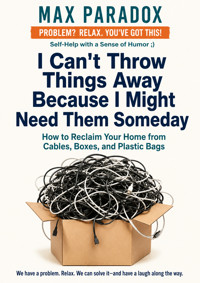
I Can't Throw Things Away Because I Might Need Them Someday - How to Reclaim Your Home from Cables, Boxes, and Plastic Bags ebook
Max Paradox
Uzyskaj dostęp do tej i ponad 240000 książek od 14,99 zł miesięcznie
- Wydawca: ALL-IN Rafał Płonkowski
- Kategoria: Biznes, rozwój, prawo•Biznes, rozwój
- Język: angielski
You know the cable.
You have no idea what it belongs to. You have not used it in years. You may not even own the device anymore.
And yet throwing it away feels reckless.
Because what if you need it someday?
I Can't Throw Things Away Because I Might Need Them Someday is a practical, funny guide for anyone whose home has slowly become a storage facility for hypothetical future needs. Boxes that are “too good to throw away.” Plastic bags multiplying under the sink. Old electronics. Duplicate kitchen tools. Broken things waiting to be repaired. Hobby supplies for hobbies you may restart. Gifts you do not want but feel guilty removing. And, of course, cables.
So many cables.
Max Paradox explains why ordinary, sensible people keep too much without turning the problem into a moral failure or recommending that you live with one plate and a single emotionally significant sock.
You will learn how to distinguish real usefulness from imaginary future usefulness, set practical limits for common clutter categories, reduce decision fatigue, handle sentimental possessions, stop organizing things you should release, and create simple exit routes for donations, sales, recycling, returns, and disposal.
You will also learn how to deal with one of the hardest parts: regret.
What if you throw something away and later need it?
It might happen.
You will survive.
This book shows you how to make rational decisions based on replacement cost, probability, space, frequency of use, and the reality of your current life-not a future emergency invented by a brain holding an unidentified adapter.
Inside, you will find practical methods including physical category limits, uncertainty boxes, replacement tests, repair deadlines, twenty-minute decluttering sessions, buying pauses, outboxes, trigger rules, and simple systems that work even when your energy level is approximately potato.
This is not a book about perfect minimalism.
It is about reclaiming a home that works.
A home where drawers close. Where you can find the scissors. Where every incoming cardboard box is not immediately offered permanent residency.
You do not need fewer possessions for philosophical reasons.
You need the right possessions in reasonable amounts, stored where they make sense, with a reliable way for unnecessary things to leave.
And yes.
You can probably throw away the cable.
This publication was prepared with the assistance of tools that support the creative process, including artificial intelligence-based solutions. The final concept, structure, and editing belong to the author.
Ebooka przeczytasz w aplikacjach Legimi na:
Liczba stron: 218
Rok wydania: 2026
Odsłuch ebooka (TTS) dostepny w abonamencie „ebooki+audiobooki bez limitu” w aplikacjach Legimi na:
Podobne


















INTRO
You are standing in front of a drawer that technically contains useful things. There are batteries, three instruction manuals, a key that definitely opens something, a charging cable from an extinct civilization, two tiny screwdrivers, a restaurant loyalty card from 2017, and a mysterious plastic clip whose purpose has been lost to history. You pick up the cable. You have not used it in six years. You no longer own the device it charged. You are reasonably sure the company that made the device no longer exists. Still, a thought appears immediately: I might need this someday.
So you put it back.
The drawer closes only after you press down with both hands.
This is how perfectly ordinary homes slowly become museums dedicated to hypothetical future emergencies. Nothing is useless because everything comes with a story about what could happen. That cardboard box? Excellent box. Very sturdy. You may need to ship something. Those twelve smaller boxes? Also potentially important, because apparently one day you will open a mail-order business without warning. The plastic bags under the sink are obviously valuable because bags are useful. There are now enough of them to survive a national bag shortage, but that is beside the point. Preparedness has been achieved.
The strange thing is that most people who struggle to throw things away are not trying to become collectors. They are trying to be sensible. Throwing away something potentially useful feels wasteful. Keeping it feels responsible. A spare cable costs nothing while it sits in a drawer, so why not keep it? A glass jar could store something. An old towel might be useful for cleaning. A nice shopping bag could carry another thing someday. And suddenly half your home is being reserved for objects that have very impressive future careers but currently contribute nothing except volume.
Your possessions have better retirement benefits than you do.
The problem is not simply that you own too much. If it were, the solution would be easy: take everything you do not need, throw it away, admire your empty shelves, and spend the evening drinking tea in a home that looks like a furniture catalog. Unfortunately, the actual problem begins about four seconds after you touch the first questionable object. Your brain stops evaluating what the thing does and starts inventing situations in which getting rid of it could become a terrible mistake.
“What if I need this adapter?”
For what?
“I don’t know yet.”
When?
“Possibly later.”
For which device?
“Let’s not get trapped in details.”
This is an extremely effective argument because the future is unlimited. Almost anything can become useful if you are allowed to invent enough circumstances. A bent spoon could theoretically help you retrieve something from behind a radiator. A shoebox could become emergency document storage. An old bedsheet could protect furniture during a renovation you have not planned. Give the brain twenty seconds and it can produce a disaster movie in which throwing away one empty cookie tin leads directly to financial ruin.
Meanwhile, the cost of keeping things feels invisible. You already own the item, so keeping it seems free. But it is not free. It takes space. It makes useful things harder to find. It creates piles that need moving, sorting, cleaning, and thinking about. It turns closets into negotiations. It makes drawers annoying. It creates the fascinating household phenomenon in which you own six versions of something but cannot find a single one when you actually need it, so you buy another.
Then you keep the packaging.
Of course you do.
There is also a powerful little fear hiding underneath all this: regret. Nobody wants to throw away a cable on Tuesday and desperately need that exact cable on Thursday. That would be unbearable. You would stand over the trash can like a tragic hero and whisper, “I knew it.” Never mind that you kept the cable for eight years without using it. Those eight years would instantly disappear from the evidence. Your brain would remember only the one dramatic moment in which the object finally became useful shortly after you removed it.
Human beings are excellent at remembering the one time keeping junk paid off and surprisingly relaxed about documenting the other 2,763 times it did not.
There is another reason clutter survives: decisions are tiring. Keeping something postpones the decision. You do not have to determine whether the object matters, whether it can be replaced, whether someone else could use it, whether it belongs somewhere, or whether you are realistically going to repair it. You can simply say, “I’ll deal with that later,” which is one of the most efficient methods ever invented for transferring problems to a future version of yourself.
Future you has received a remarkable amount of work.
Future you is expected to organize the garage, sort the photos, learn Spanish, use the fancy notebook, sell the old electronics, repair the chair, identify seventeen unidentified cables, and finally discover why there are four empty phone boxes in the closet. Present you, meanwhile, is tired and would like to watch something.
This book is not going to tell you to become a minimalist who owns one bowl, two shirts, and a morally superior houseplant. You are allowed to own things. You are allowed to keep backups. You are allowed to save objects that are genuinely useful, difficult to replace, sentimental, expensive, or connected to a realistic plan. The goal is not to create an empty home. The goal is to stop sacrificing real space to imaginary usefulness.
We are going to separate “I use this” from “this could theoretically become useful during an unusually specific Tuesday.” We will deal with duplicates, mystery objects, packaging, sentimental items, unfinished projects, cables, bags, containers, old technology, backup items, and the objects you keep because getting rid of them feels strangely irresponsible. You will learn how to make decisions faster, how to reduce regret, how to set practical limits, and how to stop turning every object into a courtroom case.
Most importantly, you will not need to clean your entire home in one heroic weekend.
Those weekends usually begin with motivational music and three empty storage bins. By Saturday afternoon, the bed is covered with everything you own, you have rediscovered a birthday card from 2009, and you are sitting on the floor reading it instead of organizing anything. By evening, most of the objects are back where they started, except now you are exhausted and one drawer no longer opens.
We can do better.
The aim is to build a system that works when you are busy, tired, sentimental, indecisive, or temporarily convinced that seven identical takeout containers represent strategic reserves. You will not have to become ruthless. You will have to become clearer. There is a difference.
And if one day you throw away a cable and later discover that you need it?
We will survive that too.
Probably for $8.99.
Chapter 1 - The Museum of Maybe
You pick up a small black cable from the back of a drawer. One end looks vaguely familiar. The other end looks like technology from a period when phones still had removable batteries and people printed directions before driving somewhere.
You do not know what it belongs to.
You have not used it recently.
You cannot identify a single device in your home that requires it.
And yet throwing it away suddenly feels reckless.
“What if I need it?”
This question has saved more useless objects than recycling programs have ever removed.
The important word is not need. It is might.
“I use this every week” is useful information. “I might use this someday” is not. Someday has no date, no plan, no location, no device, no task, and apparently no obligation to provide evidence.
Someday is where clutter gets diplomatic immunity.
This is the first mechanism you need to understand: potential usefulness is practically infinite. Almost every physical object can be useful under some imaginable circumstances. A cardboard tube could protect a poster. A chipped mug could hold pens. A takeout container could organize screws. An old T-shirt could become a cleaning rag. A cracked bucket could hold garden tools. A wooden board could become a shelf if you suddenly develop carpentry skills, buy the correct hardware, find a wall that needs a shelf, and become the sort of person who spends Saturday morning installing it.
Congratulations. The board has been acquitted.
The question “Could this ever be useful?” is therefore hopeless. If you ask it, the answer is almost always yes.
Could you need seventeen rubber bands?
Certainly.
Could civilization collapse tomorrow, leaving your household entirely dependent on its accumulated rubber-band reserves?
Less certainly.
A useful home cannot be organized around theoretical possibility. It has to be organized around probability, frequency, replacement cost, space, and actual plans.
That sounds more complicated than it is.
Instead of asking, “Could I use this someday?” ask:
“Can I name a realistic use for this in the next year?”
Not an imaginary use. Not “maybe for something.” A real use.
“I’ll use this extension cord when we put the Christmas lights up.”
Good.
“I’m keeping this box because I’m moving in three months and need boxes.”
Excellent.
“I’m keeping this adapter because my work laptop uses it when I travel.”
Perfectly reasonable.
“I’m keeping this yogurt container because containers are useful.”
The defense rests.
Notice that none of this requires you to become ruthless. The point is not to throw away anything that fails to produce a scheduled appointment. The point is to move from vague possibility to reasonable expectation.
There is a substantial difference between having a spare HDMI cable because you own several devices that use HDMI and keeping a drawer of eleven unknown cables because one of them may become important during a future archaeological emergency.
The easiest way to start is with what I call the Specific Use Test.
Pick up an uncertain object and complete this sentence:
“I am keeping this because I will probably use it for __.”
The blank must contain an actual job.
If you say, “something,” the object has failed.
If you say, “in case,” the object has not even attempted the exam.
If you need thirty seconds of creative writing to justify the thing, that is also information. Objects you genuinely use usually explain themselves rather quickly.
You do not hold your frying pan and think, “Interesting. Could this perhaps serve some purpose in my future?”
You make eggs in it.
Clutter is full of items whose usefulness requires a presentation.
There is another problem with “maybe”: it ignores quantity.
One reusable shopping bag is useful.
Five reusable shopping bags may be useful.
Thirty-seven reusable shopping bags have formed a population.
At some point, the decision is no longer whether the category is useful. The decision is how many useful objects you realistically need.
This is where people get trapped. They look at each bag individually and think, “But this is a good bag.” Correct. So are the other thirty-six. The bags are not on trial for poor moral character. You are simply deciding how much of your kitchen belongs to them.
The same applies to jars, boxes, gift bags, plastic containers, old towels, charging cables, pens, notebooks, screws, spare buttons, packing material, and the tiny Allen keys that reproduce mysteriously every time you assemble furniture.
Useful things become clutter when their quantity exceeds their realistic role.
That means your next question should be:
“How many of these do I actually need?”
Do not ask how many you can physically fit into the cupboard. Cupboards are dangerously cooperative. Given enough pressure, they will accept terrible decisions.
Suppose you regularly reuse shipping boxes. Great. Decide on a storage limit: perhaps five good boxes that nest neatly together. Once the space is full, another box can enter only if one leaves.
No debate.
No constitutional amendment because the new box has especially attractive corners.
The container creates the limit for you.
This is much easier than deciding independently about every object. Your brain does not have to conduct forty-seven tiny trials. It simply knows: this shelf is the box zone; when the shelf is full, we have enough boxes.
Physical limits are underrated because they seem almost embarrassingly simple. People often assume that solving clutter requires a profound transformation in their relationship with material possessions.
Sometimes it requires one basket.
If all spare charging cables must fit inside one basket, you now have a system. The best and most relevant cables stay. The ones for devices you no longer own lose their luxury accommodation.
A category without a limit expands because every new item can be justified individually. A category with a limit forces comparison.
This cable versus that cable.
This towel versus that towel.
This container versus the other twelve containers that already have lids, which frankly gives them a major competitive advantage.
Comparison improves decisions because “Is this useful?” is too broad, but “Is this one of the six most useful versions I own?” is far easier.
Now we need to discuss replacement, because this is where the fear of future need usually gets louder.
Imagine you have kept an unidentified adapter for seven years. You throw it away. Six months later, through a sequence of events so perfectly designed to prove your anxiety correct, you discover that you need precisely that adapter.
Annoying?
Yes.
Catastrophic?
Probably not.
You search online. A replacement costs $12.
Your home does not need to function as a free warehouse for every inexpensive object you might theoretically need again.
This idea is especially useful for items that are easy to replace: common cables, basic containers, generic tools, cheap household supplies, ordinary packaging. Keeping all of them “to save money later” can result in sacrificing hundreds of dollars’ worth of usable space to avoid a possible $12 purchase.
The economics are not strong.
Of course, replacement cost matters. You should think differently about a $300 specialty tool than a $6 adapter. You should think differently about something available at any hardware store than a proprietary component that is difficult to find.
This is why blanket rules fail.
“Throw away everything you haven’t used in a year” sounds wonderfully decisive until the item is a fire extinguisher.
We prefer thinking.
A practical decision uses four questions:
Do I have a specific, realistic use for this?
How often am I likely to need it?
How difficult or expensive would it be to replace?
Do I already own enough items that perform the same job?
These four questions solve a surprising amount of clutter without requiring you to ask whether an object “sparks joy,” apologizes for its behavior, or has completed the necessary paperwork.
You can make the process even faster with a simple three-category system: Keep, Release, and Unsure.
Keep means the item has a clear role.
Release means you know you do not need it.
Unsure means the jury has requested additional time.
The important part is that Unsure must be small. If half your home goes into Unsure, you have not made a decision system. You have created a new storage category called “Clutter, but with administrative status.”
Use one box for uncertain items. Put a date on it, perhaps three months from now. During that period, if you need something from the box, take it out and keep it. When the date arrives, anything still inside has provided actual evidence about how urgently it was needed.
This method works especially well if immediate disposal makes you anxious. You are not forcing yourself to make a permanent decision in five seconds. You are running a small experiment.
Your fear says, “You will need all of this.”
Reality gets three months to demonstrate.
Reality is usually less dramatic.
There is one important exception. Do not use an uncertainty box for sentimental objects. Sentimental items are a different decision because their job is not necessarily practical. A photograph does not have to open a jar or charge a laptop to justify its existence. We will deal with those later.
For now, begin with low-emotion categories: packaging, duplicate kitchen containers, expired manuals, cables for devices you no longer own, extra shopping bags, empty jars, and miscellaneous hardware you cannot identify.
Do not begin with your late grandfather’s watch.
That is not decluttering. That is choosing the boss level before learning the controls.
Your minimum version today is tiny: choose one category and impose one limit.
Not the whole garage.
Not the entire kitchen.
One category.
Maybe you decide that spare bags must fit inside one bag. Maybe all miscellaneous cables get one small box. Maybe shipping boxes get one shelf. Maybe food containers must fit inside one cabinet with their lids.
Then remove only the excess.
This works because you are not deciding whether bags, cables, boxes, or containers are allowed to exist. You are deciding how much space they are allowed to occupy.
That is a calmer question.
If you get stuck, use the Plan B version: remove only obvious duplicates and items connected to things you definitely no longer own. You do not have to solve your entire relationship with possessions today. You just need to stop giving permanent residency to objects whose strongest argument is “You never know.”
You rarely know.
That does not mean you need to store everything.
Your action for this chapter is simple: find one category that has been protected by the phrase “I might need it,” choose a physical limit for it, and keep only what fits comfortably.
Not what fits after compression.
Not what fits if you stand on the drawer.
Comfortably.
Your home is allowed to contain useful things.
It is not required to prepare for every possible future involving a cardboard box.
Chapter 2 - Your Brain Hates a Waste Bin
You are holding a sweater you have not worn in four years.
It does not fit particularly well. You do not like the fabric anymore. Every time you consider wearing it, another sweater wins. This one has spent most of its adult life folded beneath more successful clothing.
Then you remember what you paid for it.
$89.
Suddenly the sweater has legal representation.
Throwing it away now feels wasteful. Donating it feels like admitting you made a bad purchase. Keeping it somehow seems to preserve the money, even though the $89 left your bank account during a previous presidential administration and has shown no indication of returning.
So the sweater goes back on the shelf.
The money remains gone.
This is one reason throwing things away feels surprisingly difficult: your brain dislikes losses more than it enjoys equivalent gains. Psychologists call this loss aversion. You do not need the term to use the idea. The practical version is simple: getting rid of something often feels like losing value, even when keeping it does not actually preserve that value.
A possession can therefore continue occupying your home because removing it would make an old loss emotionally official.
The expensive shoes you never wear.
The kitchen appliance that seemed life-changing in the store.
The hobby equipment from your twelve-day enthusiasm for watercolor painting.
The stack of premium notebooks purchased during the annual belief that better stationery will reorganize your personality.
Getting rid of these items can feel like saying, “That money was wasted.”
So you keep them.
Now the money is wasted and you have storage problems.
Efficient.
This is closely related to the sunk-cost problem. Money, time, or effort you already spent cannot be recovered by continuing to store something you do not use. The past cost is real, but it should not control the current decision.
Imagine you paid $200 for a bread maker and used it twice. Keeping it for another seven years does not gradually convert the purchase into a good decision. The bread maker does not accrue moral value while sitting behind the blender.
You are not earning the money back through cupboard occupancy.
The useful question is not, “What did this cost me?”
It is:
“If I did not already own this, would I acquire it today?”
That question is brutal in a productive way.
If you saw the sweater in a store today for $5, would you buy it?
If a neighbor offered you the bread maker for free, would you carry it into your kitchen and give it cabinet space?
If someone placed those seventeen old magazines on your front porch and said, “These are yours now,” would you be delighted?
If the answer is no, ownership may be doing most of the work.
This is known as the endowment effect: we often value things more simply because they are ours. Again, you do not need to memorize the label. You need to notice the trick.
A mug in a thrift store: “No thanks.”
The identical mug in your cupboard: “But I’ve had that for years.”
Yes.
That is exactly the problem.
Possessions collect invisible arguments. Where you got them. What they cost. What you intended to do with them. Who gave them to you. What version of yourself bought them. What future version of yourself was supposed to use them.
Eventually you are not evaluating the object.
You are evaluating a small biography.
This is why decluttering can become emotionally exhausting even when the item appears trivial. The plastic container is not always just a plastic container. Maybe it came with an expensive meal. Maybe it is unusually sturdy. Maybe your mother always reused containers. Maybe throwing it away feels environmentally irresponsible. Maybe you remember the exact moment you thought, “This would be useful.”
And now you are conducting a forty-minute ethical summit about a tub that once contained noodles.
The solution is not to suppress all emotion. The solution is to identify which emotion is making the decision.
Start by separating four different reasons for keeping something:
“I use it.”
“I genuinely value it.”
“It would be hard to replace.”
“I feel bad getting rid of it.”
The first three can be excellent reasons.
The fourth requires investigation.
Feeling bad does not automatically mean keeping the object is correct. Sometimes it means the object is connected to guilt, money, identity, waste, or an unfinished intention.
Consider a set of expensive exercise bands you bought during a burst of motivation. They have spent two years in a closet.
You may think you are keeping exercise equipment.
You may actually be keeping a promise.
“One day I’m going to become the kind of person who uses these.”
This is where clutter becomes sneaky. Objects can represent imagined identities: the baker, the cyclist, the crafter, the reader of serious literature, the person who hosts elaborate dinners, the person who repairs furniture instead of buying new furniture.
There is nothing wrong with aspirations.
The problem begins when physical objects are asked to maintain those aspirations indefinitely.
Owning a calligraphy set does not make you someone who practices calligraphy.
It makes you someone who owns a calligraphy set.
The distinction is financially devastating to hobby stores.
When an item represents an abandoned or paused version of you, ask:
“Do I want the activity, or do I want the idea of being a person who does the activity?”
That question has ended many relationships with dusty equipment.
If you genuinely want to restart the hobby, give it a concrete test. Do not keep everything indefinitely because Future You might return.
Schedule one session this month.
Use the equipment.
If you enjoy it, wonderful. The item has a role.
If you spend the scheduled hour watching videos about the hobby while the actual equipment remains untouched, we have obtained additional data.
Your brain may object: “But I could sell it.”
Excellent.
Sell it.
This sentence is important because “I could sell it” is one of the most elegant long-term storage strategies ever created.
People have spare rooms filled with objects worth $20 because each object is theoretically destined for an online marketplace. The objects wait for photographs. Then descriptions. Then listings. Then messages from a man named Tyler asking whether you will accept $4 and drive forty minutes to deliver it.
Eventually, you begin to feel that donating the item would mean losing money.
But an item you never list is not inventory.
It is decor with paperwork ambitions.
Set a selling threshold. For example: if an item will realistically sell for at least $50, you will list it. Below that, donate it unless selling is extremely easy.
Choose whatever threshold makes sense for your finances. The number is less important than the rule.
Then add a deadline.
If you decide to sell something, list it within seven days.
If you do not list it, donate it.
If it does not sell within thirty days, lower the price once or donate it.
Otherwise “to sell” becomes another permanent category, usually located in the hallway.
You can apply the same thinking to donations. People sometimes keep bags of unwanted items for months because they intend to donate them responsibly.
The intention is admirable.
The bag is still in your bedroom.
Donation requires the object to leave the house.
Put the donation bag near the exit or directly in the car. Give yourself a deadline. The goal is not to create a beautifully curated transition center for objects that have already been fired.
Now let us deal with gifts, because gifts have special emotional armor.
Someone gives you a vase.
You appreciate the gesture.
You do not like the vase.
The vase now lives with you for eleven years.
This arrangement benefits nobody, including the vase.
A gift has already completed its primary job when it communicates affection, gratitude, celebration, or generosity. You do not owe every gifted object lifetime accommodation.
Keeping something you dislike does not make you more grateful.
It makes you a person with a vase you dislike.
You can appreciate the person and release the object. Those are separate decisions.
If the giver is likely to ask about it next Tuesday, use common sense. Human relationships matter more than aggressive decluttering philosophy. But most people are not conducting annual audits of every object they have ever given you.
Your aunt is probably not lying awake wondering whether the decorative bowl remains operational.
And if she is, we have discovered a different problem.