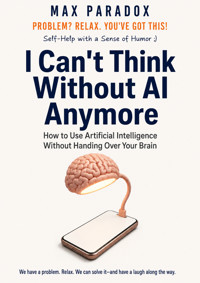
I Can't Think Without AI Anymore - How to Use Artificial Intelligence Without Handing Over Your Brain ebook
Max Paradox
Uzyskaj dostęp do tej i ponad 240000 książek od 14,99 zł miesięcznie
- Wydawca: ALL-IN Rafał Płonkowski
- Kategoria: Literatura popularnonaukowa•Nauki ścisłe
- Język: angielski
You open AI to help with one email.
Then another.
Then a decision.
Then a summary.
Then a birthday message.
Then dinner.
Soon you are staring at two perfectly ordinary options wondering whether you should ask a chatbot which one you prefer.
Artificial intelligence can save enormous amounts of time. It can improve writing, organize information, generate ideas, challenge assumptions, explain difficult concepts, and remove tedious work from your day.
The problem begins when it also becomes the place where every thought starts.
I Can't Think Without AI Anymore: How to Use Artificial Intelligence Without Handing Over Your Brain is a practical, funny guide to using AI without gradually outsourcing the abilities you still want to keep.
Max Paradox shows how to separate useful assistance from unnecessary cognitive replacement. You will learn when AI should do the work, when your brain should go first, and how to build a workflow in which artificial intelligence expands your capability instead of quietly becoming your capability.
Inside, you will learn how to:
recognize when AI use has become automatic rather than intentional;
use a simple “think first, AI second, decide last” method;
stop asking AI for constant reassurance;
use AI as a critic, examiner, opponent, and sparring partner;
make better decisions without asking the machine to choose your priorities;
learn with AI without skipping the learning itself;
avoid producing polished work you cannot actually explain;
use summaries without reducing every complex idea to five bullets;
protect creativity, judgment, confidence, and your own voice;
design AI-heavy workflows that still contain meaningful human decisions;
recognize warning signs when convenience starts becoming dependence;
reset your habits without deleting everything and moving into a cabin.
This is not an anti-AI book.
Quite the opposite.
It is about getting more value from an extraordinary tool by giving it the right job.
You do not need to manually perform every boring task to prove you still possess a brain. Formatting a table by hand is not a spiritual practice. But you also do not need to ask artificial intelligence what you think before you have had the inconvenience of thinking it.
Expect practical methods, everyday examples, dry humor, useful boundaries, Plan B options for tired days, and no speeches about waking up at 4:30 a.m. to reclaim your cognitive sovereignty.
The goal is simple:
Use AI aggressively where it removes useless effort.
Use it intelligently where it can strengthen your thinking.
And keep the final vote on the decisions that still belong to you.
This publication was prepared with the assistance of tools that support the creative process, including artificial intelligence-based solutions. The final concept, structure, and editing belong to the author.
Ebooka przeczytasz w aplikacjach Legimi na:
Liczba stron: 210
Rok wydania: 2026
Odsłuch ebooka (TTS) dostepny w abonamencie „ebooki+audiobooki bez limitu” w aplikacjach Legimi na:
Podobne



















INTRO
You open a blank document because you need to write an email. Nothing dramatic. Six sentences, maybe seven if you are feeling unusually literary. You type, “Hi Mark,” stare at the screen for three seconds, and suddenly your brain produces a deeply concerning suggestion: Maybe ask AI to write this.
So you do.
The AI gives you a polished email. It is clear, friendly, professional, and somehow sounds like you have recently completed an executive communication course at a hotel conference center. You change two words, delete “I hope this message finds you well” because nobody has ever been genuinely found well by that sentence, and send it.
Excellent. Four minutes saved.
Twenty minutes later, you need to decide whether to move a meeting from Tuesday to Thursday.
You ask AI.
Then you need a quick dinner idea.
AI.
A birthday message for your brother.
AI.
A response to a slightly annoying text.
AI.
A list of things to pack for a three-day trip.
AI.
At some point you are standing in the kitchen holding two different jars of pasta sauce and seriously considering asking artificial intelligence which one you should open.
This is the moment we may need to discuss boundaries.
Artificial intelligence is extraordinarily useful. That is not the problem. A calculator is useful too, but most of us can still estimate whether three pizzas will feed four people without opening Excel and creating a forecasting model. GPS is useful, yet it is mildly alarming when you have lived in the same neighborhood for six years and no longer know how to reach the pharmacy without a calm electronic voice saying, “Turn right in 200 feet.”
Tools are supposed to remove unnecessary effort.
They become a problem when they start removing necessary effort too.
That distinction matters because thinking is not one single activity. Some thinking is tedious administrative gravel: rewriting the same paragraph, organizing notes, formatting information, generating ten variations of a headline, checking whether your explanation makes sense. If AI carries some of that gravel, wonderful. Give it a tiny reflective vest and let it get to work.
But other thinking is the actual job.
Deciding what you believe. Noticing what matters. Forming an argument. Choosing between imperfect options. Remembering what you know before checking. Struggling with a problem long enough for your brain to understand it. Producing a first idea that did not arrive preassembled from somewhere else.
That work can feel slower, messier, and less impressive than prompting a machine and receiving six neat bullet points in four seconds.
Unfortunately, that mess is where your brain lives.
The danger is not that AI will suddenly leap out of your laptop, confiscate your frontal lobe, and leave a receipt. The danger is much less cinematic. You simply become accustomed to outsourcing tiny acts of thought because outsourcing them feels efficient. Each individual decision looks harmless. Why spend ten minutes thinking when the answer can appear instantly?
So you stop spending ten minutes thinking.
Then five.
Then two.
Eventually, the uncomfortable feeling of not immediately knowing what to say starts to seem like a technical malfunction.
You sit down to write something without AI and the blank page suddenly feels more blank than it used to. You know you have thoughts. Presumably. They were around here somewhere. But instead of reaching for them, you reach for the tool that has become your intellectual automatic transmission.
“Give me ideas.”
“Improve this.”
“What do you think?”
“Summarize this.”
“Tell me what I should do.”
None of these prompts is inherently bad. Some are excellent. The problem begins when AI stops being the assistant you consult and quietly becomes the first place your mind goes before your own mind has even entered the building.
This can happen surprisingly fast because AI removes something humans dislike very much: cognitive friction.
Cognitive friction is that mildly irritating resistance you feel when you have to think through something yourself. It is the pause before the sentence comes. The failed attempt. The half-formed idea. The moment when you cannot remember the word, so your brain wanders through seventeen incorrect ones before finally finding it behind “spatula” for some reason.
That friction feels inefficient.
But some of it is training.
Imagine going to the gym and discovering a machine that lifts every weight for you while displaying encouraging messages about your productivity. You could finish the workout in seven minutes. You would barely sweat. You might even have time for a smoothie.
Your muscles would also have a few questions.
The brain works differently from a bicep, obviously, and we should be suspicious of anyone who explains neuroscience entirely through gym metaphors. Still, the principle is useful: abilities you repeatedly practice tend to stay more available than abilities you repeatedly avoid using.
If every difficult sentence gets generated for you, writing from scratch may start feeling harder. If every decision receives an instant external recommendation, uncertainty becomes less tolerable. If every complicated article is reduced to five bullets, sustained reading starts to feel like someone accidentally published the extended director’s cut of information.
And yet the solution is not to delete every AI tool, move to a cabin, buy a fountain pen, and announce that technology has gone too far.
I would last approximately eleven minutes.
AI is too useful to reject just to prove that your brain remains independently owned. It can save time, expose blind spots, help you learn, challenge your reasoning, organize chaos, improve communication, and handle tasks that deserve exactly as much human creativity as adjusting column widths in a spreadsheet.
The goal is not to use AI less because suffering builds character.
The goal is to use it better.
You want AI doing the mental work that does not need to be yours while protecting the mental work that absolutely does.
That means learning when to think first and prompt second. When to ask for critique instead of answers. When to use AI as a sparring partner rather than a substitute player. When to deliberately tolerate a few minutes of confusion instead of treating confusion like an emergency requiring immediate chatbot intervention.
You will also need a way to notice when convenience has quietly become dependence.
One useful warning sign is simple: you hesitate to begin without AI.
Not because AI would genuinely improve the task. Not because the task is complicated. You hesitate because beginning alone now feels strangely uncomfortable.
Another sign is that you ask AI what you think.
There is a difference between “Help me examine this decision” and “Tell me which decision to make.” One keeps you in the driver’s seat. The other puts you in the passenger seat and then asks the passenger seat whether it has any opinions.
This book is about keeping the useful parts of artificial intelligence without gradually turning your own thinking into an optional feature.
You are not going to receive a heroic digital detox plan. There will be no ceremonial deleting of apps. You will not be instructed to handwrite three pages every sunrise while facing east.
We are aiming for something much less dramatic and therefore much more likely to survive Tuesday.
You will learn how to separate helpful outsourcing from harmful outsourcing, preserve your ability to generate ideas, make decisions without requiring instant validation, use AI to strengthen reasoning rather than replace it, and rebuild confidence in your own first draft—even when that first draft looks like it was written during turbulence.
Most importantly, you will not need to choose between being “pro-AI” and “anti-AI.”
That argument is already exhausting, and we have barely started.
You can use a powerful tool enthusiastically while still refusing to hand it every thought that requires more than twelve seconds of effort. You can let AI help with the map without letting it choose the destination.
Because the goal is not to prove you can think without artificial intelligence.
The goal is to make sure you still do.
Kontynuuję dokładnie według zatwierdzonej architektury: Chapter 1 + Chapter 2, bez wychodzenia poza ten zakres.
Wklejony tekst
Chapter 1 - When Did My Brain Become the Backup System?
You sit down to answer a question you definitely know the answer to.
Someone asks, “What do you think we should do?”
Nothing unusual. You have experience. You know the situation. You have opinions. Several of them, unfortunately.
But instead of answering, your hand moves toward the keyboard.
“Let me check something.”
What you mean is:
Let me ask AI what I think before I risk discovering what I actually think.
This is how dependence usually arrives. Not with a dramatic announcement. Not with a robot voice saying, “Your independent cognition subscription has expired.” It arrives quietly, disguised as convenience.
At first, you use AI for obvious tasks. Rewrite this email. Summarize this report. Give me five dinner ideas that do not involve me eating crackers over the sink. Sensible. Efficient. Civilization continues.
Then the boundary moves.
You ask for ideas before generating your own.
You ask for recommendations before deciding what matters to you.
You ask for interpretations before forming one.
You ask whether your message sounds reasonable before reading it once yourself.
Eventually, AI stops being something you use after thinking and becomes something you use instead of beginning.
That is the shift we need to notice.
The Real Problem Is Not Usage
Using AI frequently does not automatically mean you have a problem.
You may use it fifty times a day because your work genuinely benefits from it. A programmer, researcher, marketer, analyst, writer, manager, designer, student, or small-business owner can reasonably interact with AI throughout the day without becoming intellectually helpless.
Frequency is not the best measure.
Sequence is.
What happens first?
Do you encounter a problem, think about it, and then use AI to accelerate, challenge, organize, or improve your thinking?
Or do you encounter a problem and immediately open AI before your brain has been given the opportunity to produce even one mediocre thought?
That second pattern matters.
Your first thought does not need to be brilliant. It can be embarrassing. Human thought often arrives wearing sweatpants.
The point is simply that it arrives.
If you always skip your own first attempt, you stop practicing the part of thinking that happens before external help appears.
And that part is important because it contains more than “getting the right answer.” It contains recall, judgment, interpretation, preference, uncertainty, creativity, and the ability to remain mentally present when the solution does not immediately materialize.
AI makes instant assistance so available that normal mental hesitation can start to feel unacceptable.
You stare at a problem for eight seconds.
Nothing.
Nine seconds.
Still nothing.
By second twelve, apparently the brain has failed quality control and external consultants must be brought in.
The First-Thought Test
Here is a simple test.
The next time you are about to ask AI something that is not purely factual or mechanical, pause and ask:
Have I produced my own first thought yet?
Not a finished answer.
Not a polished argument.
Not a strategic masterpiece suitable for framing in the lobby.
Just a first thought.
Suppose you need to prepare for a difficult conversation with an employee. Instead of immediately typing:
“Give me a script for discussing poor performance,”
spend two minutes answering three questions yourself:
What exactly is the problem?
What outcome do I want?
What am I afraid might happen?
Then use AI.
Now the tool has something valuable to work with: your reality.
Without that first step, you may receive an excellent generic script for a conversation that exists nowhere except inside the statistical imagination of a language model.
Professional.
Balanced.
Completely wrong for Kevin.
Kevin will know.
Kevin always knows.
The same rule works for writing. Before asking AI to draft something, write three ugly sentences yourself. Before asking for ideas, list three obvious ones. Before asking what to choose, define your criteria.
Your first contribution creates direction.
Otherwise, you are not really using AI to support your thinking. You are asking it to establish the thinking environment and then renting a desk inside it.
Why This Feels So Good
Outsourcing thought works because it provides immediate relief.
Uncertainty is uncomfortable.
Blank pages are uncomfortable.
Decisions are uncomfortable.
Trying to explain something when you are not yet sure how to explain it is especially uncomfortable because your brain would prefer to already be competent.
AI removes that discomfort very quickly.
You ask.
It answers.
Suddenly there is structure.
Your shoulders relax.
The task looks manageable.
This is not laziness in the cartoon sense. You are not lying on a velvet couch demanding that technology peel grapes for you. You are responding to a system that offers cognitive relief at almost zero effort.
Humans enjoy relief.
This is why “I’ll just check quickly” is one of the most powerful phrases in modern life.
You will quickly check the weather.
Then email.
Then one message.
Then whether that actor is actually British.
Then somehow it is Thursday.
AI provides the same psychological reward in a more sophisticated form: confusion goes in, organized language comes out.
The danger is not the organized language.
The danger is teaching yourself that confusion must be eliminated immediately.
Because sometimes confusion is the work.
The Five-Minute Discomfort Problem
Imagine you are trying to understand a complicated issue at work.
There are several competing priorities. Nobody has complete information. Two people disagree, and both have good arguments. You feel uncertain.
Old approach: you sit with the problem, sketch possibilities, think about tradeoffs, maybe talk it through with someone, revise your opinion, then decide.
New approach: “Analyze this situation and recommend the best option.”
The answer arrives in seconds.
Perhaps it is useful.
Perhaps it is excellent.
But notice what disappeared.
You did not have to identify the tradeoffs yourself.
You did not have to decide what information mattered.
You did not have to feel the tension between two imperfect choices.
You got a recommendation before building the internal reasoning that allows you to evaluate the recommendation.
Now you have a strange situation: you possess an answer, but you do not fully possess the path to it.
That can create borrowed confidence.
Borrowed confidence sounds impressive until someone asks:
“Why?”
Then the internal office lights flicker.
You vaguely remember something about scalability.
AI Should Arrive Second More Often
Not always.
If you need a conversion, definition, summary of a long document, formatting help, or ten variations of a phrase, there may be no heroic intellectual benefit in staring at the wall first.
You do not need to independently rediscover Celsius.
But for tasks involving judgment, creation, interpretation, or decisions, AI often works better when it arrives second.
Try this sequence:
1. Think. 2. Capture. 3. Ask. 4. Compare. 5. Decide.
Think: give yourself a short period without assistance.
Capture: write down what you currently believe, even if incomplete.
Ask: use AI to generate alternatives, critique your reasoning, identify gaps, or improve the result.
Compare: notice where it agrees, disagrees, or introduces something useful.
Decide: you make the final call.
This adds perhaps two to ten minutes, depending on the task.
That may feel inefficient compared with instant prompting.
It is also the difference between using a tool and quietly outsourcing authorship of your judgment.
The Blank-Page Panic
Writing reveals this problem particularly well.
A blank page has always been slightly hostile. It sits there with the emotional warmth of an airport security tray.
But before generative AI, you usually had to put something on it.
Maybe you wrote:
“This report is about the main problems related to…”
Awful.
Fine.
Now there was a sentence.
You could improve it.
Today, you can skip that awkward phase entirely. You can request an introduction and immediately receive something smoother than your first attempt would probably have been.
That feels like progress.
Sometimes it is.
But first drafts do something important: they expose what you actually know.
When you try to explain something and cannot, you discover a gap. When your argument becomes confused, you discover weak reasoning. When you repeatedly avoid one part of the topic, you discover that you may not understand it as well as you thought.
A generated draft can hide those gaps by creating linguistic fluency before you have earned conceptual clarity.
It sounds complete.
Therefore it feels complete.
That is dangerous because polished language has excellent manners. It can escort mediocre thinking into the room wearing a very nice jacket.
Use the Ugly Draft Rule
For important writing, create an ugly first version before asking AI to improve it.
The rule is deliberately modest.
You do not need to draft the whole document.
Write:
the main point;
the three most important supporting ideas;
what you want the reader to do or understand.
That is enough.
Then ask AI to organize, challenge, rewrite, shorten, expand, or improve.
This keeps the intellectual skeleton yours.
AI can help with the tailoring.
It does not need to decide where your bones go.
Suppose you need to write a proposal. Your ugly draft might be:
“Current process causes delays because approval happens too late. I want approval moved earlier. Main benefits: fewer last-minute changes, better forecasting, clearer ownership. Concern: teams may see this as more bureaucracy.”
That is not elegant.
It is extremely useful.
Now you can ask AI:
“Turn this into a concise proposal. Challenge my logic first and identify missing objections.”
Much better than:
“Write a proposal to improve our process.”
One prompt starts from your thinking.
The other starts from fog.
The Difference Between Assistance and Substitution
A useful way to judge AI use is to ask what role the system is playing.
Is it your:
editor?
critic?
organizer?
research assistant?
brainstorming partner?
simulator?
teacher?
Or is it the person in the group project who quietly did the entire assignment while you adjusted the title font?
Assistance strengthens your output.
Substitution removes the need for you to generate the underlying material.
Again, substitution is not always bad. If the task is low-value, repetitive, or administrative, substitute away.
Nobody receives a medal for manually rewriting the same product description forty times.
But if the task develops or depends on a capability you want to keep, be careful.
If you want to remain good at writing, sometimes write.
If you want to remain good at deciding, sometimes decide before asking.
If you want to remain good at explaining, try explaining before requesting an explanation.
Revolutionary stuff.
Soon we may recommend walking occasionally even though cars exist.
A Practical Boundary
Use this rule:
Outsource effort more freely than judgment.
Let AI remove formatting, repetition, administrative friction, and unnecessary drafting labor.
Be more protective of:
what you believe;
what matters;
what you choose;
what you notice;
what you create before seeing alternatives;
how you interpret uncertain situations.
Those are not simply tasks.
They are parts of your mental operating system.
You do not need to guard them like state secrets. You just should not automatically hand over administrator access.
Try This Today
Choose one task you would normally begin with AI.
Do the first five minutes alone.
Write down your own ideas, answer, decision criteria, draft, or interpretation.
Then open AI and use it aggressively.
Ask it to criticize you.
Ask what you missed.
Ask for alternatives.
Ask it to make the result clearer.
Notice the difference.
You may discover that AI becomes more useful when your brain participates in the meeting.
Which, in fairness, should not be a shocking requirement.
Takeaway: Do not measure AI dependence by how often you use it. Measure how often you let it think first.
Your brain does not need to win every race.
It should still occasionally leave the starting line.
Chapter 2 - Convenience Is Training You Too
You have a question during dinner.
Someone says something about a movie.
You are almost certain the actor was in another film. The name is somewhere in your memory. You can feel it hovering just out of reach.
Ten years ago, you might have stared at the ceiling.
“Wait. Don’t tell me.”
You would mentally scroll through faces, titles, scenes, and possibly three completely unrelated actors.
Then suddenly:
“Yes! That guy!”
Tiny victory.
Today, someone reaches for a phone before the sentence is finished.
Mystery solved.
Actor identified.
Memory search canceled due to lack of commercial viability.
We do this constantly because instant answers are wonderful. Why sit with uncertainty when information is available in three seconds?
AI takes that convenience much further.
It does not merely retrieve facts.
It interprets them.
Summarizes them.
Explains them.
Rewrites them.
Compares them.
Suggests what to do next.
This creates a new problem: convenience is not neutral.
Whatever process you repeatedly use becomes the process you become accustomed to.
Every Shortcut Teaches You Something
When people talk about technology, they often focus on what the tool does.
Less attention goes to what repeated use teaches the user.
GPS teaches you that you do not need to build a mental map if navigation is always available.
Autocorrect teaches you that spelling can be approximate because a small machine elf will probably fix it.
Streaming teaches you that waiting seven days for the next episode was apparently a human rights violation.
AI teaches habits too.
If you ask for summaries constantly, you become used to compressed information.
If you ask for answers immediately, you become used to minimal uncertainty.
If you ask for polished drafts, you become used to skipping messy beginnings.
If you ask for recommendations on every decision, you become used to externalized judgment.
None of this proves your mind is deteriorating.
It means your environment is shaping your defaults.
Defaults matter because most behavior happens there.
You do not wake up every morning and conduct a philosophical review of whether you should use autocomplete. You type. It appears. You accept.
Convenience becomes invisible.
Then one day you try working without it and discover your brain has developed strong opinions about labor conditions.
Friction Is Not Always the Enemy
Modern productivity culture has spent years telling us to remove friction.
Make everything easier.
Automate.
Simplify.
Reduce clicks.
Build systems.
Create templates.
Excellent advice, especially if your current workflow resembles a municipal office designed by raccoons.
But not all friction is waste.
Some friction is where learning happens.
Consider reading.
You are halfway through a difficult article. One paragraph is dense. You do not quite understand it.
Option A: reread it slowly, connect it to what came before, maybe look up one unfamiliar term, and work out what the author means.
Option B: paste it into AI and ask:
“Explain this simply.”
Option B may be excellent.
But if you always choose B immediately, you practice less interpretation.
The problem is not asking for help.
The problem is asking before you have made any attempt to understand.
You want useful friction, not pointless suffering.
Nobody needs to prove intellectual independence by reading tax regulations unaided in a dark room.
The question is: Which difficulty is building a capability I care about?
That is the difficulty worth keeping sometimes.
Productive Friction Versus Stupid Friction
We need a distinction because otherwise this book will accidentally become a campaign for making life unnecessarily difficult.
Productive friction forces you to use a skill.
Examples:
Trying to recall something before searching.
Drafting your own explanation before asking for help.
Comparing two options before requesting a recommendation.
Reading the original argument before asking for a summary.
Attempting a problem before requesting the solution.
Stupid friction is simply inefficient.
Examples:
Formatting thirty rows manually.
Rewriting the same sentence for six audiences.
Sorting a pile of notes into categories.
Creating meeting minutes from a transcript.
Turning a messy list into a table.
Please outsource stupid friction.
Life is short.
Cells need borders.
The Two-Minute Rule for Thinking
Before asking AI for help with something you want your brain to remain good at, spend two minutes attempting it yourself.
Two minutes.
Not forty-five.
We are not restoring a Victorian education system.
The purpose is to prevent immediate outsourcing from becoming automatic.
Suppose you are reading about a complicated topic and want AI to explain it.
First, spend two minutes writing:
“I think this means…”
Then ask AI:
“Here is my interpretation. Where am I wrong or incomplete?”
Now AI becomes feedback rather than replacement.
This difference is enormous.
In the first version, your brain waits.
In the second, your brain attempts, predicts, and then receives correction.
That is much closer to learning.
Retrieval Matters
One reason instant assistance can weaken your sense of mental independence is that remembering something yourself requires retrieval.
Retrieval means pulling information out of memory rather than merely recognizing it when shown.
This is harder.
It is also useful.
You have experienced the difference.
Someone asks:
“What was the name of that restaurant?”
You cannot remember.
Then they say:
“Was it Harbor House?”
“Yes! Exactly!”
You recognized the answer.
You did not retrieve it.
Recognition feels like knowing, but retrieval is the stronger test.
AI can flood you with recognition.
You read an answer and think:
“Right. Of course. I knew that.”
Perhaps.
Your brain is extremely generous when awarding itself retroactive credit.
Try this after reading an AI explanation: close it and explain the idea in your own words without looking.
Suddenly the board meeting becomes less celebratory.