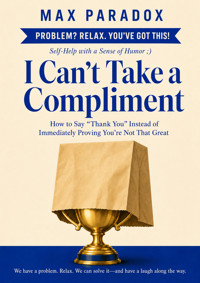
I Can't Take a Compliment - How to Say “Thank You” Instead of Immediately Proving You're Not That Great ebook
Max Paradox
Uzyskaj dostęp do tej i ponad 240000 książek od 14,99 zł miesięcznie
- Wydawca: ALL-IN Rafał Płonkowski
- Kategoria: Biznes, rozwój, prawo•Biznes, rozwój
- Język: angielski
Someone says, “You did a great job.”
You say, “Thanks, but honestly…”
And there it is.
Within seconds, you have explained why the achievement was mostly luck, why someone else deserves the credit, what you did wrong, and why the person complimenting you may need their standards professionally examined.
If accepting praise feels more uncomfortable than criticism, I Can't Take a Compliment is a practical, funny guide to understanding why-and changing what happens next.
Max Paradox takes apart the strange little habits that make compliments so difficult: minimizing achievements, arguing with praise, hiding behind self-deprecating humor, moving the goalposts, giving all the credit away, worrying that “thank you” sounds arrogant, and treating every kind sentence like an invoice that must be repaid.
This is not a book about becoming obsessed with yourself. You will not be instructed to stare into a mirror and announce that you are an unstoppable force of excellence before breakfast.
Instead, you will learn how to receive praise like a normal human being.
Inside, you’ll discover how to:
say thank you without immediately adding a disclaimer;
tell the difference between humility and self-erasure;
accept praise even when you do not fully believe it;
share credit without deleting your own contribution;
handle compliments about your appearance, work, abilities, and character;
stop treating praise as pressure or obligation;
recognize backhanded compliments and manipulation;
use positive feedback as useful evidence rather than emotional life support;
name your strengths without sounding like your own publicist;
recover when the old habit returns.
The book also shows why compliments sometimes feel threatening even when you want them. Praise can clash with an old self-image, trigger perfectionism, create fear of future expectations, or make you feel unexpectedly visible. Instead of trying to force instant confidence, you’ll learn small responses that work even when your brain is still unconvinced.
The central method is deliberately simple: pause, receive, and stop correcting.
Because a compliment does not require a courtroom.
You can be competent and still make mistakes. Attractive and still dislike some photos. Confident and still feel nervous. Proud of something and still know how to improve it.
The goal is not blind positivity.
It is accuracy.
And occasionally allowing someone to say something nice without making them defend it for the next seven minutes.
This publication was prepared with the assistance of tools that support the creative process, including artificial intelligence-based solutions. The final concept, structure, and editing belong to the author.
Ebooka przeczytasz w aplikacjach Legimi na:
Liczba stron: 197
Rok wydania: 2026
Odsłuch ebooka (TTS) dostepny w abonamencie „ebooki+audiobooki bez limitu” w aplikacjach Legimi na:
Podobne




















INTRO
Someone compliments you at work.
“That presentation was really good.”
A normal response would be, “Thank you.” Two words. Efficient. Elegant.
Your response, however, is apparently being handled by a legal team.
“Oh, no, it really wasn’t that good. I rushed the ending, most of the numbers came from finance, Sarah helped with the deck, and I almost forgot slide fourteen.”
The other person stands there, holding what used to be a compliment and is now evidence in a trial nobody knew had begun.
They try again. “Well, I thought you did a great job.”
You nod thoughtfully, as if they have made an interesting but factually weak argument.
“Yes, but you should’ve seen the first version.”
Congratulations. You have successfully defeated praise.
This book is for people who can accept a package from a delivery driver, a receipt from a cashier, and an unsolicited software update, but become strangely unable to receive one pleasant sentence about themselves. Someone says you look great, and instead of taking the win, you launch an investigation. Maybe the lighting is good. Maybe the outfit is doing most of the work. Maybe they are just being nice. Maybe they need something. Maybe the compliment has hidden fees.
A compliment arrives as a gift. You treat it like suspicious luggage at the airport.
This can happen so fast that you barely notice it. “I love your jacket.” “Oh, this? It was on sale.” “You’re really good with clients.” “I’ve just been doing it a long time.” At some point, you may begin to wonder whether your job is to correct other people’s positive opinions of you.
You are providing customer support for your own reputation.
Rejecting compliments often feels reasonable. You may think you are being humble, honest, grounded, or pleasantly free of ego. You do not want to look arrogant. You do not want to hear “Nice haircut” and respond, “Yes. I know. The public has spoken.” So you overcorrect. You do not simply avoid bragging; you actively dismantle the compliment before it can become dangerous.
This is where the problem becomes more interesting than “learn to say thank you.”
Because if it were just a vocabulary problem, we could finish the book here.
Thank you.
The end.
Unfortunately, your mouth is not the main issue. The main issue is what happens in the half second before your mouth opens. A compliment lands, and your brain checks it against an internal file containing every mistake you have made since middle school. The compliment says, “You’re talented.” The file says, “Remember that email where you wrote ‘pubic’ instead of ‘public’?” Case dismissed.
Compliments can create a conflict between how someone else sees you and how you currently see yourself. If their view is more positive, your brain may try to restore order. That is why you explain away the praise, reduce your contribution, point out a flaw, give credit to five other people, or change the subject to something safer, such as weather, taxes, or the structural integrity of the nearest wall.
Sometimes it is simply a learned habit. Maybe praise was rare in your family. Maybe compliments were followed by pressure: “Great grade. Why not an A?” Maybe you were taught that accepting praise makes you full of yourself. Maybe you got used to keeping expectations low. Maybe you became so good at self-deprecating humor that now a compliment cannot cross the border without paperwork.
Whatever the origin, the habit can become expensive.
Not financially. Amazon does not currently charge a fee for rejecting praise.
But socially and emotionally, the cost is real. When someone compliments you and you immediately argue, you make the interaction awkward. You also train yourself to discount positive evidence. One negative comment gets archived in 4K. Ten positive comments are stored in a folder called “Probably Just Being Polite.”
That system is not balanced. It is pessimism with excellent filing.
There is another cost: people may eventually stop offering praise. Not because they no longer appreciate you, but because complimenting you becomes work. They say something kind, and suddenly they have to defend it. “No, seriously, you were great.” “No, really, I meant it.” What began as “Nice job” now requires witness statements and a closing argument.
And then you may notice people praise you less and think, See? I knew I wasn’t that good.
Your brain has created the weather and then complained about the forecast.
The goal of this book is not to turn you into a person who accepts every compliment like an award speech is about to begin. You do not need to clutch your chest when someone says they like your shoes. You do not need to whisper, “At last, recognition.” You do not need to believe every compliment is an objective measurement reviewed by experts.
You only need to stop fighting every positive statement as if accuracy itself depends on your objection.
A compliment is not a contract. Accepting it does not mean you agree that you are flawless, brilliant, beautiful at all times, or legally required to maintain this standard forever. Saying “thank you” means only this: I heard the kind thing you said, and I am allowing it to exist without crushing it under a list of disclaimers.
That sounds small.
For some people, it feels bizarrely large.
You may worry that accepting praise will make you arrogant. We will deal with that. You may feel fake saying thank you when you disagree. We will deal with that too. You may automatically joke, minimize, redirect, explain, or hand the credit to someone else before you even realize what happened. We will work with the reflex instead of pretending you can remove it by reading one inspirational sentence in a tasteful serif font.
We will also deal with harder situations: compliments about appearance, work, talent, relationships, and the things you care about enough to feel exposed when someone notices them. Sometimes praise is uncomfortable precisely because it makes you visible, which wakes up every internal department responsible for risk management.
The good news is that you do not need a new personality. You do not need to become louder, more confident, more extroverted, or the sort of person who describes themselves as “a force of nature” on LinkedIn. You need a few better responses, a more accurate understanding of what compliments mean, and practice tolerating the mild discomfort of not correcting someone who sees something good in you.
Yes, tolerating kindness can be a skill.
Human beings are fascinating.
By the end of this book, the goal is simple: when someone says, “You did a great job,” you will not need to produce Exhibit A, three caveats, and the name of the colleague who fixed the spreadsheet. You will know when to accept praise, when to share credit, when to question a compliment, how to handle praise that makes you uncomfortable, and how to stop turning every kind sentence into a debate about whether you deserve it.
You will still be allowed to be modest.
You will just stop using modesty as a small emotional fire extinguisher every time someone says something nice.
Chapter 1 - Why “Thank You” Feels Suspicious
You walk into the office wearing a new shirt.
A coworker looks up and says, “That color looks great on you.”
There is a brief opportunity here. A small, peaceful opening in the universe where you could simply say, “Thank you.”
Instead, you hear yourself reply, “Really? I wasn’t sure about it. It was cheap, and I think it makes my shoulders look weird.”
Your coworker now has several options. They can defend the shirt. They can defend your shoulders. They can slowly return to their computer and pretend this exchange never happened.
You have turned a compliment into technical support.
Most people who struggle with compliments are not consciously deciding to reject them. There is no morning ritual where you stand in front of the mirror and say, “Today, if anyone says anything positive about me, I will neutralize it immediately.”
The reaction is usually automatic.
Someone praises you, and something inside you tightens. You may feel embarrassed, exposed, doubtful, suspicious, or strangely obligated. Your brain gets a tiny message saying:
POSITIVE INFORMATION DETECTED.
And instead of filing it under “Nice,” it starts checking for errors.
Maybe they do not really mean it.
Maybe they are exaggerating.
Maybe they are trying to make you feel better.
Maybe they have low standards.
Maybe they did not see the parts you messed up.
Maybe accepting the compliment would make you look arrogant.
Maybe now you have to keep performing at this level forever.
That last one is particularly efficient. A person says, “Great job today,” and your brain hears, “Excellent. This performance standard is now legally binding until retirement.”
No wonder “thank you” feels dangerous.
The compliment is not the problem
A compliment is usually a simple social event. One person notices something positive and says it out loud.
“That was a smart idea.”
“You look really good.”
“You handled that well.”
“You’re funny.”
“Dinner was amazing.”
The difficulty comes from what you add after the sentence.
If your internal response is, That was kind, the compliment passes through fairly easily.
If your internal response is, But is it objectively true under laboratory conditions?, things become more complicated.
You start treating praise as a factual claim that must survive peer review.
Imagine doing this with other pleasant interactions.
“Beautiful day.”
“Well, technically humidity is at sixty-eight percent, and there are clouds west of downtown.”
“This coffee is good.”
“Compared with what? We need a control group.”
“I like your apartment.”
“You clearly haven’t seen the cabinet under the sink.”
Nobody asked for the complete evidence file.
Compliments are rarely claims of perfection. When someone says your presentation was excellent, they are usually not saying every word, slide, gesture, and transition represented the highest achievement in the history of public speaking. They are saying they liked it. They thought you did well. They appreciated something.
You can accept that without signing a declaration that you are flawless.
Why your brain argues
One common reason compliments feel uncomfortable is that they clash with your existing self-image.
Suppose you think of yourself as awkward in social situations. Then someone says, “You’re really good with people.”
That statement does not slide neatly into place. It bumps into years of evidence you have collected in the opposite direction: the party where you forgot someone’s name, the joke that landed with the energy of a dropped sandwich, the conversation you replayed for three days because you said “you too” when the waiter said “enjoy your meal.”
Your brain has a story about who you are.
And brains enjoy consistency.
If new information fits the story, it is easy to accept. If you already believe you are organized and someone says, “You’re so organized,” you may feel fine.
If you believe you are disorganized and someone says the same thing, your brain may immediately produce seventeen exhibits labeled COUNTEREVIDENCE.
This does not mean the compliment is wrong.
It means your self-image may be outdated, incomplete, or much harsher than the image other people have of you.
You are not an unbiased observer of yourself.
You are the person who remembers the embarrassing thing from 2009.
That affects the data.
The humility trap
Another major reason people reject compliments is that they confuse acceptance with arrogance.
They imagine two possible responses:
Option A: “No, no, it wasn’t really anything. I got lucky.”
Option B: “Yes. I am exceptional. Please continue.”
Fortunately, civilization has developed a third option.
“Thank you.”
Accepting praise is not bragging. Bragging is when you generate the praise yourself.
“I absolutely crushed that meeting. Frankly, I was magnificent.”
That is different.
If someone else says, “You crushed that meeting,” and you answer, “Thanks, I appreciate that,” you have not become unbearable. You have completed a normal human interaction.
Humility does not require pretending you have no strengths.
Real humility is being able to see yourself accurately. Sometimes accurately means admitting you made a mistake. Sometimes it means admitting you did something well.
If you can only accept negative information about yourself, that is not humility.
That is a very selective accounting system.
The hidden fear of expectations
Sometimes the discomfort is not about arrogance at all. It is about pressure.
Imagine your boss says, “You handled that client brilliantly.”
A compliment, yes.
But your brain may immediately add:
Great. Now I am “the person who handles difficult clients brilliantly.”
What happens next time?
What if I mess it up?
What if they expect this every time?
What if praise is just the opening ceremony for more responsibility?
Suddenly the compliment feels less like a gift and more like someone handing you a heavier backpack.
This happens especially when you connect praise with performance standards. You do something well once and worry that you have accidentally created a permanent expectation.
But a compliment describes a moment.
It does not create a lifetime warranty.
“You did that well” means you did that well.
It does not mean:
YOU HAVE NOW ENTERED A BINDING AGREEMENT TO NEVER HAVE A BAD DAY AGAIN.
Your future mistakes do not cancel today’s success, just as today’s success does not guarantee perfection tomorrow.
Normal people are allowed to perform inconsistently.
This is excellent news for the entire species.
Suspicion: what do they want?
Some people distrust praise because compliments have not always been harmless in their experience.
Maybe someone has used flattery before asking for a favor.
“You’re so good with computers. By the way, my laptop is doing something weird.”
Aha.
There it is.
Or perhaps praise in your environment was rarely given without conditions. Someone said something nice and then followed it with criticism, pressure, or a request.
“You did great. Now imagine what you could do if you actually applied yourself.”
That sentence deserves its own small museum.
If praise has often arrived with strings attached, your brain may naturally search for the string.
That is understandable.
But the useful skill is not rejecting every compliment. It is separating the compliment from whatever comes next.
“You’re amazing at spreadsheets.”
“Thanks.”
“Could you fix mine?”
“No.”
Look at that.
Praise accepted. Boundary intact. Economy functioning.
You are allowed to receive the compliment without purchasing the optional add-on.
Your first job: notice the escape route
Before changing your response, start by noticing how you usually escape compliments.
Most people have a favorite method.
You might:
minimize: “It was nothing.”
disagree: “No, it wasn’t that good.”
explain it away: “I just got lucky.”
insult the thing being praised: “This old shirt?”
redirect instantly: “No, you’re the talented one.”
give away all the credit: “Honestly, I barely did anything.”
make a joke at your own expense: “Apparently miracles happen.”
interrogate the compliment: “Really? You actually think so?”
warn the person not to get excited: “You should see me on a bad day.”
None of these makes you a terrible person. They are protective habits.
But they all have the same effect: they prevent the compliment from landing.
For the next few days, do not try to fix everything. Just catch the pattern.
When someone says something positive, notice the first sentence your brain wants to produce.
That sentence matters.
Maybe yours is:
“It wasn’t really me.”
“Anyone could’ve done it.”
“They’re just being nice.”
“I don’t deserve that.”
“It’s not as good as they think.”
“I need to explain the flaw.”
Do not argue with the thought yet.
Just notice it.
You cannot change an automatic response very efficiently while pretending it is not automatic.
The two-second experiment
Here is your first practical exercise.
The next time you receive a compliment, pause for roughly two seconds before responding.
Not ten seconds.
Ten seconds will make the other person wonder whether you have lost your connection to the server.
Two seconds is enough.
During that pause, do one thing: stop yourself from correcting the compliment.
Then use the simplest possible response:
“Thank you.”
That is all.
You do not have to fully believe the compliment.
You do not have to feel comfortable.
You do not have to transform your self-esteem before lunch.
Your only task is behavioral: do not reject the positive statement.
This may feel strangely unnatural at first. You may say “thank you” and immediately experience the urge to add:
“…but honestly—”
Stop there.
The “but” is often the trapdoor.
“Thank you, but…”
“Thanks, although…”
“That’s kind of you, but…”
Everything before “but” is acceptance. Everything after it is the demolition crew arriving.
Try ending the sentence before construction begins.
If “thank you” feels too intense
For some people, a bare “thank you” feels almost theatrical.
They say it and think, Wow. Look at me accepting praise like a celebrity at an awards ceremony.
If that is you, use a slightly softer version:
“Thanks, that’s kind of you.”
“Thank you, I appreciate that.”
“Thanks, I’m glad you liked it.”
“That means a lot. Thank you.”
These responses work because they do not require you to agree with every possible implication of the compliment. You are acknowledging the person’s kindness or perspective.
Someone says, “You’re an amazing cook.”
Maybe you do not believe you are amazing.
Fine.
“Thanks, I’m glad you liked dinner.”
You have accepted the compliment without filing a false statement with the authorities.
Your action for today
For now, forget confidence. Forget self-esteem. Forget whether the compliment is perfectly accurate.
Practice one skill:
Receive without correcting.
That is the first step.
The next compliment you get, give yourself two seconds and choose one sentence:
“Thank you.”
“Thanks, I appreciate that.”
“Thanks, I’m glad you liked it.”
Then stop.
No disclaimer.
No evidence against yourself.
No surprise witness.
The compliment does not need a defense attorney.
It just needs somewhere to land.
Chapter 2 - You Are Not Required to Disprove the Witness
A friend tastes the cake you made and says, “This is incredible.”
You could enjoy this.
Instead, you immediately point toward the kitchen.
“The middle sank a little. And I used store-bought frosting.”
Your friend takes another bite.
“I don’t care. It’s delicious.”
“Yes, but I baked it five minutes too long.”
At this point, you are no longer discussing cake.
You are trying to prevent an inaccurate historical record.
Some people reject compliments because praise makes them uncomfortable. Others go further: they feel responsible for correcting it.
If someone thinks too highly of them, they experience an urgent need to restore accuracy.
“You’re so creative.”
“Well, not really.”
“You’re great at your job.”
“You don’t see how much I mess up.”
“You look fantastic.”
“Trust me, this is just a good angle.”
It is as if the compliment has created a dangerous inflation problem and you have been appointed chair of the Federal Reserve of Self-Esteem.
Rates must come down immediately.
The accuracy excuse
This habit often hides behind a respectable idea:
I’m just being honest.
Honesty is good.
But notice what kind of honesty you are practicing.
Someone compliments a meal, and you tell them what went wrong.
Someone praises your work, and you list the help you received.
Someone likes your outfit, and you explain why it is not impressive.
Someone admires how calm you were during a stressful situation, and you reveal that internally you were one minor inconvenience away from moving into the woods.
All of these statements may be true.
They are also unnecessary.
Truth does not require total disclosure.
If someone says, “Beautiful house,” you are not morally obligated to show them the cracked tile behind the washing machine.
There is no honesty police unit arriving later.
Accepting a compliment does not mean withholding essential evidence. It means understanding that a positive statement can be true even when other, less flattering facts also exist.
The cake can be delicious and slightly overbaked.
You can give a great presentation and feel nervous.
You can be attractive and have slept badly.
You can be competent and still make mistakes.
Two facts can exist at once.
This is apparently shocking news to the part of the brain that believes every compliment must survive cross-examination.
Stop confusing imperfection with fraud
A major problem here is all-or-nothing thinking.
If someone says, “You’re great at this,” you may compare the compliment not with reality, but with perfection.
You remember every time you struggled.
Every mistake.
Every awkward moment.
Every shortcut.
Every piece of help.
Then you conclude:
If they knew everything, they would not say that.
But why are you assuming they believe “great” means “never struggles, never needs help, never makes errors, operates at full capacity under all weather conditions”?
That is not how people evaluate each other.
Think about someone you consider good at their job.
Have they ever made a mistake?
Almost certainly.
Do you therefore conclude they are secretly incompetent and the entire organization has been deceived?
Probably not.
You allow other people complexity.
You may not be extending the same courtesy to yourself.
You can be good at something without being perfect at it.
You can be generous without giving every dollar you own to charity.
You can be funny without every joke landing.
You can be organized and still have one drawer that should legally be declared an independent landfill.
Strengths do not disappear because exceptions exist.
Credit is not a limited resource
Another common way to reject praise is immediate credit redistribution.
“Great report.”
“Honestly, Jamie did most of the analysis.”
“That was a brilliant event.”
“The team did everything.”
“You handled that situation really well.”
“I just followed the process.”
Sharing credit is often good. In teams, it is important.
But there is a difference between sharing credit and evacuating the building.
Suppose five people contributed to a project and you led it well.
Someone says, “You did a great job.”
You respond, “Thank you. The team was fantastic too.”
Perfect.
You accepted your part and acknowledged theirs.
Now compare:
“You did a great job.”
“No, it was really the team. I barely did anything.”
If that is not true, you are not being humble. You are deleting yourself from the story.
You do not need to choose between becoming an egomaniac and pretending you wandered into the project accidentally while looking for the restroom.
Shared success is still success.
The reverse test
Here is a useful way to expose how strange your standards may be.
Imagine giving someone else the same compliment.
You tell a friend, “You look great today.”
They reply, “No, I don’t. My skin looks terrible and this shirt is hiding everything.”
How does that feel?
Probably not like a successful exchange.
You tell a coworker, “That was an excellent presentation.”
They answer, “Actually, the conclusion was weak, and I forgot two points.”
Do you think:
What integrity. At last, someone willing to challenge my dangerously positive opinion.
Probably not.
You think:
Okay. I was just trying to be nice.
This is important because compliment rejection does not happen in private. It changes the social moment.
When someone offers praise, they are often doing something generous. They are noticing effort, skill, appearance, character, or contribution.
If you instantly reject the compliment, you are not only making a statement about yourself.
You are also telling them their perception is wrong.
Sometimes repeatedly.
“No, seriously, you did great.”
“No, I didn’t.”
“I really thought you did.”
“Well, you didn’t see the mistakes.”
Now both of you are somehow losing.
An impressive outcome for a conversation that began positively.
You do not have to agree completely
One reason people argue is that they think accepting praise means endorsing the exact wording.
Someone says, “You are the most patient person I know.”
You think:
Incorrect. Tuesday. Parking garage. Level three.