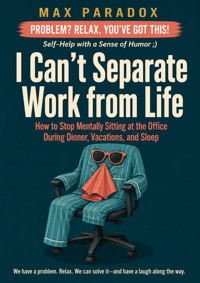
I Can't Separate Work from Life - How to Stop Mentally Sitting at the Office During Dinner, Vacations, and Sleep ebook
Max Paradox
Uzyskaj dostęp do tej i ponad 240000 książek od 14,99 zł miesięcznie
- Wydawca: ALL-IN Rafał Płonkowski
- Kategoria: Biznes, rozwój, prawo•Biznes, rozwój
- Język: angielski
You closed the laptop hours ago.
So why are you still at work?
Maybe you’re eating dinner while mentally rewriting an email. Maybe your vacation includes “just one quick check” that somehow turns the hotel balcony into a satellite office. Maybe you lie down to sleep and your brain immediately schedules an emergency meeting about tomorrow’s meeting.
If your body leaves work but your mind keeps clocking overtime, this book is for you.
I Can't Separate Work from Life is a practical, funny guide to ending the workday without carrying your inbox, deadlines, unfinished tasks, difficult conversations, and imaginary professional disasters into every other part of your life.
Max Paradox skips the usual advice about “finding balance,” changing your mindset, and creating a seventeen-step evening ritual involving meditation, herbal tea, and a notebook expensive enough to require insurance. Instead, he focuses on what actually keeps work active in your head-and what you can do about it.
You’ll learn how to create a shutdown routine your brain can trust, handle unfinished work without mentally completing it during dinner, stop responding to every work thought as if it were an instruction, and distinguish genuine urgency from anxiety wearing business casual.
You’ll also discover how to:
define after-hours availability without becoming unreliable;
stop using evenings as backup office space;
reduce compulsive checking and reassurance-seeking;
protect focused work during the day so important tasks do not follow you home;
clarify ownership instead of adopting every problem you touch;
leave legitimate problems safely unfinished until morning;
recover quickly when deadlines, crises, or travel break your boundaries;
take a real vacation instead of working from a location with better weather;
notice boundary drift before work quietly moves back into every room;
build enough life outside work that stopping does not feel like entering empty space.
This is not a book about caring less about your job.
It is about caring in a way that has edges.
You can be ambitious, reliable, responsible, helpful, and good at what you do without being psychologically available twenty-four hours a day. You can occasionally work late without turning every evening into reserve capacity. You can think about work after work without automatically reopening it.
Most importantly, you can learn to end the day while some work is still unfinished.
Because some work will always be unfinished.
That is why tomorrow exists.
This publication was prepared with the assistance of tools that support the creative process, including artificial intelligence-based solutions. The final concept, structure, and editing belong to the author.
Ebooka przeczytasz w aplikacjach Legimi na:
Liczba stron: 175
Rok wydania: 2026
Odsłuch ebooka (TTS) dostepny w abonamencie „ebooki+audiobooki bez limitu” w aplikacjach Legimi na:
Podobne




















INTRO
You are having dinner with someone you like. The food is good, the conversation is normal, and for approximately forty-seven seconds you are technically present. Then your brain remembers an email.
Not even an important email. Just one of those vague work emails containing the phrase “circle back tomorrow,” which should mean absolutely nothing at 7:43 p.m. Yet suddenly you are no longer eating pasta. Physically, yes. Mentally, you have returned to the office, opened Outlook, reconstructed the entire conversation, imagined three possible replies, and started preparing for a meeting that has not happened yet.
Someone across the table asks, “Are you listening?”
“Of course.”
You have no idea what they said.
Your body has left work. Your brain has filed an appeal.
This is the strange problem of not being able to separate work from life. You close the laptop, leave the building, drive home, change clothes, make dinner, sit on the couch, and perhaps even announce with confidence that you are “done for the day.” Your nervous system hears this statement and responds, “That is adorable.”
Because work is no longer necessarily a place you go. It is a collection of unfinished conversations, possible problems, awkward meetings, unanswered messages, future deadlines, imagined disasters, and one sentence your boss said at 3:18 p.m. that you are still analyzing at midnight.
“Interesting approach.”
What did that mean?
Interesting good?
Interesting bad?
Interesting “we admire your courage”?
Interesting “security will collect your badge tomorrow”?
By 12:26 a.m., you have produced a six-part documentary about two words.
Then you wake up tired and wonder why resting does not seem to work.
The obvious explanation is that you work too much. Sometimes that is true. If you are regularly working fourteen-hour days, answering messages at midnight, and checking spreadsheets while brushing your teeth, the problem is not a mysterious failure of mindfulness. You are still working. Calling it “just quickly checking something” does not change the fact that your toothbrush now has a project-management role.
But many people have a second problem: even when the work stops, the mental work continues.
You are on vacation, but part of you is wondering what is happening without you. You are watching a movie, but one corner of your brain is drafting tomorrow’s presentation. You are trying to sleep, and suddenly your mind remembers that you forgot to send someone a document three days ago.
Excellent timing.
Your brain had all afternoon.
It waited until the lights were off.
This is not because you secretly love work more than your family, hobbies, sleep, vacations, or basic peace. It is usually because the brain dislikes unfinished business, uncertainty, social tension, possible mistakes, and situations it thinks might become dangerous later. Unfortunately, modern work is basically a subscription service delivering all five.
There is always something incomplete.
An email you could answer.
A decision you could improve.
A conversation you could replay.
A presentation you could polish.
A task you could start early.
A mistake you could theoretically prevent if you think about it for another ninety minutes while staring into the refrigerator.
Work is extremely good at creating open loops. Your brain is extremely bad at politely leaving them at the office.
And technology has made the border even more ridiculous. Once upon a time, leaving work required physically leaving a building. Now the entire company can live in a rectangle in your pocket. Email is there. Teams is there. Slack is there. The calendar is there. Your boss is there, spiritually if not literally.
You can be standing waist-deep in the ocean and still receive: “Quick question.”
There are few phrases in professional life less quick than “Quick question.”
You know this, so you check.
Then you reply.
Then someone replies to your reply.
Now you are conducting a small business meeting in swimwear.
The problem is not merely that work can reach you. The deeper problem is that after enough repetition, you begin reaching for work yourself. Nobody told you to check your inbox at 9:30 p.m. You simply felt the little internal tug: What if something happened?
Usually, nothing happened.
But because checking briefly reduces uncertainty, your brain learns a very unhelpful lesson: anxiety appears, check work, anxiety decreases.
Congratulations. You have accidentally trained yourself.
Soon, the smallest moment of quiet becomes an invitation to scan for professional danger. Waiting for coffee? Check email. Commercial break? Check messages. In bed? Review tomorrow. Sunday afternoon? Begin pre-suffering Monday.
Monday has not even done anything yet.
It is still several hours away, minding its own business.
This book is not going to tell you to “simply switch off.” If you could simply switch off, you would not be here. You would be somewhere peacefully chopping vegetables, completely unaware that a coworker has written “Just following up” for the third time.
Nor will I suggest building an elaborate evening ritual involving incense, seventeen journal prompts, a digital detox box made from sustainable bamboo, and a declaration to the moon that you are releasing your professional identity.
You have enough tasks.
You do not need homework for recovering from work.
The goal is much more practical: teach your brain where work ends.
That sounds obvious until you notice how rarely we actually do it. Most people finish work by stopping. They do not close anything mentally. They simply reach a point where they cannot tolerate another spreadsheet and walk away.
The laptop shuts.
The loops stay open.
So the first message from your brain arrives during dinner:
Excuse me, we were not finished.
Over the course of this book, we are going to fix that without pretending you can become a completely different person with no responsibilities, no deadlines, and a mysterious passive income from a beach.
You will learn how to create a real end to the workday instead of merely relocating it into your skull. You will learn how to deal with unfinished tasks so your brain does not keep presenting them as breaking news. We will separate genuine responsibility from compulsive availability, because these two things have been dating for years and everyone is tired of pretending the relationship is healthy.
We will also deal with the situations that make separation hardest: difficult bosses, demanding jobs, remote work, guilt about not responding, performance pressure, Sunday anxiety, vacations, deadlines, mistakes, and the wonderfully modern experience of receiving a work notification while technically sitting on the toilet.
There will be no fantasy solution in which you never think about work outside work again. That is not realistic, and trying to achieve it would give you another thing to fail at.
The goal is not zero work thoughts.
The goal is that a work thought does not automatically become a work session.
That distinction matters.
You may remember something at dinner. Fine. You need a way to capture it without mentally moving back into the office.
You may worry about tomorrow. Fine. You need a way to decide whether the worry requires action or is simply your brain rehearsing a fire drill in a building that is not on fire.
You may occasionally need to work late. Fine. You need to stop one exceptional evening from quietly becoming the operating system of your entire life.
Most importantly, you need methods that still work when you are tired.
Because the version of you who creates ambitious boundaries on Sunday morning is not necessarily the same person who receives an email at 8:52 p.m. saying, “Do you have five minutes?”
Future You has excellent boundaries.
Present You is already typing.
So we will build something more reliable than motivation: clear rules, shutdown habits, friction, decision points, small scripts, minimum versions, and backup plans for the days when everything goes sideways.
Nothing dramatic.
Nothing mystical.
Nothing requiring you to move to a cabin.
Just a better answer to one question:
When work ends, what tells your brain that it is allowed to end too?
Because dinner should occasionally contain dinner.
Vacations should contain at least some vacation.
And sleep should not be an unpaid overnight meeting with people who are not even there.
Po komendzie continue przejdę dokładnie do Chapter 1 i Chapter 2.
Chapter 1 - You Left the Office. Your Brain Didn’t.
You close the laptop at 5:37 p.m. Not 5:30, because one last thing appeared at 5:26 and apparently the laws of physics allow every urgent request to materialize four minutes before the end of the day. You finish it, send the message, close the program, and push your chair back.
Done.
Except you are not done.
While washing your hands, you remember the meeting from this morning. While putting on your shoes, you replay something you said in that meeting. Halfway home, you decide you should probably have said it differently. By the time you reach the kitchen, the meeting has acquired alternate endings, deleted scenes, and director’s commentary.
You are no longer attending the meeting.
The meeting is attending you.
This is where the problem becomes confusing, because nothing visible is happening. You are not typing. You are not on a call. Nobody is paying you. Yet your brain is still processing work as if the building followed you home and parked itself behind the couch.
This is not unusual. The brain is not a light switch. It does not spend eight or nine hours managing decisions, deadlines, social tension, unfinished tasks, and possible problems, then calmly announce, “Excellent shift. I will now think about soup.”
It carries momentum.
If your workday contains unresolved issues, emotional friction, uncertainty, or tasks that still matter tomorrow, your mind keeps them active because unfinished things feel important. Sometimes they are important. The problem begins when your brain treats “important tomorrow” as “must be mentally processed every twelve minutes tonight.”
That is not preparation.
That is unpaid overtime performed entirely inside your forehead.
The first useful distinction is between actual work and mental residue.
Actual work is obvious. You are answering an email, writing a report, talking to a client, fixing a problem, or sitting in a meeting whose stated purpose is unclear but whose calendar invitation was apparently unavoidable.
Mental residue is what stays after the task ends.
You remember the task.
You simulate tomorrow.
You replay a mistake.
You imagine someone’s reaction.
You mentally rehearse an argument.
You wonder whether you forgot something.
You check whether you forgot something.
You discover that you did not forget anything.
Twenty minutes later, you check again because perhaps forgetting has become more efficient.
This residue is often more exhausting than people realize because it prevents real psychological recovery. Your body may be off duty while your attention remains in a low-level state of work readiness.
You are not working hard.
You are failing to stop working softly.
That difference matters because soft work is easy to dismiss. You tell yourself you are relaxing because Netflix is on. Technically, yes. But if you have watched the same scene three times because your brain is preparing a response to an email nobody has sent yet, the television is not really winning.
One reason this happens is that modern work produces almost no natural endings.
A factory shift used to end because the shift ended. A shop closed. A machine stopped. A door locked. There was a physical signal.
Knowledge work is different. The document could always be improved. The inbox could always be cleaner. The presentation could always be polished. You could always prepare more. You could always read one more message, solve one more issue, or make tomorrow slightly less terrifying.
There is no obvious finish line.
So many people stop based on fatigue rather than completion.
They do not think, “The day is complete.”
They think, “I can no longer look at this.”
These are not the same thing.
When you stop from exhaustion, your brain often receives no closure. It knows there are open items, but it has no trustworthy record of what happens next. So it keeps those items mentally available.
Imagine giving an assistant ten tasks and then, at 5:30, turning off the office lights without saying which tasks are done, which are waiting, and which should happen tomorrow.
The assistant would probably keep asking questions.
Your brain is that assistant.
Except less polite.
It will ask at 10:48 p.m.
“Did we send that file?”
At 1:12 a.m.:
“What if the client misunderstood?”
At 4:03 a.m.:
“Do you remember that minor mistake from 2019?”
Thank you, brain.
Very relevant.
The solution begins by stopping the habit of treating every returning work thought as proof that work still requires your attention.
A thought is not an instruction.
This sounds almost insultingly simple, but it changes the entire problem. Many people have accidentally trained themselves to respond to work thoughts with work behavior.
Thought: I should remember to update that slide.
Response: Open laptop.
Thought: I wonder whether they replied.
Response: Check phone.
Thought: Tomorrow might be difficult.
Response: Mentally rehearse tomorrow for forty minutes.
Each response teaches the brain that generating a work thought is useful because it produces action.
So the first skill is not “stop thinking about work.”
The first skill is “stop obeying every thought about work.”
When a work thought appears after hours, classify it.
There are only three useful categories:
action needed now;
action needed later;
no action needed.
“Action needed now” should be rare. This means there is a real consequence if you do nothing until your next work period. A system is down. Someone is genuinely waiting for you. You are on call. A deadline is tonight, not tomorrow morning.
“Action needed later” is far more common. You remembered something useful, but it can wait. Capture it somewhere reliable and return to your evening.
“No action needed” includes most replaying, predicting, second-guessing, imagined conversations, and professional fan fiction generated by anxiety.
You do not need a forty-seven-step productivity system for this. Use one trusted place: notes app, task list, paper notebook, whatever you will actually check.
For example:
“Ask Jenna about revised figures.”
Done.
Not:
“Ask Jenna about revised figures. Also maybe explain why the old figures were wrong. What if Jenna thinks I caused it? She seemed quiet today. Was she quiet because of me? She also did not react to my message. Possibly she is busy. Or possibly this department is collapsing.”
The note should contain the task.
Not the entire psychological miniseries.
Once you capture the task, your job is to refuse further processing.
You can say to yourself, in plain language: “This is recorded. I will deal with it tomorrow.”
Not because positive thinking has magical power.
Because you have created an external commitment that your brain can trust.
If the same thought returns five minutes later, do not reopen the case.
“Already recorded.”
That is enough.
Your mind may object.
“But perhaps we should think about it a little more.”
No.
The office is closed.
Mental reception is also closed.
This will feel unnatural at first, especially if you are conscientious. Responsible people often confuse repetitive thinking with responsibility. They believe that if something matters, they should keep mentally touching it.
But touching a problem twenty times does not mean you are handling it well.
It may simply mean you have sticky fingers.
Another source of mental residue is emotional work. Tasks are easier to leave behind than tension. If someone criticized you, ignored you, embarrassed you, interrupted you, or sent a message with a period that somehow felt aggressive, your brain may continue processing the social meaning for hours.
“Okay.”
Was that normal okay?
Cold okay?
Angry okay?
Career-ending okay?
There are only two practical questions here.
First: Is there something useful you can do about this?
Second: If yes, when?
If the answer is “I should clarify it tomorrow,” write that down.
If the answer is “No, I am simply guessing what someone thinks,” stop upgrading your guess into evidence.
This is especially important with bosses. A manager can say, “Let’s revisit this tomorrow,” and your brain will sometimes translate it into:
“Prepare for exile.”
Do not let tone analysis become a second shift.
If you genuinely need clarification, get clarification.
If you do not, leave uncertainty unresolved until there is actual information.
This is uncomfortable.
It is also a major part of separating work from life.
Because work follows you home not only through tasks.
It follows through uncertainty.
The more uncertainty you try to solve with imagination, the longer the workday becomes.
And imagination is terrible at invoicing.
It produces endless hours and no useful deliverables.
A simple practice for tonight is to notice your first three work thoughts after you finish.
Do not judge them.
Do not try to eliminate them.
Just classify them:
Now.
Later.
Nothing.
If “later,” capture the task.
If “nothing,” let it remain nothing.
That is the beginning.
You are not trying to become someone who never thinks about work.
You are becoming someone who does not automatically turn every work thought into attendance.
Takeaway: after work, treat work thoughts as items to classify, not commands to follow.
Tonight, capture one legitimate future task and refuse to mentally complete it in advance.
Tomorrow can have tomorrow.
It already owns enough.
Chapter 2 - Your Brain Hates an Open Tab
You are brushing your teeth when it happens.
You suddenly remember a task.
Not a crisis. Not a fire. Not even a particularly interesting task. Something like: “Update the project summary before Thursday.”
Thursday is two days away.
Your toothbrush is currently more urgent.
Yet your brain reacts as if a courier has arrived at the bathroom door carrying an envelope marked IMMEDIATE PROFESSIONAL CONSEQUENCES.
Now you are thinking about the summary.
Then the numbers inside the summary.
Then whether someone will question the numbers.
Then what you will say if they do.
You spit out the toothpaste and reach for your phone.
Another peaceful evening successfully prevented.
This happens because unfinished tasks occupy mental space disproportionately. An incomplete item is not just something you have not done. It is also something your brain may feel responsible for remembering.
That distinction explains a lot.
The brain often keeps unfinished work active not because the work itself is urgent, but because it does not trust the system around it.
If your task management strategy is basically “I will remember,” your mind has to keep reminding you.
Repeatedly.
Aggressively.
At terrible times.
This is why people sometimes experience an almost physical sense of relief after writing something down. The task has not been completed. Nothing in the external world has changed. But the responsibility for remembering has moved somewhere else.
That is powerful.
And underused.
Most people try to create separation by forcing themselves not to think about work.
A better strategy is to give the brain fewer reasons to remind you.
Think of your workday as a browser with twenty-three tabs open. Some are important. Some are old. One is playing music and you cannot figure out which one.
At the end of the day, you do not necessarily need to finish every tab.
You need to know what each important tab is and what happens next.
That is closure.
Closure does not mean completion.
This is one of the most useful ideas in the entire book.
You can close the day with unfinished work.
In fact, unless your profession is carving one wooden spoon per day, you probably will.
The problem is not unfinished work.
The problem is undefined unfinished work.
Compare these two situations.
Situation one:
“Presentation not finished.”
Your brain hears danger.
Situation two:
“Presentation: slides 1–8 complete. Tomorrow at 9:30, update financial slide and add final recommendation.”
Same unfinished presentation.
Very different level of mental noise.
The second version tells your brain three things:
what is done;
what remains;
when you will return.
That is often enough.
Without those three pieces, your mind keeps checking the status because it believes nobody is supervising the operation.
Apparently, that is its job now.
So here is the first practical method: give every meaningful unfinished task a next step before ending work.
Not a vague label.
A physical next action.
Bad:
“Budget.”
Good:
“Open Q3 budget file and check travel assumptions.”
Bad:
“Client.”
Good:
“Reply to client question about delivery date.”
Bad:
“Presentation.”
Good:
“Write one-slide recommendation and send draft to Mark.”
The smaller and more visible the next step, the less mystery remains.
Mystery is expensive.
Your brain charges interest.
This method also exposes fake tasks. “Think about strategy” sounds serious but often produces no clear starting point. Your brain knows that, which is why it keeps bringing the topic back like a waiter asking whether you are ready to order.
Turn it into something observable:
“List three options for next quarter.”
Now the task has edges.
Another important category is waiting.
Work follows people home because they mentally hold tasks that are no longer theirs.
You sent the proposal.
You asked for approval.
You requested the data.
You are waiting for someone else.