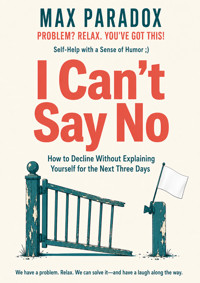
I Can't Say No - How to Decline Without Explaining Yourself for the Next Three Days ebook
Max Paradox
Uzyskaj dostęp do tej i ponad 240000 książek od 14,99 zł miesięcznie
- Wydawca: ALL-IN Rafał Płonkowski
- Kategoria: Biznes, rozwój, prawo•Biznes, rozwój
- Język: angielski
Someone asks you for a “tiny favor.”
You already know the answer should be no.
Ten seconds later, you have said yes, rearranged your weekend, canceled your own plans, and somehow become responsible for a task nobody mentioned when the conversation began.
Sound familiar?
I Can't Say No: How to Decline Without Explaining Yourself for the Next Three Days is a practical, funny guide for anyone who keeps agreeing to things they do not want, do not have time for, or immediately regret.
Max Paradox takes apart the entire exhausting process: the automatic yes, the guilt, the elaborate excuses, the fear of disappointing people, the endless explanations, the negotiations that begin after you already said no, and the strange belief that every boundary requires supporting documentation.
This is not a book about becoming selfish, cold, unavailable, or the person who responds to every request with “protecting my peace” while slowly closing the door.
It is about making better decisions.
You will learn how to:
pause before agreeing automatically;
distinguish genuine generosity from fear-based compliance;
say no clearly without sounding unnecessarily harsh;
stop overexplaining and defending reasonable choices;
handle guilt without reversing your decision;
respond when someone keeps pushing;
use partial yeses, time limits, budget limits, and scope limits;
set boundaries with friends, family, partners, and coworkers;
correct an accidental yes without inventing a medical emergency;
recognize real emergencies without becoming everyone’s permanent rescue service;
change expectations you may have accidentally trained into the people around you;
keep your boundaries working when life gets busy again.
The methods are designed for normal people with jobs, relationships, responsibilities, limited energy, and calendars that occasionally appear to be under hostile occupation.
No five-hour morning routine.
No motivational slogans pretending discomfort will disappear forever.
No requirement to become a different personality.
Instead, you get usable phrases, practical decision rules, realistic examples, fallback options, and a simple goal: make your yes mean yes because you actually chose it.
Because saying no is not really about one word.
It is about being present when your time, money, attention, and energy are being allocated.
And perhaps not writing a six-paragraph explanation every time you decline dinner.
This publication was prepared with the assistance of tools that support the creative process, including artificial intelligence-based solutions. The final concept, structure, and editing belong to the author.
Ebooka przeczytasz w aplikacjach Legimi na:
Liczba stron: 199
Rok wydania: 2026
Odsłuch ebooka (TTS) dostepny w abonamencie „ebooki+audiobooki bez limitu” w aplikacjach Legimi na:
Podobne




















INTRO
Your phone lights up.
“Hey! Any chance you could help me with something this Saturday?”
You already know the answer.
No.
Not “maybe.” Not “let me check.” Not “possibly if the weather is bad and three unrelated appointments mysteriously cancel.” You do not want to do it. Saturday is the one day this week when nobody is officially paying you, expecting you, calling you, scheduling you, or asking why a spreadsheet has turned orange.
Your thumb hovers over the keyboard.
This should take six seconds.
“Sorry, I can’t.”
Done.
Instead, your brain opens a legal department.
You begin preparing a defense. You cannot help because Friday will be exhausting, and you promised yourself you would clean the apartment, although technically you could clean it Sunday, except Sunday you are visiting your parents, and maybe if you moved that visit to the afternoon, then perhaps you could help for an hour, although an hour would probably become three hours, and then saying no afterward would feel even worse because now you would be leaving halfway through.
Seven minutes later, you have drafted a message that begins:
“I’m so sorry, I really wish I could, but unfortunately this week has been absolutely crazy…”
There are four more paragraphs.
You are declining a favor, not resigning from the United Nations.
This book is for people who know how to say the word “no” but somehow lose access to it whenever another human being is actually involved. People who can confidently reject an online cookie policy, a warranty extension, and a subscription to Premium Plus Ultra, yet become strangely diplomatic when a coworker asks, “Could you just quickly take a look at this?”
“Quickly” is one of the most dangerous words in the English language.
You know what often comes next. You say yes to something you do not want to do. Then you become annoyed. Not necessarily at the person who asked—you may be a reasonable adult—but at the situation, at yourself, at your calendar, at society, and briefly at the invention of weekends. You do the favor while internally delivering a twelve-minute speech about boundaries to an imaginary audience.
The audience is impressed.
The boundary remains theoretical.
Or perhaps you manage to say no, but then comes the explanation. You explain why you cannot attend dinner. Why you cannot take another project. Why you cannot lend the thing. Why you cannot stay late. Why you cannot drive someone somewhere. Why you do not want to join the committee, group chat, birthday weekend, networking breakfast, volunteer initiative, shared vacation plan, or mysteriously urgent task that existed peacefully for three weeks before becoming your emergency at 4:47 p.m.
You provide evidence. Dates. Context. Supporting documentation.
Sometimes you offer alternative solutions nobody asked for.
“I can’t do Tuesday, but maybe Wednesday after six, unless Thursday works better, or I could possibly help remotely, or I know someone who might—”
Stop.
You were trying to say no.
Somewhere along the way, your no became a customer service department.
The reason this happens is not usually that you are weak, indecisive, or secretly desperate to spend your free evening helping Steve move a sofa that looks heavier than your future. Saying no is difficult because human beings are social animals, and social animals are highly interested in not being rejected, disliked, criticized, excluded, or described later in a group chat as “a little difficult.”
We like cooperation. We like being useful. We like being seen as kind, dependable, flexible, generous, competent, easygoing, supportive, and generally pleasant to have around during both weddings and organizational crises.
None of that is bad.
The problem begins when “being a good person” quietly becomes “being permanently available.”
Then every request starts to feel like a test of character.
If you say yes, you are helpful.
If you say no, apparently you must present a detailed explanation proving that you remain morally acceptable.
So you explain.
And explain.
And explain.
Ironically, the more you explain, the less confident your answer often sounds. A simple “I can’t make it” is clear. A six-paragraph account involving traffic, workload, your cousin’s dentist appointment, and the emotional condition of your washing machine sounds like the opening statement of someone hoping for acquittal.
People notice uncertainty.
Sometimes they push.
“Oh, but it’ll only take an hour.”
“Could you come later?”
“What if we change the day?”
“You don’t have to stay long.”
Now you are negotiating a decision you had already made.
This is how a two-letter word becomes a three-day administrative process.
And here is the uncomfortable part: overexplaining often feels polite, but sometimes it is actually an attempt to control the other person’s reaction. You are not only saying, “I can’t.” You are secretly trying to make sure they also think, “Of course. Completely understandable. What a reasonable and wonderful person. We should probably send flowers.”
That is a difficult standard.
You cannot control whether someone is disappointed.
You can only decide whether their disappointment automatically becomes your responsibility.
This book will not teach you to become cold, selfish, difficult, or the kind of person who responds to every request with “Not my problem” while slowly rotating away in an office chair. Boundaries are not about refusing everything. They are about choosing consciously instead of automatically volunteering your time, energy, money, attention, and Saturday because silence lasted half a second too long.
You will learn how to tell the difference between genuine generosity and reluctant compliance. How to stop treating every request like an obligation. How to buy yourself time before answering. How to say no without building a courtroom case around it. How to handle pushback without immediately reopening negotiations. How to deal with guilt after the conversation is over.
Because guilt is often the second shift.
You finally say no at 2:14 p.m.
At 2:16, the internal investigation begins.
“Was that rude?”
“Maybe I sounded cold.”
“I could still message them.”
“Perhaps I should add a smiley face.”
“Not that smiley face. That one looks passive-aggressive.”
Congratulations. You declined one request and accidentally accepted an afternoon of emotional paperwork.
We are going to reduce that paperwork.
The goal is not to become someone who says no effortlessly to everything. That person may exist, but I suspect they either live alone on a mountain or sell expensive online courses about personal sovereignty. Normal people still feel awkward sometimes. They still care what others think. They still hesitate when someone they love needs help.
The goal is simpler: to stop confusing discomfort with wrongdoing.
A good boundary can feel uncomfortable and still be correct.
A disappointed person can still like you.
A request can be reasonable and your answer can still be no.
You can care about someone without becoming their emergency contact for every inconvenience.
Most importantly, you do not need to prove that your no deserves to exist.
Over the next twenty chapters, we are going to make saying no shorter, clearer, calmer, and far less dramatic. We will look at why you automatically agree, why explanations multiply once they escape containment, what to say in common situations, how to handle persistent people, and what to do when your confidence level is approximately a damp paper towel.
You do not need a new personality.
You need a better response.
Preferably one that does not require attachments.
Chapter 1 - Why “No” Feels Like a Crime
The request arrives at 10:07 a.m.
“Could you take this on too?”
You look at your calendar. There is no space. Not “very little space.” No space. Thursday appears to have been designed by someone who dislikes you personally. You already have meetings stacked against deadlines, a task you postponed yesterday because yesterday also had ambitions, and lunch currently exists only as a theoretical concept.
You know the answer.
“No.”
Then something strange happens.
Your mouth says, “Sure.”
Excellent.
You have just accepted a task your schedule rejected before the conversation even started.
This is one of the central problems with saying no: the decision often happens before you consciously make it. Someone asks. Your nervous system detects a social situation. Your brain rapidly calculates the possible cost of refusal—disappointment, awkwardness, conflict, judgment—and produces the safest short-term answer.
“Yes.”
Immediate danger avoided.
Future you has been sacrificed.
That future version of you will meet the consequences at 8:42 p.m., when the extra task is still unfinished and you are eating something over the kitchen sink because sitting down would suggest a level of leisure the day has not authorized.
The yes felt easier because, in the moment, it was easier.
That is important.
People often assume they say yes because they are “too nice.” Sometimes that is true, but it is not the whole story. Saying yes also removes tension immediately. You do not have to explain yourself. You do not have to watch someone’s face change. You do not have to wonder whether they think you are selfish. You do not have to sit through that tiny silence after a refusal.
Yes buys instant social relief.
Unfortunately, the payment plan is terrible.
You pay later in time, irritation, exhaustion, resentment, canceled plans, rushed work, and occasionally sitting in your car for five extra minutes because the car is the only place where nobody currently wants anything.
This is why changing the habit requires more than telling yourself, “I should say no more often.” You already know that. Knowing is not the missing ingredient. If knowledge automatically changed behavior, every gym membership would be profitable for the customer.
The first step is understanding what you are actually avoiding.
Usually, it is not the request.
It is the feeling that comes with refusing it.
The five-second discomfort problem
Imagine someone asks you to cover their shift, attend an event, help with a project, lend them money, join a committee, proofread something, drive them somewhere, or spend your Saturday transporting furniture through a staircase apparently designed for decorative plants.
You want to decline.
What happens next?
You may feel a brief surge of discomfort. Your chest tightens slightly. Your brain begins searching for reasons. You picture the other person being disappointed. You may even hear an internal voice saying:
“That’s rude.”
“They’ll think I don’t care.”
“I should help.”
“It’s not that big a deal.”
“They helped me once.”
“What if they get upset?”
Notice how quickly your brain moves from a request to a moral hearing.
Nobody asked, “Are you a good person?”
They asked, “Can you help Saturday?”
These are different questions.
Your brain sometimes treats them as identical.
That is why a simple refusal can feel disproportionately serious. You are not merely deciding whether to attend dinner. You feel as if you are voting on whether you are kind, loyal, generous, dependable, and worthy of future invitations.
No wonder you panic.
If every declined barbecue becomes a referendum on your character, you are going to attend a great many barbecues.
The useful correction is simple:
A request is not a moral exam.
It is a request.
The other person is allowed to ask.
You are allowed to answer.
That sounds obvious while reading it calmly. It becomes less obvious when your manager, sister, neighbor, friend, client, or highly organized parent from the school group is staring directly at you.
Which is why we need to separate discomfort from danger.
Awkward is not dangerous
For most ordinary situations, saying no creates discomfort, not catastrophe.
The person may be disappointed.
They may ask why.
They may try again.
They may look surprised.
They may become mildly annoyed.
These outcomes are unpleasant. They are not automatically emergencies.
Your brain may react as if you have just damaged the relationship beyond repair.
In reality, you declined brunch.
Brunch has survived worse.
A lot of people who struggle to say no have become very skilled at preventing other people from experiencing even small amounts of disappointment. They rearrange schedules, accept extra work, attend things exhausted, lend things they would rather not lend, and volunteer for responsibilities they secretly resent.
The logic is:
“If I can prevent them from feeling bad, I should.”
But this creates a strange system in which their discomfort matters and yours becomes invisible.
They should not be disappointed for fifteen minutes.
You may apparently be exhausted until Thursday.
This is not kindness.
It is an unfair distribution of inconvenience.
Healthy cooperation requires both people to remain real. Their needs matter. Your limits also matter. If one person’s preference automatically overrides the other person’s capacity, we are no longer discussing generosity. We are discussing a very polite form of self-erasure.
That may sound dramatic.
So does agreeing to organize the holiday party when you hate organizing parties and are already behind on everything.
The hidden deal behind automatic yes
Many automatic yeses contain an unspoken bargain.
You think:
“I will do this thing I do not want to do, and in exchange you will continue to think I am helpful.”
Sometimes the bargain is even more specific:
“I will make myself inconveniently available, and in exchange you will not be disappointed in me.”
There is one problem.
The other person never signed this contract.
They may still be disappointed.
They may barely notice your effort.
They may thank you and ask again next week.
They may begin assuming you are always available because, historically, you are always available.
Now you have trained the system.
This is how “Could you help just this once?” becomes a recurring franchise.
People learn from patterns. If you respond quickly, take extra work, always drive, always organize, always cover, always listen for two hours, always solve the technical problem, or always say “fine” when it is not fine, others naturally begin expecting that behavior.
Not because they are villains.
Because humans notice what works.
Press button.
Rafał appears with a spreadsheet.
Press again.
Another spreadsheet.
Eventually nobody remembers that the button is connected to a person.
The solution is not to become unpredictable or hostile. It is to stop creating expectations you cannot maintain without resentment.
Resentment is useful information
Resentment gets a bad reputation because it can become ugly when ignored for too long. But early resentment is often useful data.
You agree to something.
Then, ten minutes later, you are annoyed.
Why?
Sometimes the other person behaved badly.
But sometimes nobody did anything wrong.
They asked.
You agreed.
Your resentment is telling you that your answer did not match your preference.
That does not mean every moment of annoyance proves you should have refused. Adult life includes responsibilities we would not choose recreationally. Taxes remain stubbornly indifferent to personal boundaries.
But repeated resentment around voluntary commitments is worth examining.
Try asking:
“If nobody would be upset, would I still say yes?”
That question is powerful because it removes the social penalty from the decision.
Your friend asks you to attend a second event that weekend.
If you knew they would reply, “Totally fine, no worries,” would you go?
Your colleague asks you to take another piece of work.
If you knew they would not judge you, would you accept it?
Your relative asks for another favor.
If you knew there would be zero guilt afterward, what would you choose?
The answer tells you something important.
Sometimes you still want to help.
Good.
That is generosity.
Sometimes the answer is an immediate, glorious no.
Also useful.
That is information.
Stop deciding based only on the other person’s reaction
One of the biggest mistakes people make is evaluating a refusal by asking:
“Will they like my answer?”
That is not a useful standard because some people will dislike any boundary that inconveniences them.
You could decline with perfect manners, provide twelve months’ notice, send pastries, and include a handwritten apology.
They may still prefer yes.
Of course they do.
Yes is more convenient.
A better question is:
“Is my answer reasonable given my time, energy, priorities, responsibilities, and relationship with this person?”
That puts the decision back where it belongs.
For example:
A close friend needs emergency help after an accident. Your inconvenience may be worth accepting.
A coworker repeatedly sends you work they could do themselves because you are faster. Different situation.
Your parent needs help understanding an important document. Maybe yes.
A family member wants you to spend six hours fixing their laptop because they refuse to restart it. Negotiable.
Context matters.
Boundaries are not a machine that prints “NO” whenever someone approaches.
They are a decision system.
Your first practical rule: do not answer instantly
If automatic yes is your problem, the first method is almost embarrassingly simple:
Stop answering requests immediately.
You need a pause between request and decision.
Use one of these:
“Let me check and get back to you.”
“I need to look at my schedule.”
“Let me think about it.”
“I’ll confirm later today.”
“I’m not sure yet. I’ll let you know.”
These sentences are not manipulative. They are a braking system.
Right now, someone asks, and your helpful-person reflex grabs the steering wheel.
The pause gives the adult version of you time to return to the vehicle.
Use the pause even when you think you already know the answer. Especially at first. You are practicing a new sequence:
Request.
Pause.
Check.
Decide.
Respond.
Not:
Request.
Panic.
Yes.
Regret.
This one change can dramatically reduce accidental commitments because many bad yeses are created by speed.
What should you check during the pause?
Do not spend three hours building a decision matrix. We are trying to reduce the drama.
Ask four questions:
Do I genuinely want to do this?
Do I realistically have capacity?
What will I have to postpone, cancel, or rush if I say yes?
Am I saying yes mainly to avoid guilt or disappointment?
That is enough.
If the request is small and the cost is low, say yes if you want.
If the request matters to someone you care about and you choose to prioritize it, say yes.
But if your internal answer is no and the only thing turning it into yes is fear of the other person’s reaction, notice that.
You do not have to fix the whole habit today.
You only have to stop pretending the reaction is the same thing as the decision.
Minimum viable boundary
If saying a full no still feels too difficult, start smaller.
Do not automatically agree.
That is the minimum viable boundary.
Instead of:
“Sure, I can do that.”
Say:
“Let me check.”
That is it.
You have not refused.
Nobody has fainted.
The economy continues.
You have simply stopped outsourcing your decision to the first three seconds of social discomfort.
Practice this for one week.
Whenever the request requires meaningful time, money, effort, emotional energy, or a change to your plans, pause.
You can answer later.
And when your brain says, “But what if they think that’s weird?”
Let them survive the suspense.
Netflix has made people wait years for final seasons.
They can wait twenty minutes for your answer.
The takeaway from this chapter is simple: saying no feels difficult because you are often trying to avoid immediate discomfort, not because the request is impossible to refuse. Your first job is not becoming fearless. It is creating enough space to make an actual decision.
Today, use one sentence:
“Let me check and get back to you.”
That sentence may save your Saturday.
Chapter 2 - You Are Not on Trial
You finally do it.
Someone invites you to something you do not want to attend.
You type:
“Thanks for inviting me, but I can’t make it.”
Your finger hovers over Send.
The message is clear. Polite. Normal. Complete.
Then your brain whispers:
“That seems harsh.”
So you add:
“I’ve had a really busy week…”
Now it feels safer.
But perhaps still insufficient.
“…and I have a few things I need to catch up on this weekend…”
Better.
“…plus I promised my family I’d spend some time with them…”
Excellent. We now have witnesses.
“…and Sunday is really my only chance to reset before next week…”
You continue.
Five minutes later, your refusal has a plot.
There is character development.
Weather may become relevant.
This is overexplaining: providing more justification than the situation requires because a simple no does not feel emotionally safe enough.
It is extremely common.
It is also exhausting.
Why explanations multiply
An explanation feels like protection.
If you give a sufficiently good reason, perhaps the other person will not be disappointed.
If the reason is strong enough, perhaps they cannot argue.
If the explanation proves that you genuinely cannot do the thing, then you are no longer choosing to decline.
You have been forced.
That feels morally safer.
Notice the difference:
“I don’t want to go.”
Versus:
“I desperately wish I could go, but a complicated sequence of external circumstances has tragically prevented me.”
The second version allows you to remain innocent.
You did not refuse.
Fate refused.
You are merely the messenger.
This is why people sometimes prefer reasons that sound unavoidable: work, illness, appointments, prior commitments, family obligations, transportation problems.
“I’m tired and want to stay home” feels weak.
“I have an appointment” feels official.
Apparently your own need for rest requires certification.
The problem is that building every no around an unchallengeable reason creates a dangerous rule:
You may decline only when you can prove you have no alternative.
That gives everyone else access to your time unless you can produce documentation.
You are a person.
Not a conference room.
People do not need to see an Outlook conflict before your availability becomes real.
Explanation invites evaluation
Here is the practical problem with detailed explanations: once you give reasons, the other person can evaluate them.
“I can’t stay late because I have to pick up my daughter.”
Hard to argue.
“I can’t stay late because I’m exhausted.”
Someone may respond:
“We’re all tired.”
“I can’t attend because I already have plans.”
“What plans?”
“I need the evening to myself.”
“You can relax another day.”
This is where overexplaining becomes especially dangerous. You think you are making your no stronger. In reality, you are giving the other person more handles to grab.
Every additional detail can become a negotiation point.
“I can’t come Saturday because I need to clean the apartment.”
“Clean Sunday.”
“I’m seeing my parents Sunday.”
“Go Saturday morning.”
“I have errands Saturday morning.”
“Do them Friday.”
Congratulations.
Your calendar is now a community project.
A boundary should not require the other person to approve your priorities.
If you say, “I can’t make it,” the decision is clear.
If you say, “I can’t make it because I need to clean, shop, rest, visit my parents, finish laundry, and emotionally recover from Wednesday,” you have accidentally submitted a proposal for review.
The committee has comments.
Explanation versus justification
Not all explanations are bad.
Sometimes context is useful.
If you are canceling something important, changing an agreement, disappointing someone who reasonably expected your participation, or dealing with a close relationship, a brief explanation can be considerate.
For example:
“I can’t come tonight. I’m feeling sick and need to rest.”
Perfectly normal.
“I won’t be able to finish this by Friday because another priority came in from the client. I can deliver Monday.”
Useful.
“I can’t lend you the car because I need it that day.”
Fine.
The problem begins when explanation becomes justification.
An explanation provides relevant information.
A justification tries to prove that your boundary deserves permission.
The difference is often visible in length.
“I can’t make it—I already have plans.”
Explanation.
“I can’t make it because I already have plans, although they’re not fixed plans exactly, it’s just been a long week and I was hoping to get a few things done, but maybe if everyone is going I could possibly stop by…”
Your no has escaped.
Please notify local authorities.
The “reasonable person” test
If you are unsure how much explanation to give, use this test:
What would a reasonable person need to understand the situation?
Not:
“What information would make it impossible for them to dislike my decision?”