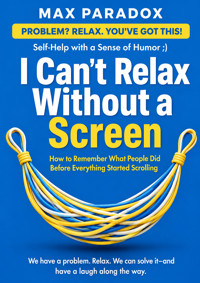
I Can't Relax Without a Screen - How to Remember What People Did Before Everything Started Scrolling ebook
Max Paradox
Uzyskaj dostęp do tej i ponad 240000 książek od 14,99 zł miesięcznie
- Wydawca: ALL-IN Rafał Płonkowski
- Kategoria: Literatura popularnonaukowa•Nauki ścisłe
- Język: angielski
You finally have time to relax.
So naturally, you spend forty minutes watching videos you did not choose, reading comments you do not care about, checking messages you already checked, and learning how a stranger restored a lawn mower you will never own.
Then you put the phone down and wonder why you still feel tired.
I Can't Relax Without a Screen is a practical, funny guide for anyone whose downtime has quietly become another stream of incoming information.
This is not a book about throwing your smartphone into a lake, deleting every app, buying a cabin, or pretending modern technology has contributed nothing useful since the invention of the toaster. Screens are useful. Entertainment is good. The problem begins when every pause, meal, walk, wait, evening, and moment of boredom automatically becomes screen time.
Max Paradox shows you how to rebuild the ability to relax without requiring constant digital stimulation-and how to do it without turning “digital wellness” into another exhausting self-improvement project.
Inside, you will learn how to:
tell the difference between entertainment and genuine recovery;
tolerate boredom without treating thirty empty seconds like a technical emergency;
break the habit of using two or three forms of stimulation at once;
create simple screen-free moments that actually survive busy days;
build an offline leisure menu for days when your energy level is approximately potato;
stop automatically filling every wait, transition, meal, and quiet moment;
use screens deliberately instead of opening them without knowing why;
create realistic stopping points for endless feeds;
reduce bedtime scrolling without requiring heroic willpower;
handle stressful weeks, travel, low motivation, bad weather, family life, and the inevitable return of old habits;
maintain a healthier relationship with technology without obsessively monitoring every minute.
There are no lectures about becoming your best self before sunrise.
No guilt about enjoying television.
No demand that every walk become mindfulness practice.
Instead, you will get practical methods, minimum-effort versions, Plan B options, and uncomfortable recognition of just how many times you have opened your phone to check the time and returned twenty minutes later knowing everything except the time.
The goal is simple: screens should become one option for relaxation, not the automatic answer to every empty moment.
You do not need to eliminate technology.
You need to remember that boredom is survivable, a walk does not require a podcast, television does not require a second television in your hand, and an evening can contain several minutes during which nobody on the internet gets access to you.
Your phone can remain smart.
It just does not need to be management.
This publication was prepared with the assistance of tools that support the creative process, including artificial intelligence-based solutions. The final concept, structure, and editing belong to the author.
Ebooka przeczytasz w aplikacjach Legimi na:
Liczba stron: 207
Rok wydania: 2026
Odsłuch ebooka (TTS) dostepny w abonamencie „ebooki+audiobooki bez limitu” w aplikacjach Legimi na:
Podobne




















INTRO
You sit down on the couch after a long day with one noble objective: relax.
Nothing ambitious. No personal growth. No learning Mandarin. No finally understanding retirement accounts. You just want your brain to stop behaving like it has seventeen browser tabs open, three of them playing music, and one asking whether you accept cookies.
So you reach for your phone.
Obviously.
You check one message. Then the weather, despite having windows. Then Instagram. Then a video. Then another video, because the first video ended and apparently this constitutes an emergency requiring immediate replacement content. Twenty-seven minutes later, you are watching a man in Ohio restore a rusty lawn mower you do not own, have never wanted, and now somehow feel emotionally invested in.
This is relaxation in the twenty-first century.
Your body is technically resting. You are horizontal. Nobody is asking you to answer an email. Your feet have achieved full sofa status.
Your brain, meanwhile, is working the night shift.
The strange part is that screens have become so closely connected with downtime that many of us no longer know what relaxing without one is supposed to look like. Remove the phone, television, tablet, laptop, gaming console, smartwatch, and possibly the refrigerator display that tells you the milk is getting nervous, and an uncomfortable question appears:
Now what?
You could read a book, except many books now live on screens. You could listen to music, but the music is on your phone, which means you first have to unlock it, which means you see a notification, which means twelve minutes later you are reading comments written by strangers arguing about whether someone cooked pasta correctly.
You could go for a walk.
Without headphones?
Easy there, pioneer.
For most of human history, people had enormous amounts of time in which absolutely nothing scrolled. They sat on porches. They stared out windows. They walked places without receiving live updates about eight hundred people they barely knew. They cooked dinner without simultaneously consuming a podcast, a television show, three messages, and a short video explaining five signs that they might be emotionally exhausted.
Today, silence can feel suspicious.
You finish lunch and immediately reach for something. You stand in line and reach for something. You wait thirty seconds for the microwave and reach for something. You go to the bathroom and apparently require entertainment programming. A red light lasts forty-five seconds and your brain reacts as if authorities have placed you in solitary confinement.
The phone is not entirely to blame. It did not break into your home and force itself into your hand. You invited it in because it is genuinely useful, frequently entertaining, socially important, and extremely good at removing tiny pockets of boredom before you even notice they exist.
That last part matters.
Boredom used to arrive naturally. You waited for a bus. You stared around. You thought about things. Maybe you noticed a weird building. Maybe you remembered something. Maybe your brain wandered into a completely unnecessary debate about whether you would survive if civilization collapsed and the only food available was canned beans.
Now boredom gets intercepted at the border.
The moment nothing is happening, something happens.
Scroll.
Refresh.
Play.
Check.
Tap.
Congratulations. You have successfully prevented yourself from experiencing eight consecutive seconds of unstimulated consciousness.
This does not mean screens are evil. This book is not going to ask you to move into a cabin, throw your phone into a lake, grow potatoes, and communicate exclusively through handwritten postcards. That would create several new problems, including the fact that lakes do not offer device insurance.
The goal is much less dramatic.
You need to remember how to rest without requiring a constant stream of incoming material.
Because consuming content and recovering are not the same thing.
Sometimes they overlap. Watching a good movie can be relaxing. Playing a game can be relaxing. Laughing at videos your friend sends you can absolutely be relaxing, particularly when the alternative is discussing mortgage rates.
But automatic screen use often creates a weird imitation of rest. You stop doing work, yet your attention keeps sprinting. New image. New headline. New joke. New message. New outrage. New person renovating a kitchen. New person explaining why another person renovated the kitchen incorrectly.
Your thumb is relaxing beautifully.
The rest of you may not be.
This is why you can spend two hours “doing nothing” online and somehow finish feeling more scattered than when you started. You gave your body a break but kept feeding your attention small pieces of information at the speed of an airport conveyor belt.
Then you wonder why reading ten pages of a book feels difficult.
Nothing is wrong with your ability to relax. You have simply trained relaxation to require input.
That is fixable.
Not with discipline worthy of a Navy SEAL. Not with a thirty-day digital detox conducted in a mountain monastery. And definitely not with another app that sends you notifications reminding you to use your phone less.
That solution has always had a certain architectural flaw.
Instead, we are going to rebuild your ability to tolerate—and eventually enjoy—slower forms of downtime. You will learn how to create screen-free moments that do not feel like punishment, how to deal with the automatic urge to check something, how to rediscover activities that are enjoyable without becoming projects, and how to make boredom useful again without turning it into a spiritual achievement.
You will also learn the important difference between choosing a screen and defaulting to one.
That distinction changes everything.
If you deliberately decide to watch a movie tonight, wonderful. Watch the movie. Eat something unnecessarily crunchy. Ignore anyone who says you should be optimizing this time.
But if you intended to rest for twenty minutes and instead spent ninety minutes bouncing between five apps because your hand kept opening them before your brain had submitted the paperwork, that is not really a choice.
That is a habit wearing your pajamas.
The good news is that you do not need to eliminate screens to change the relationship. You only need to create enough space for other kinds of rest to become available again.
At first, they may feel strangely empty.
You make tea and sit down.
No phone.
You look around.
The room appears to contain walls.
You hear a clock.
Apparently it has been there for years.
Your brain immediately proposes several urgent alternatives. Perhaps check email. Perhaps investigate whether that actor from the show is married. Perhaps compare air fryers even though you already own an air fryer and have never once complained about its performance.
This is the point where most people conclude, “I guess I just can’t relax without my phone.”
You can.
You are simply out of practice.
And practice is much less dramatic than transformation. It means ten minutes here. A small rule there. One activity that does not involve a glowing rectangle. A few moments in which boredom arrives and you do not immediately call security.
Eventually, something interesting happens.
Your mind starts supplying its own material again.
You notice things. Ideas appear. Conversations last longer. A walk becomes a walk instead of mobile content consumption with legs. Waiting becomes mildly boring instead of intolerable. Even television gets better when you actually watch one thing instead of watching one thing while checking four other things.
The objective is not to return to 1987.
You do not need a cassette player, a landline, or wallpaper with tiny flowers.
You just need to recover one surprisingly modern luxury:
being unavailable to content for a while.
That is what this book will help you do—practically, gradually, and without treating your phone like a radioactive artifact.
We are not declaring war on screens.
We are just reminding them they are furniture.
Not management.
Chapter 1 - When Rest Became Another Feed
You get home, drop your keys somewhere you will later accuse the universe of hiding them, take off your shoes, and announce that you are done for the day.
Then you sit down and immediately begin consuming information.
Messages. News. Videos. Posts. Comments. Recommendations. A review of a restaurant in a city you are not visiting. Someone explaining the correct way to fold a fitted sheet. A stranger revealing the “three biggest mistakes” people make when buying olive oil.
Twenty minutes ago, your brain was tired from work.
Now it is tired from learning that you have apparently been buying olive oil incorrectly for years.
This is one of the central problems with modern relaxation: we often confuse stopping one activity with resting. Work stops, so we assume recovery has begun. But your attention does not care whether the incoming information is labeled “work,” “entertainment,” or “a surprisingly detailed argument about cordless vacuum cleaners.”
Attention still has to process it.
That does not make every screen activity exhausting. A familiar sitcom may be exactly what you need. A game can absorb you in a pleasant way. Calling someone you like can improve your evening considerably, assuming the call does not begin with, “Do you have a minute?” which has never once meant a minute.
The issue is not screens.
The issue is automatic stimulation.
You finish one thing and immediately request another. Then another. Then another. Your brain never gets the small empty spaces in which it can reduce speed.
Imagine finishing a twelve-hour road trip and deciding to relax by driving around the neighborhood because technically this is recreational driving.
The scenery changed.
The engine is still running.
The Resting Position of the Human Thumb
Watch what happens during an ordinary pause.
The elevator is coming.
Phone.
The microwave has forty seconds left.
Phone.
Your friend goes to the restroom at a restaurant.
Phone.
A website takes slightly longer than expected to load, so while waiting for the website on your laptop, you check another website on your phone.
Humanity waited thousands of years for this level of efficiency.
You may not even consciously decide to do it. Your hand reaches before your mind has formed a request. That matters because habits thrive on transitions: after finishing something, while waiting, during uncertainty, before sleep, after waking, while eating, while sitting down.
The screen fills the gap before you have time to notice there was a gap.
This creates a loop:
You feel a tiny moment of boredom, discomfort, restlessness, or emptiness.
You check something.
The feeling disappears.
Your brain learns: excellent, whenever nothing is happening, we know what to do.
Repeat this hundreds of times and eventually “nothing happening” starts to feel like a problem.
Not a major problem. You are not standing in the kitchen screaming because Spotify is unavailable.
Usually.
It is subtler. You feel itchy. Impatient. You reach for your phone without purpose. You open an app, realize there is nothing interesting there, close it, and then reopen the same app six minutes later as if the employees may have restocked.
This is not stupidity.
It is training.
And if you trained it, you can train something else.
You Are Not Bad at Relaxing
People often describe the problem as a personality defect.
“I can’t sit still.”
“I need background noise.”
“I get bored immediately.”
“I don’t know how people just sit there.”
Maybe. But before declaring yourself constitutionally incapable of peace, look at the environment you have practiced in.
For years, nearly every quiet moment has had an emergency exit.
Bored in bed? Phone.
Awkward at a party? Phone.
Waiting for someone? Phone.
Don’t want to think about something? Phone.
Want to avoid beginning something? Excellent news: your phone contains enough material to delay civilization itself.
Your brain has become accustomed to a world in which stimulation arrives on demand. It is not surprising that slower activities initially feel weak by comparison.
A walk has poor graphics.
A bath rarely sends push notifications.
A cup of tea has terrible user engagement.
This does not mean those activities are inherently boring. It means they are competing against products designed to offer constant novelty.
That is not a fair fight.
The correct response is not to make your walk more exciting by carrying three screens.
It is to stop demanding that every form of rest compete on the same terms.
The Difference Between Pleasure and Recovery
Here is a useful question:
After this activity, do I usually feel better, the same, or more scattered?
Do not ask whether you enjoy it while doing it. Many things are enjoyable during consumption and disappointing afterward. This principle has been thoroughly demonstrated by both social media and large bags of cheese-flavored snacks.
You need to judge rest partly by its aftereffect.
Suppose you spend forty-five minutes watching a show you deliberately chose. You laugh, relax, and afterward feel calmer.
Fine. That counted.
Now suppose you spend forty-five minutes opening and closing apps, reading fragments, checking messages, bouncing between short videos, and briefly researching whether a celebrity has had cosmetic dental work.
You may have been entertained.
But did you recover?
That distinction is important because your goal is not a screen-free purity score. You are not competing in the Digital Monk Championships.
Your goal is to build a larger menu of activities that genuinely lower your internal speed.
Try dividing your downtime into three categories.
Rest that restores you: activities after which you usually feel calmer, clearer, physically better, or pleasantly satisfied.
Rest that entertains you: enjoyable activities that may not restore much but are still worth doing.
Rest that leaks time: activities you did not really choose and afterward barely remember.
The same activity can move between categories.
Watching two episodes of a show you love might be entertainment or restoration.
Autoplaying seven episodes until 2:13 a.m. because standing up requires executive authority from Congress is probably time leakage.
Scrolling can sometimes entertain you. It can also become the largest unplanned room in your day.
The point is not moral judgment.
The point is classification.
You cannot improve something you keep calling “relaxing” simply because you were not being paid during it.
Run the After Test
For the next few days, do something extremely simple.
After a common downtime activity, ask:
How do I feel now compared with before?
That is all.
Do not create a spreadsheet.
Please.
If your response to a book about reducing screen dependence is to design a color-coded digital dashboard with conditional formatting, the irony will become powerful enough to affect regional weather.
You only need three possible answers:
better;
about the same;
worse.
Try it after twenty minutes of scrolling.
After watching a movie.
After a shower.
After a short walk.
After cooking.
After sitting outside.
After a conversation.
After reading.
After lying on the couch doing absolutely nothing except wondering whether the ceiling always looked like that.
You are looking for patterns, not perfection.
You may discover that some activities you assumed were restorative actually leave you agitated. You may also discover that a screen-based activity works perfectly well for you when you choose it deliberately.
That is useful information.
We are not prosecuting Netflix.
Why Empty Time Feels Uncomfortable
One reason screen-free rest can feel strange is that unfilled time gives your mind room to produce whatever it has been carrying.
Sometimes that is pleasant.
Ideas.
Memories.
Daydreams.
Plans.
Sometimes it is less charming.
The conversation you replay from Tuesday.
The task you forgot.
The vague worry you successfully avoided all afternoon by learning fifteen facts about sharks.
When stimulation stops, those thoughts can become more noticeable.
This is why “just put your phone down and sit quietly” is not universally relaxing advice.
For some people, the first few minutes feel worse.
The brain says, excellent, now that management has stopped distracting us, here are seventeen unresolved matters.
This does not mean screens caused all your stress or that screen-free time will magically cure it. It simply means constant input can function as a convenient cover.
Remove the cover and you notice what is underneath.
If difficult thoughts become intense, persistent, or interfere significantly with daily life, that is a different issue and may be worth discussing with a qualified mental health professional. This book is about habits of attention and rest, not diagnosing psychological conditions.
For ordinary restlessness, however, the solution is surprisingly practical:
Do not begin with long periods of nothing.
Begin with low-stimulation activities.
That difference saves people a lot of unnecessary suffering.
Low Stimulation Is the Bridge
Imagine two options.
Option A: spend two hours scrolling rapidly through short videos.
Option B: sit silently in an empty room facing a beige wall.
If B sounds unbearable, congratulations, you have a functioning nervous system and opinions about furniture.
There is an enormous middle ground.
You can:
make coffee without bringing your phone into the kitchen;
shower without playing a video;
take a ten-minute walk without audio;
sit on a balcony or porch;
fold laundry while listening to one album instead of switching between five forms of content;
cook something familiar;
stretch;
water plants;
doodle;
work on a puzzle;
read a few pages of a physical book or magazine;
stare out a window like an elderly detective who suspects the neighbors.
These activities give your brain something to do, but not much to chase.
That is ideal.
You are not trying to create instant enlightenment.
You are lowering the stimulation dial from eleven to seven.
Later, seven can become five.
Nobody needs to begin at zero.
Your First Screen-Free Island
Today, pick one predictable ten-minute period and make it screen-free.
Ten minutes.
Not two hours.
Do not announce a digital detox. Do not buy a special notebook. Do not tell your friends you are “reclaiming your attention.”
You are making tea without YouTube.
Stay calm.
Choose a period that already exists:
the first ten minutes after getting home;
part of your lunch break;
while drinking morning coffee;
after dinner;
before taking a shower;
a short walk;
ten minutes before bed.
Then give that time a specific replacement activity.
This matters.
“Do not use phone” creates a hole.
“Drink coffee on the balcony” creates a plan.
“Do not scroll” is vague resistance.
“Walk around the block” tells your body where to go.
The replacement should be easy enough that you can do it while tired.
If your screen-free alternative is “learn watercolor painting,” you may accidentally create another obligation. Then you will need to relax from your relaxation project.
Choose something almost insultingly simple.
Tea.
Walking.
Music.
Stretching.
A few pages.
Sitting outside.
That is enough.
What If You Reach for the Phone Anyway?
You probably will.
That does not mean the experiment failed.
The goal is not to become a person who never feels an urge. The goal is to notice the urge before obeying it automatically.
When your hand reaches, pause and ask:
What was I about to check?
If you have a real answer, decide whether it can wait ten minutes.
If the answer is, “I don’t know,” that is even more useful.
You have just caught the habit in civilian clothing.
Put the phone back.
Continue what you were doing.
Do not make the moment dramatic. You are not resisting a hypnotic artifact recovered from an archaeological site. You are simply declining to open an app.
If ten minutes feels surprisingly difficult, reduce it to five.
That is Plan B.
Five minutes practiced daily is more useful than a heroic sixty-minute experiment that makes you conclude this whole idea is ridiculous.
The Smallest Useful Change
The minimum viable solution for this chapter is:
One ten-minute screen-free island attached to an existing part of your day.
If ten minutes is too much, make it five.
If silence feels too abrupt, use one low-stimulation activity.
If you forget, leave a physical cue where the habit begins: a book on the chair, walking shoes by the door, tea already on the counter.
Do not rely entirely on remembering.
Your phone does not rely on remembering.
It uses badges, sounds, vibrations, widgets, recommendations, alerts, and occasionally what appears to be psychological warfare.
You may use a pair of shoes.
Fair is fair.
For now, do not try to change your entire evening.
Just prove to yourself that a gap can exist without immediately being filled by a feed.
That is the first skill.
Rest does not begin when the screen turns off.
It begins when you stop demanding that every empty second entertain you.
Chapter 2 - Boredom Did Not Actually Die
You are standing in line at a coffee shop.
There are four people ahead of you.
This situation may take six minutes.
Your ancestors survived winters, crop failures, epidemics, and journeys involving actual maps. You have been asked to stand near a pastry display for approximately one-tenth of an hour.
Your hand moves toward your pocket.
Naturally.
Within seconds, you are reading an email that does not require action, checking a message you already checked, and looking at a news story you will forget before the barista asks whether you want room for cream.
The line moves.
You barely notice.
Nothing terrible happened. You did not ruin your brain. No government agency needs to intervene.
But you lost something small.
You lost six minutes in which your mind could have wandered.
That may sound like a very minor tragedy.
It is.
That is why it happens so often.
Boredom Has a Public Relations Problem
Boredom is treated like a system failure.
Children say, “I’m bored,” with the same urgency adults reserve for water leaking through the ceiling.
Adults are not much better. We just have better equipment.
We rarely announce boredom anymore because we can remove it instantly. If there are three seconds of unused attention, we have inventory ready.
The result is that boredom has become unfamiliar enough to feel uncomfortable.
But boredom is not one thing.
There is miserable boredom: being trapped in a pointless meeting while someone reads aloud from the slide currently visible to everyone.
There is restless boredom: wanting stimulation because nothing nearby is grabbing you.
And there is productive boredom: a low-input state in which your mind begins wandering, connecting things, remembering, imagining, or simply settling down.
We are mainly interested in the third kind.
Not because boredom is magical.
People occasionally describe it as if forty minutes staring at a radiator will reveal your life purpose.
Probably not.
You may simply notice that the radiator needs dusting.
Still, a mind that is not constantly occupied has room to do things that do not happen as easily when it is processing a continuous stream of external input.
You remember.
You rehearse.
You imagine.
You notice.
You mentally wander into unexpected territory.
Sometimes you finally think through something you have been postponing.
Sometimes you invent a business.
Sometimes you remember you need bananas.
Not every internal breakthrough needs a TED Talk.
The Brain's Waiting Room
Think about the places where ideas often appear.
The shower.
Walking.
Driving familiar routes.
Lying in bed.
Doing dishes.
Why there?
Usually because part of your attention is gently occupied, but not fully consumed.
You are not forcing an idea.
You are giving your mind enough unused capacity for connections to appear.
This is one reason screen-free rest does not have to mean sitting perfectly still. Mild activity can be more comfortable and more useful.
Your brain often enjoys having a small physical job.
Hands busy.
Attention loose.
This is excellent news for anyone who hears “sit quietly with your thoughts” and immediately wants to relocate internationally.
You can sweep a floor.
Take a walk.
Chop vegetables.
Organize a drawer.
Not twelve drawers.
One.
We know how this goes.
You start by seeking ten minutes of peaceful activity and four hours later you are holding a warranty card from 2016 asking whether this is still legally part of your identity.
Moderation.
The First Minute Is Often the Worst
Suppose you try walking without your phone.
You leave the house.
After about thirty seconds, your brain provides a helpful suggestion:
Podcast?
No.
Music?
No.
Maybe check messages?
No.
Weather?
You are currently outdoors.
We know the weather.
Your mind now acts mildly offended.
What exactly are we supposed to do?
This uncomfortable transition is important because people often misinterpret it.
They assume:
“This activity is boring.”
But sometimes what is really happening is:
“My attention expected more stimulation and has not adjusted yet.”
Give it a few minutes.
The experience may change.
You begin noticing houses, trees, dogs, people, sounds, weather, your own thoughts, and one neighbor who appears to own seventeen identical recycling bins.
You settle into the pace.
The activity becomes easier.
This does not happen every time. Some walks are genuinely dull. There is no guarantee of spiritual revelation near the pharmacy.
The point is that the first restless reaction is not always a reliable verdict.
Do Not Turn Boredom Into Homework
There is a danger here.