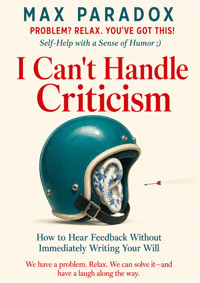
I Can't Handle Criticism - How to Hear Feedback Without Immediately Writing Your Will ebook
Max Paradox
Uzyskaj dostęp do tej i ponad 240000 książek od 14,99 zł miesięcznie
- Wydawca: ALL-IN Rafał Płonkowski
- Kategoria: Biznes, rozwój, prawo•Biznes, rozwój
- Język: angielski
Someone says, “Can I give you some feedback?”
Your face says, “Of course.”
Your nervous system says, “We had a good run.”
If criticism turns a small correction into a full internal emergency, I Can't Handle Criticism is for you.
Maybe you defend yourself before the other person finishes speaking. Maybe one negative comment wipes out ten compliments. Maybe you replay the conversation for three days, ask four people whether the criticism was fair, and eventually conclude that moving to another state might be simpler.
Max Paradox takes a practical, funny, and refreshingly non-guru approach to one of the most exhausting everyday problems: hearing feedback without treating it as a verdict on your entire worth.
This is not a book about accepting every criticism.
Some feedback is useful. Some is clumsy. Some is unfair. Some is vague nonsense delivered with extraordinary confidence.
The skill is learning to tell the difference.
Inside, you will learn how to:
separate criticism of your behavior from criticism of your identity;
stop reacting before you understand what was actually said;
ask questions that turn vague feedback into useful information;
recognize when you are adding your own catastrophic story;
stop overexplaining, counterattacking, and replaying conversations;
disagree with criticism without turning the room into a courtroom;
receive useful feedback from bosses, partners, friends, and family;
handle critics who are rude, vague, inconsistent, or impossible to satisfy;
apologize without collapsing into a full memorial service for your self-esteem;
turn criticism into one clear behavioral change;
recover when you still react badly;
stop seeking approval from everyone with an opinion;
maintain progress without becoming emotionally numb.
Most importantly, this book will help you shrink criticism back to its actual size.
A comment can be uncomfortable without becoming catastrophic.
A mistake can require correction without becoming evidence that you are a failure.
Someone can disagree with you without automatically becoming correct.
And you can hear something difficult without immediately defending your entire biography.
The goal is not to become someone who loves criticism.
That person would be suspicious.
The goal is to become someone who can pause, listen, evaluate, respond, and move on.
Because sometimes feedback is useful.
Sometimes it is nonsense.
And sometimes your biggest problem is the three-hour documentary your brain makes afterward.
This publication was prepared with the assistance of tools that support the creative process, including artificial intelligence-based solutions. The final concept, structure, and editing belong to the author.
Ebooka przeczytasz w aplikacjach Legimi na:
Liczba stron: 186
Rok wydania: 2026
Odsłuch ebooka (TTS) dostepny w abonamencie „ebooki+audiobooki bez limitu” w aplikacjach Legimi na:
Podobne




















INTRO
Your manager says, “Can I give you some feedback?”
And there it is.
Six harmless words, arranged in a perfectly ordinary sentence, somehow capable of making your nervous system behave as if a small helicopter has just landed in the conference room. Your face remains professional. You nod. You may even say, “Of course.” Meanwhile, inside your head, three departments have been evacuated, Legal has been called, and someone is quietly shredding your self-esteem.
The feedback itself may be mild. “The presentation was strong, but the middle section could be tighter.” That is what the other person says. What your brain hears is: “You are a fraud. Everyone knows. Security is already downstairs. Please surrender your laptop and any remaining dignity.”
You leave the conversation carrying one sentence like a cursed object. The praise disappears instantly, because praise has the shelf life of cut avocado. The criticism, however, receives permanent residency. You replay the tone. The exact wording. The eyebrow movement. Why did they pause before saying “strong”? Was that a real “strong” or a diplomatic “strong”? Should you update your résumé? Move to another state? Learn pottery?
By dinner, the presentation is no longer the issue.
Your entire life is under review.
This is the strange thing about criticism: the event is often small, but the internal production has an unlimited budget. A partner says, “You seemed a little distracted tonight,” and suddenly you are defending your character, your intentions, your childhood, and possibly your conduct during a vacation in 2019. A friend says, “You can be late sometimes,” and your brain immediately opens the case of The People Who Have Never Appreciated Me Properly. Someone online writes, “Not your best post,” and now a stranger named Dave, whose profile picture is a pickup truck, has been appointed Chief Justice of your personality.
Criticism can hurt because it does not arrive as neutral information. It lands on top of everything you already believe about yourself, everything you fear other people might believe about you, and everything you have been trying very hard not to think about since approximately middle school. If you already worry that you are not competent enough, “This needs more work” does not sound like a comment about the work. It sounds like a classified document confirming your suspicions.
So you defend.
Or explain.
Or collapse.
Or become extremely calm in the way people become calm five seconds before delivering a forty-minute speech titled Why Your Feedback Is Technically Incorrect.
Sometimes you argue immediately. Sometimes you smile, say “Thanks,” and spend the next six hours mentally writing a response so devastating that historians will one day call it unnecessary. Sometimes you decide the critic is jealous, controlling, ignorant, emotionally unavailable, poorly dressed, or simply “not my kind of person.” This can be comforting. It can also make it nearly impossible to learn anything useful.
The problem is not that you dislike criticism. Almost everyone dislikes criticism. Human beings did not evolve a deep emotional passion for hearing, “A few notes.” The problem begins when feedback stops being information and becomes a verdict. If every correction feels like rejection, every suggestion feels like disrespect, and every disappointed expression feels like evidence that you have failed as a human, you are no longer evaluating feedback. You are surviving it.
That changes your behavior in ways that are easy to miss.
You may avoid asking for opinions because you “already know what you’re doing.” You may overprepare for simple tasks so nobody can find a flaw. You may procrastinate because starting creates the horrifying possibility of being judged. You may become perfectionistic, defensive, agreeable, controlling, or mysteriously unavailable whenever someone says, “Could we talk for a minute?” You may even choose environments where nobody challenges you, which is peaceful in the same way living alone in a bunker is peaceful.
No complaints.
No growth either.
There is also an annoying twist: being sensitive to criticism does not necessarily mean you are weak, insecure, or bad at handling life. Plenty of competent, intelligent, successful people react badly to feedback precisely because they care deeply about doing things well. The brain makes a very efficient but deeply inconvenient mistake: it confuses “I made a mistake” with “I am a mistake.” Those sentences are only one word apart, yet emotionally they live in different postal codes.
This book is about learning to separate them.
Not by becoming cold. Not by pretending words do not hurt. Not by developing the emotional range of a parking garage. And definitely not by repeating “Feedback is a gift” until you start resenting both feedback and gifts.
Some feedback is useful. Some is clumsy but useful. Some is accurate but delivered with all the elegance of a shopping cart hitting your ankle. Some is vague. Some is biased. Some is nonsense wearing a confident expression. The goal is not to accept every criticism like a humble village philosopher. The goal is to become good at sorting it.
What is true?
What is useful?
What belongs to the other person?
What actually needs to change?
And what can be left on the floor without turning the rest of your week into an emotional crime scene?
That sorting process matters because criticism can contain valuable information, but only if you can stay mentally present long enough to hear it. When your system immediately switches into defense mode, you lose access to curiosity. You stop asking, “Is there something here I can use?” and start asking, “How do I prove I am still a good person before lunch?”
We will fix that.
You will learn how to hear feedback without treating it as a personal emergency, how to slow down the first defensive reaction, how to separate tone from content, how to ask questions that produce useful information, and how to decide what deserves action. You will also learn how to handle unfair criticism, repeated criticism, criticism from people you love, criticism at work, criticism online, and the special category known as “helpful advice from someone who has clearly been waiting all week to deliver it.”
You will not become someone who enjoys every negative comment. That would be suspicious.
You will become someone who can hear, think, choose, and respond.
That is a much better deal.
Because the moment criticism stops being a referendum on your worth, it becomes smaller. Sometimes uncomfortable, yes. Sometimes irritating. Occasionally useful. Occasionally ridiculous. But smaller. A sentence can remain a sentence instead of expanding into a full-length documentary about everything that may be wrong with you.
And that is the point.
The next time someone says, “Can I give you some feedback?” you may still feel the internal helicopter warming up.
But you will not have to board it.
Continuing with exactly Chapters 1 and 2, following the supplied series structure, voice, humor, and progression rules.
Wklejony tekst
Chapter 1 - Your Brain Heard “Danger”
You send your coworker a draft.
Ten minutes later, the reply arrives:
“Looks good overall. I’d rethink the opening.”
That is the entire message.
Seven words of approval. Four words of criticism.
Naturally, your brain deletes the seven.
Now you are staring at “I’d rethink the opening” as if forensic analysis may reveal a hidden second message: Also, we regret hiring you.
Nothing physically dangerous has happened. Your chair remains stable. Nobody has broken into the building. There is no smoke coming from the ceiling, unless you work somewhere unusually exciting. Yet your body may react as if something important is under threat. Your stomach tightens. Your face gets hot. Your thoughts speed up. You immediately want to explain why the opening is exactly the way it is, except now you are apparently defending it before the International Court of Openings.
This is the first thing to understand about criticism:
Your reaction often starts before your reasoning does.
That matters because most bad responses to feedback happen in the tiny gap between hearing something uncomfortable and deciding what it means.
Someone says, “I think you interrupted me a few times.”
Your brain hears:
“You are rude.”
Then:
“You are a bad listener.”
Then:
“You are difficult to be around.”
Then, somehow:
“This relationship may be collapsing.”
The original statement has now traveled a remarkable distance.
It has earned frequent-flyer miles.
Criticism often hits identity before behavior
Feedback usually describes something relatively narrow.
“This report needs more detail.”
“You were late.”
“That joke bothered me.”
“I wish you would listen without looking at your phone.”
But if you are sensitive to criticism, the mind can turn a comment about behavior into a judgment about identity.
The report needs more detail becomes:
“I am incompetent.”
Being late becomes:
“I am unreliable.”
A bad joke becomes:
“I am a bad person.”
Looking at your phone becomes:
“I am a terrible partner who will eventually die alone beside a charger.”
The last conclusion may feel dramatic when written down.
Inside your head, however, it can happen in seconds.
This is one reason criticism feels so much larger than praise. Praise usually confirms something pleasant but nonurgent. Criticism suggests there may be a problem that needs attention. Your mind naturally gives problems priority because problems might require action.
Unfortunately, it is not always excellent at deciding how much action.
A slightly weak presentation can receive the same internal urgency as a structural failure at a major airport.
Gate C is closed.
Your self-worth has been diverted.
The reaction is not proof
One of the most useful distinctions you can learn is this:
Feeling threatened does not mean you have been threatened.
You can feel embarrassed without being humiliated.
You can feel rejected without actually being rejected.
You can feel attacked while someone is simply describing an experience you do not enjoy hearing about.
This does not mean every critic is reasonable. Some people absolutely do criticize badly. They may be rude, vague, unfair, manipulative, aggressive, passive-aggressive, or blessed with the interpersonal finesse of a falling refrigerator.
We will deal with them later.
For now, the important point is that your emotional reaction cannot be the only evidence you use to decide what just happened.
Imagine a partner says:
“When I was telling you about my day, you kept checking your phone.”
Your immediate reaction may be:
“That’s unfair. I barely checked it.”
Maybe you are right.
But notice what happened. You started with a factual disagreement before asking the more useful question:
“Did they feel ignored?”
Those are not the same issue.
If you spend ten minutes proving that you checked your phone only three times rather than seven, congratulations. You have won the Phone Counting Championship.
Your partner still feels ignored.
Meet the internal defense attorney
The brain has several favorite ways to protect you from criticism.
One is instant explanation.
“Yes, but the traffic was terrible.”
“Yes, but you did the same thing last week.”
“Yes, but you don’t understand the context.”
“Yes, but that customer is impossible.”
“Yes, but I was tired.”
Some explanations are completely valid. Context matters.
The problem is timing.
When explanation appears before understanding, it sounds like dismissal.
Someone says, “This hurt me.”
You say, “Yes, but—”
And the conversation has barely started before your defense attorney kicks open the door carrying fourteen binders.
Another reaction is counterattack.
“You think I’m disorganized? You forgot the reservation.”
“You’re criticizing my tone? Have you heard yourself?”
“You think I was late? At least I showed up.”
This strategy is emotionally efficient. For three seconds, you no longer feel accused because now everyone is accused.
Problem solved.
Technically, problem doubled.
A third reaction is collapse.
This one looks different.
Instead of fighting, you immediately agree with the harshest possible interpretation.
“You’re right. I ruin everything.”
“I’m terrible at this.”
“I can never do anything properly.”
“I knew I wasn’t good enough.”
This may sound humble, but it is not useful humility. It actually makes the conversation harder because the other person now has to stop giving feedback and begin emergency reconstruction of your identity.
“I only said the soup needs salt.”
“Yes. And clearly I have failed this family.”
Nobody can season dinner under these conditions.
The first job is not responding
When criticism lands, your first job is not to explain yourself.
It is not to agree.
It is not to apologize.
It is not to decide whether the other person is right.
Your first job is much smaller:
Notice the reaction before obeying it.
That is all.
Suppose your boss says, “You need to be more concise in these meetings.”
Your internal reaction may immediately produce:
That is ridiculous.
Everyone else talks longer than I do.
She clearly does not value my contribution.
Maybe she wants me gone.
This is a terrible company.
I should update LinkedIn tonight.
You do not need to argue with those thoughts. You do not need to believe them either.
Treat them as the first draft.
Your brain is extremely fast.
Accuracy is sometimes scheduled for later.
A simple internal sentence helps:
“I’m reacting. I haven’t evaluated this yet.”
That sentence creates distance between feeling and conclusion.
It changes:
“This is unfair.”
into:
“My first reaction is that this feels unfair.”
Those phrases look almost identical.
They are psychologically miles apart.
The second version leaves the door open.
Use the ten-second rule
You do not need a breathing ritual involving candles, a mountain retreat, or an app that charges $79 a year to tell you to inhale.
You need about ten seconds.
When feedback catches you off guard:
Do not answer the substance immediately.
Take one slow breath.
Relax the part of your body that has suddenly volunteered for military service—jaw, shoulders, hands.
Say something neutral.
Ask one clarifying question if necessary.
Useful neutral responses include:
“Okay. Let me think about that.”
“I hear you.”
“Can you give me an example?”
“What part bothered you most?”
“When did you notice it?”
“What would you have preferred instead?”
These sentences are deliberately boring.
Boring is excellent.
Nobody has ever destroyed a relationship by saying, “Give me a second to think.”
Plenty of relationships have had exciting evenings because someone said, “Oh, really? Well, since we’re being honest…”
Do not confuse speed with strength
People often think a strong response is immediate.
Someone criticizes you, and you instantly answer with confidence, logic, evidence, supporting documents, and perhaps a PowerPoint you did not know you had emotionally prepared.
But speed is not always confidence.
Sometimes speed is panic wearing a blazer.
The stronger response is often slower because it gives you time to decide what you actually think.
Imagine a coworker says:
“You can be dismissive when people disagree with you.”
The automatic response:
“That’s not true.”
The stronger response:
“I don’t like hearing that, but give me an example.”
Notice what the second response does.
It does not confess guilt.
It does not accept a vague label.
It asks for data.
Now you can evaluate something concrete.
Maybe the example is valid.
Maybe it is exaggerated.
Maybe you discover that your “efficient tone” sounds to everyone else like you are canceling their citizenship.
Useful information.
Separate the alarm from the message
Think of your reaction as two separate things:
There is the alarm.
And there is the message.
The alarm is emotional.
The message is informational.
Your job is to avoid judging the message while the alarm is still screaming.
For example:
Message: “You seemed unprepared.”
Alarm: “They think I am incompetent.”
Message: “You didn’t call me back.”
Alarm: “They think I’m selfish.”
Message: “This version isn’t ready.”
Alarm: “I’m failing.”
The alarm may be understandable. It may even connect to old experiences of being judged, dismissed, embarrassed, or expected to perform perfectly.
But you do not have to solve your entire history every time somebody edits a spreadsheet.
For now, simply recognize the difference.
The alarm tells you:
“This matters to me.”
It does not automatically tell you:
“This criticism is correct.”
or:
“This criticism is wrong.”
That comes next.
Your first practical exercise
For the next week, do not try to become “better at criticism.”
That is too vague.
Instead, catch one reaction.
Just one.
When someone gives you feedback and you feel the surge—anger, shame, defensiveness, panic, the sudden desire to join a monastery—mentally label it:
“Reaction first. Evaluation second.”
Then delay your conclusion.
If possible, ask for one concrete example.
That is your entire assignment.
You are not trying to enjoy criticism.
You are trying to stop converting it into a verdict before the evidence has even entered the room.
The criticism may still be wrong.
Wonderful.
You can reject it later with better information.
But first, make sure you are responding to what was actually said rather than the twelve-episode drama your nervous system released immediately afterward.
Feedback is not always danger.
Sometimes it is just a note.
Annoying, perhaps.
But still just a note.
Chapter 2 - The Story You Add
A friend says:
“You’ve been canceling plans a lot lately.”
You hear the sentence.
Then you hear another sentence that was never spoken.
“So obviously you don’t care about me.”
Then another:
“You’re selfish.”
Then another:
“I’m tired of this friendship.”
By the time your friend reaches for their coffee, your brain has already written the final episode.
There is tension.
There are flashbacks.
Someone has moved to another city.
This is one of the biggest reasons criticism becomes unbearable: you are often not reacting only to what was said.
You are reacting to what you added.
Facts are usually smaller than interpretations
Take this sentence:
“You looked annoyed during the meeting.”
The fact is simple.
Someone thought you looked annoyed.
Your interpretation may be:
“They think I’m unprofessional.”
“They’ve probably mentioned it to the boss.”
“Everyone noticed.”
“I have damaged my reputation.”
Now compare the size of the original comment with the size of the mental sequel.
This happens because the brain hates incomplete information. If someone gives you criticism without explaining every detail, your mind fills in the blanks.
And when you already feel insecure, it does not fill them with generosity.
It rarely says:
“Perhaps this person has one narrow observation and otherwise considers me delightful.”
No.
It hires a screenwriter.
The three layers of criticism
When you hear feedback, separate three layers:
Layer 1: What was literally said?
Layer 2: What does it reasonably mean?
Layer 3: What story did I add?
Example:
What was said: “You missed two deadlines this month.”
Reasonable meaning: “There is a reliability problem around recent deadlines.”
Added story: “My manager has lost all confidence in me and is probably interviewing my replacement while I sit here holding a yogurt.”
Those are different levels of certainty.
The first is information.
The second is interpretation based on information.
The third is fan fiction.
Your brain may present all three in the same voice, which is deeply unhelpful.
The courtroom in your head
Once you feel criticized, you may begin collecting evidence for your interpretation.
If your boss says, “I need you to communicate earlier when something is delayed,” suddenly you remember:
They answered your email with “Thanks” instead of “Thanks!”
They did not laugh at your joke Tuesday.
They moved your one-on-one by fifteen minutes.
Last month they said, “We’ll discuss this later.”
It is all connected.
You are now a detective.
Unfortunately, your specialty is evidence that supports whichever conclusion frightened you first.
This is called confirmation bias in psychology: once we form an expectation, we become more likely to notice information that supports it and overlook information that does not. You do not need to memorize the term. You just need to recognize the experience.
If you believe someone is disappointed in you, every neutral facial expression becomes evidence.
If you believe your partner is angry, the way they load the dishwasher develops a tone.
That plate was placed aggressively.
The spoon knows.
Ask: “What do I actually know?”
This question is painfully effective because anxiety hates paperwork.
Suppose someone says:
“I wish you would ask me before making plans for both of us.”
Your first story:
“They think I’m controlling.”
Pause.
What do you actually know?
You know they want to be consulted.
That is it.
Maybe they do think you are controlling.
Maybe they do not.
If it matters, you can ask.
But do not convict yourself using testimony that has not occurred.
Try this sequence:
What was said?
“I wish you would ask me first.”
What am I adding?
“They think I’m selfish and controlling.”
Do I know that?
“No.”
What can I ask?
“Are you saying this happens often, or are you talking mainly about today?”
Now you have moved from drama to information.
It is less cinematic.
Also more useful.
Stop arguing with adjectives
Some criticism comes packaged in dangerous words.
“You’re careless.”
“You’re selfish.”
“You’re lazy.”
“You’re difficult.”
“You’re negative.”
These words are emotionally explosive because they describe identity rather than behavior.
If someone says, “You forgot to send the document,” you can discuss a document.
If they say, “You’re irresponsible,” suddenly your entire moral character has been dragged into Outlook.
Do not accept or reject the adjective immediately.
Translate it into behavior.
Ask:
“What did I do that felt careless?”
“When you say I was selfish, what are you referring to?”
“What happened that made you see it that way?”
This forces vague criticism to become specific enough to evaluate.
Sometimes the person has a clear example.
Good. Now you have something usable.
Sometimes they do not.
Also useful.
Vagueness loses a lot of power under fluorescent lighting.
Tone is not content
One of the most difficult situations is when the criticism contains a useful point but arrives in irritating packaging.
For example:
“You NEVER listen.”
The word never is probably inaccurate.
You listened last Thursday.
There may have been witnesses.
So you focus on the exaggeration.
“That is ridiculous. I listen all the time.”
And technically, you have defended yourself successfully against the word never.
Meanwhile, the real issue is still sitting there:
The other person feels unheard.
Try separating delivery from content.
Delivery: “You NEVER listen.”
Possible content: “I often feel you are not listening when I talk.”
Now you can respond to both:
“I don’t think ‘never’ is fair. But if you’re saying you’ve been feeling ignored, I want to understand that.”