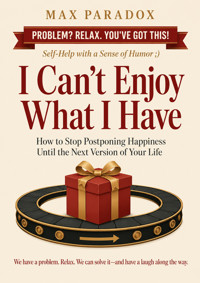
I Can't Enjoy What I Have - How to Stop Postponing Happiness Until the Next Version of Your Life ebook
Max Paradox
Uzyskaj dostęp do tej i ponad 240000 książek od 14,99 zł miesięcznie
- Wydawca: ALL-IN Rafał Płonkowski
- Kategoria: Biznes, rozwój, prawo•Biznes, rozwój
- Język: angielski
You finally get the thing you wanted.
The better job. The nicer apartment. More money. The relationship. The new phone. The vacation. The goal you were sure would make life feel different.
For a while, it does.
Then your brain looks around and says, “Great. What’s next?”
I Can't Enjoy What I Have is a practical, funny guide for anyone who keeps postponing happiness until life becomes a little richer, calmer, thinner, more successful, more organized, or generally more impressive.
Max Paradox explores why the finish line keeps moving even when life improves-and, more importantly, what to do about it.
You will learn how to recognize when healthy ambition turns into chronic dissatisfaction, stop treating ordinary days like waiting rooms, define what “enough” actually means, reduce comparison, enjoy progress before immediately upgrading the goal, and use what you already have instead of constantly preparing for a better version.
This is not a book about abandoning ambition, pretending every day is magical, or becoming deeply grateful for your dishwasher.
You are allowed to want more.
The goal is to want more without making the present emotionally worthless.
Inside, you will find practical methods for separating wants from needs, interrupting comparison, designing better ordinary days, creating stopping points for work, using small pleasures before life becomes “perfect,” recognizing progress that adaptation has made invisible, and returning quickly when old patterns come back.
You will also learn what to do when gratitude feels forced, a bad day suddenly makes your entire life look terrible, motivation disappears, or the future keeps looking more attractive than anything currently happening.
The methods are deliberately realistic.
No four-hour morning routine.
No compulsory journaling beneath a sunrise.
No requirement to become a person who meditates peacefully while someone nearby is asking where the charger is.
Just concrete tools for normal people with jobs, bills, relationships, laundry, goals, phones, and brains that sometimes decide a larger kitchen is the missing piece of the human experience.
If you are tired of reaching goals only to move them, saving good things for later, comparing your real life with everyone else's edited version, or waiting for some future version of yourself to finally know how to relax, this book will help you change the pattern.
You can still build the next version of your life.
You just do not have to miss this one while doing it.
This publication was prepared with the assistance of tools that support the creative process, including artificial intelligence-based solutions. The final concept, structure, and editing belong to the author.
Ebooka przeczytasz w aplikacjach Legimi na:
Liczba stron: 202
Rok wydania: 2026
Odsłuch ebooka (TTS) dostepny w abonamencie „ebooki+audiobooki bez limitu” w aplikacjach Legimi na:
Podobne



















INTRO
You finally get the thing you wanted. The better apartment. The raise. The new phone. The relationship that does not require forensic analysis of punctuation. Maybe you even reach one of those goals you have been carrying around for years like a sacred promise: when this happens, then I will relax. Then I will enjoy myself. Then life will officially begin. And for a few days, perhaps even a few weeks, it works. You feel pleased. Proud. Relieved. Then your brain clears its throat, opens a fresh spreadsheet, and says, “Excellent. Now what is next?”
Apparently happiness has a trial period.
You look around at a life that contains several things an earlier version of you would have considered luxurious, impressive, or at least deeply reassuring. Yet instead of enjoying them, you are mentally standing in the lobby of the next life. The current apartment is fine, but the next one would have more light. Your job is better, but the next promotion would make you feel secure. Your body is okay, but ten fewer pounds would make summer more legitimate. Your weekend is pleasant, but the real fun is scheduled for the vacation three months from now. Even dinner can become a waiting room. You are eating perfectly decent pasta while scrolling photos of a restaurant you may visit in October.
Your life is happening. You are busy comparing it with the trailer for the sequel.
This habit can look ambitious, responsible, even mature. After all, what is wrong with wanting to improve things? Nothing. Wanting more is not the problem. Planning is not the problem. Goals are not the problem. The problem begins when your brain turns every good thing into a temporary placeholder and every ordinary day into construction scaffolding around a future life that is supposedly the real one. You stop living with what you have and start living in permanent pre-release mode.
The strange part is that this can happen after genuine progress. You wanted more money, and now you earn more, but your standard for “enough” quietly moved during the night. You wanted a relationship, and now you have one, but instead of enjoying Tuesday dinner together, you are evaluating whether the relationship is progressing at the correct speed according to an imaginary committee that has never met and somehow has strong opinions about engagement timelines. You wanted a nicer home, and six months after moving in you are looking at kitchen renovations as if the current cabinets have personally betrayed you.
The finish line is on wheels.
There is a psychological reason this keeps happening. Human beings are extremely good at adapting. The new thing becomes normal. The improvement stops glowing. What once felt exciting gets absorbed into the background, where it joins electricity, running water, and the ability to order tacos from a phone without speaking to anyone. This adaptation is useful because otherwise we would spend our days standing in the kitchen whispering, “My God, the refrigerator is cold inside.” But it also means that satisfaction needs some deliberate attention, because the brain is designed to notice change, problems, threats, gaps, and opportunities faster than it notices the quiet fact that many things are already okay.
And then modern life gives this tendency a power tool.
You can now see thousands of possible upgrades before breakfast. Better homes. Better bodies. Better vacations. Better careers. Better morning routines. People drinking green liquids on balconies with suspiciously good bone structure. Someone your age has built a company, renovated a farmhouse, run a marathon, learned Italian, and apparently still has time to make sourdough. You were feeling reasonably content with your Saturday until a stranger named Chloe showed you what Saturday could have been if you owned linen pants and lived near a cliff.
The comparison is not fair, but your nervous system did not receive the memo.
So you begin postponing happiness in increasingly sophisticated ways. You tell yourself you will enjoy life when the debt is lower, the schedule is calmer, the house is finished, the kids are older, the project ends, the next quarter is over, the weather improves, your body changes, your savings reach a certain number, or you finally become the kind of person who has matching storage containers. The conditions sound reasonable because each one is individually possible. The trap is that once one condition is met, another usually appears. Happiness becomes an appointment that keeps being rescheduled by someone with access to your calendar and no respect for your time.
This book is not going to tell you to stop having goals, sell your belongings, delete ambition, and spend your afternoons admiring a spoon. You are allowed to want a better life. You are allowed to improve your finances, health, work, relationships, home, habits, and possibly that one drawer where batteries, receipts, and three mystery keys have formed their own government. The goal is not to become so satisfied that you stop moving. The goal is to stop making movement a condition for permission to feel good.
That distinction matters. There is a large difference between “I would like something better” and “I cannot be okay until I get something better.” The first creates direction. The second creates a hostage situation. When every future goal carries the secret promise of emotional rescue, ordinary progress becomes impossible to enjoy. You achieve something and immediately convert it into evidence that you should now achieve something else. You are not climbing a ladder anymore. You are working for a ladder company.
Over the next twenty chapters, we are going to dismantle that pattern without pretending you can permanently float through life in a cloud of gratitude. You will learn how to notice when your brain is moving the finish line, how to separate healthy ambition from chronic dissatisfaction, how to stop treating ordinary life as an inconvenient gap between major events, and how to enjoy progress before it becomes old news. We will look at comparison, anticipation, perfectionism, lifestyle upgrades, money, achievement, routines, and the seductive fantasy that the next version of you will finally know what they are doing.
Spoiler: future you will also have laundry.
More importantly, you will get practical ways to change how you relate to the life already in front of you. Not by forcing gratitude every morning like a hostage reading a prepared statement, but by learning how attention, expectations, novelty, and desire work. You will build ways to enjoy what is good without becoming complacent, pursue what is next without insulting what is now, and recognize the moment when a goal has quietly stopped being a goal and started becoming a ransom demand.
You do not need to lower your standards until nothing matters. You do not need to convince yourself that every day is magical. Some days are mostly email. The aim is simpler and more useful: to stop requiring your life to become a different life before you allow yourself to experience this one.
Because the next version of your life is not coming to rescue you.
It is being built out of the days you keep postponing.
Chapter 1 - The Finish Line Keeps Moving
You finally buy the thing.
Not a ridiculous yacht. Just something you genuinely wanted. Maybe a better laptop because your old one sounded like it was preparing for takeoff whenever you opened six browser tabs. Maybe a nicer couch. Maybe a watch, a car, a kitchen appliance, or a pair of headphones expensive enough to make you briefly believe you have become a person who understands audio engineering.
For the first few days, you notice it constantly. You admire it. You use it carefully. You may even wipe fingerprints off it with the solemn concentration of a museum conservator.
Three weeks later, it is just your laptop.
Then you see the newer model.
Apparently your happiness has received a software update.
This is one of the most important mechanisms behind the feeling that you cannot enjoy what you have: the mind changes the standard after you reach it. Before getting something, you compare your current situation with the desired one. After getting it, you quickly stop comparing downward and begin comparing upward again.
Yesterday, your goal was the thing you now own.
Today, the thing you own is merely the starting point.
This happens with more than purchases. Suppose you earn $55,000 and dream about reaching $70,000. You imagine the relief. You will save more. Worry less. Order the appetizer without conducting a small parliamentary debate.
Then you reach $70,000.
For a while, excellent. Soon, however, your social circle changes, your spending expands, your expectations rise, and someone casually mentions making $95,000. Suddenly $70,000 no longer feels like arrival. It feels like a strangely specific form of financial underachievement.
The number did not shrink.
The reference point moved.
This is why people can make substantial progress and still feel almost exactly as dissatisfied as before. The mind is a comparison machine, and comparison machines need two points. Once the old target becomes normal, the brain finds a new one.
It does this efficiently.
No meeting required.
There is nothing inherently wrong with this. Adaptation is one reason humans can survive change. You would not want to remain permanently overwhelmed every time you moved to a nicer home or received a promotion. Imagine waking every morning for six years and screaming, “WE HAVE A DISHWASHER!”
Your neighbors would eventually become concerned.
The problem is not adaptation itself. The problem is failing to notice it. If you do not recognize that your internal standard keeps shifting, you may mistake adaptation for evidence that you made the wrong choice, have not achieved enough, or need another upgrade immediately.
You think:
“This doesn’t make me as happy as I expected.”
Therefore:
“I need more.”
But sometimes the better conclusion is:
“Of course it feels normal now. I adapted.”
Normal does not mean worthless.
That distinction can save you a remarkable amount of money, career anxiety, and unnecessary browsing.
Consider housing. You move from a cramped apartment into a place with a spare bedroom. At first, the extra space feels enormous. You walk into that room and think, “We could have guests. We could have an office. We could finally stop storing the vacuum cleaner behind the bedroom door like a suspicious roommate.”
Six months later, the spare room contains a printer, two boxes you have not opened, and a chair whose only known function is holding clothes.
Then you visit someone with a larger home.
Their kitchen has an island.
Oh no.
You return home and suddenly the perfectly functional kitchen you were delighted with in February appears to be suffering from a serious lack of geological features.
This is moving-finish-line thinking. The mind does not simply want improvement. It quietly rewrites the meaning of “good enough” whenever improvement occurs.
If you want to enjoy what you have, you need to catch that rewrite.
A useful first method is what I call the Former You Test.
When something in your life feels ordinary, ask:
What would the version of me from two or five years ago think about this?
Not because former you was wiser. Former you may have thought buying cryptocurrency after watching three videos was retirement planning. We are not consulting them on everything.
We are using them as a reference point.
Think about your job, home, income, relationships, health habits, skills, freedom, possessions, or daily conveniences. Which parts of your current life once existed as goals?
Maybe you once wanted to work remotely one day a week. Now you work remotely three days and complain about the commute on Thursday.
Maybe you once wanted enough savings to handle a surprise $1,000 expense. Now you have that buffer, but it does not feel impressive because your new goal is six months of expenses.
Maybe you once wanted a partner who communicated clearly. Now you have one, and you are annoyed because they load the dishwasher like a person who has rejected geometry.
Both things can be true.
The dishwasher loading can be terrible.
The relationship can still be what you once hoped for.
The Former You Test does not require you to romanticize the present. It simply restores an older reference point so that progress becomes visible again.
Try it in concrete terms. Write down three things you currently treat as normal that an earlier version of you actively wanted.
For each one, finish this sentence:
I used to want __. I now have __. I stopped noticing it when __.
Example:
“I used to want a job where nobody messaged me at 10:30 p.m. I now have one. I stopped noticing it once the new arrangement became normal.”
That sentence is more useful than vaguely telling yourself to “be grateful.”
Gratitude is often presented as if you should sit quietly and generate warm feelings on command.
That is difficult.
Emotions are terrible employees.
You cannot walk into the brain at 8:00 a.m. and announce, “Today we will appreciate the mortgage.”
Instead, work with evidence. Show yourself the change.
The second method is to separate improvement from invalidating the present.
These often get mixed together.
You can say:
“I would like a larger home.”
without saying:
“This home is inadequate.”
You can say:
“I want to earn more.”
without saying:
“My current income proves I am failing.”
You can say:
“I want to get fitter.”
without declaring your current body an administrative error.
This sounds subtle, but the emotional difference is huge. Goals become much heavier when they are attached to a verdict about the present.
Instead of:
“I have to get promoted because I am behind.”
Try:
“I want the promotion because I want more responsibility and income.”
Instead of:
“I need a new car because this one is embarrassing.”
Try:
“I may replace this car because I want more comfort and reliability.”
The first version turns the goal into emotional rescue. The second keeps it as a practical preference.
One gives the future a job it cannot reliably perform.
You are basically telling a salary increase, “Please fix my relationship with myself.”
The salary increase did not apply for this position.
A third strategy is to define enough before you get more.
This is especially useful with money, possessions, career status, and lifestyle upgrades. If you never define what enough looks like, the market, your peer group, and the internet will happily define it for you.
Their definition will be expensive.
Suppose you want to upgrade your phone. Before researching models, write down what problem the upgrade must solve. Battery life? Camera quality? Storage? A cracked screen currently held together by optimism?
Then define what would satisfy you.
If the phone you buy meets those conditions, the purchase is complete.
Not emotionally complete forever. You will still see advertisements. A man with dramatic lighting will explain that the next model contains aerospace-grade something.
Remain calm.
The phone still does what you needed it to do.
The same principle works with income. Instead of using only a vague goal such as “more money,” define levels.
For example:
enough to cover expenses comfortably;
enough to build savings at your chosen rate;
enough for certain optional upgrades;
additional income that is welcome but not required for basic emotional peace.
The exact numbers will differ. The important part is that you decide what the money is for.
Otherwise every increase simply creates a new baseline.
Lifestyle inflation loves an undefined target.
It sees extra income and immediately buys throw pillows.
There is another trap here: sometimes the moving finish line disguises itself as self-improvement.
You read, optimize, track, upgrade, and refine. There is always another habit to build. Sleep better. Exercise more. Eat better. Learn faster. Network smarter. Become calmer. Drink water from a bottle large enough to qualify as municipal infrastructure.
Again, none of these goals is automatically bad.
The warning sign is when improvement prevents enjoyment.
You finish a workout and instantly criticize the pace.
You cook a healthy meal and worry that the ingredients were not organic enough.
You read twenty pages and feel guilty that someone online reads fifty.
Your improvement system has become a machine for manufacturing insufficiency.
This is not discipline.
It is a subscription service for disappointment.
A practical way to interrupt it is to create a short arrival pause whenever you reach something you wanted. Not a six-month celebration. Not a gratitude retreat. Just enough time to register the result before turning it into the new minimum.
When something improves, ask four questions:
What exactly changed?
What problem did this solve?
What is better now than before?
Can I wait before creating the next target?
That last question matters.
You do not need a new goal immediately.
Achievement does not create a legal obligation to begin another achievement by Tuesday.
Sometimes the healthiest thing you can do after improvement is remain at the new level long enough to experience it.
Suppose you finish paying off a debt. Your brain may instantly say, “Great. Now maximize investments, increase retirement contributions, renovate the bathroom, start a side business, and somehow become the type of person who understands tax-loss harvesting.”
Maybe some of those things are good ideas.
But first, notice what disappeared.
The payment is gone.
The balance is zero.
The stress associated with it is different.
That deserves fifteen minutes of psychological registration before the next spreadsheet begins.
Plan B matters because sometimes you understand all this and still cannot feel satisfied.
Fine.
Do not force satisfaction.
Use recognition instead.
You do not have to feel:
“I am overwhelmed with joy about my current life.”
You can simply say:
“This is better than it used to be, and I want to notice that before I move on.”
Recognition is easier than manufactured gratitude.
It is also more honest.
Your practical action today is simple: identify one finish line that moved.
Choose something you wanted, achieved, and now barely notice. Write down what you expected it to change, what it actually changed, and what new standard replaced it.
Then do one unusual thing.
Do not set the next target yet.
Give the current result twenty-four hours without turning it into a launchpad.
Your ambition will survive.
It is extremely resilient.
Chapter 2 - Stop Living in the Waiting Room
It is Wednesday evening, and technically nothing is wrong.
Dinner was fine. Work is over. You have an hour before bed. The room is comfortable. Nobody is demanding an emergency response. Your phone battery is above 20 percent, which in modern civilization qualifies as stability.
And yet you are not really there.
You are thinking about Friday.
Friday will be better.
On Friday you can relax properly.
Then Friday arrives, and you spend part of it thinking about the weekend trip next month.
The trip arrives, and halfway through breakfast you are checking photos of a bigger trip you might take next year.
Congratulations.
You have turned your own life into an airport lounge.
This is postponement thinking: the habit of treating present life as preparation for a more legitimate future period. You are not necessarily miserable. You are simply emotionally absent from whatever is happening now because some upcoming event, milestone, purchase, season, or version of yourself seems more worthy of attention.
The language gives it away.
“I’ll relax after this project.”
“I’ll enjoy summer once I lose some weight.”
“I’ll start dressing better when I get in shape.”
“I’ll invite people over when the house is finished.”
“I’ll travel when work calms down.”
“I’ll be happy once I have more savings.”
“I’ll finally feel settled when we move.”
These sentences are dangerous because they are not obviously ridiculous.
Some delays make perfect sense. If you are in the middle of a difficult project, you may genuinely have less free time. If money is tight, you may need to postpone a vacation. If your kitchen contains no cabinets because someone is renovating it, hosting a dinner party might be unnecessarily ambitious.
The problem is not practical delay.
The problem is emotional delay.
You are allowed to postpone an activity.
You do not need to postpone being alive.
One reason we do this is that future happiness is wonderfully clean. The future has no dirty dishes, awkward conversations, unexpected bills, headaches, traffic, or weather. In the future version, the goal has been achieved without complications.
You imagine the vacation.
You do not imagine getting to the airport at 4:45 a.m. while holding a boarding pass, a coffee, and the growing suspicion that you left the bathroom window open.
You imagine the new home.
You do not imagine arguing about where the router should go.
You imagine the promotion.
You do not imagine that the promotion comes with a meeting called “Quarterly Strategic Alignment Sync,” which somehow lasts ninety minutes and aligns nothing.
Future life benefits from excellent marketing.
Present life has operational costs.
That is why the next version can feel emotionally superior even when your current situation is objectively decent. You compare lived reality, complete with inconvenience, against a concept.
Reality rarely wins that contest.
A fantasy has no laundry.
So the first thing to stop doing is using future conditions as permission slips.
Watch for the structure:
When X happens, then I can Y.
Sometimes X is genuinely required.
“When the cast comes off, I can go running.”
Fair.
Sometimes X has quietly become unnecessary.
“When I lose fifteen pounds, I can buy clothes I like.”
Why?
Do clothes only work after certification?
“When the house is perfectly organized, I can invite friends over.”
Unless your friends are health inspectors, perhaps not.
“When I have more money, I can enjoy weekends.”
What exactly costs money about drinking coffee slowly and ignoring email for twenty minutes?
The brain loves attaching permission to conditions because conditions create a sense of control. If happiness is delayed until after a specific achievement, then happiness appears manageable.
Step one: achieve target.
Step two: collect happiness.
Very tidy.
Unfortunately, happiness has never respected project management software.
A better question is:
What part of the desired future can exist now in a smaller form?
This is one of the most useful tools in the entire book because it turns vague waiting into immediate action.
Suppose your dream is a long international vacation, but it is currently too expensive or impractical. What is the real experience you want from it?
Novelty?
Rest?
Good food?
A break from routine?
Time with your partner?
You may not be able to create the full version now, but you can create a smaller version of the function.
Visit a place in your region you have never seen.
Take a phone-free afternoon.
Try a restaurant from the country you want to visit.
Spend one Saturday behaving like you are on vacation instead of using it to complete twenty-seven domestic tasks that apparently determine your moral worth.
No, this does not replace the trip.
That is not the point.
The point is to stop demanding that all enjoyment wait for the premium package.
This works with larger life goals too.
You want a better home because you want calm and comfort. What can make the current home five percent calmer this week?
Not a $40,000 renovation.
Maybe better lighting.
Maybe removing the chair covered in clothes.
Maybe finally hanging the picture that has been leaning against the wall for eleven months because apparently it needed time to understand the room.
You want a future job with more autonomy.
Where can you create a little more autonomy now?
Maybe by blocking one uninterrupted hour.
Maybe by asking for ownership of a project.
Maybe by reducing unnecessary meetings.
Maybe by not answering a nonurgent message in forty-six seconds.
Tiny versions matter because they break the false rule that the desired feeling belongs exclusively to a future achievement.
Your brain learns:
Some of this is available now.
Another useful method is to separate event happiness from baseline life.
Event happiness comes from things like vacations, celebrations, purchases, promotions, concerts, weddings, big meals, and the arrival of a package you had been checking every twenty minutes despite knowing the delivery window was “by 8 p.m.”
These experiences are valuable.
But they are occasional.
Baseline life is Tuesday.
Tuesday morning. Tuesday lunch. Tuesday evening. The kitchen. The commute. The couch. The people you see regularly. Your ordinary coffee mug with the small chip that you continue using despite owning seven better mugs.