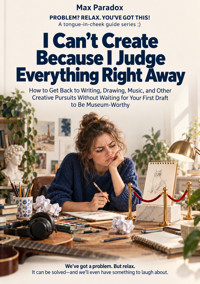
I Can't Create Because I Judge Everything Right Away - How to Get Back to Writing, Drawing, Music, and Other Creative Pursuits Without Waiting for Your First Draft to Be Museum-Worthy ebook
Max Paradox
29,99 zł
19,90 zł
Najniższa cena z 30 dni przed obniżką: 29,99 zł
19,90 zł
Najniższa cena z 30 dni przed obniżką: 29,99 zł
Dowiedz się więcej.
- Wydawca: ALL-IN Rafał Płonkowski
- Kategoria: Biznes, rozwój, prawo•Biznes, rozwój
- Język: angielski
You sit down to create something. You have an idea, a little free time, and enough enthusiasm to believe this might actually be enjoyable. Then you write one sentence, draw three lines, or play four notes.
And immediately decide that the entire project is embarrassing.
Congratulations. Your inner critic has arrived before the creative process has even taken off its coat.
I Can't Create Because I Judge Everything Right Away is a funny, practical guide for anyone who loves the idea of writing, drawing, making music, crafting, or creating something original but somehow turns every first attempt into a final examination of their abilities.
Max Paradox explores the exhausting habit of judging work before it has had a chance to develop. Why does an exciting idea seem magnificent in your imagination but disappointing when you try to make it real? Why do you keep preparing, researching, purchasing equipment, and taking courses instead of beginning? And why does a supposedly relaxing hobby start feeling like an unpaid job with an exceptionally unpleasant supervisor?
Across 20 engaging chapters, this book helps you understand the difference between useful artistic judgment and criticism that prevents you from learning. You'll discover how to approach unfinished work without demanding immediate excellence, recognize when revision has become avoidance, and stop treating every awkward result as evidence that you lack talent.
You'll also explore practical ways to make creativity part of real life. That means working with limited time, imperfect conditions, interrupted projects, and materials that occasionally behave as though they have personal objections to your artistic vision.
Rather than promising miraculous inspiration or insisting that everything you make is secretly brilliant, the book offers a more realistic approach to creative confidence.
You'll learn to focus on particular skills instead of judging your entire ability, use small experiments to investigate ideas, respond to feedback without surrendering your artistic direction, and recognize when a project is ready to finish. You'll also discover why deliberately making a terrible version can sometimes be useful, how to develop ideas through improvisation, and why originality doesn't require inventing an entirely new form of human expression.
The book doesn't ignore the difficult parts. It addresses real creative failures, professional deadlines, conflicting expectations, limited resources, and the frustrating return of perfectionism even after you've made progress.
Most importantly, it challenges the belief that everything you create must become impressive, profitable, publishable, or worthy of public admiration.
Perhaps you want to become a better writer. Perhaps you're returning to painting after years away. Maybe you simply want to enjoy playing an instrument without turning every practice session into an audition.
You don't have to abandon your standards or stop caring about quality. You need to know when those standards help and when they're preventing you from doing the work.
With observational humor, relatable creative disasters, and practical insights that respect ordinary life's limitations, Max Paradox invites you to rediscover the pleasure of making things.
Your first draft doesn't need to belong in a museum.
It just needs a chance to exist.
This publication was prepared using tools that support the creative process, including artificial intelligence solutions. The final concept, structure and editing are the responsibility of the author.
Ebooka przeczytasz w aplikacjach Legimi lub dowolnej aplikacji obsługującej format:
Liczba stron: 301
Rok wydania: 2026
Podobne
















Cover
I Can't Create Because I Judge Everything Right Away
How to Get Back to Writing, Drawing, Music, and Other Creative Pursuits Without Waiting for Your First Draft to Be Museum-Worthy
Max Paradox
PROBLEM? RELAX. YOU'VE GOT THIS!
ISBN: 978-83-8483-610-1
Table of contents
Title page
INTRO
Chapter 1 - Your Inner Critic Has Somehow Been Promoted to Creative Director
Chapter 2 - Who Decided You Needed Talent Before You Were Allowed to Begin?
Chapter 3 - The Masterpiece in Your Head Has Never Had to Deal with Gravity
Chapter 4 - You've Prepared Everything Except the Courage to Begin
Chapter 5 - Your Imaginary Audience Has Started Attending Private Rehearsals
Chapter 6 - The Final Revision Has Been Going on for Three Weeks
Chapter 7 - Your Abandoned Project Hasn't Been Sitting There Judging You
Chapter 8 - Everything Has Already Been Done, So Apparently You Need to Invent a New Art Form
Chapter 9 - Your First Twenty Minutes Don't Need to Change Art History
Chapter 10 - Make the Worst Version. This Time, Do It on Purpose
Chapter 11 - An Idea Knocks, and You Ask to See Its Qualifications
Chapter 12 - Inspiration Hasn't Arrived. Have You Given It Anything to Work With?
Chapter 13 - You Don't Have to Improve at Everything at Once
Chapter 14 - A Brilliant Idea Can Still Be Wrong for This Project
Chapter 15 - Creativity Has a Deadline, and the Client Has Opinions
Chapter 16 - Sometimes It Really Fails, and You Can't Call It an Artistic Experiment
Chapter 17 - Your Creative Life Doesn't Have a Studio, a Schedule, or a Personal Assistant
Chapter 18 - You Finally Enjoy Creating. Please Don't Turn It Into Another Performance Review
Chapter 19 - The Inner Critic Is Back, This Time Wearing a Quality Control Badge
Chapter 20 - You Don't Need Permission to Create Your Own Way
Landmarks
Cover
Title page
Table of contents
Start of content
INTRO
The canvas tote bag looked perfectly innocent when you bought it. Plain cotton, sensible handles, plenty of room for groceries. Then you decided to paint a little fox on the front. Nothing elaborate. Just a cheerful fox sitting among some flowers, perhaps with a slightly mischievous expression. In your imagination, it was charming, distinctive, and effortlessly artistic. Twenty minutes later, the fox has one ear substantially larger than the other, its tail resembles a suspiciously orange banana, and its expression suggests it has just been informed of an unexpected tax inspection. You stare at the bag. You consider fixing the tail. You reconsider the flowers. Then you wonder whether you should have chosen a different painting technique altogether. Before the first layer of paint has dried, you've reached a devastating conclusion: apparently, you're not a creative person. The fox, meanwhile, has done absolutely nothing to deserve this level of professional scrutiny.
Perhaps painting isn't your thing. Maybe you want to write short stories, but every opening sentence sounds embarrassingly ordinary. Perhaps you enjoy making music, yet the moment you record a melody, you start noticing everything that separates it from the songs you admire. You might enjoy photography, sewing, animation, pottery, or designing things that have no particular purpose beyond being interesting. The details change, but the experience is familiar. You begin with curiosity and enthusiasm, only to find yourself conducting a ruthless performance review before you've produced enough material to review. Somehow, an activity you chose because it seemed enjoyable has become an examination you never registered for, administered by an examiner who apparently considers encouragement a disciplinary offense.
Here's the peculiar thing about this problem: being able to recognize weak work isn't necessarily a weakness. In fact, noticing awkward proportions, clumsy wording, or an unconvincing musical phrase can be extremely useful. You need judgment to improve your skills. The trouble begins when judgment takes control of a process that hasn't had a chance to develop. Instead of making something and discovering what it needs, you insist that every decision justify itself immediately. A tentative idea must arrive fully dressed, carrying references, proof of originality, and a convincing explanation of its commercial potential. Naturally, most ideas fail this interview. They are unfinished possibilities, not polished accomplishments. Expecting them to behave otherwise is rather like demanding that a cake taste magnificent while the ingredients are still sitting separately on the kitchen counter.
There is another reason early attempts can feel so disappointing. Your imagination is remarkably good at skipping difficult details. You can picture an elegant illustration without knowing exactly how to construct its perspective. You can imagine an exciting story without having worked out how the characters move from one important event to the next. You can hear a beautiful arrangement in your mind without knowing how to produce the sounds that give it depth. The imagined result feels complete because your mind doesn't insist on supplying every practical decision. Real materials are less accommodating. Paint spreads, sentences refuse to cooperate, instruments produce unwanted noises, and fabric has opinions about gravity. What feels like proof of inadequate talent may simply be your first encounter with the actual work involved in realizing an appealing idea.
Unfortunately, we often interpret this distance between imagination and execution as a personal verdict. A drawing doesn't look right, and suddenly the conclusion isn't that you need more practice with perspective. It's that you were foolish to believe you could draw. A story loses momentum, and you begin questioning whether you possess an imagination worth using. Creative work can feel especially vulnerable because it contains your choices, preferences, and personal way of seeing things. You aren't merely producing an object. You're exposing something you care about. That makes criticism uncomfortable, even when the criticism comes entirely from your own head. But the quality of one unfinished project cannot establish the limits of your abilities, and a disappointing result doesn't automatically reveal some permanent truth about who you are.
Comparison makes matters more complicated. You see someone's beautifully finished embroidery, expertly arranged photograph, or carefully produced recording. You admire the result, then turn toward your own beginner-level attempt and wonder why the difference is so enormous. What you may not see is how much experience, revision, experimentation, and discarded material contributed to the work you're admiring. Nor do you necessarily know what resources the creator had available. You are comparing your current process with someone else's selected result. That comparison might help you identify skills you'd like to develop, but it becomes considerably less useful when you interpret the difference as evidence that you shouldn't bother trying. Other people's accomplishments can show you what's possible without becoming minimum entry requirements for your own creative life.
Sometimes the fear of producing something disappointing disguises itself as responsible preparation. You decide you should understand more about technique before beginning. You research the best materials, bookmark instructional videos, and investigate software features you may never use. Eventually, you've developed an impressive theoretical understanding of your chosen pursuit while producing almost nothing of your own. Preparation can be genuinely necessary, particularly when equipment, money, or safety is involved. But it can also become a comfortable place to hide from uncertainty. Watching an expert demonstrate something beautifully is satisfying. Attempting it yourself involves the considerably less glamorous possibility of discovering that your hands have not yet received the same training as your expectations.
This book won't tell you to abandon standards, celebrate every mistake, or insist that everything you create is secretly brilliant. Some work will be disappointing. Some projects will require substantial revision, and certain skills will take considerable time to develop. Occasionally you'll discover that an idea simply doesn't work. That's part of making things, not an embarrassing exception to the process. What matters is learning to distinguish useful judgment from criticism that stops you before you can learn anything. You'll explore how to recognize the expectations that interfere with your work, make room for experiments, develop particular skills, handle other people's opinions, and finish projects without requiring absolute certainty that no better version could exist.
And we'll keep the practical realities firmly in view. You may have a demanding job, children, relatives who depend on you, limited money, unpredictable energy, or a home that offers approximately seventeen square inches of available workspace. Not everyone can disappear into a peaceful studio for an entire afternoon. Some creative activities genuinely need specialized facilities or uninterrupted time, and pretending otherwise isn't helpful. The aim is to find sensible ways of working within your actual circumstances, including recognizing when a project needs to change shape or temporarily wait. Creative freedom shouldn't require you to neglect your responsibilities, ignore genuine limitations, or feel guilty for occasionally being too tired to pick up a pencil.
One small change is worth considering immediately. Before your next creative session, decide what you actually want that particular attempt to accomplish. Perhaps you're exploring how two colors interact, testing a character's voice, or learning to play a difficult transition. Give yourself an opportunity to perform that task before demanding that the result be beautiful. If you're exploring a technique, the attempt can be useful even when the outcome looks dreadful. If you're producing something for another person, you'll eventually need to judge it against their requirements. The distinction matters. A practice attempt and a finished commission shouldn't be forced through the same evaluation process, just as a rehearsal and a public performance serve different purposes.
You may still feel the urge to judge everything immediately. That doesn't mean you've failed. Changing your relationship with creative work isn't a matter of discovering one miraculous sentence that silences every doubt forever. It involves learning to respond differently when those doubts appear. Sometimes you'll recognize a genuine problem and address it. Sometimes you'll decide that a flaw can remain until you've developed the rest of the piece. Other times you'll stop because you're exhausted, the circumstances are unsuitable, or the project no longer interests you. These are different situations, and they deserve different responses. You don't need to turn every difficulty into another opportunity to question your worth.
Most importantly, creativity doesn't have to justify its existence through exceptional achievements. You're allowed to enjoy drawing without becoming an illustrator, writing without pursuing publication, and making music without building an audience. You can also pursue ambitious goals and take your craft seriously. Neither approach is inherently superior. The point is to make those choices deliberately rather than allowing fear, comparison, or imagined expectations to decide everything for you. The pleasure of making something, the satisfaction of developing a skill, and the pride of finishing a demanding project can all have a place in your life. They don't have to compete for permission to exist.
As for that unfortunate fox on your tote bag, perhaps its tail really does need fixing. Perhaps you'll eventually paint a better one. Or perhaps you'll decide that the peculiar expression is precisely what gives it character. You don't have to settle that question before you've finished painting the flowers. The bag doesn't need to become a masterpiece to make the afternoon worthwhile, and your first attempt doesn't need to predict the quality of everything you'll ever create.
The museum can manage perfectly well without your first draft.
Your imagination, on the other hand, might appreciate being allowed to make one.
Chapter 1 - Your Inner Critic Has Somehow Been Promoted to Creative Director
You decide to record a bedtime story for your niece. Nothing elaborate. You've invented a funny adventure about a dragon who is terrified of heights and consequently works in the basement of a castle. You have a phone, a quiet room, and approximately fifteen minutes before you need to leave for an appointment. The plan is to tell the story, send the recording, and enjoy the possibility that an imaginary dragon might make a child laugh. You press record. "Once upon a time..." Stop. Your voice sounds strange. You start again, this time speaking more slowly. Now you sound like a documentary narrator describing the discovery of an endangered washing machine. Third attempt. Too cheerful. Fourth attempt. Not cheerful enough. By the seventh recording, you are researching microphone placement and wondering whether professional voice actors warm up before delivering dialogue about dragons employed in underground administration. Your niece, who would probably enjoy the story even if you narrated it from inside a cupboard, has received nothing.
The interesting part is how quickly the purpose of the activity disappeared. You wanted to share a story. Within minutes, you were assessing the technical and artistic qualities of your performance against standards nobody had requested. Some of those standards might be perfectly reasonable under different circumstances. Clear speech matters. A recording should be audible. But there is a considerable difference between noticing that your phone captured too much background noise and deciding that your natural speaking voice is fundamentally unsuitable for storytelling. One observation identifies a problem you might solve. The other turns an ordinary creative attempt into a verdict about your abilities. When that happens repeatedly, the actual work struggles to survive long enough to become anything.
Your inner critic isn't necessarily a mysterious psychological villain. For our purposes, it's a convenient name for the collection of judgments, expectations, and automatic reactions that appear while you're making something. Sometimes those reactions reflect useful experience. You notice that a sentence doesn't communicate what you intended, or that a visual arrangement feels unbalanced. At other times, your thoughts leap from a small imperfection to an enormous conclusion. One awkward sentence becomes evidence that you can't write. One unsuccessful experiment supposedly establishes that you lack originality. The critic is especially persuasive because it occasionally provides accurate observations. Unfortunately, being right about a detail doesn't make every conclusion that follows from it equally reliable.
Imagine a theater director interrupting actors after every three words to evaluate the emotional depth of their performances. The director might have excellent artistic judgment. Perhaps the actors really are emphasizing the wrong syllables. But if nobody is allowed to finish a sentence, the scene cannot develop, and the director has very little meaningful material to assess. Something similar happens when you continuously switch between generating ideas and examining their quality. Creative exploration involves discovering possibilities whose value isn't always apparent immediately. Evaluation involves making decisions about what works. Both activities have a place, but demanding a polished result from every unfinished thought can prevent the material needed for useful evaluation from existing.
The critic's most damaging habit is often its ability to change the subject without announcing it. You're working on a melody, and you notice that the transition between two phrases feels awkward. That's a specific observation. Then comes, "Someone with musical ability would have figured this out already." The discussion has shifted from the transition to your identity. A moment later, you're comparing yourself with musicians who have years of experience, reconsidering whether you should continue, and regretting the money you spent on your instrument. Meanwhile, the original problem remains exactly where it was: two phrases need a better connection. You could have spent those minutes trying a different transition. Instead, you've conducted a comprehensive investigation into your right to own a keyboard.
When criticism stops describing the work
One useful distinction is between a judgment that describes something you can examine and one that announces a supposedly permanent limitation. "The introduction doesn't make the subject clear" can lead to a revision. "I'm terrible at explaining things" offers no comparable direction. "These colors compete for attention" identifies a relationship between elements. "I have no taste" condemns a person. The second kind of statement often feels more important because it concerns your abilities rather than the immediate project. In practical terms, though, it's usually less informative. It doesn't tell you which decision caused the problem, which skill might help, or what you should attempt differently. Its main achievement is making a manageable difficulty feel enormous.
This distinction becomes particularly useful when you genuinely dislike something you've created. You don't need to pretend otherwise. Suppose you're writing a short scene in which two strangers discover they've accidentally exchanged identical suitcases. The dialogue feels lifeless. You could tell yourself that the scene is awful and close the document, or you could investigate the source of that impression. Perhaps both characters speak in the same rhythm. Perhaps neither has a convincing reason to care about the exchange. Maybe the dialogue explains information that the action could communicate more effectively. Those possibilities suggest different changes. Your original feeling of dissatisfaction hasn't been dismissed. It has been turned into a question specific enough to explore.
The same principle applies when you cannot immediately explain what's bothering you. Artistic judgments often begin as impressions rather than precise diagnoses. A photograph might feel flat without an obvious technical fault. A paragraph may sound unnatural even though its grammar is correct. You don't have to force an explanation prematurely. You can acknowledge the impression, continue far enough to gather context, and investigate later. The important thing is not to confuse "I don't yet understand what bothers me" with "This entire idea is worthless." Uncertainty about a problem is a reason to look more carefully, not automatically a reason to abandon the work.
Sometimes the critic sounds less like an angry examiner and more like a considerate financial adviser. It tells you to avoid wasting time on something that might not turn out well. You have responsibilities, after all. Wouldn't it be more sensible to spend your evening on a task with a guaranteed result? That argument can sound persuasive, particularly when time is scarce. Yet creative activities often involve uncertainty precisely because you're learning or exploring. If you require guaranteed success before attempting anything, you may avoid many of the experiences through which skills develop. A person learning to write dialogue cannot know in advance which exchanges will work. A beginner experimenting with clay cannot predict every change in shape. That uncertainty isn't proof that the activity is irresponsible.
Of course, there are genuine situations where caution matters. If you're producing work for a paying customer, using expensive materials, or making something subject to safety requirements, some decisions need to be checked before you proceed. The point isn't to silence judgment indiscriminately. It's to apply it where it serves an identifiable purpose. Double-checking the dimensions of a costly piece of wood before cutting it makes sense. Spending forty minutes wondering whether your decorative carving reveals an embarrassing lack of imagination is a different activity. A useful critic understands the difference between preventing a costly mistake and preventing a person from attempting anything that might expose an imperfection.
Another clue lies in how frequently you revisit decisions that haven't acquired any new information. You choose a particular phrase for a poem, replace it, restore the original, and then spend another ten minutes wondering whether your first instinct was actually more authentic. Revision can be valuable, but repeatedly alternating between two choices without a clear reason may indicate that you're searching for certainty rather than improvement. There may be no objectively correct answer. Both versions might work differently. When the critic insists that only one can be acceptable, it creates a problem the task itself doesn't require you to solve.
You can test this distinction by asking what new information would allow you to decide. If the choice concerns readability, view the text at its intended size. If it's about whether a joke works aloud, try saying it naturally. If you're comparing two possible arrangements, listen to each within the larger composition instead of isolating the same few seconds indefinitely. These actions produce evidence relevant to the decision. If you cannot identify anything that would help you choose, you may be dealing with competing preferences rather than a detectable fault. Eventually, choosing one reasonable option can be more useful than continuing the search for a certainty that doesn't exist.
There is also the matter of the invisible audience. Even when you're creating something privately, you may imagine someone whose opinion you respect examining your work. You picture their raised eyebrow at an awkward sentence or their disappointed expression when they notice an obvious technical shortcut. You adjust the project to avoid these imaginary reactions, often without considering whether those people will ever see it. Your imagined audience is particularly difficult to satisfy because it can keep changing its requirements. One moment it demands originality; the next, it considers your experiment too strange. Its feedback isn't based on an actual encounter with your work. It's a series of predictions you produce while feeling uncertain.
This doesn't mean you should disregard genuine audiences. Designing an accessible information leaflet and creating private sketches are different tasks. Readers, listeners, and customers can have legitimate needs. The difficulty arises when you allow vague expectations about hypothetical reactions to override the purpose of what you're currently doing. If your goal is to test the pacing of a scene, speculation about how a famous novelist might judge your prose probably won't help. If you're preparing a finished piece for publication, carefully selected feedback may be useful. Knowing which stage you're in makes a difference. You don't need an imaginary panel of experts supervising every movement of your hand.
Your physical and emotional circumstances can also affect how convincing critical thoughts feel. After a demanding day, you may have less patience with frustrating details than you would after a restful weekend. Limited time can increase the pressure to produce something worthwhile immediately. Noise, interruptions, and uncomfortable working conditions may make concentration difficult. None of this automatically means that the inner critic is the cause of every creative problem. Sometimes the task genuinely needs different conditions. Before interpreting a difficult session as evidence of declining ability, consider whether fatigue or practical obstacles are influencing your response. You might need a simpler task, a different time, or rest rather than an elaborate attempt to improve your attitude.
Give the critic a specific job
A productive way to change this pattern is to ask your critical judgment to answer a narrower question. Instead of inviting a general opinion on whether your work is any good, identify the decision you're actually trying to make. If you're working on a short piece of fiction, you might want to know whether the central conflict is understandable. If you're arranging a piece of music, you might be checking whether the rhythm supports the melody. A critic given one concrete question is less likely to wander into an unnecessary evaluation of your entire creative identity. You can still notice other issues, but they don't all demand immediate attention.
Consider someone learning to create simple digital animations. Their character is supposed to appear surprised when a door opens unexpectedly. The first attempt looks stiff. A sweeping judgment such as "I can't animate" doesn't help. A more focused question might be whether the character's reaction begins too late or whether the movement lacks sufficient contrast. The person can adjust one element, play the sequence, and observe the difference. If the result improves, the change has taught them something. If it doesn't, the experiment still narrows the possible explanations. This process requires no false enthusiasm. It simply makes criticism useful enough to support another decision.
You can also notice the moment when an observation stops producing information and starts repeating itself. Perhaps you've established that a passage is awkward, but you keep thinking about how awkward it is instead of trying to change it. At that point, the critic isn't discovering anything. It's replaying the same verdict. You don't need to argue with it or persuade yourself that the passage is wonderful. You can acknowledge the problem and choose a relevant action. Rewrite one exchange, change the order of events, or leave a clear note about what needs attention. The difference may seem modest, but it changes your relationship with the observation. The problem becomes part of the work rather than an ongoing commentary on the person doing it.
A brief record of these moments can help if premature judgment repeatedly interrupts your projects. After a difficult session, note what you were doing, the first critical thought that appeared, and how it changed your behavior. You might discover that you consistently stop when an unfamiliar technique produces an awkward result. Perhaps you abandon ideas when they become more complicated than expected, or spend excessive time adjusting details just before showing something to another person. These patterns suggest different obstacles. You don't need to record every thought or turn creativity into a supervised psychological experiment. A few specific examples may reveal more than a sweeping declaration that you're simply too perfectionistic.
There's an important limitation here: recognizing the mechanism doesn't mean you'll always enjoy what you make. You may still feel disappointed when a promising idea develops poorly. You may become frustrated with a technique that refuses to cooperate. Such reactions are part of having preferences and ambitions. The goal is to prevent every unpleasant feeling from automatically determining what happens next. You can dislike a result and decide to revise it. You can dislike it and leave it alone because its flaws aren't relevant to the current task. You can also abandon a genuinely unsuitable idea. What matters is that you're choosing among possibilities rather than allowing the first critical reaction to make the entire decision.
Return to the bedtime story about the dragon who works beneath the castle. The recording does need to be audible, and it would probably benefit from a voice that sounds reasonably engaged. But you can achieve those things without producing a professional audiobook. If the narration contains a slightly awkward pause, your niece may not mind. If the story itself needs a better ending, you can invent one. The important distinction is between improving something that matters to your purpose and trying to eliminate every possible sign that the recording was made by an ordinary human being. Your niece asked for a story, not an audition tape for the Royal Academy of Dragon Narration.
Your critical judgment can become an ally when it learns to describe problems accurately, recognize which ones matter, and stop pretending that every unfinished attempt is a final examination. You don't have to get rid of it. You don't even need to like every result it helps you assess. But you can stop allowing it to transform each small difficulty into a conclusion about whether you deserve to create.
A creative director who never allows anything to be made is not directing creativity. They're managing an exceptionally well-organized absence of work. And however professional that arrangement may appear, there is very little worth putting in a portfolio.
Chapter 2 - Who Decided You Needed Talent Before You Were Allowed to Begin?
Somewhere in your past, there may be a sentence that has enjoyed an entirely unreasonable career. Perhaps it was, "You're just not the artistic one." Maybe somebody told you that your singing wasn't very good, or that your older sister had inherited all the family's creative ability. The remark might have been made casually, without any intention of shaping your future. Nevertheless, years later, you can find yourself repeating it whenever you consider trying something new. You've accepted an assessment delivered under circumstances you barely remember, possibly by someone who was distracted, tired, or simply making conversation. Yet the statement has remained in force longer than some national constitutions. Nobody reviewed it, nobody checked whether the evidence was sufficient, and nobody thought to establish an expiration date.
Not everyone has a memorable childhood comment lurking behind their creative doubts. Some people develop them through repeated comparisons, disappointing attempts, or the simple experience of watching others acquire a skill more quickly. Still, it's worth examining where your expectations came from, because they may contain assumptions you've never deliberately accepted. One of the most common is that creative ability should announce itself early. You're supposed to pick up an instrument and reveal an instinctive musical gift, make your first drawing and discover an unmistakable talent, or write a short story that causes a teacher to predict an extraordinary literary future. If your early experiences are ordinary, you assume that something essential must be missing. Unfortunately, most learning looks rather ordinary from the inside.
Consider a teenager joining a school photography club. Another student immediately produces striking pictures, instinctively choosing interesting angles and noticing unusual lighting. You take photographs that look like evidence collected by an insurance company. The difference feels enormous. Perhaps the other student has been taking pictures for years, has learned from an enthusiastic relative, or simply approaches visual subjects differently. Perhaps they do possess some useful natural advantages. You might not know any of these details. What you do know is that your pictures appear weaker during the first few sessions. From that limited information, you may construct a permanent identity: photography isn't for you. You leave the club before discovering what you could learn through practice, feedback, or experimenting with subjects that actually interest you.
The underlying mistake is treating early performance as a comprehensive prediction of future ability. A first attempt can reveal your current skill, familiarity, preparation, and response to a particular task. It cannot reliably establish everything you're capable of learning. This doesn't mean that everyone has identical potential or that sufficient determination guarantees professional excellence. People differ in experience, opportunities, physical abilities, preferences, and many other relevant circumstances. Some skills come more easily to certain individuals. But the existence of differences doesn't make a beginner's awkward performance an adequate reason to declare the entire pursuit permanently unavailable. That conclusion goes much further than the evidence supports.
The problem with being "the talented one"
Surprisingly, encouraging labels can become just as restrictive as discouraging ones. Imagine growing up hearing that you're naturally brilliant at writing. Adults praise your stories, classmates ask you to help with assignments, and you become accustomed to receiving approval for work that feels relatively easy. Eventually, you attempt something more demanding. Perhaps you start writing a mystery with several interconnected characters and discover that keeping the plot coherent requires substantial planning and revision. Suddenly the task doesn't feel effortless. Instead of recognizing a new challenge, you begin questioning your supposed gift. If you're truly talented, shouldn't this come naturally? You may find yourself avoiding projects that could expose the difference between being praised for early work and possessing the advanced skills required for larger ambitions.
There's nothing wrong with praising creative achievements. Thoughtful encouragement can make experimenting feel worthwhile. The difficulty arises when the message emphasizes effortless identity rather than the actual choices and abilities involved. "You have a gift" may feel wonderful, but it doesn't explain what made the work effective. "Your description made that character feel nervous without directly saying so" gives the recipient something more useful to understand. Similarly, telling someone they're hopeless at music communicates very little about their actual difficulties. Perhaps they struggle to maintain a rhythm, distinguish certain pitches, or coordinate their hands while playing. Those are different challenges, and they deserve more precise consideration than a blanket verdict about musical worthiness.
Family identities can reinforce these assumptions without anyone consciously intending harm. One child becomes "the sporty one," another "the clever one," and a third "the creative one." These descriptions make family stories easy to tell, but they can quietly discourage exploration outside established roles. You might decide not to try painting because a sibling already occupies the position of family artist. Nobody necessarily forbids you. You simply assume the position has been filled, rather like discovering that the household has reached its permitted quota of people who enjoy watercolors. Yet interests aren't exclusive appointments. Two siblings can enjoy the same pursuit, develop very different abilities, and produce work that doesn't need to compete.
Adult life often introduces a different version of the same division. People describe themselves as practical rather than creative, analytical rather than artistic, or organized rather than imaginative. These categories can reflect genuine preferences, but they aren't mutually exclusive. Designing a useful object may require practical reasoning and imagination. Composing music involves decisions about structure and relationships as well as emotional expression. Writing a convincing story can demand careful analysis of cause and effect. A person who enjoys solving technical problems may discover considerable pleasure in creative construction. The ability to appreciate order doesn't disqualify you from making art. You do not have to surrender your spreadsheets at the entrance to the pottery studio.
These labels become troublesome when they stop describing familiar habits and start regulating unfamiliar possibilities. Saying "I've never enjoyed drawing much" leaves room for change. Saying "I'm not a creative person" can make experimentation seem pointless before it begins. The first statement concerns your experience. The second pretends to define an enduring category of human being. Sometimes that category provides a convenient explanation for avoiding discomfort. If you're fundamentally unsuited to an activity, you never have to experience the embarrassment of being inexperienced. The price is that you may also miss something you would have enjoyed after learning the basics.
There's an understandable reason people prefer clear labels: they simplify decisions. You have limited time and cannot explore every possible interest. Knowing what you usually enjoy is useful. But efficient decision-making and premature self-exclusion are not the same thing. You can decide that learning classical guitar isn't currently a priority without announcing that you're biologically incapable of music. You can recognize that drawing doesn't interest you enough to justify regular practice while leaving open the possibility of trying it occasionally. Those choices are more accurate and considerably less dramatic. They also spare you the peculiar task of defending your entire personality whenever somebody invites you to a creative workshop.
Difficulty doesn't necessarily mean you've chosen the wrong activity
A particularly misleading belief is that an appropriate talent should make learning enjoyable and straightforward from the beginning. This expectation can survive even when you intellectually understand that skills require practice. You start learning a new technique, encounter resistance, and feel disappointed that the experience doesn't match the effortless enthusiasm you imagined. Perhaps your hands move too slowly, your ideas are difficult to execute, or the result lacks the character you hoped for. You begin wondering whether this is a sign that you should stop. Sometimes it is reasonable to reconsider an activity after experiencing it. But difficulty alone doesn't tell you whether the pursuit is unsuitable.
Imagine someone interested in writing songs who discovers that finding lyrics for a melody is unexpectedly frustrating. They enjoy experimenting with melodies, understand the mood they want, and have plenty of ideas about what the song should express. Yet whenever they try to write words, everything sounds forced. They might conclude that songwriting isn't for them. A more informative interpretation would separate their interest in the activity from the particular skill causing difficulty. Perhaps they need to learn more about phrasing, stress patterns, or how words interact with rhythm. They might also discover that they prefer instrumental composition. Both are legitimate outcomes. What doesn't follow automatically is that one difficult element has invalidated their entire musical interest.
The important question is whether you want to engage with the challenges associated with a pursuit. You don't have to enjoy every minute, and you shouldn't expect permanent enthusiasm. But the subject may continue to interest you even when particular tasks are frustrating. If you find yourself curious about how others solve the same problems, if you enjoy noticing small improvements, or if the process offers something you value beyond receiving praise, those are reasons to keep exploring. Conversely, you may discover that you only liked the idea of being someone who performs that activity. Perhaps you admired the image of yourself as a filmmaker but dislike the actual work of assembling scenes. There's no shame in discovering that distinction.