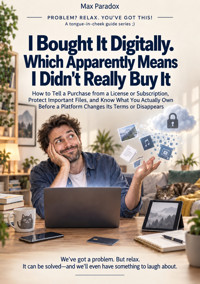
I Bought It Digitally. Which Apparently Means I Didn't Really Buy It - How to Tell a Purchase from a License or Subscription, Protect Important Files, and Know What You Actually Own Before a Platform Changes Its Terms or Disappears ebook
Max Paradox
29,99 zł
19,90 zł
Najniższa cena z 30 dni przed obniżką: 29,99 zł
19,90 zł
Najniższa cena z 30 dni przed obniżką: 29,99 zł
Dowiedz się więcej.
- Wydawca: ALL-IN Rafał Płonkowski
- Kategoria: Biznes, rozwój, prawo•Biznes, rozwój
- Język: angielski
You paid for it. You downloaded it. You even received a receipt. So why does your digital purchase suddenly need permission to exist?
Welcome to the wonderful world of digital ownership, where the Buy button can mean several different things, your favorite software may depend on a distant server, and a subscription can remain remarkably loyal to your credit card long after you've stopped using it.
In I Bought It Digitally. Which Apparently Means I Didn't Really Buy It, Max Paradox takes you behind the cheerful checkout screens to explore what actually happens when you purchase ebooks, movies, games, software, digital collections, and online services.
With sharp observational humor, relatable situations, and practical explanations, this guide helps you understand the rules of a marketplace where paying for something doesn't always mean controlling how, where, or for how long you can use it.
Inside, you'll discover how to:
Tell the difference between a digital purchase, a license, a rental, and a subscription without needing a law degree.
Understand DRM, device restrictions, activation systems, and the hidden dependencies behind downloaded products.
Recognize when an attractive digital ecosystem is becoming difficult or expensive to leave.
Identify which digital purchases and original files genuinely deserve protection.
Create a useful inventory of important digital assets without turning your spare time into an administrative career.
Protect essential accounts and prepare realistic recovery options.
Build backups that can actually restore your work, rather than merely displaying reassuring green check marks.
Preserve valuable files when software, formats, and devices become obsolete.
Ask the right questions before purchasing and avoid unexpected licensing or renewal surprises.
Handle broken digital purchases, contact sellers effectively, and understand when consumer remedies may be relevant.
Move between services without unnecessarily abandoning important information.
Prepare for digital inheritance, platform closures, and incidents that interrupt access to essential resources.
The book doesn't pretend that every subscription is a trap, every company is untrustworthy, or every digital file needs to be preserved for the next five centuries.
Sometimes renting access makes perfect sense. Sometimes a subscription offers excellent value. And sometimes an independent downloadable file is worth paying more for because your future plans shouldn't depend entirely on a provider's continuing enthusiasm.
The difference is knowing which arrangement you're choosing.
Through twenty engaging chapters, Max Paradox combines consumer awareness, practical technology knowledge, realistic decision-making, and plenty of dry humor. There's no demand to abandon the cloud, install seventeen security applications, or begin every morning by inspecting your software licenses.
Instead, you'll learn how to distinguish genuine risks from unnecessary worries, make proportionate choices, and keep control of the digital resources that actually matter.
Because if your money is real, your understanding of what you're buying should be real too.
And if a platform ever announces that your permanent purchase has entered its final week of availability, at least you'll know which questions to ask before congratulating its marketing department.
This publication was prepared using tools that support the creative process, including artificial intelligence solutions. The final concept, structure and editing are the responsibility of the author.
Ebooka przeczytasz w aplikacjach Legimi lub dowolnej aplikacji obsługującej format:
Liczba stron: 239
Rok wydania: 2026
Podobne


















Cover
I Bought It Digitally. Which Apparently Means I Didn't Really Buy It
How to Tell a Purchase from a License or Subscription, Protect Important Files, and Know What You Actually Own Before a Platform Changes Its Terms or Disappears
Max Paradox
PROBLEM? RELAX. YOU'VE GOT THIS!
ISBN: 978-83-8483-682-8
Table of contents
Title page
INTRO
Chapter 1 - The Buy Button Is Not a Property Deed
Chapter 2 - Purchase, License, Rental, Subscription: Four Labels, Several Different Deals
Chapter 3 - Where Digital Purchases Go When Nobody Has Stolen Them
Chapter 4 - It Worked Yesterday, So It Must Be Safe Forever
Chapter 5 - DRM: The Security Guard Who Doesn't Recognize Paying Customers
Chapter 6 - The Digital Walled Garden: Beautiful Flowers, Very Expensive Exits
Chapter 7 - We've Updated Our Terms. Thank You for Agreeing
Chapter 8 - One Account to Rule Them All, and One Lost Phone to Ruin Tuesday
Chapter 9 - Take Inventory Before Your Digital Possessions Take You by Surprise
Chapter 10 - Your Backup Is Only as Good as Your Last Successful Restore
Chapter 11 - The File Survived. Unfortunately, the Software Didn't
Chapter 12 - Six Questions to Ask Before Your Credit Card Gets Excited
Chapter 13 - I Paid, It Doesn't Work, and Customer Support Has Entered Witness Protection
Chapter 14 - How to Leave a Platform Without Leaving Half Your Life Behind
Chapter 15 - The Digital Estate: When Someone Leaves Behind Accounts Instead of Keys
Chapter 16 - Everything Breaks at Once: Save the Situation, Not Just the Software
Chapter 17 - Some Digital Things Cannot Be Saved. That Doesn't Mean You Have to Lose Everything
Chapter 18 - Digital Housekeeping Without a Second Full-Time Job
Chapter 19 - Keep Your Options Open: The Art of Depending on Technology Without Becoming Trapped
Chapter 20 - The Next Time You Click Buy, You'll Know What You're Choosing
Landmarks
Cover
Title page
Table of contents
Start of content
INTRO
Your laptop dies on a Tuesday. Not dramatically, with sparks and smoke, which would at least make for an interesting story. It simply refuses to turn on, displaying the enthusiasm of a teenager asked to clean the garage. Fortunately, you have another computer. You restore your files, install your favorite software, and prepare to continue working on a project you started last month. Except one application refuses to activate. You bought it two years ago, paid a substantial amount, and have the receipt to prove it. The activation system insists that your license is already being used on another machine. That machine is currently sitting on your desk, displaying all the useful characteristics of a decorative brick. You contact support and discover that the software company has changed its licensing system. Welcome to digital ownership, where proving you paid is sometimes easier than proving you're allowed to use what you paid for.
The peculiar thing about buying digital products is how reassuringly ordinary the process feels. You select an item, see a price, enter your payment details, and receive an enthusiastic confirmation. Your purchase appears in a library with a neat little icon, perhaps accompanied by a message congratulating you on becoming its proud owner. Nobody interrupts the celebration to explain that your new acquisition may depend on an active account, a functioning authentication server, a compatible device, and contractual terms longer than the operating instructions for a nuclear submarine. Those details are usually waiting somewhere behind a modest link labeled "Terms and Conditions." The checkout button, meanwhile, practically throws confetti.
For most of human shopping history, paying for something tangible has come with fairly understandable expectations. Buy a chair, and you can generally sit on it without asking the furniture manufacturer to verify your subscription. Buy a notebook, and the company that printed it cannot remotely disable page forty-seven because its distribution agreement has expired. Physical ownership certainly comes with legal restrictions and practical limitations, but the underlying relationship usually feels straightforward. Digital products complicate that relationship because the thing you're paying for might be a file, permission to use copyrighted material, access to an ongoing service, or several of these combined.
That distinction matters more than the wording on a checkout screen. A one-time payment does not automatically mean unrestricted use forever. A subscription isn't necessarily a bad deal, and a license isn't some sinister loophole invented to torment customers. Licenses can provide valuable, clearly defined rights, while subscription services can deliver convenience and features that would be expensive or impractical to maintain independently. What matters is understanding the particular arrangement you're entering. The actual terms, the nature of the product, and applicable consumer protections all affect your position. A company cannot necessarily make every restriction enforceable simply by burying it in a document nobody wants to read.
Then there is the technical side, which has a remarkable ability to create problems even when everyone involved is behaving reasonably. You might have permission to use a program but lack the working software needed to open its files. You might have downloaded an audiobook only to discover that its offline playback still depends on periodic authorization. You might store years of notes in a convenient service, unaware that its export function preserves the text but not the relationships between your notes. In each case, the question of what you legally possess is only part of the picture. What can you actually use, preserve, move, and recover when circumstances change?
This is where our collective faith in technology occasionally becomes a little too generous. We see a file in an online account and assume it's safely stored. We see a download button and assume the result will work independently. We see a famous company logo and imagine the product will remain available indefinitely. None of those assumptions is completely irrational. Modern digital services can be impressively reliable, and they often make difficult tasks effortless. But convenience is not the same as permanence. A beautifully organized online library tells you remarkably little about what will happen if its provider stops operating, changes its business model, or decides your favorite feature belongs in a more expensive plan.
The consequences aren't always dramatic. Sometimes you lose access to an inexpensive purchase you barely used. Sometimes an automatic renewal charges you for another year of something you no longer need. These situations are irritating, but generally manageable. Other losses are more serious. A professional project locked inside an obsolete application may take days to reconstruct. An inaccessible account can prevent you from retrieving important documents. Unique recordings, photographs, or creative work may be impossible to replace. That's why protecting everything equally makes little sense. The important question is what would genuinely matter if it disappeared, and how much control you need over it.
You also don't need to become a cybersecurity specialist, contract lawyer, and part-time archivist to shop sensibly. Most people already have enough responsibilities without adding "Director of Personal Digital Asset Continuity" to their unpaid job titles. The useful approach is selective. Learn which terms reveal important restrictions, what makes one product more portable than another, and how to recognize a risky dependency before building years of work around it. Understand what a backup actually protects, why owning a file doesn't necessarily mean owning the rights to its contents, and how to approach a dispute when a purchase fails to deliver what was promised.
We'll also take an unsentimental look at the money involved. A cheap monthly subscription can be excellent value for a temporary need and a terrible bargain when it quietly renews for years. A supposedly permanent purchase might give you long-term access to one software version without promising future updates or compatibility. A more expensive option may be worthwhile if it preserves important capabilities, but paying extra doesn't automatically buy independence. The goal isn't to declare one purchasing model the winner. It's to understand the real costs, benefits, and limitations well enough to choose according to your circumstances rather than the seller's preferred button.
There will be situations where the sensible response is to accept a limitation. You might happily rent access to something you'll use once. You might choose a closed platform because its tools save you hours every week. You might decide that preserving a certain digital purchase simply isn't worth the effort. These aren't failures of digital responsibility. They're reasonable judgments when you understand what you're trading away. The problem begins when you make the trade without realizing there was a trade at all, then discover its consequences at precisely the least convenient moment.
Here's a useful starting point. Think of one digital item you've paid for and expect to use again in the future. Forget its price for a moment. Ask yourself what would happen if the store disappeared tomorrow. Could you still access it? Would you need a particular application, account, or internet connection? Is there something important you've created using that product that would be difficult to recover? You don't need to solve every uncertainty immediately. Simply identifying one is progress, because a question you can articulate is considerably easier to investigate than a vague belief that everything will probably be fine.
By the time you've explored these issues, the digital world won't suddenly become perfectly predictable. Companies will still change products, software will still age, and technology will occasionally behave like it has personal objections to your plans. But you'll be better equipped to recognize what you're buying, protect what matters, and decide when a convenient service is worth its limitations.
You should be able to enjoy digital products without treating every purchase as a legal emergency. And when you click "Buy Now," you deserve a clearer idea of what those two cheerful words actually mean.
Because your payment was real. Your expectations should have a reasonable connection to reality, too.
Chapter 1 - The Buy Button Is Not a Property Deed
The trouble begins with a birthday present. You have purchased a beautifully illustrated digital collection of vintage botanical drawings for someone who loves gardening. The store calls it a permanent purchase, the illustrations look magnificent, and the price is just high enough to make the gift feel thoughtful without requiring a conversation with your bank manager. You imagine the recipient displaying the drawings on a large screen, studying the details, and perhaps printing a few for the study. Instead, after opening the gift, they discover that the collection can only be viewed through the seller's application. Printing is restricted, exporting isn't available, and the supposedly permanent collection requires an account that cannot be transferred to another person. You have bought a present that behaves suspiciously like a museum membership. The flowers are lovely, but apparently they belong to the institution.
The most frustrating part is how normal the transaction looked. There was a product description, a price, a shopping cart, and a confirmation announcing that your purchase was complete. At no point did a serious-looking representative emerge from behind the website to explain that you were entering a relationship involving intellectual property, contractual permissions, authentication systems, and the continuing availability of a commercial service. The store used the language of ordinary shopping because ordinary shopping is familiar. Customers understand buying things. They're considerably less enthusiastic about acquiring conditional access to a digital environment governed by fourteen pages of definitions. Unfortunately, familiarity can conceal important differences. The transaction may be perfectly legitimate while still delivering something substantially different from what you expected.
The first distinction worth understanding is that paying for a digital product doesn't necessarily transfer ownership of the underlying intellectual property. When you purchase a digital illustration, you ordinarily aren't acquiring the artist's copyright or the unrestricted right to manufacture merchandise featuring the artwork. You're receiving particular rights or access associated with the transaction. The same basic distinction exists with physical products: buying a printed novel doesn't make you the owner of the author's copyright. But digital delivery introduces additional complexity because the copy, the permission to use it, and the technology needed to access it may be controlled in different ways.
Consider a physical painting and a digital image of that painting. If you buy the physical painting, the object itself can generally remain in your possession without any continuing involvement from the seller. Your ability to reproduce the artwork commercially is a separate question. With a digital image, the seller might provide an ordinary downloadable file, a protected file requiring special software, or access through an online gallery. Each arrangement can provide genuine value, yet your practical ability to retain and use the image differs considerably. The question isn't simply whether you own something. It's which rights, copies, and capabilities you've actually received.
Three Things That Look Like One Purchase
Digital stores often package several distinct elements into a single transaction. There is the payment, which establishes that you've provided money or another agreed form of consideration. There is the legal entitlement, which describes the rights granted under the contract and applicable law. Finally, there is practical access, which determines whether you can actually use the product under real conditions. These elements are connected, but they're not interchangeable. A receipt may prove the transaction occurred without containing the software needed to open the purchased material. A valid license may continue to exist even when an authentication server temporarily fails. And possession of a usable file doesn't automatically authorize every possible use of its contents.
This explains a particularly aggravating experience: being told by a computer that you lack permission to use something despite having paid for it. The computer is rarely making a sophisticated legal judgment. It's checking whatever information its authorization system requires. Perhaps your account isn't recognized, a device limit has been reached, or a technical service is unavailable. The resulting error message may sound absolute, but it doesn't necessarily establish that your underlying rights have disappeared. When the problem is significant, understanding that difference helps you determine whether you're dealing with a technical failure, a contractual restriction, or a dispute about the product supplied. Shouting your order number at the monitor, although emotionally understandable, is unlikely to clarify which one.
Another distinction concerns the meaning of a download. People naturally associate downloaded files with possession because the information occupies space on their devices. Yet downloading can mean several different things. You might receive a standard file that compatible software can open independently, or you might receive encrypted content that works only inside a particular application. Some systems also require periodic authorization even when the content itself is stored locally. The fact that your device reports several gigabytes of downloaded material doesn't establish that those gigabytes will remain useful after your account changes or the application stops working.
None of this means that digital purchases are inherently inferior to physical ones. A downloadable product can be wonderfully convenient, easy to duplicate for legitimate backup purposes where permitted, and available across many devices. A cloud-based product may deliver capabilities that couldn't reasonably be included in a standalone file. The important point is that these advantages come with different dependencies. A feature supported by remote servers may rely on continuing service availability, whereas a simple local file may depend primarily on compatible software and functioning storage. The best arrangement depends on what you're trying to accomplish, not on a universal rule declaring every online service suspicious.
When the Word "Mine" Becomes Complicated
Imagine you've purchased a package of digital typefaces for designing invitations. You install the fonts, create several beautiful projects, and decide that the purchase was worthwhile. Six months later, a friend asks whether you can send them the font files. You paid for them, they're stored on your computer, and forwarding a file takes seconds. Surely this is no different from lending someone a pencil? Not necessarily. Font software is commonly distributed under licenses that define permitted installations, users, and uses. Your permission to create designs with a typeface may not include permission to distribute the software itself. The fact that copying is technologically effortless doesn't answer whether that copying is authorized.
This is where digital ownership discussions often become unnecessarily dramatic. One group insists that paying for something means having the right to do absolutely anything with it. Another assumes that whatever limitations a company puts in its terms must be legally binding. Neither position is reliable. Copyright law, consumer protection rules, contract terms, and the nature of the transaction can all matter. Different jurisdictions also treat particular rights and restrictions differently. Some contractual provisions may be unenforceable, and mandatory consumer rights cannot necessarily be waived through a checkbox. If a specific dispute arises, the correct answer requires examining the circumstances rather than accepting either side's favorite internet slogan.
A more useful approach is to distinguish the things you expect to do with a product. Reading purchased material privately, transferring access to another device, sharing copies with friends, including content in commercial work, and reselling an entitlement are different activities. A product may permit some while restricting others. You don't need to master the legal treatment of every activity before making an ordinary purchase, but you should investigate the uses that matter to you. If you're buying artwork to print on products for customers, commercial-use permissions are important. If you're buying material simply to view at home, compatibility and continued access may matter more.
The language used in marketing doesn't always make these distinctions obvious. Words such as "own," "forever," and "unlimited" can sound reassuring without explaining exactly what is covered. Unlimited downloads might refer to the number of times you can access materials while a subscription remains active. Permanent access might describe a particular entitlement rather than a promise that every supporting service will operate indefinitely. These claims shouldn't automatically be dismissed as meaningless, because advertising representations and contractual promises can matter. They should, however, be read in context. If a statement influences your decision to spend a substantial amount, look for an explanation of what it actually guarantees.
You may discover that the information is scattered across several places. The product page describes features, the licensing agreement discusses permitted use, and the help center explains technical limitations. This fragmentation is irritating, especially when all you want is a set of illustrations rather than an advanced qualification in commercial archaeology. Still, you can often avoid exhaustive reading by identifying a specific uncertainty. Ask whether the files can be opened outside the supplied application, whether access survives cancellation, or whether the intended use is permitted. A clear question is easier for a seller to answer than the surprisingly philosophical inquiry, "Is it really mine?"
A Small Reality Check Before Trusting Your Library
Take a digital product you already use and examine what would happen if you changed devices tomorrow. Don't deliberately lock yourself out or delete anything. Simply locate the transaction details, identify the account associated with the purchase, and determine how the product would be restored. Is there an ordinary installer or downloadable file? Would the application require activation? Are your own projects stored separately from the software? Could you access the essential results if the seller's website became unavailable? You may not find every answer immediately, and that's fine. The exercise is useful precisely because it reveals assumptions that were previously invisible.
Suppose the product is a purchased recipe-layout application. You discover that the software requires an account but that finished recipe cards can be exported into commonly readable files. This gives you one form of independence even if the editing software remains tied to the provider. If the application also saves editable projects in a proprietary format, you now know that continuing to edit older designs may depend on compatible software. Neither discovery automatically makes the purchase good or bad. It tells you what you're relying on, and therefore which future changes would actually matter.
You might also learn that your purchase includes rights you hadn't realized you possessed. Perhaps the seller permits installation on several personal devices, supplies offline installers, or offers a documented procedure for transferring an activation. People sometimes assume restrictions that don't exist simply because one familiar application imposed them in the past. Treat the actual terms as evidence rather than assuming all digital products follow the same rules. A particularly restrictive service shouldn't become your mental template for the entire industry, just as one remarkably unpleasant customer-service experience shouldn't convince you that every employee is secretly trained to hate customers.
The practical value of this distinction becomes clear when problems arise. If you know that your entitlement remains valid but your activation has failed, you can describe the issue precisely when contacting support. If a promised feature was never supplied, you can identify the relevant discrepancy rather than arguing abstractly about ownership. If you discover that the product is fundamentally unsuitable before purchasing, you can choose something else. In all three cases, understanding the relationship between payment, rights, and access leads to a better decision than relying on the appearance of a checkout screen.
There are limits to how much control any buyer can obtain. Digital products may rely on technologies, formats, or services that you cannot maintain personally. Even standalone files need usable storage and appropriate software. And some experiences are valuable precisely because they involve continually provided services. Expecting total independence from every provider would make ordinary shopping unnecessarily difficult, expensive, and sometimes pointless. The objective is to recognize dependencies and decide which are acceptable, especially when a purchase involves important work, substantial money, or something irreplaceable.
Our botanical collection, for example, might still be a lovely present for someone who enjoys viewing the illustrations in the seller's application. It becomes a disappointing gift when the recipient expects printable files or the freedom to use a preferred device. The artwork hasn't changed. The price hasn't changed. What matters is the match between what was supplied and what the buyer reasonably needed, subject to the terms and protections governing the transaction.
A button labeled "Buy" can initiate a perfectly worthwhile digital purchase. It simply doesn't explain every right, limitation, and dependency involved. Once you stop expecting four cheerful letters to perform the work of an entire agreement, the digital marketplace becomes considerably easier to navigate.
And if a store ever introduces a checkout button labeled "Acquire a Contractually Defined Bundle of Access Rights," you can congratulate its legal department on a magnificent achievement while quietly shopping somewhere with clearer explanations.
Chapter 2 - Purchase, License, Rental, Subscription: Four Labels, Several Different Deals
A remarkably large part of digital shopping depends on customers treating four different arrangements as though they were interchangeable. Purchase, license, rental, and subscription appear on websites in combinations that would make a restaurant menu considerably more adventurous. Imagine ordering dinner and discovering that the appetizer is yours permanently, the main course requires a renewable license, the dessert expires forty-eight hours after your first bite, and the waiter will continue charging your credit card until you locate the cancellation page. Most people would demand an explanation. Online, we often accept comparable arrangements because the product arrives instantly and nobody wants to interrupt a convenient checkout.
The confusion begins because these labels describe different aspects of a transaction. A purchase describes an acquisition or transaction, while a license specifies permissions to use something. A rental emphasizes temporary access, and a subscription generally describes an ongoing arrangement involving recurring payment or continuing service. These aren't four perfectly separate categories. You can purchase a license, rent access to licensed content, or subscribe to a service that provides certain permanent benefits alongside temporary ones. The arrangements overlap because digital commerce wasn't designed to fit neatly into a beginner's vocabulary exercise. Understanding them requires looking beyond the label to the actual rights, time limits, payments, and technical dependencies involved.
Consider a community choir preparing for its annual concert. The director needs a digital rehearsal package containing musical arrangements, practice recordings, and an interactive score viewer. Several suppliers offer products that appear almost identical in promotional screenshots. One sells downloadable materials for a single payment. Another provides an annual license to specialist software. A third rents individual arrangements for a fixed rehearsal period. A fourth offers a subscription to a large online catalog. All four could help the choir rehearse. However, the appropriate choice depends on whether the materials will be needed for one performance, repeated future concerts, or an ongoing program of different musical projects.
When a One-Time Purchase Actually Means One-Time Payment
The first supplier offers a downloadable package for a fixed price. After payment, the director receives score files and practice recordings that can be stored locally and used according to the accompanying terms. There are no automatic renewals. Assuming the files are compatible with the choir's equipment and don't require ongoing authorization, this arrangement provides substantial practical control over continued access. The supplier might disappear next year without preventing the choir from opening copies it has properly retained. That's a meaningful advantage when the same arrangement will be rehearsed repeatedly.
But the phrase "one-time purchase" doesn't answer every relevant question. The supplier may grant particular rights for using, printing, or distributing the materials. A license for one choir may not permit forwarding the complete package to unrelated organizations. Public performances or recordings may involve additional rights depending on the music, jurisdiction, and circumstances. The director therefore needs to distinguish possession of the files from permission for the planned activities. A downloadable score isn't a declaration that copyright law has decided to take the afternoon off.
The buyer should also understand what happens to future versions. If the publisher corrects errors, adds recordings, or changes the score viewer, those updates might be included or sold separately. A perpetual entitlement to the originally supplied version doesn't automatically imply free access to every future improvement. Conversely, a product sold with clearly promised updates should be evaluated against that promise. The useful question is whether the original materials will continue to meet the choir's needs, rather than whether the word "permanent" appears somewhere in particularly reassuring typography.
A one-time purchase is attractive when you expect repeated use and want to avoid recurring payments. It can be less appealing when the material becomes outdated quickly, requires frequent service-based improvements, or will only be used once. Paying more upfront for theoretical independence isn't necessarily prudent if you have little reason to use the product again. The buyer who purchases an expensive lifetime package for a single weekend project hasn't necessarily made a wise investment. They've merely committed very enthusiastically to a future that may never happen.
A License Is a Set of Permissions, Not a Dirty Word
The second choir supplier offers specialist rehearsal software under an annual license. The director pays for permission to use the application during a defined period, perhaps with a specified number of accounts or devices. The arrangement may include updates, technical assistance, and functions unavailable in ordinary score files. It could be ideal for a choir that regularly prepares complicated arrangements and benefits from interactive tools. The license is neither imaginary ownership nor evidence of wrongdoing. It is a defined legal arrangement, and its usefulness depends on whether those permissions match the intended activities.
Licenses also come in different durations and structures. Some remain effective without a predetermined end date for a particular software version, while others expire or require renewal. Certain licenses may permit use on multiple devices, restrict commercial applications, or distinguish individual and organizational customers. A license can also be free, as happens with many software products, including programs distributed under open-source licenses. The important distinction is the scope of permission, not merely whether money changed hands. Calling every licensed product a subscription would be like calling every rented vehicle a taxi because both involve transportation.
Suppose the choir purchases a perpetual software license, meaning that the right to use the specified version isn't inherently limited to one year. That doesn't establish that the manufacturer must provide endless support, compatibility updates, or replacement activation infrastructure in every circumstance. The application may eventually become difficult to run on newer equipment. At the same time, the supplier's obligations and the buyer's rights cannot be determined from the word "perpetual" alone. The contract, representations made during the sale, and applicable law all matter. Where the software is expensive or critical to an organization, these questions deserve clarification before purchase.