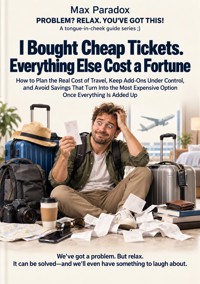
I Bought Cheap Tickets. Everything Else Cost a Fortune - How to Plan the Real Cost of Travel, Keep Add-Ons Under Control, and Avoid Savings That Turn Into the Most Expensive Option Once Everything Is Added Up ebook
Max Paradox
29,99 zł
19,90 zł
Najniższa cena z 30 dni przed obniżką: 29,99 zł
19,90 zł
Najniższa cena z 30 dni przed obniżką: 29,99 zł
Dowiedz się więcej.
- Wydawca: ALL-IN Rafał Płonkowski
- Kategoria: Poradniki•Przewodniki
- Język: angielski
The flight was cheap. The trip, somehow, developed ambitions.
A low fare can feel like a financial victory right up until baggage, airport transfers, parking, inconvenient departure times, currency conversion, rental-car extras, hotel location, food, deposits, and twenty innocent little charges all introduce themselves. None of them seems catastrophic on its own. Together, they can turn a bargain into the most expensive version of “saving money.”
I Bought Cheap Tickets. Everything Else Cost a Fortune is a practical, funny guide to understanding what travel actually costs before the final bank statement explains it for you.
Max Paradox shows how to stop judging a trip by its most attractive headline price and start comparing complete travel scenarios instead. You will learn how to build a realistic door-to-door budget, spot costs that hide outside the booking screen, compare baggage and fare options properly, judge whether a cheaper hotel is still cheaper after daily transport, and decide when convenience is genuinely worth paying for.
The book also tackles the expenses that become visible only after several decisions start interacting. Separate tickets may save money until one delay breaks the chain. A rental car may have an irresistible daily rate until fuel, parking, insurance, deposits, tolls, and additional drivers arrive for the reunion. A flexible date may reduce the airfare while increasing accommodation, leave, or local transport. Even foreign-currency payments can add cost without adding anything enjoyable to the trip.
This is not a book about choosing the cheapest possible option every time. Sometimes paying more is the smarter financial decision because it saves time, reduces risk, protects something important, or prevents several secondary costs. The goal is to understand the trade before paying for it.
You will also learn how to plan when dates and destinations cannot move, how to handle different budgets inside a group, what to do when the original plan has already fallen apart, and how to stop throwing new money at costs that are already gone. There are practical minimum versions for people who do not want to maintain elaborate spreadsheets, realistic Plan B options when life refuses to cooperate, and simple ways to notice when a “cheap trip” has quietly started getting expensive.
By the end, the aim is not to turn you into a person who audits every coffee. It is to help you create your own travel decision system: know what matters to you, know where you usually overspend, compare full costs, protect a sensible buffer, and stop optimizing once the saving is no longer worth the trouble.
Because a $149 ticket can still be a fantastic deal.
It just should not be allowed to appoint itself chief financial officer of the entire vacation.
This publication was prepared using tools that support the creative process, including artificial intelligence solutions. The final concept, structure and editing are the responsibility of the author.
Ebooka przeczytasz w aplikacjach Legimi lub dowolnej aplikacji obsługującej format:
Liczba stron: 211
Rok wydania: 2026
Podobne




















Max Paradox
I Bought Cheap Tickets. Everything Else Cost a Fortune
How to Plan the Real Cost of Travel, Keep Add-Ons Under Control, and Avoid Savings That Turn Into the Most Expensive Option Once Everything Is Added Up
ALL-IN Rafał Płonkowski
2026
ISBN 9788384833773
Table of contents
Title page
INTRO
Chapter 1 - A $149 Ticket Does Not Mean a $149 Trip
Chapter 2 - The Cheapest Option Can Send the Most Expensive Bill
Chapter 3 - The Base Price Is Bait, Not a Budget
Chapter 4 - Your Budget Loses to "It's Only a Few Euros"
Chapter 5 - Your Luggage Can Cost More Than What's Inside It
Chapter 6 - A Cheap Hotel at the Edge of Nowhere Is Cheap Only While You Are Inside It
Chapter 7 - When the Deal Starts Choosing the Trip for You
Chapter 8 - A Budget With No Buffer Is a Plan for Perfect Weather in Real Life
Chapter 9 - Build One Door-to-Door Budget
Chapter 10 - Decide Your Maximum Before the Offer Starts Negotiating With You
Chapter 11 - Separate Bookings Are Cheap Until They Have to Cooperate
Chapter 12 - Book in the Right Order Before One Deal Locks the Whole Trip
Chapter 13 - Do Not Pay for the Same Currency Twice
Chapter 14 - The $12-a-Day Rental Car Has a Very Expensive Social Life
Chapter 15 - When You Cannot Change the Date, the Place, or the Budget
Chapter 16 - One Trip, Several People, Several Completely Different Budgets
Chapter 17 - When the Plan Falls Apart, Stop Trying to Save Money That Is Already Gone
Chapter 18 - Recognize the Moment a Cheap Trip Starts Getting Expensive
Chapter 19 - Build Your Own Travel Pricebook Instead of Starting From Zero Every Time
Chapter 20 - Cheap Travel Is Not a Search Result. It Is a Way of Making Decisions
Landmarks
Cover
Title page
Table of contents
Start of content
INTRO
You have found it: the fare that proves you are better at travel than everyone else. The number on the screen is so low that you briefly suspect the airline has made a clerical error and you are about to benefit from it before anyone in accounting notices. You check the dates again. Correct. Destination? Correct. Price? Still offensively cheap. A few clicks later, the ticket is yours, and you experience that specific kind of financial pride normally reserved for people who bought property before the neighborhood became fashionable. You have not packed, booked a room, worked out how to reach the airport, or discovered where the destination airport actually is, but none of that matters yet. The important fact has already entered the family history: the flights were cheap. This fact will be repeated later, possibly while paying for a taxi that costs more than the outbound ticket.
Then the supporting cast arrives. A cabin bag costs extra. The bag you assumed was a cabin bag turns out to belong to a philosophical category called "larger cabin bag," which apparently exists several economic levels above ordinary luggage. Sitting next to the person you are traveling with may also cost extra, because human companionship is now available as an optional feature. The airport is seventy minutes from the city it claims to serve. The affordable hotel is affordable because it sits in a district whose strongest connection to the historic center is emotional. Your rental car has an irresistible daily rate and a security deposit large enough to make you wonder whether the company is lending you a hatchback or a small satellite. By the time you arrive, the original fare is still technically cheap. It has simply become the opening sentence of a much more expensive story.
This book is about that story. Not about proving that budget airlines are bad, hotels are dishonest, rental cars are traps, or every low price is secretly waiting behind a curtain with a calculator. Cheap travel can be genuinely cheap. Deals exist. Discounts can save real money. The problem begins when we confuse the price of one component with the cost of the trip that component creates. A $49 ticket is a $49 ticket. It is not automatically a $49 journey, in exactly the same way that buying a very cheap front door does not mean you have acquired a very cheap house. Travel is a system of connected costs. Transportation affects timing. Timing affects accommodation. Accommodation affects local transport. Baggage affects fares. Location affects food, taxis, parking, and time. One decision quietly recruits the next, and if you only judge them one at a time, the final total can look like it was assembled by strangers.
The reason this happens so easily is that the first attractive number becomes the mental anchor for everything that follows. Once you have decided that a trip is "cheap," later costs feel like irritating exceptions rather than evidence that the original label may need updating. Another $35 for luggage? Annoying, but the flight was cheap. $60 to get from the airport? Unfortunate, but the flight was cheap. An extra hotel night because the only affordable departure leaves before public transportation starts? Yes, but have I mentioned how cheap the flight was? At some point the cheap flight becomes less a financial fact and more a family member you are defending in an argument. You keep producing character references long after the evidence has become awkward.
There is another reason ordinary travel budgets fail: they are often designed for the version of you who behaves perfectly. This imaginary traveler packs exactly what fits, eats according to plan, never gets tired enough to take a cab, remembers every charger, walks cheerfully in the rain, reads every booking condition, uses public transport flawlessly, and feels no spontaneous desire to enter a restaurant that looks better than the one identified six weeks earlier in a spreadsheet. Real travelers are less elegant. They get hungry at inconvenient times. They miss buses. They decide that a forty-minute walk with suitcases is no longer "totally doable" after the first eleven minutes. They discover that saving $20 on a room may require spending $18 every day getting to and from it. A useful budget has to work for humans, not for a disciplined little accountant who lives permanently inside a planning app.
That does not mean the answer is to spend more. It means the answer is to compare properly. Sometimes the cheapest option really is the best option, and you should take it without guilt, upgrade anxiety, or the vague suspicion that adulthood requires paying extra for things described as "flexible." Sometimes the more expensive option is cheaper once the entire journey is counted. A hotel closer to where you will actually spend your time may save daily transportation. A flight at a sensible hour may remove the need for a taxi or an extra night. One checked bag shared between two people may cost less than turning each passenger into a heavily layered textile sculpture at the boarding gate. The important skill is not learning to choose cheap or expensive. It is learning to see the complete trade.
You will also learn to notice the costs that do not appear neatly on a receipt. Time matters. Fatigue matters. Risk matters. So does flexibility. Saving $80 by adding two connections may be excellent if you have plenty of time and enjoy complicated travel. It may be terrible if a delay can destroy a separate onward booking worth five times that amount. Paying more to avoid inconvenience is not automatically wasteful, just as tolerating inconvenience is not automatically clever. The question is whether the trade is deliberate. If you spend an extra $100 because it gives you a full extra day at your destination, that is a decision. If you spend an extra $100 because three earlier "savings" created problems that now need fixing, that is an invoice from your past self.
The goal, then, is not to turn travel into an accounting exam. You should not need to stand outside a café calculating the long-term return on investment of a croissant. A good travel budget is supposed to reduce mental effort, not create a new recreational form of bookkeeping. You need a simple way to see the full trip, identify the few categories capable of blowing up the total, leave room for normal unpredictability, and recognize when an apparent bargain merely moves a cost somewhere less visible. Once those habits become routine, you can spend less where spending less changes nothing important and spend more where it buys something you genuinely value.
Most importantly, you can stop judging the success of a trip by the lowest number you managed to find. The cheapest ticket is not a trophy if everything around it becomes unnecessarily expensive. The lowest hotel rate is not a victory if you spend your vacation commuting to your vacation. Saving money is useful only when the saving survives contact with the rest of the journey. That is the standard we will use here: not "Was one part cheap?" but "Did the whole decision still make sense once everything was added up?"
Because the best travel deal is not the one that gives you the most impressive screenshot before departure. It is the one that still looks like a good decision after you come home and open your banking app without needing several minutes of emotional preparation.
Chapter 1 - A $149 Ticket Does Not Mean a $149 Trip
The first number has an unfair advantage over every number that comes after it. You see a fare of $149 and, before you have checked anything else, your brain has already classified the trip as cheap. You have not looked at baggage, airport access, accommodation, local transportation, departure time, or whether the airport is technically in the same region as the city printed in large letters beside it. None of that matters yet. The story has begun, and the opening line is excellent: "Flights for $149." From that point forward, every later expense tends to be treated as an annoying add-on to a cheap trip rather than evidence that the trip itself may not be particularly cheap. That is how a number earns diplomatic immunity. It remains innocent while everything around it becomes expensive.
This matters because there is a huge difference between the price of a travel component and the cost of the travel scenario it creates. A fare can genuinely cost $149. Nobody needs to be lying. The problem is that you are often answering the wrong question. You ask, "How much is this flight?" when the useful question is, "How much will choosing this flight make the whole trip cost?" The same applies to hotels, rental cars, trains, ferries, and package deals. A room may cost $90 a night, but staying there might require $25 a day in transportation. A rental car may cost $18 a day, but using it may involve insurance, fuel, tolls, parking, and a deposit large enough to make you briefly consider whether buying the car outright would be simpler. The initial price can be perfectly accurate while still being financially incomplete.
Travel pricing becomes especially misleading when two options include different things. Imagine one flight costs $230 and another costs $310. The first looks clearly better. Then you discover that the cheaper ticket does not include the bag you actually need, and adding it costs $65. You also want to sit beside the person you are traveling with, which adds another $25. The $230 ticket is now $320. The apparently expensive option at $310 includes both. You did not make a mathematical mistake. You compared two different products as though they were identical. This happens constantly because search results are excellent at lining up prices and less enthusiastic about lining up the real conditions behind those prices. The cheapest column wins the beauty contest before anyone checks whether all contestants are wearing the same amount of clothing.
A useful habit is to stop comparing prices until the options are configured for the trip you are actually taking. If you know you need a checked bag, add it before comparing. If you need airport parking, include it. If the fare arrives at a secondary airport, add the realistic cost of getting where you are going. If one train leaves at a time that requires an extra hotel night, that extra night belongs to the decision. This does not mean building a complete vacation budget before every search. It means refusing to call something "cheaper" until it has been dressed in the same requirements as the alternatives. You are not trying to calculate every coffee and museum ticket. You are trying to compare equivalent travel scenarios instead of a full product with a stripped-down advertisement.
The easiest way to do that is to think in four layers. First, the headline price: the ticket, room, rental, or tour itself. Second, the mandatory extras: taxes, required fees, baggage you genuinely need, unavoidable transfers, parking if there is no practical alternative. Third, the likely extras: things you will probably pay because of how you travel, such as local transportation, a meal during a long connection, or a larger bag on the return leg after shopping. Fourth, the optional upgrades: better seats, room category, lounge access, premium insurance packages, faster transfers. The first three layers help you understand the likely real cost. The fourth tells you what comfort costs. Mixing all four together makes the trip look artificially expensive. Ignoring layers two and three makes it look artificially cheap. Neither version is useful.
Group size can completely change the result, which is why per-person pricing deserves suspicion. A transfer at $40 per person may look reasonable until four people are traveling both ways and suddenly the "little transfer" costs $320. Meanwhile, a private ride costing $160 each way would total the same and might be faster. The reverse can also happen. A rental car that looks expensive for one person may become economical for four once the cost is shared. One checked suitcase may serve two travelers more cheaply than two larger cabin allowances. The correct unit is not always "price per traveler." Sometimes it is price per vehicle, room, bag, or booking. If you compare everything on a per-person basis automatically, you can make a shared service look expensive or a multiplied fee look cheap. Mathematics is neutral. Pricing screens are under no obligation to present mathematics in the form most helpful to you.
Time also belongs in the scenario, even when you decide not to convert it into money. Consider two weekend flights. Option A costs $260 and lands Friday at 10:30 p.m., then departs Sunday at 6:20 a.m. Option B costs $340 and lands Friday at 4:00 p.m., then leaves Sunday at 8:00 p.m. The fare difference is $80, but the usable-trip difference is enormous. Option A has technically given you two calendar dates while aggressively removing most of them. If you are traveling for ten days, this may not matter. If you are going away for a weekend, it matters a lot. A cheap flight that turns a three-day trip into one full day plus two airport performances may still be the right choice, but the comparison should be honest. You are buying both transportation and access to time at the destination.
There are also costs that do not appear on any booking confirmation because they are created by timing. A very early departure might require a taxi because public transport is not running. It may require an airport hotel if you live far away. A very late arrival might trigger a more expensive transfer or a late check-in fee. A connection that looks reasonable during the day can become expensive if missing it means buying a last-minute ticket. This is why "same destination, lower fare" is not enough information. The schedule creates its own budget. Sometimes paying $70 more for a sensible departure eliminates $120 of side costs and several hours of misery. Sometimes the early flight really is the better deal. The point is not to avoid awkward hours. The point is to stop pretending hours are financially silent.
One powerful method is to calculate the price "from your front door to your accommodation door." Not just airport to airport. What does it cost to leave home, reach the departure point, complete the main trip, and get from the arrival point to where you are staying? Then do the same in reverse. This simple boundary catches a surprising number of expenses that otherwise float outside the mental budget. Parking suddenly exists. Airport trains exist. Fuel to the station exists. The overnight hotel before a dawn flight exists. The $149 fare remains $149, but now it is surrounded by the company it keeps. You are not accusing the fare of wrongdoing. You are simply introducing it to the rest of the household.
A realistic example makes the difference clear. Suppose Flight A costs $170. It leaves from an airport two hours away. Driving there costs about $55 in fuel, parking is $95, and the destination airport requires a $35 shuttle each way. Total travel cost: $390. Flight B costs $285, leaves from your local airport, and lands on a direct metro line costing $8 each way. Total travel cost: $301. On the search page, Flight A wins by $115. In actual use, Flight B wins by $89 and probably saves several hours. This does not mean secondary airports are bad. They can be fantastic, especially if you live nearby or the transfer is cheap. It means the airport is part of the ticket. Geography does not disappear because the booking engine stops calculating at the runway.
The same principle applies to accommodation. A hotel at $75 a night sounds better than one at $110. Over four nights, you save $140. But if the cheaper hotel adds $18 a day in transit for two people, the savings shrink quickly. If you also take two taxis because the last bus stops early, the cheaper hotel may become the more expensive one. Again, there is no rule saying you must stay centrally. Staying outside the center can be excellent. You may prefer the area, have a car, or simply value the lower room rate more than the extra commute. The calculation is not designed to force the "better" option. It is designed to show you the actual trade instead of letting the nightly rate pretend it is the entire decision.
This is also why a travel budget should distinguish between what is paid and what is merely estimated. The ticket price may be exact. The transfer may be estimated. Food may be a range. That is fine. A useful budget does not need laboratory precision. If you know an airport transfer is likely to cost somewhere between $40 and $60, entering $50 is already far better than entering zero because you have not booked it yet. Unknown cost does not mean no cost. It means uncertain cost. A surprisingly large number of "budget surprises" are not surprises at all. They are expenses that everyone knew would exist but nobody invited into the spreadsheet because they had not yet introduced themselves with an invoice.
The minimum version of this method takes about three minutes. Before buying any major transportation or accommodation, answer five questions: What will it cost to reach the starting point? What must I add to make this option usable for me? What will it cost to get from the arrival point to where I am actually going? Does the timing create another expense? Is the displayed price for the whole party or just one person? You do not need a spreadsheet. You can do it in a note on your phone. The purpose is not perfect accuracy. The purpose is to catch the large invisible companions traveling beside the headline price.
Plan B is for situations where the deal appears to be disappearing while you are still calculating. Maybe the site says only two seats remain at this price, or the fare has already moved once. Do not try to build the entire holiday budget under pressure. Calculate the three biggest dependent costs only: access to the departure point, baggage or required extras, and arrival transfer or extra accommodation caused by the schedule. If those three still leave the offer clearly attractive, you have enough information to make a reasonable decision. If the bargain collapses after adding just those, losing it is not a tragedy. You have successfully avoided buying an expensive trip with a cheap opening line.
One more habit helps: after every major booking, update the total cost of the trip, not just the category you purchased. If you booked the $170 flight plus $95 parking, your travel budget did not increase by $170. It increased by at least $265. If the new hotel requires daily transit, add the transit estimate now. This prevents the original headline prices from remaining permanently frozen in your memory while the real cost develops elsewhere. The trip you budget should be the trip you are currently building, not the cheaper historical version that existed forty minutes before you clicked three additional boxes.
The point is not to distrust low prices. Low prices are wonderful when they remain low after they become usable. The point is to let every option compete under real conditions. Once you do that, genuine bargains become easier to recognize because they no longer have to compete with imaginary ones. You can still celebrate the $149 ticket. You can send the screenshot. You may even feel briefly superior to everyone who paid more. Just wait until you have met its baggage policy, its airport, its schedule, and its transportation arrangements before commissioning the statue.
Chapter 2 - The Cheapest Option Can Send the Most Expensive Bill
Cheap choices often arrive wearing a convincing disguise: they look like savings before they have had time to create consequences. You book the room forty minutes outside the center because it saves $35 a night. You take the departure at 5:50 a.m. because it is $80 cheaper. You build a journey from separate tickets because the total is lower. You skip the larger bag because you are certain this is finally the trip on which you become a minimalist. Every decision makes sense in isolation. The problem is that low prices are sometimes achieved by transferring cost rather than eliminating it. Money becomes time. Convenience becomes logistics. Flexibility becomes risk. Occasionally all three show up together and ask whether they can sit beside you.
A good saving removes cost without removing something you care about. A bad saving moves the cost somewhere less obvious. That distinction is more useful than any rule about always choosing budget options or always paying for convenience. Suppose you save $120 by choosing a hotel farther out. If you enjoy the neighborhood, the train is direct, and the journey takes fifteen minutes, excellent. You have probably made a strong choice. If the same $120 saving requires an hour of commuting every day, multiple transit fares, and a taxi after the final train, you have purchased a different product. The room is cheaper. The stay may not be. Whether the trade is still worth it depends on your budget, schedule, and tolerance for spending part of your vacation learning the emotional personality of Bus Route 47.
The most useful question is: "What am I paying instead of money?" Sometimes the answer is time. Sometimes it is inconvenience, uncertainty, restricted cancellation, physical effort, or the chance of a much larger cost if something goes wrong. A budget traveler may happily accept many of these. There is nothing irrational about taking a slower train to save $150 or walking twenty minutes instead of paying for a taxi. The problem begins when you pretend the sacrifice does not exist because it is not printed in currency. Every option has a structure. If one is cheaper, ask what has been removed, shifted, limited, or made your responsibility. Often the saving remains excellent. Sometimes you discover that the low price is being subsidized by your future patience.
Very early and very late departures are a perfect example. A 6:00 a.m. flight can be dramatically cheaper than a 10:00 a.m. one, and sometimes it is absolutely worth it. But compare the price difference with the full consequence. Can you reach the airport by public transport? Do you need a taxi? Does leaving home at 2:30 a.m. make the first day largely useless? Are you traveling with children, older relatives, or someone whose personality at 3:15 a.m. has historically failed to enhance group morale? An $80 saving may still win. A $20 saving might not. You do not need to assign a dollar value to sleep. You do need to stop describing the two choices as identical except for price.