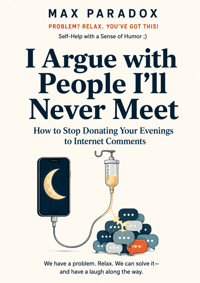
I Argue with People I'll Never Meet - How to Stop Donating Your Evenings to Internet Comments ebook
Max Paradox
Uzyskaj dostęp do tej i ponad 240000 książek od 14,99 zł miesięcznie
- Wydawca: ALL-IN Rafał Płonkowski
- Kategoria: Literatura popularnonaukowa•Nauki humanistyczne
- Język: angielski
You were going to relax.
Then someone in the comments was wrong.
Forty-five minutes later, dinner is cold, your jaw is tight, and you are explaining basic logic to a stranger whose profile picture is a pickup truck.
Sound familiar?
I Argue with People I'll Never Meet: How to Stop Donating Your Evenings to Internet Comments is a practical, funny guide for anyone who keeps getting dragged into online debates they never planned to have-and rarely feel better after finishing.
Max Paradox does not tell you to delete the internet, become indifferent to everything, or achieve monk-like serenity whenever somebody posts nonsense. Instead, this book shows you how to keep caring without automatically handing strangers your attention, mood, sleep, and free time.
You will learn how to recognize the exact moment a comment hooks your brain, decide which discussions are actually worth entering, correct misinformation without signing up for a forty-message argument, stop chasing the last word, and leave conversations even when the other person insists that leaving means they “won.”
The book also tackles the harder situations: arguments involving politics, identity, expertise, friends, coworkers, partners, and family group chats. You will learn when to move an important conversation somewhere better, how to use questions that reduce conflict instead of feeding it, how to deal with anger before it gets publishing rights, and what to do when you know every technique in the book and still reply anyway.
Most importantly, the advice is designed for normal people. Tired people. Busy people. People who occasionally open a comment section at 10:47 p.m. despite knowing exactly how this movie ends.
You will get concrete tools including reply limits, time budgets, exit rules, notification strategies, the one-correction rule, the ten-minute pause, the twenty-minute firewall, useful-question techniques, relapse warning signs, and a minimum version for days when your energy level is approximately potato.
The goal is not to stop having opinions.
The goal is to decide when your opinion deserves your time.
Because the internet has unlimited arguments.
You have one evening.
This publication was prepared with the assistance of tools that support the creative process, including artificial intelligence-based solutions. The final concept, structure, and editing belong to the author.
Ebooka przeczytasz w aplikacjach Legimi na:
Liczba stron: 191
Rok wydania: 2026
Odsłuch ebooka (TTS) dostepny w abonamencie „ebooki+audiobooki bez limitu” w aplikacjach Legimi na:
Podobne




















INTRO
It is 9:47 p.m., and you are having an argument with a man named Trevor who lives somewhere you have never been, works in an industry you know nothing about, and has a profile picture featuring sunglasses, a pickup truck, and what may or may not be a bass fish.
You did not plan this.
At 8:30, you were going to relax. Maybe watch an episode of something. Read a little. Talk to your partner. Go to bed at a reasonable hour and wake up tomorrow feeling like a person whose life is broadly under control.
Then you made one small tactical error.
You opened the comments.
Someone had written something ridiculous under a post. Not merely incorrect. Incorrect in a way that seemed to have been handcrafted specifically to irritate you. You stared at it for a few seconds and experienced the dangerous thought that has ruined millions of otherwise perfectly serviceable evenings:
I should probably explain this to them.
This is how it begins.
You type a short reply. Calm. Rational. Almost diplomatic. You are not arguing, obviously. You are simply adding useful context for the benefit of civilization. Five minutes later Trevor responds with twelve words, three spelling mistakes, and enough confidence to power a small regional airport.
Now you have a problem.
Because Trevor has misunderstood you.
You cannot allow that.
So you clarify.
Trevor clarifies his clarification.
Someone called EagleDad77 enters the discussion.
A woman named Melissa replies only, “Wow.”
You are no longer sure whether Melissa agrees with you, disagrees with you, or simply dropped her phone while typing, but unfortunately your brain has opened an investigation.
By 10:06 p.m., you have cited two sources, rewritten one paragraph four times, checked Trevor’s profile to determine what kind of person you are dealing with, and briefly considered whether his 2019 post about lawn fertilizer reveals anything about his current political reasoning.
Your evening is gone.
Trevor is making a sandwich.
This book is about that.
Not Trevor specifically. Trevor is probably fine. Somewhere, at this exact moment, he may be telling his spouse about the unreasonable stranger he encountered online. In Trevor’s version of the story, you are Trevor.
That is one of the first unpleasant facts we will have to deal with.
The internet makes it incredibly easy to donate large portions of your life to people who will never remember your name. You can spend forty minutes carefully constructing a response to someone who reads the first sentence, rolls their eyes, and goes back to watching a video of a raccoon stealing cat food.
This would be less of a problem if online arguments were satisfying.
Usually they are not.
You rarely finish one thinking, Excellent. That was a wise investment of my finite time on Earth.
More often, you close the app with your jaw slightly tighter than before, replay the conversation in your head while brushing your teeth, invent a much better comeback in the shower, and check the thread again the next morning to see whether someone has finally recognized that you were obviously correct.
Congratulations.
You have created unpaid overnight customer support for your own irritation.
The strange part is that you may know all of this already. You know internet arguments are often pointless. You know strangers rarely change their worldview because someone named MikeFromOhio posted a devastating fourth reply. You know that replying while angry usually makes you more angry.
And yet there you are.
Typing.
Why?
Because online arguments are not powered only by logic. They are powered by irritation, status, identity, justice, boredom, anxiety, tribal loyalty, curiosity, and the deeply human desire to correct someone who is wrong in public.
Especially when they are very wrong.
Your brain does not experience every ridiculous comment as meaningless text on a screen. Sometimes it experiences it as a tiny violation that requires action. Someone has misrepresented something you believe. Someone has insulted a group you belong to. Someone has posted information you think is dangerous. Someone has been smug in a way that should probably require a permit.
The urge to respond can feel surprisingly physical.
You see the comment.
Your attention locks on.
A reply begins composing itself in your head before you have consciously decided to participate.
At that moment, the argument stops being about information. It becomes unfinished business.
And the human brain hates unfinished business almost as much as it hates being corrected by someone whose username contains six random numbers.
This is why simply telling yourself, “Stop arguing online,” tends to work about as well as telling yourself, “Stop thinking about snacks.”
Excellent idea.
Very elegant.
Please inform the brain.
The solution is not to become indifferent to everything. It is not to delete the internet, move into a cabin, and communicate exclusively through handwritten notes delivered by a well-trained goat.
You are allowed to care.
You are allowed to disagree.
You are allowed to correct misinformation, defend someone, challenge a bad argument, discuss politics, debate culture, or tell a stranger that no, microwaving aluminum foil is not “basically fine if you watch it.”
The goal is not silence.
The goal is choice.
You should be able to decide when a conversation deserves your time instead of discovering forty-seven minutes later that your nervous system has been subcontracted to the comment section.
That distinction matters.
A useful discussion can teach you something, sharpen your thinking, solve a misunderstanding, influence people who are genuinely listening, or help someone who is watching quietly from the sidelines. Online conversation is not inherently pointless. Plenty of valuable conversations happen between strangers.
But there is a difference between participating in a conversation and being dragged behind one like a shopping cart with a broken wheel.
You probably already know the feeling.
You want to leave.
Then someone replies.
Now you must clarify one thing.
Then another person misunderstands the clarification.
Now you cannot leave because leaving would look like losing.
So you remain.
At some point, you are no longer trying to communicate. You are trying to achieve emotional closure from people who have no intention of providing it.
This is approximately as reliable as asking a casino to let you know when you have gambled enough.
The house has other plans.
Over the next twenty chapters, we are going to make this problem smaller in practical ways. You will learn how to recognize the exact moment when a discussion stops being useful, how to interrupt the urge to reply before it becomes a forty-minute side quest, how to decide which conversations deserve engagement, and how to leave without spending the next three hours mentally defending your departure.
We will also deal with the harder situations: when the person is genuinely offensive, when misinformation matters, when the argument involves someone you actually know, when you have already typed half the reply, and when your brain insists that this particular stranger absolutely must understand your point before you can peacefully continue living.
Spoiler: they do not.
You will learn ways to make your phone and social feeds less effective at pulling you back into arguments, but this will not be one of those books that tells you to turn off every notification, uninstall every app, buy a notebook made from ethically sourced bark, and become a person who wakes naturally at sunrise.
We are aiming lower.
Much lower.
We are aiming for you to see a ridiculous comment at 9:15 p.m. and somehow still be doing something enjoyable at 9:20.
That is progress.
Because the real cost of internet arguments is not that strangers sometimes annoy you. Strangers have been annoying each other since the invention of roads.
The cost is what you give them.
Your attention.
Your mood.
Your evening.
Your sleep.
The conversation you were going to have.
The movie you were going to watch.
The book you were going to read.
The completely respectable twenty minutes you intended to spend staring into the refrigerator even though you already knew what was inside.
Your life happens in those minutes.
You do not need to win every argument.
You need to stop losing your evening.
Trevor can keep his opinion.
He already has plenty.
Chapter 1 - The Comment That Hijacks Your Brain
You are scrolling without a mission. This is important, because the internet behaves differently when you arrive without one. You open an app to “check something,” which is a phrase so vague it could mean answering one message or accidentally becoming an amateur expert on maritime law.
Then you see it.
A comment so spectacularly wrong that your thumb stops moving.
You read it once.
Then again, because perhaps your eyes committed a clerical error.
They did not.
The person really wrote that.
Your first reaction is not even a decision. It is a physical little spark: irritation, disbelief, maybe a tightening in your chest. Then comes the thought.
Someone needs to correct this.
Conveniently, someone is available.
You.
This is the first thing to understand about online arguments: the argument usually begins before you consciously choose to participate.
By the time you are thinking, Should I reply?, your brain may already be halfway through the opening paragraph.
This matters because we often treat internet arguing as a problem of opinion. “I care too much.” “People are stupid.” “Politics makes everyone crazy.” “Social media is toxic.”
Sometimes.
But those explanations are too large to be useful. If the problem were simply that the internet contains irritating people, the only available solution would be removing approximately four billion people from the internet.
Administrative burden aside, this seems unlikely.
The more useful question is: what happens inside you during the few seconds between seeing the comment and replying?
That is where your evening is usually lost.
The Tiny Hook
A provocative comment creates what we can call a hook: something captures your attention and makes disengaging feel unfinished.
The hook does not need to be important. It only needs to feel important.
Someone insults your profession.
Someone mocks something you like.
Someone confidently explains a subject you know well and gets half of it backward.
Someone posts a political claim that seems outrageous.
Someone says a movie you love is “objectively terrible,” which is not technically a national emergency but may briefly be processed as one.
The hook works because your brain does not simply record information. It constantly evaluates what information means for you.
Is this threatening?
Is this unfair?
Does this challenge my identity?
Does this make my group look bad?
Does this person think people like me are idiots?
Could other people believe this?
Can I fix it?
That last one is especially dangerous.
Because correcting a stranger feels like action.
You are no longer merely irritated. You have a mission.
And missions are emotionally cleaner than irritation. Irritation is uncomfortable. A mission gives it a uniform.
This is why typing a reply often feels good at first. You are converting helpless annoyance into activity. Instead of merely thinking, That is ridiculous, you are doing something.
The problem is that the feeling of action and the usefulness of action are not the same thing.
You can spend an hour being extremely active while accomplishing almost nothing.
Ask anyone who has ever reorganized a kitchen drawer during tax season.
Your Brain Wants the Loop Closed
Once you reply, a second mechanism appears.
Now there is an open loop.
Will they respond?
Will they understand?
Will they apologize?
Will someone support you?
Will your comment get likes?
Will another person misread your point and create a new administrative department of nonsense?
You have created a small unresolved event.
That event now has emotional ownership of part of your attention.
You may put the phone down, but part of your brain keeps checking the door.
Anything yet?
You make tea.
Anything yet?
You start a show.
Anything yet?
Someone on television is being murdered in a dramatic Scandinavian forest and you are thinking about whether Darren_1983 has replied to your explanation of renewable energy.
This is not ideal entertainment management.
The more emotionally charged the topic, the stronger the loop becomes. When disagreement touches identity, fairness, intelligence, morality, or belonging, your brain treats the outcome as meaningful even when the other person is a stranger.
And the internet makes the loop easy to reopen.
Your phone is right there.
The notification arrives.
The red dot appears.
The app remembers exactly where the conflict is.
In older times, if you wanted to continue an argument with a stranger, you had to locate them physically.
This created healthy friction.
Now friction has been reduced to one thumb movement.
Civilization has achieved many remarkable things.
Not all efficiencies are improvements.
The Three Questions Your Brain Skips
When you get hooked, your mind tends to jump directly from “This is wrong” to “I should respond.”
It skips three useful questions.
First: Is this person actually reachable?
Meaning: is there evidence that they are willing to think, clarify, or change their mind?
Some people are.
You can often recognize them because they ask questions, acknowledge nuance, respond to what you actually said, and occasionally use phrases such as “fair point” without developing a rash.
Other people are not discussing.
They are performing.
They want applause, conflict, attention, dominance, entertainment, or a chance to repeat their position using larger emotional letters.
A person who writes, “Anyone who believes this is a complete idiot LOL” may not be entering a Socratic dialogue.
Adjust expectations accordingly.
Second: Is there an audience worth talking to?
Sometimes your reply is not really for the original commenter. It is for everyone else reading. Correcting false information publicly can be worthwhile, especially when the topic is important and a clear answer may help silent readers.
That is different from trying to force Trevor into enlightenment before bedtime.
You may write one useful correction, include a credible source, and leave.
Your work is then complete.
You do not have to escort every reader personally to the conclusion.
Third: What will this cost me?
This question sounds almost offensively practical, which is why it is useful.
If you reply, are you likely to spend two minutes?
Or forty?
Will the exchange energize you?
Or keep you irritated until midnight?
Are you willing to pay that price?
Not every correct response is worth its emotional delivery fee.
The Argument Is Rarely About One Comment
A strange feature of online conflict is that the current comment often carries luggage from somewhere else.
You are tired.
Work was irritating.
Your boss dismissed an idea.
Someone cut you off in traffic.
Your partner seems distracted.
You have been reading bad news for twenty minutes.
Then a stranger writes something condescending.
Perfect.
Your brain has found a representative.
This person may now receive emotional mail addressed to several other departments.
That does not mean your disagreement is fake. The comment can still be wrong. But your intensity may be coming from more than the comment itself.
A useful test is to ask:
If I saw this exact comment tomorrow morning after sleeping well, would I care this much?
Sometimes yes.
Often the answer is, “I would still think it was stupid, but I probably would not be writing a twelve-part constitutional response.”
That difference matters.
Fatigue lowers your patience and raises the probability that minor provocation feels major.
This is one reason evening arguments are so expensive. At 10:30 p.m., you are often bringing a tired brain into an environment optimized for provocation.
Excellent.
Nothing could possibly go wrong.
Learn the First Sensation
The practical skill in this chapter is not “never reply.”
It is learning to recognize your hook.
Your hook has a signature.
Maybe you feel heat in your face.
Maybe your thumb stops.
Maybe you reread the comment.
Maybe you immediately open the reply box.
Maybe a sentence appears in your head beginning with, “Actually…”
“Actually” has ended many peaceful evenings.
Your job for the next few days is simply to notice the moment.
You do not need to become calm, wise, spiritually advanced, or capable of smiling gently at humanity.
Just notice.
There it is. I’m hooked.
That sentence creates a tiny gap between the comment and your reaction.
The gap may last three seconds.
Three seconds is enough.
Because without the gap, the sequence is automatic:
See comment → feel irritation → reply.
With the gap, it becomes:
See comment → feel irritation → notice irritation → decide.
That final word is the whole game.
Decide.
The Ten-Minute Rule
When the hook is strong, do not decide immediately.
Wait ten minutes.
Not forever. Not until you have achieved inner peace. Ten minutes.
Close the reply box.
Do something physical and boring enough to interrupt the loop: refill your water, brush your teeth, take out the trash, fold two shirts, pet the dog, stare at the refrigerator and confirm that yes, the same cheese is still there.
Then come back only if you still want to.
This works because emotional urgency often declines faster than the issue itself.
The comment will probably still be wrong in ten minutes.
But you may no longer feel personally appointed to fix it.
If, after ten minutes, the reply still seems useful, write it.
Prefer one clean response.
Shorter than your first draft.
Much shorter.
The internet has never been rescued by paragraph seven.
Use the Reply Test
Before posting, ask four questions:
Am I adding information, or merely adding heat?
Is this person capable of a real exchange?
Would one reply be enough?
Will I be glad I spent time on this tomorrow?
You do not need four perfect yeses.
But if the answers are:
“Mostly heat.”
“Probably not.”
“Absolutely not.”
“And I already regret opening the app.”
you have received useful guidance.
Leave.
That is not losing.
Losing is spending forty-five minutes trying to defeat someone who is enjoying the argument more than you are.
What If the Comment Is Genuinely Harmful?
Sometimes disengagement feels irresponsible.
The post may contain dangerous misinformation, harassment, prejudice, scams, or harmful advice.
In those cases, silence is not your only option.
You can:
report the content;
provide one factual correction;
link to a reliable source;
support the person being targeted;
contact moderators or platform support where appropriate;
step away after doing the useful part.
Notice the last point.
Action does not require endless engagement.
You can put out a small fire without moving into the fire station.
If a stranger claims something dangerous and you have reliable information, one clear correction may help other readers. After that, continuing to trade insults usually does not increase truth.
It increases comments.
Platforms are delighted.
Your nervous system is less enthusiastic.
Plan B: You Already Replied
Fine.
The experiment is not ruined.
You replied.
Now decide your stopping point before the next notification arrives.
For example:
I will respond once more only if they ask a sincere question.
Or:
I will provide one source and stop.
Or:
I am not continuing after 10 p.m.
Pre-deciding is easier than trying to make a wise decision while your brain is shouting, But they just said another thing!
Of course they did.
That is how replies work.
You are not surprised when tennis continues because the other person hit the ball back.
If you want the game to end, stop returning every serve.
Your Action
Today, do not try to stop arguing online.
That is too broad.
Instead, catch one hook.
The moment you feel the urge to correct, defend, expose, clarify, or destroy someone with impeccable punctuation, pause and name what is happening:
I’m hooked.
Then wait ten minutes before replying.
You may still respond.
But now it will be your decision.
That is the first skill.
Not silence.
Control.
Because a stranger can post whatever they want.
They should not automatically receive custody of your next hour.
Chapter 2 - You Are Not the Internet’s Emergency Department
At 6:18 p.m., you see a post containing misinformation about a topic you understand well.
This is different.
This is not someone insulting your favorite movie or claiming pineapple belongs on pizza, a matter on which international law remains disappointingly weak.
This person is wrong about something that matters.
Maybe health.
Maybe money.
Maybe politics.
Maybe technology.
Maybe your profession.
You know the facts.
And because you know the facts, a new form of pressure appears:
If I don’t correct this, who will?
This is the noble version of the internet argument.
It feels less like ego and more like public service.
You are no longer arguing with strangers.
You are defending civilization.
Civilization, meanwhile, has not completed the necessary paperwork.
The problem is not that the impulse is always wrong. Sometimes speaking up is genuinely useful.
The problem is what happens when responsibility expands without limit.
One incorrect post becomes your problem.
Then another.
Then another.
Soon you are patrolling your feed like a volunteer firefighter in a town where everyone is actively experimenting with gasoline.
There will always be another fire.
You cannot personally extinguish the internet.
The Responsibility Trap
People who argue online frequently are not always conflict-loving. Many are conscientious.
They care about accuracy.
Fairness.
Evidence.
Standards.
They dislike watching nonsense spread uncontested.
Those are good traits.
The internet can turn them into unpaid shift work.
You see a false claim and think, Someone should say something.
Then your brain quietly replaces “someone” with “me.”
Why?
Because you are present.
You understand the issue.
And the reply box is open.
This is how competence becomes a trap.
If you know more than average about a subject, you can find mistakes everywhere.
A doctor can find terrible medical advice.
A mechanic can find terrible car advice.
A teacher can find terrible educational claims.
A financial professional can find investment nonsense.
An IT specialist can spend their entire remaining lifespan replying to people who believe restarting a computer is a conspiracy invented by technical support.
Expertise gives you the ability to notice.
It does not create a duty to respond to everything you notice.
This distinction may save you several hundred hours.
Ask: What Is My Job Here?
Before engaging, ask:
What useful job could my response actually perform?
There are several possibilities.
You may be:
correcting a factual error;
protecting someone from harmful advice;
offering context;
helping silent readers;
defending someone being unfairly targeted;
asking a question that improves the discussion.
Those are legitimate jobs.
Now compare them with the less useful jobs we often perform without admitting it:
proving I am smarter;
making this person admit defeat;
punishing them for being smug;
winning in front of the audience;
getting the last word;
making sure nobody thinks their comment “beat” mine.
The first group can sometimes be completed.
The second group is an infinite subscription service.
Especially “getting the last word.”
If two people both want the last word, congratulations: you have invented renewable energy.
The conversation can power itself indefinitely.
Correct Once, Not Forever
Suppose someone posts a false claim.
You know the subject.
A good response may be: