Uzyskaj dostęp do tej i ponad 240000 książek od 14,99 zł miesięcznie
- Wydawca: ALL-IN Rafał Płonkowski
- Kategoria: Biznes, rozwój, prawo•Biznes, rozwój
- Język: angielski
You know what needs to be done.
The email. The form. The workout. The report. The appointment. The difficult phone call. The project you have been "starting tomorrow" since sometime around the invention of electricity.
And yet you keep putting it off.
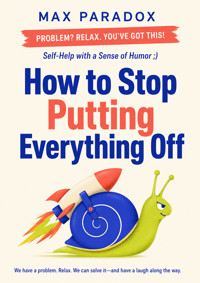
How to Stop Putting Everything Off is a practical, funny guide to understanding why procrastination happens - and, more importantly, what to do when it does.
Max Paradox skips the inspirational speeches, impossible morning routines, and productivity systems that require seventeen apps and a personality transplant. Instead, this book gives you concrete methods for starting difficult tasks, reducing overwhelm, handling perfectionism, resisting distractions, using time blocks effectively, recovering after bad days, and preventing one delayed task from becoming three weeks of guilt.
You will learn how to:
identify what you are really avoiding;
turn vague projects into clear next actions;
start without waiting for motivation;
use five-minute starts and realistic work containers;
reduce digital and physical distractions;
stop perfectionism from becoming elegant procrastination;
batch annoying administrative tasks;
use accountability without creating another management system;
build bad-day versions of important routines;
restart quickly after interruptions;
recognize when the task - not your discipline - is the real problem;
create simple systems that need less willpower;
notice procrastination returning before it becomes expensive.
This is not a book about becoming a productivity robot.
You are allowed to rest. You are allowed to dislike paperwork. You are even allowed to spend an afternoon doing something completely useless without filing an internal performance report.
The goal is simpler: stop postponing the things that actually matter.
With everyday examples, practical procedures, dry humor, and methods designed for normal people with jobs, phones, responsibilities, limited energy, and refrigerators that occasionally become more interesting than work, How to Stop Putting Everything Off turns procrastination from a mysterious personality flaw into a problem you can actually manage.
You do not need more guilt.
You need a next move.
Preferably one that takes less than five minutes to begin.
This publication was prepared with the assistance of tools that support the creative process, including artificial intelligence-based solutions. The final concept, structure, and editing belong to the author.
Ebooka przeczytasz w aplikacjach Legimi na:
Liczba stron: 193
Rok wydania: 2026
Odsłuch ebooka (TTS) dostepny w abonamencie „ebooki+audiobooki bez limitu” w aplikacjach Legimi na:
Podobne



















INTRO
You sit down to do one thing.
Not ten things. Not “reorganize your life.” Not “become the kind of person who owns matching glass food containers and remembers to stretch.” One thing. Send the email. Pay the bill. Start the report. Book the appointment. Put the laundry away before it develops voting rights.
You know what needs to happen. You may even have written it on a list, which feels suspiciously close to doing it.
Then your brain makes a counteroffer.
First, perhaps you should make coffee. Fair enough. A person cannot possibly send a six-line email without adequate hydration, caffeine, and emotional infrastructure. While the coffee is brewing, you check your phone. There is a message. Then another message. Then an article. Then a video about a man restoring a rusty lawn mower from 1974.
Forty-three minutes later, the lawn mower runs beautifully.
Your email does not.
This is the strange thing about putting things off: it often has almost nothing to do with not knowing what to do. You know. The task may be sitting directly in front of you, glowing on a screen, practically waving both arms. You simply do everything around it instead.
You clean the kitchen before making the difficult phone call. You research note-taking systems instead of studying. You compare five budgeting apps instead of opening your bank statement. You spend twenty minutes deciding when to start the task that would have taken twelve minutes.
At some point procrastination stops being laziness and becomes event management.
There are meetings. Logistics. Refreshments.
You may tell yourself that you work better under pressure. Sometimes you probably do. There is nothing like an approaching deadline to transform a person who spent Tuesday afternoon staring at fonts into a highly efficient emergency response unit.
At 10:00 a.m., the report feels impossible.
At 11:47 p.m., with thirteen minutes left, you become NASA.
Suddenly there is focus. Decisions happen. Perfection becomes less important. You stop wondering whether the opening paragraph “really captures the tone” and begin hoping it contains verbs.
Then you finish, experience five minutes of triumph, and promise yourself that next time will be different.
Next time is not different.
Next time is wearing the same shirt.
The problem is that procrastination works surprisingly well in the short term. That is why it survives. If delaying a task immediately caused your chair to catch fire, humanity would have solved procrastination centuries ago. Instead, putting something off usually gives you relief.
The unpleasant task disappears from the present moment.
Excellent.
Unfortunately, it does not disappear from your life.
It waits.
The tax form waits. The dentist waits. The awkward conversation waits. The presentation waits. The pile of unopened mail sits there with the quiet confidence of something that knows you eventually have to deal with it.
Meanwhile, your brain enjoys the immediate reward: not now.
That tiny reward is powerful. You avoid discomfort, uncertainty, boredom, effort, the possibility of failure, the possibility of success followed by more work, or simply the irritation of beginning. The future cost is abstract. The relief is immediate.
Your brain is not necessarily making a good decision.
It is making a very convenient one.
That distinction matters, because people often try to solve procrastination with methods designed for a completely different problem. They call themselves lazy. They buy a new planner. They download an app. They watch a forty-eight-minute video called something like “THE MORNING ROUTINE THAT CHANGED EVERYTHING.”
The video recommends waking at 5:00 a.m.
Naturally.
Apparently all human problems become easier before sunrise.
For three days, you attempt a new system. There are color codes. Time blocks. Maybe a habit tracker. Perhaps one innocent spreadsheet that somehow evolves into a command center containing twelve tabs, conditional formatting, and a dashboard showing the percentage of your life currently under administrative review.
Then Wednesday happens.
You are tired. Work runs late. Someone needs something. You sleep badly. Your perfect schedule slips by ninety minutes, which feels like civilization has collapsed.
And because the system only works when you behave like a calm, motivated, highly organized person with no unexpected problems, it stops working exactly when you need it most.
This book will take a different approach.
We are not going to build your entire personality around productivity. You do not need to become a machine. Machines also delay things, incidentally. My printer has been “processing” the same document since the previous administration.
We are going to look at why you delay certain things, what happens in the seconds before avoidance begins, and how to interrupt that process without requiring heroic motivation. You will learn how to make starting easier, reduce the emotional weight of tasks, deal with vague and overwhelming projects, stop waiting for the perfect mood, and use deadlines without turning every Tuesday into a hostage situation.
More importantly, the goal is not to become someone who never procrastinates.
That person probably does not exist.
And if they do, do not invite them over. They will notice the garage.
The goal is to stop letting procrastination run the important parts of your life. There is a huge difference between occasionally putting off folding towels and repeatedly delaying decisions, conversations, work, paperwork, health appointments, applications, financial tasks, or personal projects until they become harder than they needed to be.
A task can be small and still occupy a ridiculous amount of mental space. You can postpone a five-minute action for three weeks and somehow think about it every day.
That is an extraordinary return on investment.
Five minutes of work.
Four hundred minutes of guilt.
We should probably renegotiate the contract.
Throughout this book, we will keep coming back to one practical principle: make the next action easier than the avoidance routine.
Because avoidance has a routine. It begins automatically. You feel discomfort, hesitation, boredom, confusion, or pressure. Then you reach for relief. The relief might be your phone, another task, more research, food, cleaning, planning, checking email, or suddenly deciding that your sock drawer represents an urgent threat to household stability.
If you can recognize that moment, you can change what happens next.
Not with a motivational speech.
With a smaller move.
Sometimes the answer will be to shrink the task. Sometimes it will be to define it properly. Sometimes you will need a deadline, an environment change, a rule, a timer, another person, or permission to do an embarrassingly mediocre first version.
Especially that last one.
Perfectionism is procrastination wearing glasses and carrying a clipboard.
We will also deal with what happens when the sensible method fails, because it will. You will have bad days. You will ignore your own system. You will understand exactly why you are procrastinating and continue procrastinating anyway.
Congratulations. You remain human.
The solution is not to restart your entire life every Monday. It is to become better at recovering quickly. One delayed task should not become a delayed week. One unproductive afternoon should not require a new notebook, a new identity, and a documentary about your comeback.
By the end of this book, you should know how to catch procrastination earlier, start unpleasant tasks with less drama, finish more of what matters, and stop spending so much energy thinking about things you are not doing.
You will still occasionally avoid something.
You may even read a chapter of this book instead of doing it.
I respect the creativity.
But when you close the book, you will have a better answer than “I really should.”
You will know what to do next.
And, more importantly, how to actually begin.
Chapter 1 - You’re Not Lazy
You have a task to do, so naturally you begin by conducting a detailed investigation into why you are the kind of person who does not do tasks.
This feels productive because the investigation contains serious words. Discipline. Motivation. Willpower. Habits. Character. Maybe you conclude that you are lazy, which is convenient because “lazy” explains everything while solving absolutely nothing.
You were supposed to submit an expense report.
Instead, you have diagnosed your personality.
Efficient.
Calling yourself lazy is tempting because it turns a complicated behavior into a simple identity. You delay things because you are lazy. Other people get things done because they are disciplined. Case closed. Everyone can go home.
Except the evidence usually does not support the verdict.
The same person who has been avoiding a fifteen-minute administrative task for nine days may spend four hours repairing a shelf, researching a vacation, helping a friend move, playing a complicated game, cooking dinner for eight people, or arguing online about which actor played the best Batman.
Clearly, energy exists.
It simply becomes mysteriously unavailable when the spreadsheet opens.
That tells us something important. Procrastination is not usually a general refusal to exert effort. It is selective. Certain tasks trigger avoidance far more reliably than others, even when those tasks are objectively easier.
You may happily mow a lawn for an hour but avoid making a two-minute phone call.
You may reorganize an entire closet instead of writing the first paragraph of a proposal.
You may answer twelve unimportant emails because one important email makes your stomach tighten slightly.
If laziness were the whole explanation, you would avoid the harder activity.
Instead, people often choose a harder activity because it feels easier emotionally.
That is where things get interesting.
The Deal Your Brain Keeps Making
Imagine you need to call your insurance company. Nothing dramatic is happening. Nobody has announced that a helicopter will be involved. You simply need clarification about a charge.
You look at the number.
A small resistance appears.
Maybe the call will take forever. Maybe you will be transferred six times. Maybe you will have to explain the same thing to someone called Tyler, then another Tyler, and finally a supervisor who appears to live inside hold music.
So you decide to call later.
Immediately, you feel better.
That little improvement matters.
Your brain has just learned something:
Avoiding the task reduced discomfort.
This is one of the main engines of procrastination. The reward for delay arrives immediately, while the punishment arrives later.
Avoid the call now: relief.
Deal with the problem tomorrow: future problem.
Your brain approves this financing arrangement because it has never personally met tomorrow.
The same mechanism can appear with boring tasks, difficult tasks, emotionally loaded tasks, confusing tasks, tasks where you might fail, tasks where someone might judge you, and tasks where success creates another obligation.
The feeling changes. The pattern does not.
Task appears.
Discomfort appears.
You escape.
Discomfort decreases.
Escape becomes more attractive next time.
This is why procrastination can become automatic even when you consciously hate it. Your rational mind says, “We need to finish this.”
Another part of your brain says, “Interesting proposal. Have you considered not feeling uncomfortable?”
And because the second option pays immediately, it often wins.
Procrastination Is Often Mood Management
This does not mean every delayed task conceals a deep emotional wound. Sometimes a spreadsheet is simply boring.
We do not need to call a therapist because you would rather watch videos than reconcile receipts.
But even boredom is a feeling your brain may try to escape. So are frustration, uncertainty, embarrassment, resentment, overwhelm, insecurity, and the unpleasant sensation of not immediately being good at something.
The task is not always what you are avoiding.
Sometimes you are avoiding the feeling attached to the task.
That difference is enormously useful.
Suppose you need to prepare a presentation. You keep delaying it. If you decide the problem is “I lack discipline,” your solution will probably involve forcing yourself harder.
But what if the real issue is that you do not know what your boss expects?
Now the problem is uncertainty.
Different problem. Different solution.
Or maybe you know exactly what is expected, but you worry that your work will not be good enough.
Now the problem may be fear of judgment.
Or perhaps the presentation is easy, but you resent doing it because it was dumped on you Friday afternoon by someone who wrote, “Shouldn’t take long :)”
The smiley face has not improved matters.
Now the resistance may be resentment.
When you identify what you are actually avoiding, procrastination becomes less mysterious. You stop treating every delay as a moral failure and start treating it as information.
Information is much easier to work with than shame.
Shame mostly sits in the corner shouting, “You should have done this already.”
Very helpful.
Catch the Moment Before the Escape
Most people notice procrastination too late.
They notice it after forty minutes.
They notice it when they are standing in the kitchen eating crackers they did not particularly want while watching a review of a vacuum cleaner they do not own.
At that point, procrastination has already completed several administrative steps.
A better place to intervene is the first moment of resistance.
The moment you think:
“I’ll do this after lunch.”
“I should check something first.”
“I’m not really in the mood.”
“I need to be able to focus properly.”
“I’ll start when I have more time.”
That sentence is often the door.
You do not need to become suspicious of every break you take. Breaks are allowed. This is not a prison camp with herbal tea.
The question is whether you consciously decided to stop or automatically escaped because the task produced discomfort.
For the next few days, try something simple. When you catch yourself moving away from an important task, do not immediately force yourself back. Stop for ten seconds and ask:
What am I trying not to feel right now?
You do not need an impressive psychological answer.
“Bored.”
“Confused.”
“I don’t know where to start.”
“I’m worried I’ll do it badly.”
“I don’t want to deal with that person.”
“This is annoying.”
“I’m tired.”
Good.
Now you have something useful.
“I am a hopeless procrastinator” gives you no next move.
“I am avoiding this because I do not know how to begin” gives you one.
Separate the Task from the Feeling
Once you identify the feeling, make one important distinction:
The feeling does not have to disappear before you act.
This is where procrastination gets a remarkable amount of business.
You assume that first you must feel ready, clear, motivated, confident, energetic, or interested.
Then you will begin.
Unfortunately, feelings have not signed this agreement.
You can spend half a day waiting for motivation to arrive like a delayed flight.
Still nothing at Gate 6.
A more reliable approach is to let the feeling exist while reducing the action.
You are bored?
Do five minutes.
You are uncertain?
Write down the first question that needs answering.
You are intimidated?
Open the document and make a deliberately rough start.
You resent the task?
Decide exactly how much of it you are willing to complete before taking a break.
You are anxious about the phone call?
Write the first sentence you will say.
The goal is not to conquer your emotions.
The goal is to stop requiring their permission.
That is a much smaller project.
Use the Three-Part Check
When you notice avoidance, use this quick check:
What am I supposed to be doing? State the task without drama.
What feeling or friction am I avoiding? Boredom, uncertainty, fear, resentment, effort, confusion?
What is the smallest useful action I can take while feeling this way?
That final question is the important one.
Not: “How do I finish everything?”
Not: “How do I become more disciplined?”
Not: “Why did my parents not teach me a flawless productivity system in 1997?”
Just:
What can I do next, as I am?
Suppose you have postponed updating your résumé.
Task: update résumé.
Friction: it feels overwhelming and forces you to think about changing jobs.
Small useful action: open the file and update the most recent job title.
That is all.
Once you are moving, you may continue. If you do not, you have still broken the automatic escape pattern.
The goal is not to win the entire war at 2:15 p.m. on a Wednesday.
We are trying to reclaim one intersection.
Do Not Turn Awareness into Another Hobby
There is a danger here.
Once people learn why they procrastinate, they can become extremely sophisticated procrastinators.
Instead of doing the task, they analyze the task.
“What emotion is present?”
“Where do I feel resistance in my body?”
“Is this perhaps connected to my relationship with achievement?”
Forty minutes pass.
The form remains unsigned.
Insight is useful only if it changes the next action.
You do not need a complete psychological profile every time you hesitate before loading the dishwasher. Sometimes the answer is simply, “I don’t feel like it.”
Fine.
Load three plates.
The dishwasher has no interest in your personal growth.
What If You Really Are Exhausted?
Sometimes you are not avoiding discomfort.
Sometimes you are genuinely depleted.
This matters because the wrong response to exhaustion is to keep accusing yourself of procrastination and then attempt to solve the problem with stricter rules.
If you have slept badly for several nights, worked twelve hours, handled family problems, and spent the evening putting out small fires nobody else seemed to notice, your inability to enthusiastically organize tax documents at 10:45 p.m. may not indicate a character flaw.
You may need rest.
The practical question is whether rest restores your ability to act.
Real rest tends to improve capacity.
Avoidance disguised as rest tends to leave you in exactly the same position, except now it is later and you know significantly more about celebrity kitchens.
If you genuinely need recovery, decide when the task will restart.
“I’m not doing this tonight. I will work on it tomorrow at 9:30 for twenty minutes.”
That is rest with a boundary.
“I’ll get to it when I feel better” is procrastination wearing pajamas.
Your Action for Today
Pick one thing you have been putting off.
Do not choose your entire life. We are starting with one item.
Write down:
Task: What specifically needs doing?
Friction: What feeling or difficulty appears when you think about starting?
Minimum move: What is one useful action that takes less than five minutes?
Then do the minimum move immediately if circumstances allow.
Open the file.
Find the number.
Put the form on the table.
Write the first sentence.
Create the appointment.
Reply with two lines.
You are not proving that you are a disciplined person. You are teaching your brain a different sequence:
Discomfort appears.
Action still happens.
That is the beginning of change.
You do not have to feel like doing the task.
This is excellent news, because apparently your feelings have been running the scheduling department, and performance has been mixed.
Chapter 2 - Make the Task Smaller Than the Drama
You have decided to finally clean the garage.
Wonderful.
You stand in the doorway and look inside.
There are boxes, tools, sports equipment, an unidentified cable from 2009, three paint cans containing approximately one tablespoon of paint each, and something covered by an old towel that you are not emotionally prepared to investigate.
Your brain considers the situation.
“No.”
You close the door.
This is not irrational.
“Clean the garage” sounds like one task, but it is actually a small government program. It contains dozens of decisions, multiple physical actions, uncertainty, disposal logistics, and a serious risk of discovering objects you forgot buying but are now legally required to feel sentimental about.
Many things we procrastinate on have the same problem.
They are not tasks.
They are vague containers filled with tasks.
“Work on the report.”
“Get finances organized.”
“Fix the house.”
“Plan the trip.”
“Deal with insurance.”
“Start exercising.”
“Find a new job.”
“Sort out the website.”
These phrases sound actionable until you attempt to act on them.
Then your brain asks a perfectly reasonable question:
What exactly do you want me to do?
And because you have no good answer, you check Instagram.
A Vague Task Creates Invisible Work
The more undefined a task is, the more mental effort is required merely to begin.
Imagine someone tells you:
“Take care of the client situation.”
Thank you.
Very clear.
Should you call them? Email them? Review the contract? Ask accounting what happened? Speak to your manager? Perform a ceremonial dance around the printer?
The action is hidden inside the label.
Before you can work, your brain must figure out what “take care of it” means. That creates friction. If the task is unpleasant already, the extra uncertainty can be enough to trigger avoidance.
This is one reason tiny concrete errands often get done faster than important projects.
“Buy toothpaste” is clear.
“Figure out my career” is not.
Toothpaste wins again.
The solution is not necessarily to make the entire project easy. Some projects are genuinely difficult. The solution is to make the entry point obvious.
Your brain does much better with a visible action than a conceptual ambition.
Stop Writing Projects on Your To-Do List
A useful distinction:
A project requires more than one action.
A task is something you can actually do.
“Prepare annual tax return” may be a project.
“Download last year’s income statement” is a task.
“Renovate bathroom” is a project.
“Measure the wall beside the shower” is a task.
“Plan birthday party” is a project.
“Text Jamie and ask whether Saturday works” is a task.
This sounds basic, yet a shocking number of to-do lists contain entries such as:
Get healthy
Sort money
Learn Spanish
Fix career
Organize life
These are not tasks.
These are documentary titles.
If an item can stare at you for three weeks without making clear what physical action should happen next, it is probably too vague.
A good next action usually begins with a verb you can see yourself doing.
Call.
Open.
Write.
Find.
Send.
Measure.
Book.
Ask.
Compare.
Delete.
Put.
You should be able to imagine the first thirty seconds.
If you cannot, the task is not ready.
The First Action Should Be Embarrassingly Obvious
Suppose you need to prepare a presentation for Monday.
You write:
“Finish presentation.”
Your brain hears:
Produce a complete, intelligent, polished document containing accurate information, attractive visuals, strong conclusions, correct formatting, and absolutely nothing that makes Linda from Finance ask a question in front of everyone.
Understandably, resistance appears.
Try replacing the project with the next visible action:
“Open last quarter’s presentation and duplicate the file.”
That is almost insultingly small.
Excellent.
Small is not the problem.
Starting is the problem.
After you duplicate the file, the next step may become obvious: replace the title slide. Then delete outdated slides. Then list the data you need.
Movement creates clarity.
Standing outside the task demanding a complete plan often does not.
This is why “just start” is technically correct but practically useless.
Start what?
Where?
How much?
What counts?
“Just start” is the productivity equivalent of telling someone who is lost to “go in the correct direction.”
Thank you, wise traveler.
Use the Fifteen-Minute Deconstruction
For any project you have avoided repeatedly, spend no more than fifteen minutes breaking it down.
Not an hour.
Not an afternoon.
You are not creating the Olympic opening ceremony of task management.
Write the outcome at the top, then list the first several physical actions needed to move toward it.
Example: