Uzyskaj dostęp do tej i ponad 240000 książek od 14,99 zł miesięcznie
- Wydawca: ALL-IN Rafał Płonkowski
- Kategoria: Biznes, rozwój, prawo•Biznes, rozwój
- Język: angielski
You check the news because you want to know what's happening.
Reasonable.
Then you check again because something might have changed. Then you see another headline, another warning, another expert explaining why the next six months could be decisive, and somehow you are standing in the kitchen at 11:47 p.m. investigating a geopolitical situation you cannot influence while the pasta you were supposed to make has become an abandoned infrastructure project.
Welcome to modern news consumption.
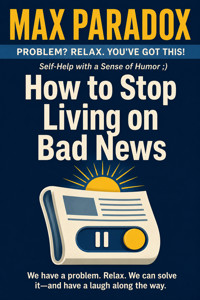
How to Stop Living on Bad News is a practical, funny guide for anyone who wants to stay informed without letting headlines occupy every spare corner of their brain.
This is not a book about ignoring reality, deleting every news app, moving into a cabin, and discovering major world events six months later from a confused postal worker. Important things happen. Some of them deserve your attention.
The problem begins when staying informed turns into constant monitoring.
When you check for reassurance instead of information.
When every breaking-news alert feels personally addressed to your nervous system.
When you know the essential facts but keep reading anyway.
When you confuse caring about something with exposing yourself to it for four additional hours.
Inside, you'll learn how to:
recognize when useful news checking becomes anxiety-driven checking;
break the doomscrolling loop without becoming uninformed;
create realistic news windows that work in normal life;
turn off unnecessary alerts without worrying that civilization will collapse unnoticed;
decide which stories deserve your attention and which are mostly noise;
separate confirmed facts from predictions, speculation, commentary, and online panic;
know when you have enough information and stop searching for the mythical final update;
handle genuinely serious breaking news without spending the whole day inside it;
stop absorbing anxiety from family chats, coworkers, social media, and enthusiastic amateur analysts;
prepare for realistic risks without mentally rehearsing every possible disaster;
build a sustainable news system that survives stressful days, major events, and the occasional relapse into scrolling.
The goal is not perfect calm.
The world is complicated. Politics will remain politics. Markets will move. Storms will happen. Experts will disagree. Somebody on the internet will continue insisting that nobody is talking about something while thousands of people are visibly talking about it.
The goal is proportion.
To know what matters.
To act when action is useful.
To tolerate uncertainty when no answer exists yet.
And then to return to your work, your relationships, your dinner, your sleep, and the surprisingly important business of actually living the life all those headlines keep interrupting.
You can stay informed without standing permanent guard over the planet.
The world will keep happening.
You do not have to watch every second of it.
This publication was prepared with the assistance of tools that support the creative process, including artificial intelligence-based solutions. The final concept, structure, and editing belong to the author.
Ebooka przeczytasz w aplikacjach Legimi na:
Liczba stron: 174
Rok wydania: 2026
Odsłuch ebooka (TTS) dostepny w abonamencie „ebooki+audiobooki bez limitu” w aplikacjach Legimi na:
Podobne














INTRO
It is 7:08 a.m. You have been awake for approximately four minutes, and already civilization is experiencing several emergencies. Somewhere, something is collapsing. Someone important has said something alarming. A headline informs you that a thing you had never heard of yesterday may now affect your finances, your health, your job, your democracy, your breakfast, or possibly all five. You open one article because you would like to be “informed.” Twelve minutes later you are reading comments written by a man named PatriotWolf1947 who appears to have solved international relations from his bathroom.
Excellent. The day has begun.
You put the phone down. You make coffee. While the coffee is brewing, you check whether anything else has happened during the forty-seven seconds since your last inspection. Apparently yes. Something is “BREAKING.” Something else is “DEVELOPING.” A third event is described as “WHAT YOU NEED TO KNOW,” which is a bold claim because you did not know it existed until a rectangle in your hand shouted at you. By 7:30, you have consumed more crisis than most humans in history encountered before lunch, and you have not yet located your socks.
This is not stupidity. It is not weakness. It is not evidence that you secretly enjoy being miserable. Bad news is extremely good at getting attention, and modern technology has become extremely good at delivering attention-grabbing material repeatedly, instantly, and with the subtlety of someone firing a starter pistol inside your kitchen.
Your brain notices possible threats because noticing threats has generally been useful for human survival. A strange sound in the bushes deserved attention long before anyone invented the push notification. The problem is that your nervous system did not receive a software update explaining that the bushes are now global, open twenty-four hours a day, and funded partly by your inability to stop looking at them.
So you check.
You check because something important might have happened. You check because not knowing feels irresponsible. You check because everyone is talking about it. You check because the previous thing frightened you and, in a magnificent piece of human logic, you hope the next frightening thing will somehow make you feel better.
It rarely does.
Instead, you enter the familiar loop. Headline. Concern. Another headline. More concern. Search for reassurance. Find three additional reasons to worry. Read comments for clarification. Discover that strangers have apparently divided themselves into two groups: people certain the world ends Tuesday and people furious that anyone would wait until Tuesday. You close the app feeling worse than before, but also strangely unfinished.
Maybe one more update will settle things.
This is the trap at the center of living on bad news: information starts masquerading as control. If you know enough, perhaps you can relax. If you read enough perspectives, perhaps uncertainty will disappear. If you monitor the situation closely enough, perhaps you will be emotionally prepared for whatever comes next. Unfortunately, the world has declined to provide a final page saying, “That’s everything. Nothing else will happen. You may now go make pasta.”
There is always another update.
And because there is always another update, the goal quietly changes. You are no longer checking the news to learn something useful. You are checking because checking has become the response to anxiety created partly by previous checking. The fire alarm has started pressing its own test button.
You may recognize the smaller ways this spills into ordinary life. You are watching a movie, but part of your attention is waiting for the phone. You are having dinner, and someone mentions a political event, an economic problem, a war, a crime, a new disease, an election, an environmental disaster, or something a celebrity has done for reasons that apparently require a twelve-person panel discussion. You feel the urge to look it up immediately. Five minutes later, dinner is still on the table, but mentally you are testifying before Congress.
Or perhaps you decide to take a break from the news.
A serious break.
No more doomscrolling tonight.
Then you open social media, where the news has dressed casually and is pretending not to be the news.
Now the crisis comes with dance videos.
Avoiding bad news completely is neither realistic nor necessarily desirable. Important things happen. Some developments genuinely affect decisions you need to make. Responsible citizenship does require knowing more than the current price of coffee and whether your favorite show has been renewed. The goal of this book is not to turn you into a peaceful woodland creature who learns about major world events three years later from a confused hiker.
The goal is to help you become informed without being continuously invaded.
There is a difference between knowing what is happening and emotionally living inside everything that is happening. There is a difference between checking the news and standing guard over the entire planet. There is a difference between useful awareness and treating every headline as if headquarters has personally requested your immediate psychological involvement.
Headquarters has made no such request.
Over the course of this book, you will learn how to decide what information actually deserves your attention, how to reduce compulsive checking without feeling irresponsibly disconnected, how to recognize when “staying informed” has turned into anxiety management, and how to build limits that survive contact with real life. You will learn what to do with breaking-news urges, upsetting stories, uncertainty, conversations with people who seem professionally alarmed, and those evenings when you accidentally read one disturbing headline and your brain immediately produces a twelve-part documentary called Everything Is Going Terribly.
The aim is not ignorance. It is proportion.
You should be able to learn that something bad happened without donating the rest of your afternoon to it unless there is genuinely something you need to do. You should be able to care about serious issues without carrying all of them simultaneously in your nervous system like an overloaded grocery bag whose bottom is beginning to look suspicious. You should be able to say, “Yes, this matters,” and also, “No, I do not need seventeen updates before bed.”
That may sound obvious.
So does “stop checking your phone.”
Civilization continues to struggle.
The practical shift begins when you stop asking, “How do I make the news less bad?” You cannot. News organizations will not consult your stress level before publishing tomorrow. Politicians will continue speaking. Markets will move. Weather will happen aggressively in several places at once. The internet will find fresh reasons for people to type in capital letters.
A better question is: “How much access does all of this get to me?”
That is something you can change.
You can choose when information enters your day. You can distinguish information that requires action from information that merely produces agitation. You can stop using endless updates as a substitute for certainty. You can create enough distance to think clearly again without becoming uninformed, careless, or the person at lunch who says, “Wait, there was an election?”
Most importantly, you can reclaim ordinary moments from the feeling that somewhere, something terrible is happening and you should probably be reading about it.
Because somewhere, something terrible probably is happening.
Somewhere, something wonderful is happening too.
And somewhere very close to you, your coffee is getting cold while you read a live blog that has not contained genuinely new information for twenty-three minutes.
We should probably start there.
Chapter 1 - Your Brain Has Mistaken the News for a Fire Alarm
You are brushing your teeth when the notification appears.
“MAJOR DEVELOPMENTS EXPECTED.”
Expected where? Concerning what? By whom? Apparently these details are available only after you tap, which you do while still holding the toothbrush because adulthood has reached a point where international events are routinely investigated with mint foam on your chin.
The article is serious. You read it. Then you read another because the first article mentions something you do not fully understand. That article contains a link to yesterday’s development, so you open that too. Soon you have six browser tabs, a rapidly cooling cup of coffee, and a working knowledge of a situation occurring four thousand miles away that you can neither influence nor accurately explain.
Your heart rate, however, is participating enthusiastically.
This is one of the first things to understand about news anxiety: your brain does not calmly classify every piece of information according to practical relevance. It does not receive a headline and say, “Interesting. Low immediate personal impact. File under General Awareness and continue brushing.”
That would be useful.
Instead, threatening information is designed by nature to get priority. For most of human history, this made excellent sense. If someone shouted that there was a fire, a predator, an invading group, or Cousin Greg doing something experimental with mushrooms, immediate attention was valuable.
Your ancestors survived partly because they were bad at saying, “I’ll look into that later.”
The modern problem is that your threat-detection system now has a high-speed internet connection.
A headline about war, economic instability, crime, disease, artificial intelligence, climate, elections, layoffs, shortages, cyberattacks, or some new thing that may destroy society before Thursday can create a genuine stress response even when no immediate action is required from you. Your brain detects uncertainty plus possible danger and decides that increased attention would be prudent.
So you pay attention.
Then you keep paying attention because the story is unresolved.
This matters because the human mind likes completed information. “Building collapsed; here is what happened; situation resolved” is psychologically easier than “Officials are investigating; more details expected.”
Modern news is full of the second kind.
The story is developing.
Results are pending.
Markets are reacting.
Officials are concerned.
Experts disagree.
Negotiations continue.
More information will follow.
Your brain hears all of this and thinks, “Fine. I suppose I live here now.”
The Open-Loop Problem
Imagine someone walks into your living room and says, “There may be a serious problem with your house.”
Naturally, you ask, “What problem?”
They shrug.
“We don’t know yet.”
“When will you know?”
“Possibly later.”
“Should I do anything?”
“Hard to say.”
Then they sit on your couch and refresh their phone.
You would find this person exhausting.
Yet this is roughly the structure of a large amount of breaking news.
Breaking news is often not a finished explanation. It is an information stream. Early reports may be incomplete, contradictory, repetitive, speculative, or wrong. That does not mean journalism is useless. It means the earliest phase of an event is frequently the phase with the most uncertainty and the least context.
Unfortunately, uncertainty is exactly what an anxious brain wants to eliminate.
So you refresh.
Maybe the next update will contain the missing piece. Sometimes it does. More often it says that officials are expected to make a statement later, which means you have successfully spent eleven minutes discovering that information may eventually exist.
An impressive return on investment.
The key distinction is between information that changes what you should do and information that merely changes how agitated you feel.
Those are not the same thing.
Suppose a severe storm is approaching your area. Updates may affect whether you travel, where you park the car, whether you need supplies, or whether you should move away from windows. That is actionable information. Checking makes sense.
Now suppose you are following a political dispute in another country at midnight. You already understand the basic event. No new decision is required from you before morning. Yet you continue refreshing because the situation feels unresolved.
That is not necessarily information gathering anymore.
It may be uncertainty management.
And uncertainty management through repeated checking has one irritating side effect: it teaches your brain that checking is how we respond to uncertainty.
The loop strengthens.
You feel uneasy.
You check.
Checking briefly reduces the discomfort because you are doing something.
Then the new information creates fresh uncertainty.
So you check again.
Congratulations. You have invented a machine that uses anxiety to produce more anxiety.
Very efficient.
“But I Need to Know What’s Going On”
Perhaps you are already objecting.
Good.
A useful self-help book should survive contact with objections.
You may genuinely care about current affairs. You may believe informed people have a responsibility to understand politics, economics, public health, international conflicts, social issues, technology, or local events. That is reasonable.
The alternative to compulsive news consumption is not ignorance.
You do not have to move into a cabin, smash your router with a shovel, and receive national updates once a month from a traveling accordion player.
The question is not whether you should know what is happening.
The question is whether knowing requires continuous exposure.
Usually, it does not.
Consider how rarely a major story genuinely requires you to follow every stage in real time. Many events become easier to understand after a few hours, or even the next day, when reliable facts have replaced speculation and somebody has had time to organize the situation into coherent sentences.
Live coverage gives you sequence.
Good analysis gives you meaning.
Those are different products.
If your goal is understanding, consuming more updates is not always better. At some point, you stop gaining meaningful knowledge and start collecting variations of the same emotional signal:
Still bad.
Still uncertain.
Still developing.
Thank you, News App. Your work here is done.
The Three Questions Before You Tap
You need a small interruption between the headline and the automatic click.
Not a twelve-step ritual. Nobody needs to light a candle before opening Reuters.
Use three questions:
Is this relevant to a decision I need to make soon?
Do I already know the essential facts?
Am I checking for information, or for relief?
The third question is the important one.
Imagine you see another update about a story you have already followed for two hours. Ask yourself what you are hoping the update will provide.
New practical information?
Fine.
A complete resolution?
Possible, but unlikely.
A sentence that finally makes you feel safe?
Now we have found the problem.
News cannot reliably perform that job because reality is not organized around your need for emotional closure. Even accurate reporting may end with uncertainty. Nobody knows what markets will do next month. Nobody can guarantee how an election will unfold, how long a conflict will continue, whether a new technology will transform your profession, or whether housing prices will rise, fall, levitate, or join a jazz ensemble.
Some uncertainty must remain uncertainty.
Repeated checking does not eliminate it. It simply keeps you physically close to it.
Try the Relevance Test
For one day, classify news into three categories.
1. I need to act. This includes information that may affect your immediate safety, travel, work, finances, family logistics, or another concrete decision.
Read enough to act properly.
2. I want to understand. This includes important events that matter to you but do not require an immediate response.
Read them deliberately, preferably from a reliable summary or analysis rather than twenty-seven fragments arriving throughout the day.
3. I am feeding the loop. You already know the story. You have no action to take. You are checking because the discomfort of not checking has appeared.
Do not check again immediately.
Wait twenty minutes.
That is all.
Not forever. Not until retirement. Twenty minutes.
If twenty feels impossible, use ten.
The purpose is not to prove that you possess monk-like discipline. The purpose is to show your brain that uncertainty can exist without being immediately answered by a thumb movement.
You are changing the association:
Uneasy → check.
into:
Uneasy → notice → wait → decide.
That tiny gap matters.
What If Something Important Happens?
This is one of anxiety’s favorite questions.
“What if something major happens while I am not checking?”
An excellent question, especially if you are the president, an emergency coordinator, an air-traffic controller, or Batman.
If you are not currently responsible for national security, the answer is usually less dramatic.
If something truly major happens and materially affects your life, there is a strong chance you will find out. Someone will message you. Your workplace will send an alert. A weather service will notify you. Multiple major outlets will report it. Your family group chat, normally dedicated to blurry photos and mysterious thumbs-up emojis, will suddenly become operational.
You are not personally holding civilization together by refreshing the homepage.
This is important because compulsive checking often carries a strange hidden sense of responsibility. You feel that not looking would be careless. As if world events might proceed badly because you were making lunch.
They will proceed without supervision.
History has demonstrated this repeatedly.
Give the Alarm a Job Description
Your news habit becomes easier to manage when you decide in advance what deserves immediate attention.
Create a short personal “urgent news” list.
For example:
severe weather or emergencies in your area;
major developments directly affecting your work;
urgent financial or travel information;
important events involving close family;
genuinely time-sensitive public-safety information.
Everything else can wait for your chosen news window.
This prevents every red banner from declaring itself your personal emergency.
“BREAKING” is a publishing label.
It is not an instruction.
News organizations may have excellent reasons to push updates quickly. Your nervous system does not have to accept every invitation.
The Minimum Version
If your current pattern is checking ten, twenty, or fifty times a day, do not begin by announcing that you will read the news only every second Sunday while sitting beside a lake.
This plan will survive approximately fourteen minutes.
Instead, pick one repeat situation.
Maybe you always check immediately after waking.
Delay it until after breakfast.
Maybe you check whenever work becomes difficult.
Keep the phone away for the first twenty-five minutes of a task.
Maybe you check in bed.
Choose a cutoff time.
One boundary is enough to begin.
You are not trying to become less informed.
You are trying to stop treating every piece of uncertainty as an alarm that requires immediate investigation.
Today, notice one moment when you reach for an update you do not actually need. Before tapping, ask:
What decision will this information help me make?
If there is no answer, wait.
The world can develop without you for twenty minutes.
It has experience.
Chapter 2 - Bad News Is Built to Win Your Attention
At 2:17 p.m., you open a news site because you want to check one thing.
The homepage offers several possibilities.
“Local Budget Approved After Routine Meeting.”
“Most Flights Arrive Without Incident.”
“Millions of People Had a Fairly Normal Tuesday.”
Oddly, none of these dominates the screen.
Instead, you get danger, conflict, outrage, uncertainty, scandal, warnings, threats, failures, dramatic predictions, and a photograph of somebody looking deeply concerned outside a government building.
Apparently nobody in public life has relaxed facial muscles.
This does not require a conspiracy theory. News has always paid special attention to unusual, consequential, threatening, or conflict-filled events because those are often genuinely newsworthy. “Nothing significant happened” is accurate on many days and also a difficult product to sell.
But the digital environment adds another factor: your attention can be measured.
Publishers can see what people click, how long they stay, what they share, and what brings them back. Social platforms can observe similar behavior at enormous scale. Headlines compete not only with other journalism but with videos, messages, entertainment, shopping, sports, gossip, games, and a clip of a golden retriever refusing to leave a bathtub.
That dog is formidable competition.
To win, information must get noticed.
Bad news has an advantage.
Why Threat Beats “Everything Is Mostly Fine”
Suppose you see two headlines:
“Experts Say Most Systems Continue to Function Normally”
and
“Experts Warn of Growing Risk”
Which one makes your eyes stop?
Probably the second.
This is not because you are gloomy. Human attention has what psychologists often call a negativity bias: potential threats and negative events can attract more attention and weigh more heavily than neutral or positive ones.
Again, this is not completely irrational. Missing one pleasant development rarely kills you. Missing one serious threat occasionally could.
Unfortunately, your brain’s ancient weighting system now operates in an environment where threats are collected from the entire planet and delivered to one screen.
A person living several centuries ago might directly encounter a limited number of serious events in a day. You can encounter a train crash, wildfire, political crisis, violent crime, market drop, disease outbreak, corporate layoff, military escalation, cyberattack, and celebrity divorce before finishing your cereal.
The celebrity divorce may not threaten survival, but the headline designer is doing remarkable work.
The result can create a distorted emotional picture of reality. You know intellectually that the news shows selected events, not a statistically representative sample of ordinary life. Yet emotionally, repeated exposure can make rare dangers feel common and distant problems feel constantly nearby.
Your brain does not experience a feed as a spreadsheet.
It experiences a feed as a sequence.
Bad thing.
Bad thing.
Bad thing.
Terrible thing.
Opinion about terrible thing.
Video of bad thing.