


Uzyskaj dostęp do tej i ponad 240000 książek od 14,99 zł miesięcznie
- Wydawca: ALL-IN Rafał Płonkowski
- Kategoria: Biznes, rozwój, prawo•Biznes, rozwój
- Język: angielski
You are brushing your teeth, driving to work, making dinner, or trying to fall asleep when your brain suddenly decides it is time to reopen a case from 2017.
Why did you stay so long? Why did you leave? Why did you say that? Why did you not say something else? What if you had chosen the other job, moved to the other city, trusted a different person, saved more money, acted sooner, or somehow possessed today's wisdom several years before you actually earned it?
Welcome to regret: the only time machine that takes you backward without changing anything.
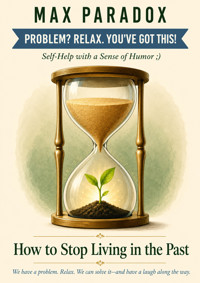
How to Stop Living in the Past is a practical, funny guide to breaking the cycle of regret, rumination, nostalgia, self-blame, and endless alternate-life scenarios. Max Paradox explains why your brain keeps returning to old mistakes, missed opportunities, painful relationships, unfair experiences, and versions of life that never happened - and, more importantly, what to do when it does.
This is not a book about pretending the past was wonderful. Some decisions were bad. Some people hurt you. Some opportunities really were missed. Some years genuinely did not go the way you wanted.
The solution is not to put a motivational quote over it.
Instead, you will learn how to separate useful reflection from mental punishment, judge old decisions using the information you actually had at the time, distinguish responsibility from shame, stop idealizing roads you never took, reduce the habits that keep old memories active, and convert regret into practical rules for the future.
You will also learn how to handle setbacks, anniversaries, old relationships, family roles, unresolved unfairness, nostalgia, alternate timelines, and the deeply unhelpful habit of comparing your actual Tuesday with an imaginary life in which everything worked perfectly.
Most importantly, this book helps you move your attention somewhere useful: toward current relationships, current decisions, current repairs, and a future that contains enough real life to compete with the archive.
No mystical "letting go."
No requirement to forgive everyone by Thursday.
No pretending every painful experience was secretly a gift from the universe.
Just practical methods for learning what needs to be learned, repairing what can still be repaired, accepting what cannot be changed, and stopping yesterday from running today's schedule.
The past is allowed to be part of your story.
It simply does not need to keep writing the next chapter.
This publication was prepared with the assistance of tools that support the creative process, including artificial intelligence-based solutions. The final concept, structure, and editing belong to the author.
Ebooka przeczytasz w aplikacjach Legimi na:
Liczba stron: 188
Rok wydania: 2026
Odsłuch ebooka (TTS) dostepny w abonamencie „ebooki+audiobooki bez limitu” w aplikacjach Legimi na:
Podobne



















INTRO
It is 11:37 p.m. You are brushing your teeth, which should be one of the least psychologically demanding activities available to an adult. Then your brain remembers something you said at a dinner in 2019.
Perfect.
You stop brushing. Why did you say that? Why did you phrase it like that? Did everyone notice? Of course they noticed. They probably still discuss it. Somewhere, six people are sitting around a table saying, “Do you remember what Alex said seven years ago?” They have photographs. There may be a documentary in production.
Meanwhile, the people who were actually there have forgotten the dinner, the conversation, possibly your last name, and certainly the exact sentence that has just been promoted to a major historical event inside your bathroom.
This is one of the stranger things about living in the past: the event is over, but your brain keeps renewing the subscription.
Sometimes it is a stupid comment. Sometimes it is a relationship you wish you had handled differently, a job you should have taken, a job you should never have taken, money you wasted, years you feel you lost, someone you hurt, someone who hurt you, an opportunity you missed, or a decision that seemed reasonable at the time and now looks like it was made by a committee of exhausted raccoons.
You know you cannot change it. This information is not exactly breaking news. People have probably told you, “You need to let go,” which is excellent advice in the same way that “Try not to be poor” is excellent financial planning.
Yes. Thank you.
How?
That is the useful question.
Regret has an irritating ability to disguise itself as productive thinking. You replay the situation because it feels as though one more round of analysis might finally produce the missing answer. Maybe if you examine the breakup from seventeen additional angles, you will discover the sentence that would have saved everything. Maybe if you reconstruct the meeting precisely, you will identify the moment your career took a wrong turn. Maybe if you think hard enough about who you were at twenty-five, you can somehow send that person an urgent message.
Unfortunately, the past has terrible customer service.
There is no edit button. No recall option. No manager available. You cannot go back and say, “Hello, I would like to exchange this decision. I have the receipt and several years of hindsight.”
Hindsight is the part that makes regret especially unfair. You judge the person you were then using information available to the person you are now. Today you know how the relationship ended, what the job became, which friend disappeared, what the investment did, how your priorities changed, and that the haircut was a mistake.
Past you did not have the season finale.
Yet we often examine old choices as if we had deliberately ignored information that did not exist yet. “How could I not see it?” Because you were standing before it happened. That is generally how time works.
This does not mean every past decision was secretly brilliant. Some were bad. Some were selfish. Some were careless. Some were made because you were scared, immature, angry, lonely, desperate to be liked, desperate to leave, or convinced that sending a five-paragraph text message at 1:14 a.m. was the beginning of a calm and productive conversation.
Human history contains very few successful five-paragraph texts sent at 1:14 a.m.
The goal of this book is not to declare that everything happened for a reason, because sometimes the reason was simply that you made a bad call. Nor are we going to paint every mistake gold and call it a blessing. You can learn from something without pretending you are delighted it happened. A car accident may teach you to drive more carefully. You do not need to send the accident a thank-you card.
The real problem begins when remembering stops helping and starts becoming a place where you live.
You revisit conversations while driving. You compare your current life with the version you think you should have had. You imagine alternative timelines in which you chose differently and everything worked out beautifully, because imaginary timelines are extremely cooperative. In them, the job you rejected becomes a spectacular career, the person you left becomes your perfect partner, the city you did not move to contains excellent friends, affordable housing, and apparently no traffic.
Your alternate self is doing very well.
This is partly because you never have to watch that person deal with the consequences of the choice you did not make. You see the benefits, not the new problems. The path not taken remains wonderfully clean because nobody actually walked down it long enough to discover the potholes.
Then there is nostalgia, regret’s better-dressed cousin. Nostalgia usually arrives carrying selected highlights. It remembers the summer evenings but not the arguments, the old job friendships but not Sunday-night dread, the relationship vacations but not the forty-seven conversations about the same unresolved problem. Memory is not security-camera footage. It edits.
Sometimes aggressively.
This is why “I miss how things were” can quietly become “Everything was better then,” even when everything was absolutely not better then. Some things were better. Some were worse. Some were merely younger, which is not the same thing.
None of this means the answer is to stop thinking about the past. That would be neither possible nor desirable. Your past contains information. It tells you what matters to you, what hurts you, what patterns you repeat, what boundaries you ignored, what risks were worth taking, and which phrases should never again be included in a text to an ex.
The question is not whether you remember.
The question is what you do after remembering.
In this book, we are going to separate useful reflection from repetitive mental punishment. We will look at why regret keeps looping, why trying to force thoughts away often makes them return wearing heavier boots, and why forgiveness—of yourself or someone else—does not require declaring that what happened was fine.
You will learn how to deal with mistakes that can still be repaired and how to handle the ones that cannot. We will talk about unfinished conversations, shame, resentment, idealized memories, missed opportunities, and the dangerous hobby of comparing your real present with an imaginary past or imaginary alternative life.
Most importantly, we are going to make this practical.
Not “embrace the journey.”
Not “raise your vibration.”
Not “simply choose peace,” as though peace were sitting beside the cereal and you somehow kept forgetting to put it in the cart.
You will get specific ways to interrupt rumination, decide whether a regret requires action or acceptance, stop reopening cases that have already been investigated seventeen times, and shift your attention toward a present life that still contains actual decisions.
Because that is the part regret tends to hide from you: while you are trying to renegotiate yesterday, today continues without supervision.
You still have choices.
You still have relationships to improve, things to repair, places to go, conversations to have, and mistakes available that you have not even made yet.
Relax.
There will be fresh material.
Chapter 1 - Your Brain Has Reopened the Case
You are making coffee when your brain decides this is an excellent time to reopen a case from eight years ago.
Not a major legal case. Nothing requiring witnesses, DNA, or a documentary narrator with a serious voice. It is the time you stayed too long in a relationship, turned down an opportunity, trusted the wrong person, said something embarrassing, failed to speak up, or made a decision that now looks painfully obvious.
The kettle has not even boiled.
Your brain is already presenting Exhibit A.
This is what regret often feels like: an internal investigation that was supposed to produce useful information but somehow became permanent. You review what happened, search for the exact point where things went wrong, imagine what you should have done, and then review it again because apparently the previous forty-seven investigations were considered preliminary.
At first, this can look sensible. Reflection is useful. If you touched a hot stove, remembering that experience is significantly more efficient than checking every stove personally for the rest of your life. Your brain is built to learn from outcomes. It asks questions such as: What happened? What did I miss? What should I do differently next time?
Excellent questions.
The problem begins when the answers have already arrived and the questioning continues.
Suppose you stayed in a job you hated for three years because you were afraid to leave. You have now understood the lesson: when a job is making you miserable for months, do not wait indefinitely for the workplace to transform through spontaneous corporate enlightenment. You have the information. You may have even changed jobs.
Useful reflection would say, “I ignored several warning signs because uncertainty scared me. Next time I will set a deadline for reassessing the situation.”
Rumination says, “Yes, but why did I waste three years?”
Then: “What would have happened if I had left after six months?”
Then: “I could be much further ahead now.”
Then: “What if I ruined my career?”
Then, because the brain enjoys a dramatic finale: “Perhaps my entire life has been built incorrectly.”
You started with a former employer.
You have somehow reached the structural integrity of your existence.
That escalation matters. Living in the past is rarely just remembering. It is remembering plus interpretation, judgment, prediction, and emotional re-experiencing. The original event may have lasted an hour, a month, or a few years. The replay can continue for decades if every memory becomes a fresh trial of the person you used to be.
And there is one unusual feature of this trial.
The prosecutor has access to information the defendant did not.
You know how things turned out. You know what your ex did later, what happened to the company, whether the investment collapsed, whether the friend betrayed you, whether the opportunity would have mattered. Past you knew none of that.
Yet present you walks into court carrying the full case file and asks:
“How could you not know?”
This is like yelling at someone watching the first ten minutes of a movie because they have not yet identified the murderer.
They are doing their best.
The murderer has barely appeared.
Reflection Has an End Point
A useful way to understand regret is to separate three activities that often get mixed together:
Learning: What can this experience teach me?
Repairing: Is there something I can still do?
Punishing: Am I repeatedly making myself feel bad without creating new information or useful action?
The first two can improve your life.
The third mostly creates emotional paperwork.
Take a common example. You were unfair to someone during a difficult period in your life. Years later, you still feel ashamed. Learning might mean recognizing that when you feel threatened, you become defensive and say things you later regret. Repairing might mean apologizing if that is appropriate and does not create new harm.
Punishing is replaying the conversation every few weeks and announcing internally, “I was terrible.”
That may feel morally serious, but it is not the same thing as accountability.
Accountability changes future behavior.
Self-punishment mostly changes your evening.
This distinction can be uncomfortable because people sometimes fear that if they stop suffering over a mistake, they are somehow approving of it. As though guilt is the security guard preventing them from becoming a monster.
“If I forgive myself, what stops me from doing it again?”
Ideally, learning.
If the only thing preventing you from repeating a mistake is the requirement to hate yourself indefinitely, your prevention system could use an upgrade.
You do not need to forget what happened. You need to stop confusing pain with responsibility.
Why the Replay Feels Necessary
Regret often continues because your brain believes unfinished thinking will eventually produce control.
If you can understand the past perfectly, maybe you can prevent future pain perfectly.
This sounds reasonable until you notice the word perfectly.
Human beings are not especially comfortable with uncertainty. We like explanations. We particularly like explanations after something painful happens because randomness, ambiguity, and incomplete information are rude. The mind would rather create a complicated theory than accept that sometimes you made the best decision you could and it still went badly.
So it keeps looking.
Maybe there was a sign.
Maybe you missed something.
Maybe you should have known.
Maybe if you analyze enough, you will find the one detail that makes the whole thing predictable.
Occasionally you will. Often you will not.
Life does not always provide a satisfying postgame analysis. Sometimes the relationship failed because two people changed. Sometimes the business idea was reasonable and the timing was terrible. Sometimes you trusted someone because they behaved like a trustworthy person until they did not.
Very inconsiderate of them.
The temptation is to believe that if you can make the past entirely understandable, you can make the future safe. But no amount of analysis can remove uncertainty from life. It can make you wiser. It cannot make you psychic.
That is a disappointing feature.
Still no refund available.
The Three Questions Test
When an old regret begins looping, do not immediately wrestle with the thought. First classify it.
Ask:
Is there new information here?
Is there a useful action I can still take?
If neither is true, what exactly am I trying to achieve by thinking about this again?
These questions are deliberately boring. Good. Regret thrives on drama. A boring procedural question is often exactly what it deserves.
Imagine you keep thinking about a friendship that ended badly.
“Could I have handled that differently?”
Perhaps yes.
New information? You now see that you avoided difficult conversations until resentment built up.
Useful action? Maybe you can use that lesson in current relationships. Perhaps an apology is appropriate. Perhaps contacting the person would reopen something that should stay closed.
If you have learned the lesson and no repair is useful, then the remaining replay may simply be punishment wearing a detective hat.
Case closed does not mean case forgotten.
It means you stop scheduling hearings.
You Are Not Required to Reach a Perfect Verdict
Another trap is believing you must decide exactly who was right, who was wrong, how much responsibility belonged to each person, and what would have happened under every alternative.
Good luck.
Some old situations remain messy because people are messy. You may have made mistakes and also been treated badly. Someone may have loved you and still damaged the relationship. You may have chosen badly with good intentions. There may be no final sentence that makes everything emotionally tidy.
This is frustrating if your brain enjoys closure.
Your brain may prefer:
“I was entirely wrong.”
Or:
“They were entirely wrong.”
These conclusions have the advantage of simplicity. They also have the disadvantage of frequently being nonsense.
A more accurate conclusion may sound like this:
“I ignored signs I would pay attention to now. I was afraid. They also behaved badly. I cannot know what would have happened if I had left earlier. I know what I would do differently today.”
Less cinematic.
Much more useful.
Regret Is Often Trying to Protect You
It helps to notice that even painful mental habits usually began with a useful purpose. Your brain is not replaying old mistakes because it has a personal grudge against your afternoon. It is trying to help.
Badly, sometimes.
But still.
Regret says:
“Remember this so we do not get hurt again.”
The trouble is that your brain can move from remembering the lesson to preserving the emotional pain as if the pain itself were necessary evidence.
You do not need to keep touching the bruise to remember where the table is.
A better approach is to extract the instruction.
For example:
“I ignored my finances for too long.”
becomes:
“I review my accounts every Friday.”
“I trusted someone too quickly.”
becomes:
“I let trust build through repeated behavior.”
“I stayed silent when I should have spoken.”
becomes:
“I raise important concerns earlier, before resentment turns into a private Netflix series.”
“I spent years waiting for the perfect moment.”
becomes:
“I make reversible decisions faster.”
Notice what happened. The regret became a rule for the future.
That is when the past starts paying rent.
The Five-Minute Case Review
When a regret is especially persistent, give it a formal review instead of allowing random ambushes while you are trying to buy toothpaste.
Take five minutes and write four lines:
What happened? State the event without the courtroom drama.
What was my responsibility? Be specific. Do not write “everything” unless you personally controlled the weather, the economy, the other person’s personality, and international shipping.
What did I learn? Turn the lesson into one sentence.
What will I do differently now? Choose an action, rule, boundary, or decision.
Example:
What happened? I stayed in a relationship long after I knew it was not working.
My responsibility: I avoided making a painful decision because I was afraid of being alone.
What I learned: Avoiding a difficult ending does not prevent pain; it delays it and often adds interest.
What I will do differently: If I repeatedly feel a relationship is fundamentally wrong, I will address it directly instead of hoping discomfort develops a hobby and moves away.
That is reflection.
Writing seven pages titled “Why I Ruined Everything” is a different genre.
What If the Thought Comes Back?
It probably will.
Do not interpret this as failure. Memories do not disappear because you completed a worksheet. Your brain is not a customer-support ticketing system where the issue changes to RESOLVED and vanishes from the dashboard.
When the regret returns, recognize it.
“I know this case.”
Then ask whether there is new evidence.
If there is, think.
If there is not, redirect.
This is not suppression. You are not screaming, “DO NOT THINK ABOUT 2016,” which is one of the fastest known methods for thinking about 2016.
You are deciding that familiar material does not require another full hearing.
You can even use the same sentence each time:
“I have already taken the lesson from this.”
Short.
Accurate.
No incense required.
Your Action
Choose one regret that returns often. Do not pick the most painful event of your life if this is your first attempt. Start with something important but manageable.
Write down:
what happened;
what part was actually yours;
what you learned;
what you do differently now.
Then add one final sentence:
There is nothing more I need to solve about this today.
Not forever.
Today.
That matters because the goal is not to win a dramatic battle against your entire history. The goal is to stop one old case from automatically taking over the present every time it appears.
You are allowed to learn from the past.
You are not required to maintain an office there.
Chapter 2 - Hindsight Is a Terrible Time Machine
You missed an opportunity five years ago.
Now it looks obvious.
Of course you should have taken the job. Of course you should have bought the house. Of course you should have left sooner, stayed longer, invested, sold, spoken up, kept quiet, moved, not moved, called, not called, and definitely not worn that jacket.
Today, the correct answer shines like an airport runway.
At the time, it was approximately as clear as the instructions for assembling furniture written entirely in diagrams.
This is hindsight.
And hindsight is one of regret’s favorite accomplices.
After we know the outcome, our brains quietly rewrite how predictable that outcome looked before it happened. Once you know that the relationship ended, the warning signs become obvious. Once the company succeeds, rejecting the job offer seems ridiculous. Once the investment triples, not buying it feels like financial incompetence.
But you are looking backward with information that did not exist when you made the decision.
This is not a small detail.
It is the entire case.
The Past Looks Simpler After It Is Finished
Imagine choosing between two jobs.
Job A pays more, has a prestigious title, and seems like a strong career move. Job B pays less but offers more flexibility and a manager you like. You choose Job A.
A year later, Job A becomes miserable. The manager leaves. The company restructures. Your workload expands until your laptop begins to feel like a family member.
Now your brain says:
“I knew I should have chosen Job B.”
Did you?
Or do you know it now?
Those are not the same sentence.
Perhaps Job B would also have changed. Perhaps its manager would have left. Perhaps the company would have cut your role. Perhaps you would have hated the work. You do not know because that timeline was never tested.
The path you did not take has a powerful advantage.
It has no documented problems.
You can imagine it any way you like.
This creates one of the most unfair comparisons in human thought: your real life, with traffic, mistakes, disappointing Tuesdays, bills, misunderstandings, bad moods, and actual consequences, versus an imaginary alternative life assembled from highlights.
The imaginary version has excellent lighting.
Counterfactual Thinking: Your Brain’s Alternate-Universe Department
Psychologists use the term counterfactual thinking for imagining how things could have gone differently.
You do it constantly.
“If I had left ten minutes earlier…”
“If I had accepted that offer…”
“If I had never met that person…”
“If I had studied something else…”
“If I had bought Bitcoin in 2012…”
The last one has ruined many otherwise peaceful showers.
Counterfactual thinking is not useless. It helps us learn. If you missed a flight because you left home far too late, imagining the alternative—leaving earlier—can improve your next trip.
Very good.
Next time you leave earlier.
Lesson complete.
The problem is when your brain builds increasingly elaborate alternate realities that cannot teach you anything new.
“If I had chosen a different major, I would have entered another industry, met different people, lived in another city, earned more money, bought a house earlier, married someone else, and probably developed excellent posture.”
At this point you are no longer reviewing a decision.
You are writing fan fiction about yourself.
You Compare Outcomes Instead of Decisions
One of the most important corrections you can make is this:
Judge old decisions by the information available then, not only by the outcome you know now.
A good decision can lead to a bad outcome.
A bad decision can lead to a good one.
You can drive carefully and still be hit by someone else.
You can drive irresponsibly and arrive home safely.
The first outcome does not prove careful driving was pointless. The second does not establish a promising new transportation philosophy.





