Uzyskaj dostęp do tej i ponad 240000 książek od 14,99 zł miesięcznie
- Wydawca: ALL-IN Rafał Płonkowski
- Kategoria: Biznes, rozwój, prawo•Biznes, rozwój
- Język: angielski
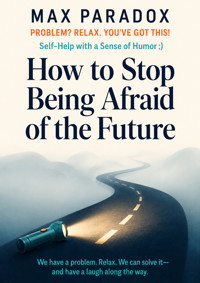
What if you could think about the future without mentally experiencing seventeen disasters before breakfast?
How to Stop Being Afraid of the Future is a practical, funny guide for anyone whose brain treats uncertainty like an emergency. If you constantly wonder what could go wrong with your job, money, health, relationships, plans, technology, or life in general, Max Paradox has some good news: you do not need to become fearless. You need to stop treating every possible future as if it has already sent a calendar invitation.
This book shows you how to separate realistic preparation from endless worry, tell possibility from probability, stop rehearsing disasters, make decisions without impossible certainty, and focus on the parts of the future you can actually influence.
You will learn how to:
recognize when your brain is predicting rather than reporting facts;
stop confusing worrying with preparation;
reduce compulsive checking, reassurance-seeking, and future-focused research;
make decisions without waiting to feel completely certain;
use realistic backup plans without turning preparedness into a bunker-building hobby;
identify what you control, what you influence, and what you need to leave alone;
create simple financial, career, practical, and personal resilience;
handle waiting when no answer is available yet;
recover when fear comes back;
use a minimum "Potato Version" of the system on days when your motivation has left the building;
build a life with enough options and margin that you need less prediction in the first place.
This is self-help for normal people: people who have work, laundry, bills, relationships, bad sleep, limited energy, and no desire to meditate under a waterfall at 4:30 a.m.
The advice is concrete. The humor is frequent. The goal is simple: help you prepare for what deserves preparation, act where action is possible, and stop sacrificing today to scenarios that may never happen.
The future will remain uncertain.
That is not the problem.
The problem is spending your present trying to force tomorrow to provide guarantees it does not have.
You cannot control everything that may happen.
You can become much better at deciding what deserves your attention now.
And maybe finally go to bed without mentally reviewing the economy.
This publication was prepared with the assistance of tools that support the creative process, including artificial intelligence-based solutions. The final concept, structure, and editing belong to the author.
Ebooka przeczytasz w aplikacjach Legimi na:
Liczba stron: 182
Rok wydania: 2026
Odsłuch ebooka (TTS) dostepny w abonamencie „ebooki+audiobooki bez limitu” w aplikacjach Legimi na:
Podobne

















INTRO
It is 11:47 p.m., and you are trying to sleep. Nothing is actually happening. The apartment is quiet, your phone is charging, tomorrow’s clothes are somewhere between “prepared” and “still in the dryer,” and civilization appears to have survived another day. This would be an excellent moment to rest.
Your brain disagrees.
What if work gets worse? What if you lose your job? What if prices keep going up? What if you get sick? What if someone you love gets sick? What if the economy collapses, artificial intelligence replaces half the workforce, your retirement savings evaporate, your relationship changes, the climate becomes unbearable, and you eventually end up living in a storage unit with three canned beans and a suspicious extension cord?
Excellent.
Sleep well.
Fear of the future has an impressive business model. It takes events that have not happened, may never happen, and in some cases are not even particularly likely, then charges you emotionally for experiencing them in advance. You pay in stress, lost sleep, distraction, indecision, and occasionally forty-five minutes of reading an article titled something like “Ten Signs Everything Is About to Change Forever.”
The article contains eleven pop-up ads.
This does not mean your concerns are ridiculous. Some things genuinely can go wrong. Jobs disappear. Relationships end. People get sick. Markets fall. Plans fail. A washing machine can break precisely three days after you spend your emergency fund on something you described as “basically an investment,” even though it has leather seats and heated cup holders.
The future contains risk.
Unfortunately, this fact has somehow convinced the human brain that constant worrying is useful preparation.
It is not.
Worrying feels productive because your mind is busy. You are reviewing scenarios, calculating possibilities, replaying conversations, anticipating disasters, and mentally preparing statements for events that have not yet been scheduled by reality. There is activity everywhere. Your internal management team is clearly working overtime.
Nobody has produced anything.
That is one of the strangest parts of future anxiety: it can make you feel as if you are taking responsibility when you are actually standing still. You think about changing jobs instead of updating your résumé. You worry about money instead of checking the numbers. You fear your health getting worse while postponing the appointment that could give you useful information. You imagine a difficult conversation in seventeen possible versions and then avoid having the actual three-minute conversation.
Your mind is rehearsing for a play that may never open.
Meanwhile, Tuesday still needs dealing with.
The problem is not that you think about the future. You should. Adults who never think ahead eventually discover that electricity companies have surprisingly little respect for spontaneity. Planning matters. Saving matters. Preparing matters. Making sensible decisions based on what might happen is one of the reasons we no longer store our entire retirement strategy in a jar labeled “miscellaneous.”
The problem begins when planning quietly turns into predicting, predicting turns into catastrophizing, and catastrophizing starts wearing a fake mustache labeled RESPONSIBILITY.
Now every uncertainty becomes a threat. A delayed email means something is wrong. A change at work means layoffs are coming. A strange sound from the car means financial ruin. A headline about the economy becomes a personal notification from destiny.
You do not know what will happen.
Your brain finds this unacceptable.
So it makes something up.
Usually not a pleasant picnic.
Human beings are remarkably uncomfortable with uncertainty. We prefer a bad answer to no answer because at least a bad answer gives us something solid to panic about. “I don’t know what will happen” leaves the door open. “Everything will go wrong” feels strangely definite.
Terrible.
But definite.
This is why fear of the future often survives even when the future keeps proving your predictions wrong. You worried about ten things last month. Seven never happened, two were mildly inconvenient, and one turned out better than expected. Your brain does not issue a correction.
It simply moves on to next month’s emergency schedule.
This book is not going to tell you that everything will be fine. Nobody can promise that without either lying or operating a suspiciously successful crystal-ball business. Some things will go badly. Some things will go wonderfully. Many things will be much more boring than your imagination predicted.
That last category is enormous.
The goal here is not to make you stop caring about tomorrow. It is to stop sacrificing today to an imaginary version of tomorrow that keeps changing anyway. You are going to learn how to separate real preparation from repetitive fear, how to recognize when your mind is producing possibilities instead of facts, and how to respond when uncertainty starts behaving like an emergency.
You will also learn what to do when there really is something worth worrying about.
Because sometimes fear contains useful information. If your finances are fragile, the answer is not to chant, “Money flows toward me,” while your credit card quietly catches fire. If your job is unstable, pretending not to notice is not courage. If something important needs action, action matters.
The trick is learning the difference between a problem you can work on and a future you are merely trying to mentally control.
One deserves a plan.
The other deserves less airtime.
We will deal with both.
Along the way, we will look at why your brain keeps demanding certainty that nobody can provide, why reassurance helps for about twelve minutes before you need another dose, why endlessly researching possible problems often creates more fear instead of less, and why “I just want to be prepared” can sometimes mean “I would like to eliminate every unpleasant surprise from the remainder of my natural life.”
A modest objective.
We will also get practical. You will learn ways to reduce useless future-scanning, make decisions without waiting for complete certainty, prepare for realistic risks without building a private disaster museum, and bring your attention back to what can actually be influenced now.
Not someday.
Now.
And when the methods do not work perfectly—because you are a human being, not a downloadable software patch—we will simplify them. There will be smaller versions, fallback options, and ways to recover when you spend an evening worrying despite knowing perfectly well that worrying is not helping.
Knowing something is useless has never prevented humanity from doing it enthusiastically.
The point is not to become fearless. Fear is part of the equipment. Sometimes it protects you. Sometimes it warns you. Sometimes it sees a shadow on the wall and immediately contacts the authorities.
You do not need to remove fear.
You need to stop giving it the keys.
By the end of this book, the future will still be uncertain. That part cannot be fixed. But uncertainty will no longer have to mean danger, and thinking ahead will no longer require mentally living through every catastrophe before breakfast.
Tomorrow will arrive when it arrives.
You can meet it then.
Chapter 1 - Your Brain Is a Terrible Fortune-Teller
You open your inbox at 8:14 a.m. There is a message from your manager: “Can we talk later today?”
That is all.
No angry punctuation. No dramatic attachment titled FINAL DECISION. No company lawyer copied in. Just six ordinary words.
Within thirty seconds, however, your brain has produced an entire limited series.
Maybe something is wrong with the project. Maybe someone complained. Maybe budgets are being cut. Maybe you are being fired. If you are fired, you will need another job. The market is terrible. Your savings are not enough. You will have to sell things. Probably the car. Maybe the house. You will eventually explain to your children that dinner is now a creative interpretation of crackers.
At 2:00 p.m., your manager calls.
“Do you still have the presentation from last quarter?”
Yes.
“Great. Can you send it?”
Meeting concluded.
Your nervous system would like compensation.
This is one of the basic mechanisms behind fear of the future: the brain does not merely notice uncertainty. It tries to close it. If information is missing, it supplies information of its own.
Unfortunately, it does not always hire the best writer.
The human brain is excellent at simulation. That is useful. You can imagine what might happen before doing something, spot risks before walking into them, and learn from events that have not yet happened. If you are planning a road trip, it helps to think, “Perhaps I should fill the tank before entering a region where every gas station appears to have been abandoned in 1987.”
Simulation is not the problem.
Confusing simulation with prediction is.
A thought such as “What if I lose my job?” is not evidence that you are likely to lose your job. It is evidence that your brain can create a sentence. This is an important distinction because brains are astonishingly productive sentence factories.
They produce hits such as:
“What if this pain is serious?”
“What if the relationship falls apart?”
“What if I make the wrong choice?”
“What if my savings disappear?”
“What if things never improve?”
“What if everybody else knows something I do not?”
And the timeless classic:
“What if somehow everything goes wrong at once?”
Your brain deserves points for range.
When you are afraid of the future, thoughts often arrive with emotional force. That force makes them feel more credible. A mild thought is easy to dismiss. A thought accompanied by a tight chest, restless stomach, and sudden desire to search the internet at 1:23 a.m. feels important.
But emotional intensity is not the same thing as accuracy.
If you watch a horror movie alone at night and hear a sound in the kitchen, your heart may respond as if an axe murderer has entered the property. The sound may be the refrigerator.
Your heart is committed to safety.
It is not committed to proportion.
This matters because people often respond to future fear by asking the wrong question. They ask:
“Could this happen?”
Usually, yes.
Almost anything could happen.
Your company could restructure. Your flight could be canceled. Your investment could fall. Your partner could change their mind. Your roof could leak. A raccoon could enter your garage and establish a regional headquarters.
Possibility is an enormous category.
If “could happen” becomes your standard for worrying, you will never run out of material.
A better question is:
“What evidence do I have that this is becoming more likely?”
That small change moves you from imagination toward reality.
Suppose you are worried about losing your job. Evidence might include repeated layoffs, canceled projects, falling revenue, direct comments about restructuring, or your role being actively reduced. Those are signals worth taking seriously.
Your manager sending “Can we talk?” is not in the same category.
Unless the message also contains the phrase “please bring your building access card.”
Then perhaps update the probability.
The goal is not to talk yourself out of every concern. That would be another form of pretending. The goal is to grade your thoughts according to evidence instead of volume.
A useful first habit is to label future thoughts correctly.
Instead of:
“I am going to lose my job.”
Try:
“I am having the thought that I may lose my job.”
That wording may sound almost annoyingly simple, but it creates a useful gap. The first statement sounds like news. The second accurately describes what is happening: your mind has produced a possibility.
You can make the language even more concrete:
“This is a prediction, not a fact.”
That sentence is not positive thinking.
It is bookkeeping.
You are putting the thought in the correct column.
Imagine your mind as an employee who regularly submits dramatic forecasts with no supporting documentation. You would not fire the employee immediately. You would simply start asking for sources.
“Interesting. What are we basing this on?”
Your brain may respond:
“A feeling.”
Anything else?
“Well, it feels very strong.”
Thank you. The committee will review it.
One reason future fear becomes exhausting is that people keep mentally debating every prediction. They try to prove that the bad outcome will not happen. This creates a trap because certainty is impossible.
“What if the presentation goes badly?”
“It probably will not.”
“But it could.”
“Yes.”
“And if it does?”
“I will deal with it.”
“But what if I cannot?”
“You probably can.”
“But what if—”
Congratulations. You have entered a customer service chat with your own anxiety.
There is no exit button.
Trying to defeat every “what if” with reassurance teaches your mind that every imaginary scenario deserves a full hearing. Soon the brain starts submitting more cases because apparently the office is open twenty-four hours.
A better response is shorter:
“Maybe. What can I do now?”
That question does two things. First, it refuses to promise certainty. Second, it redirects attention toward action.
Maybe the presentation could go badly. What can you do now? Review the slides, practice the first five minutes, check the numbers, then stop.
Maybe you could lose your job. What can you do now? Keep your résumé current, maintain an emergency fund if possible, strengthen useful skills, and pay attention to actual signals.
Maybe your relationship could end. What can you do now? Communicate, deal with real problems, and stop interrogating your partner because they used a period instead of a heart emoji.
Preparation has an endpoint.
Worry does not.
That difference is worth remembering.
Real preparation usually produces something: a decision, a phone call, a saved document, a financial buffer, a checked fact, a booked appointment, a backup plan. Worry often produces more worry.
If you spend an hour thinking about a problem and at the end have no new information, no action, and no decision, you may not be preparing anymore.
You may simply be renting a furnished apartment inside the problem.
Here is a simple method to use when your mind begins forecasting disaster. Take the prediction and run it through three questions:
What exactly am I predicting?
What actual evidence supports it?
Is there anything useful I can do today?
Be specific.
Not:
“Everything is unstable.”
Instead:
“I am worried my department may be cut because two projects were canceled and leadership mentioned cost reductions.”
Now you have something you can evaluate.
Maybe the fear is mostly imagination. Then your job is to stop treating it as information.
Maybe the fear contains a real signal. Then your job is to act on the signal.
Both outcomes are more useful than free-range panic.
Let us take money as another example. You think, “I am going to run out of money.”
That sounds serious, but it is still too vague to solve. Look at your account. Look at monthly expenses. Check debt payments. Calculate the actual gap.
You may discover that things are fine.
You may discover that they are not fine.
Either way, numbers are more useful than dread.
Fear loves fog because anything can be hiding in fog. A spreadsheet is less cinematic.
This principle works in many situations. If you fear a health problem, get appropriate medical advice instead of diagnosing yourself from a forum where someone named DragonDad77 has very strong opinions about magnesium. If you fear an upcoming conversation, write down the two things you actually need to say instead of rehearsing twenty-three imaginary arguments. If you fear making the wrong choice, decide what criteria matter and accept that decisions are made with incomplete information.
You are not trying to become certain.
You are trying to become oriented.
There is a large difference.
People who fear the future often think they need more prediction. Usually they need better contact with the present. What is known? What is unknown? What can be checked? What can be done? What must simply remain uncertain for now?
That last category annoys the brain enormously.
Good.
It needs practice.
You cannot train yourself to tolerate uncertainty by removing all uncertainty. That is like trying to become comfortable with water while insisting the swimming pool remain empty.
Start small. The next time you notice a future prediction, do not immediately solve it, research it, or argue with it. Name it.
“Prediction.”
Then ask for evidence.
Then choose one action, if an action exists.
If no action exists, leave the thought unfinished.
That may feel uncomfortable because your brain wants closure. Let it want closure. Wanting certainty is not the same thing as needing certainty.
Your first task is simple: catch one prediction today and rewrite it as what it actually is.
Not:
“This will go badly.”
But:
“My brain is predicting that this may go badly.”
Then ask:
“What do I know?”
“What can I do?”
And after that, return to your day.
Your brain may continue broadcasting.
It is allowed to have a radio station.
You do not have to listen to every program.
Chapter 2 - Possible Is Not Probable
At 7:30 one morning, you notice a small headache.
By 7:35, you have remembered an article about neurological symptoms.
By 7:42, you are reading a medical website.
At 7:51, you have developed a condition so rare that the webpage itself seems surprised to see you.
At 8:03, you are wondering whether you should organize your passwords for the family.
At 8:14, you drink water.
The headache disappears.
A magnificent diagnostic journey.
The mind has a strange relationship with possibility. Once it realizes an outcome can happen, it can begin behaving as though that outcome deserves immediate attention.
The missing piece is probability.
A plane can crash. A house can burn down. A healthy person can develop a serious illness. A business can fail. A relationship can end unexpectedly. Someone can break into your home.
All true.
It is also true that a piece of space debris could damage your car while you are buying groceries.
You are probably not adjusting your insurance around that possibility.
Why not?
Because somewhere in your reasoning, probability quietly returned to work.
Future fear often weakens that filter. Instead of asking, “How likely is this?” the mind asks, “Can I imagine it?”
If the answer is yes, the scenario gets admitted.
This becomes especially powerful when the outcome is emotionally important. If you care deeply about your family, your health, your job, or your financial security, your brain tends to monitor threats in those areas more aggressively.
That is understandable.
It is also how you end up interpreting one slow week at work as the opening scene of complete professional collapse.
The important distinction is simple:
Possible means an event can happen.
Probable means there is meaningful reason to expect it.
Those are not the same thing.
You know this intuitively in ordinary life. When you leave the house, you do not bring a fire extinguisher, twelve gallons of water, a satellite phone, snow chains, antibiotics, climbing equipment, and a canoe.
Technically, situations could arise in which each item becomes useful.
You are going to Target.
Reasonable people make decisions using a mixture of probability, consequence, and cost. We prepare more for events that are likely, more for events that would be severe, and less when preparation itself is absurdly expensive.
That basic framework can help with future fear.
Ask three questions:
How likely is this, based on what I know?
How serious would it be if it happened?
What level of preparation is reasonable?
Notice the third question.
Reasonable.
Not maximum.
Maximum preparation is an endless project because there is always another layer. You can save six months of expenses. Why not twelve? Why not five years? You can back up your files. Why not keep four physical copies in three states? You can buy travel insurance. Why not also learn emergency dentistry?
At some point, safety becomes a hobby.
The goal is not to become careless. It is to stop letting low-probability possibilities consume high amounts of attention.
Consider flying. A nervous passenger may know intellectually that commercial air travel is generally safe but still feel intense fear during turbulence. Emotion says, “Something is wrong.”
Evidence may say, “This is uncomfortable, not necessarily dangerous.”
The body does not always care about the distinction.
That is why arguing with fear can be ineffective. You can give yourself excellent statistics while gripping the armrest like it owes you money.
The practical goal is not to force your body to feel calm. It is to behave according to the best available information even while discomfort is present.
That principle extends far beyond flying.
You can feel afraid that the meeting will go badly and still walk into the meeting.
You can feel uncertain about changing careers and still gather information.
You can fear market volatility and still follow a sensible long-term plan rather than making dramatic decisions at 10:17 a.m. because a red line moved downward.
Feelings can come along.
They do not get to drive.
One common mistake is constantly searching for reassurance about low-probability risks. You read reviews, check symptoms, search forecasts, compare predictions, refresh news, and ask people what they think.
The first search may give useful information.
The twelfth search usually gives you new things to worry about.
Suppose you are planning a trip and become worried about weather. You check the forecast.
Fine.
Then you check another app.
Then an hourly model.
Then a weather forum.
Then historical precipitation.
Then a video from a man who owns three barometers and says, “I don’t like what I’m seeing.”
Now you are not planning a vacation.
You are coordinating the evacuation of Florida.
More information is not always more certainty. Sometimes it simply increases the number of possible scenarios your mind can manufacture.
This is especially true online because search systems are excellent at finding unusual events. If you search “Can X go wrong?” you will almost always find somebody for whom X went spectacularly wrong.
Search:
“Can luggage disappear permanently?”
Yes.
“Can a new car have engine failure?”
Yes.
“Can a routine dental procedure cause complications?”
Yes.
“Can a toaster catch fire?”
Yes.