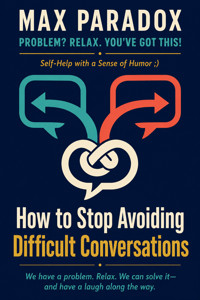
Uzyskaj dostęp do tej i ponad 240000 książek od 14,99 zł miesięcznie
- Wydawca: ALL-IN Rafał Płonkowski
- Kategoria: Biznes, rozwój, prawo•Biznes, rozwój
- Język: angielski
You know exactly what you need to say.
You have said it beautifully in the shower.
You have delivered a flawless version in the car.
You have won the argument at 2:13 a.m. against a person who was not there.
And then you see them.
"Hey! Everything good?"
Apparently, yes.
How to Stop Avoiding Difficult Conversations is for anyone tired of postponing the conversations that matter until annoyance becomes resentment, boundaries become explosions, and "it's fine" becomes the least convincing sentence in the English language.
Learn how to start clearly, stay calm enough to think, handle defensiveness, say no without writing a legal defense, set boundaries that actually mean something, and recognize when another conversation is no longer the answer.
You do not need to enjoy difficult conversations.
You just need to stop letting silence make your decisions.
You know that conversation you have already had seventeen times in your head but zero times with the actual person?
This book is about finally changing that.
How to Stop Avoiding Difficult Conversations shows you how to speak up before irritation becomes resentment, make clear requests, set boundaries without turning into a courtroom prosecutor, deal with defensiveness, stay on topic, repair mistakes, and stop waiting for the mythical "perfect moment."
For relationships. Work. Family. Friends. Money. Boundaries. Awkwardness. And every situation where your current strategy is smiling politely while internally delivering a three-hour speech.
You do not need to become fearless.
You just need to stop requiring comfort before you speak.📘 How to Stop Avoiding Difficult Conversations - Max ParadoxRead it before your next "we should probably talk."
This publication was prepared with the assistance of tools that support the creative process, including artificial intelligence-based solutions. The final concept, structure, and editing belong to the author.
Ebooka przeczytasz w aplikacjach Legimi na:
Liczba stron: 204
Rok wydania: 2026
Odsłuch ebooka (TTS) dostepny w abonamencie „ebooki+audiobooki bez limitu” w aplikacjach Legimi na:
Podobne




















INTRO
You have been meaning to have the conversation for four days. Maybe six. At this point, the calendar has stopped judging you and moved on to pity. You know exactly which conversation I mean: the one with your partner about money, your coworker about the thing they keep not doing, your friend about the joke that was not actually funny, your boss about your workload, your parent about the boundary they keep treating as a decorative suggestion. You have rehearsed it in the shower, in the car, while brushing your teeth, and once during a meeting where someone was discussing quarterly targets and you were mentally delivering a devastatingly calm speech to a completely different person.
Then you see them.
And you say, “Hey! How’s it going?”
Excellent work. Crisis professionally postponed.
Avoiding a difficult conversation is one of those behaviors that makes perfect sense for about twelve minutes. You feel anxious, so you delay. The delay lowers the anxiety. Your brain notices this and says, “Fantastic. We have discovered a system.” Unfortunately, the system is basically borrowing calm at an interest rate normally associated with extremely questionable lenders. The conversation does not disappear. It quietly gains weight. A small irritation becomes resentment. A simple correction becomes a performance review. A boundary you could have stated on Tuesday becomes an emotional Supreme Court hearing by Saturday.
The strange part is that most people who avoid difficult conversations are not incapable of speaking. Quite the opposite. They can explain a streaming show in forensic detail, complain about airline boarding groups for twenty minutes, and tell a restaurant server exactly why the table near the bathroom is unacceptable. But when the subject carries emotional risk—disappointment, anger, rejection, embarrassment, conflict, or the possibility that somebody may look slightly less delighted with us—we suddenly become diplomats negotiating a fragile ceasefire between countries that do not technically exist.
So we wait for the “right moment.”
The right moment, naturally, is a mythical creature. It lives somewhere between “when I am completely calm,” “when they are in a good mood,” “when I know exactly what to say,” and “when Mercury stops doing whatever people on social media say Mercury is doing.” Meanwhile, real life keeps moving. They do the annoying thing again. You say nothing again. You become warmer on the outside and colder on the inside, which is a remarkable emotional trick and also terrible for relationships.
Sometimes avoidance disguises itself as kindness. You tell yourself you do not want to hurt the other person. You do not want to create tension. You want to be understanding. You are giving them the benefit of the doubt. All noble motives. The problem is that kindness without honesty can quietly mutate into resentment wearing a cardigan. You keep “being nice” until your tone changes, your patience shortens, your replies become suspiciously efficient, and you begin loading the dishwasher with the emotional intensity of a war drummer.
Other times, avoidance comes from fear of what happens after the first sentence. What if they get angry? What if they cry? What if they deny everything? What if you freeze? What if you say it badly? What if the conversation becomes awkward?
Here is some reassuring news: it probably will be awkward.
Not necessarily disastrously awkward. Not “someone overturns a conference table” awkward. More often it is ordinary human awkwardness: a pause, a defensive look, a sentence that comes out clumsier than it sounded in your head, two people trying to discuss something important while their nervous systems act as if a tiger has entered the kitchen. We often avoid these conversations because we believe competence should feel smooth. It usually does not. Competence often looks like saying something imperfectly, staying in the room, listening, correcting yourself, and continuing.
There is also a second problem hiding underneath the first: many of us confuse a difficult conversation with a confrontation. We imagine raised voices, courtroom logic, somebody saying “always” or “never,” and one person storming away so dramatically that a door becomes emotionally involved. But most useful difficult conversations are not about winning. They are about making reality visible. Something happened. Something is not working. Something needs to change. Someone needs to know how their behavior affects you. You need information you do not currently have. That is not warfare. That is maintenance.
Relationships, teams, friendships, families, and workplaces all require maintenance. Nobody buys a car and says, “I love this car too much to ever mention the strange grinding noise.” Yet we do exactly that with people. We hear the grinding noise. We turn up the radio. Then six months later we are standing beside the emotional highway wondering why something important has smoke coming out of it.
This book is not going to teach you how to become fearless, because that would be a suspicious promise. Difficult conversations can remain difficult even when you get good at them. The goal is not to remove discomfort. The goal is to stop treating discomfort as an emergency. You can feel nervous and still speak. You can care about someone and still disagree. You can be kind without becoming vague. You can be clear without becoming cruel. You can ask for a change without submitting a ninety-page legal brief proving that your feelings have sufficient documentation.
You will learn how to recognize the different reasons you avoid conversations, prepare without writing a screenplay, start without launching a missile, stay grounded when the other person reacts, listen without surrendering your point, set boundaries without overexplaining them, repair a conversation that goes badly, and deal with people who are defensive, emotional, dismissive, or simply determined to misunderstand you. We will also cover the situations where the best conversation is short, the situations where it needs more time, and the situations where safety, power, or repeated harmful behavior changes the approach completely.
Most importantly, this is a practical book. You will not be asked to “speak your truth” while staring meaningfully at a mountain. You will get language you can actually use. You will see what makes conversations worse, what makes them more workable, and how to begin when your brain is offering excellent alternatives such as cleaning the garage, reorganizing your inbox, or suddenly researching whether you need a new air fryer.
Because that is the central problem: avoidance feels easier now, but it makes life harder later. The conversation you do not have does not remain empty space. Something fills it—assumptions, tension, passive aggression, distance, overthinking, resentment, or one very aggressive “K.” in a text message.
You do not need to become someone who enjoys difficult conversations.
Frankly, that person sounds exhausting.
You only need to become someone who can have them before silence starts doing the talking for you.
Chapter 1 - The Conversation Gets Bigger While You Wait
It is 8:43 a.m., and you have decided that today is the day.
At 9:00, you are going to talk to your coworker about the reports they keep submitting late. You have prepared the opening sentence. You have rehearsed it twice. You have even chosen a neutral facial expression that says, “Responsible adult discussing a normal workplace issue,” rather than, “Prosecutor who has been building this case since March.”
At 8:56, they walk past your desk.
“Morning!”
“Morning!” you reply cheerfully.
They keep walking.
And apparently the justice system is closed for the day.
By 9:04, your brain has produced several respectable explanations for why postponing was actually wise. They looked busy. You were not quite ready. Monday mornings are difficult. Perhaps tomorrow would create a more collaborative atmosphere. Maybe the issue will solve itself through a spontaneous and unprecedented improvement in their time-management skills.
Your brain is not avoiding the conversation.
It is apparently conducting diplomacy.
This is one of the first things to understand about difficult conversations: avoidance rarely feels like avoidance while you are doing it. It feels like caution, patience, timing, kindness, professionalism, strategic thinking, or “I just want to make sure I say this properly.”
Sometimes those things are true.
Often, however, they are fear wearing business casual.
Why Your Brain Loves Postponement
Imagine you need to tell a friend that their constant last-minute cancellations are starting to bother you. You think about bringing it up, and immediately your mind begins displaying possible outcomes like a cinema with a very depressing film schedule.
They become defensive.
They say you are too sensitive.
They accuse you of doing something similar in 2019.
They get quiet.
They tell someone else.
The friendship changes.
Within forty-five seconds, you have gone from “Could you please stop canceling dinner ten minutes before dinner?” to mentally dividing the furniture after a friendship divorce.
So you decide not to mention it today.
And immediately, you feel better.
That relief is important.
Your brain learns from what happens immediately after a behavior. You imagine the conversation, feel discomfort, avoid it, and then experience relief. That relief can reinforce the avoidance. You have accidentally taught yourself:
The fact that the “safety” lasts approximately until the next cancellation is inconveniently omitted from the training program.
This is why telling yourself to “just be brave” is often useless. The problem is not simply that you lack courage. Your brain has discovered a reliable way to reduce discomfort quickly.
Unfortunately, the method works like putting unpaid bills in a drawer because the drawer does not charge interest.
Reality remains stubbornly outside the drawer.
Avoidance Has a Hidden Cost
Suppose your partner keeps making expensive purchases without discussing them with you. The first time, you are annoyed but say nothing. You do not want to ruin the evening.
The second time, you make a small comment.
“Another package?”
They say, “Yeah.”
You say, “Nice.”
It is not nice.
Your tone has now entered the conversation on your behalf.
By the fifth package, you are no longer reacting only to the fifth package. You are reacting to all five packages, the silence around them, the imaginary conversations you have conducted internally, and the fact that your partner somehow seems unaware they are starring in a financial thriller.
The issue has accumulated emotional interest.
That is what avoidance does. It rarely freezes a problem at its original size. Instead, several things may happen:the behavior continues;you gather more examples;your frustration rises;your interpretation becomes harsher;the other person has no idea anything is wrong;eventually you react with much more intensity than the latest event alone would justify.
Then the other person says the sentence that makes everything worse:
“Why didn’t you tell me earlier?”
An excellent question.
Deeply annoying.
But excellent.
The Story You Add to the Facts
Avoidance also creates time for your imagination to become involved, and your imagination does not always have appropriate adult supervision.
Consider two facts:
Your manager interrupted you three times during a meeting.
That is what happened.
Now watch what the mind can add:
They do not respect me.
They think I am incompetent.
They deliberately do this when senior people are present.
They want to undermine me.
They have always been threatened by strong communicators.
By lunchtime, three interruptions have become the opening chapter of a corporate conspiracy.
Perhaps your interpretation is partly correct. Perhaps it is completely correct. But you do not know yet. That is one reason the conversation matters.
A useful distinction is:
What happened?versus:
What have I concluded about what happened?
For example:
Fact: “You arrived more than thirty minutes late to our last three meetings.”
Interpretation: “You clearly do not value my time.”
The interpretation may feel obvious. It may even turn out to be true. But starting with it creates an argument about character before you have discussed the behavior.
Compare:
“You clearly don’t respect me.”with:
“You’ve arrived more than thirty minutes late the last three times we met, and I want to talk about it.”
The second version gives the conversation somewhere to go.
The first version has already rented a tank.
The Three Things You Are Usually Avoiding
When people say, “I hate confrontation,” they are often describing several different fears at once.
The first is the other person’s reaction.
You may be afraid they will become angry, disappointed, defensive, upset, cold, sarcastic, or dramatically fascinated by a spot on the wall while pretending not to care.
The second is your own reaction.
Maybe you worry you will cry. Freeze. Lose your point. Become angry. Start explaining so much that forty minutes later you are discussing your childhood even though the original problem was dirty dishes.
The third is what the conversation might change.
This one goes deeper. If you tell your boss the workload is unsustainable, what if they think you are not capable? If you tell your partner you are unhappy with part of the relationship, what if they question the whole relationship? If you challenge a family member, what if the comfortable old arrangement stops working?
Avoidance protects the current situation.
Even when the current situation is bad.
Humans can become remarkably loyal to familiar misery. At least familiar misery knows where the bathroom is.
Not Every Uncomfortable Issue Needs a Summit
There is an important correction here. Becoming better at difficult conversations does not mean raising every annoyance immediately.
Your partner loads the dishwasher differently.
Your colleague says “circle back” too often.
Your friend sends six-minute voice messages when the information could legally fit into twelve seconds.
These may be irritating. They are not automatically important.
The goal is not to become a person who schedules a “quick chat” every time civilization disappoints you.
Instead, use three questions.
1. Is this recurring?
One strange incident may need curiosity, not confrontation. A repeated pattern deserves more attention.
2. Does it meaningfully affect me, the relationship, or the work?
Some things are mildly annoying. Others affect trust, workload, money, respect, safety, expectations, or your ability to function well.
3. Am I becoming resentful because I keep saying nothing?
This is often the clearest sign.
If you repeatedly tell yourself, “It’s fine,” while developing increasingly detailed evidence that it is not fine, the conversation has probably already begun.
It is simply happening entirely inside your head.
Attendance: one.
Productivity: terrible.
The Twenty-Four-Hour Test
For smaller recurring issues, try a simple rule.
When something bothers you, do not automatically react in the hottest moment. But also do not automatically bury it. Give yourself a short period—often around a day—to decide whether the issue actually matters.
During that period, ask:
What specifically happened?
Is this a pattern or a one-off?
What effect did it have?
What would I like to be different?
Is a conversation the simplest way to address it?
This prevents two opposite mistakes.
The first is immediate emotional detonation.
“You left one mug in the sink, and apparently I am the only person committed to maintaining civilization!”
The second is long-term silence followed by an archaeological presentation of every mug since 2024.
You are aiming for the boring middle.
Boring is underrated.
Boring solves a lot.
Make the Problem Smaller Before You Speak
One reason difficult conversations feel enormous is that we often define them too broadly.
“I need to talk about our relationship.”
That sentence can make another human being experience all five stages of grief before you sit down.
Try narrowing it.
“I want to talk about how we handle plans when one of us is going to be late.”
Or:
“We need to discuss your performance.”
Becomes:
“I want to talk about the last two missed deadlines and what needs to change going forward.”
Or:
“We need to talk about Mom.”
A classic sentence. Nothing peaceful has ever followed.
Instead:
“I want us to agree on how we divide Mom’s appointments over the next month.”
Specificity reduces threat because it turns an enormous emotional cloud into a problem with edges.
The conversation may still be uncomfortable.
But now at least everyone knows which building is on fire.
Your First Practical Tool: The Conversation Sentence
Before having a difficult conversation, write one sentence containing three elements:
What happened + why it matters + what you want to discuss.
Not your entire speech.
One sentence.
For example:
“You’ve changed our meeting time at the last minute three times this month, and it’s making scheduling difficult for me, so I’d like us to agree on how we handle changes.”
Or:
“When jokes about my weight come up at family dinners, I feel uncomfortable, and I want to ask you not to make those comments anymore.”
Or:
“We’ve gone over our monthly budget twice recently, and I’m getting worried about it, so I’d like us to look at what’s happening and agree on a plan.”
Notice what these sentences do not contain.
They do not contain a personality diagnosis.
They do not contain “always.”
They do not contain “never.”
They do not begin with “I’m sorry, and this is probably stupid, and maybe I’m completely wrong, and please don’t be upset, and actually forget it.”
You are allowed to enter the conversation without apologizing for occupying approximately seventeen seconds of reality.
What If You Still Cannot Start?
Make the first step smaller.
Do not promise yourself, “Tonight I will resolve the entire issue.”
Promise yourself:
I will open the conversation.
That may mean saying:
“Can we talk for ten minutes tonight about how we’re handling expenses?”
Or:
“There’s something from yesterday’s meeting I’d like to discuss with you.”
Or:
“I want to bring up something that’s been bothering me. Is now an okay time?”
The goal is not immediate resolution. The goal is ending the cycle in which the issue lives only inside your imagination.
Once spoken, it becomes a shared problem rather than a private mental subscription service.
And yes, the first few seconds may feel uncomfortable.
Your heart may beat faster. Your mouth may briefly forget that it has spoken English for decades. You may suddenly become deeply interested in the pattern on the carpet.
Continue anyway.
Discomfort at the beginning does not mean the conversation is going badly.
It means the conversation has begun.
Your action after this chapter is simple: identify one conversation you have been postponing and write your one-sentence version:
What happened + why it matters + what you want to discuss.
Do not deliver a closing argument.
Just make the problem small enough to say out loud.
The conversation has already spent enough time living rent-free in your head.
Chapter 2 - Stop Writing the Other Person’s Script
You are lying in bed at 11:38 p.m., and tomorrow you need to tell your manager that you cannot keep absorbing extra work.
Naturally, this is the perfect time to conduct a full simulation.
You say, “I want to talk about my workload.”
Your imaginary manager narrows their eyes.
“So you can’t handle the role?”
“No, that’s not what I’m saying.”
“It sounds like what you’re saying.”
“Well, I’ve taken on three additional projects.”
“Everyone is busy.”
“Right, but—”“And frankly, I’m disappointed.”
You stare into the darkness.
This has gone terribly.
There is only one minor problem.
Your manager has not participated.
You have lost an argument to a person who is currently asleep in another ZIP code.
This is an extremely common reason difficult conversations become difficult before they even happen. We do not merely prepare what we want to say. We predict what the other person will say, how they will say it, what they will mean by it, how we will respond, how badly that response will go, and what the relationship will look like six months later.
By morning, the real person is competing with a fictional version of themselves who has already behaved terribly.
That seems unfair.
Convenient, but unfair.
Prediction Is Not Preparation
Some preparation is useful. You should know what you want to discuss. You may want a few examples. You should think about the outcome you want.
But there is a point where preparation becomes rehearsal for a trial that may never occur.
The distinction is simple:
Preparation focuses on what you can control.
Prediction focuses on what you cannot.
You can control whether you speak clearly.
You cannot control whether they immediately agree.
You can control whether you use specific examples.
You cannot control whether they become defensive.
You can control whether you listen.
You cannot control whether they suddenly bring up Christmas 2017.
And someone eventually will.
Christmas 2017 apparently remains legally admissible evidence forever.
The Mind-Reading Problem
Difficult conversations are especially vulnerable to mind-reading because the stakes feel emotional. When the outcome matters, uncertainty becomes uncomfortable, so the brain tries to remove it by inventing certainty.
“She’ll think I’m selfish.”
“He’ll definitely get angry.”
“They won’t take me seriously.”
“My boss will assume I’m uncommitted.”
“My parents will say I’m ungrateful.”
Perhaps.
But “perhaps” feels unstable.
“Definitely” feels much more organized.
Unfortunately, confidence does not turn a prediction into a fact.
Suppose you need to tell a close friend that you cannot lend them money again. Before the conversation, you may think:
“They’ll think I don’t care about them.”
This prediction immediately changes how you speak. You may become excessively apologetic. You may give twelve explanations. You may offer partial compromises you do not want. You may sound uncertain about a boundary you had actually decided on.
The strange result is that your attempt to prevent a negative reaction makes your message less clear.
You enter saying no.
Twenty minutes later, you have somehow said “maybe next Thursday.”
An impressive collapse.
Separate the Four Layers
Before a difficult conversation, it helps to separate four things that your mind tends to throw into one emotional blender.
1. The factsWhat happened that could reasonably be observed or documented?
“Three deadlines were missed.”
“We agreed to split the cost, and I paid the full amount.”
“You raised your voice during yesterday’s argument.”
“You canceled our last four plans on the same day.”2. Your interpretationWhat meaning are you assigning to those facts?
“You don’t care.”
“You’re taking advantage of me.”
“You don’t respect me.”
“You think my time matters less than yours.”
These interpretations may be understandable. They may even be accurate. But they are not the same as the facts.
3. Your feelings or impactWhat effect is the situation having on you?
“I’m frustrated.”
“I’m worried.”
“I’m finding it difficult to plan.”
“I’m starting to feel resentful.”
At work, the impact may also be practical:
“The delays mean I have to finish the client package after hours.”4. Your requestWhat would you actually like to happen?
“I need the draft by Wednesday at noon.”
“I’m not willing to lend more money.”
“If you’re going to be more than fifteen minutes late, please text me.”
“I want us to discuss major purchases before making them.”
Many messy conversations happen because the speaker arrives with facts, interpretations, emotions, history, predictions, and requests welded together into one giant sentence.
“You never think about anyone but yourself, and I knew this would happen because every time your sister visits you do this thing where suddenly nothing else matters, and I’m tired of being treated like I’m unreasonable!”
There is probably a real issue in there.
It has simply been buried under falling furniture.
Speak From What You Know
A stronger opening stays close to what you can reasonably know.
Instead of:
“You deliberately embarrassed me in that meeting.”
Try:
“When you joked about my mistake in front of the team, I felt embarrassed. I want to talk about that.”
Instead of:
“You don’t care whether I’m exhausted.”
Try:
“I’ve handled bedtime alone six nights this week, and I’m exhausted. We need to rebalance this.”
Instead of:
“You clearly don’t respect deadlines.”
Try:
“The last two drafts came in after the agreed deadline, and that caused delays on my side. I need us to figure out what’s getting in the way.”
This does not make you weak.
It makes the conversation harder to derail.
When you accuse someone of a motive, they can spend twenty minutes defending the motive.
“I wasn’t trying to embarrass you.”
“I do care.”
“I respect deadlines.”
Now you are debating their internal state, a mysterious territory to which you do not have administrative access.
When you describe behavior and impact, there is something concrete to discuss.
Curiosity Is Not Surrender
People sometimes resist this approach because they think curiosity means giving up their position.
“If I ask for their side, doesn’t that make it sound like I’m not sure?”
No.
You can be sure about your experience and still be curious about theirs.
For example: