Uzyskaj dostęp do tej i ponad 240000 książek od 14,99 zł miesięcznie
- Wydawca: ALL-IN Rafał Płonkowski
- Kategoria: Biznes, rozwój, prawo•Biznes, rozwój
- Język: angielski
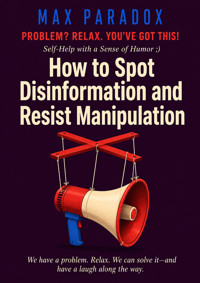
You open your phone to check one thing. Five minutes later, someone is warning you about a hidden conspiracy, a dramatic new study has supposedly changed everything, a viral video proves somebody is evil, and a stranger with 2.7 million followers would like you to panic immediately.
Welcome to modern information.
How to Spot Disinformation and Resist Manipulation is a practical guide for anyone who wants to think clearly without turning every headline into a doctoral research project.
Max Paradox takes the reader through the everyday mechanisms that make false and misleading information so persuasive: confirmation bias, emotional manipulation, tribal thinking, misleading statistics, cropped videos, fake context, questionable experts, selective evidence, viral outrage, compelling narratives, and the dangerous confidence produced by hearing the same claim fifty times.
But this is not a book about becoming paranoid.
It is a book about becoming harder to fool.
You will learn how to identify the exact claim hiding underneath emotional language, trace information toward its original source, verify images and video, read statistics without being hypnotized by percentages, evaluate whether an "expert" is actually an expert in the relevant field, compare independent sources, recognize artificial urgency, correct misinformation without starting a family civil war, and decide when a claim deserves deeper investigation - and when it deserves approximately none of your remaining Tuesday.
The methods are designed for real life.
You do not need four hours, twelve browser tabs, or professional intelligence training. The book includes quick verification procedures, practical questions, minimum-effort versions for busy days, and fallback strategies for situations where reliable information is incomplete.
Just as importantly, it deals with the uncomfortable part: your own brain.
Because manipulation does not work only on "other people." It works through ordinary human tendencies - wanting certainty, believing information that supports our existing views, trusting familiar people, reacting quickly to fear and anger, and occasionally deciding that a claim must be true because it is extremely satisfying.
The goal is not perfect skepticism.
It is calibrated skepticism.
Enough to slow down when the stakes are high, demand better evidence when a claim is dramatic, keep uncertainty attached to uncertain information, and change your mind without requiring a public inquiry.
Clear, practical, funny, and built for an internet that has absolutely no intention of becoming less weird, How to Spot Disinformation and Resist Manipulation will help you make better decisions about what to believe, what to share, what to ignore, and when to say the most useful sentence in the information age:
"Wait. How do we know that?"
This publication was prepared with the assistance of tools that support the creative process, including artificial intelligence-based solutions. The final concept, structure, and editing belong to the author.
Ebooka przeczytasz w aplikacjach Legimi na:
Liczba stron: 217
Rok wydania: 2026
Odsłuch ebooka (TTS) dostepny w abonamencie „ebooki+audiobooki bez limitu” w aplikacjach Legimi na:
Podobne



















INTRO
You open your phone because you want to check the weather.
Seven minutes later, you know that a common household product has supposedly been “BANNED in seventeen countries,” a celebrity has definitely been arrested even though nobody reputable seems to have noticed, scientists are apparently hiding something enormous, and a man filming himself inside a parked pickup truck has explained why the entire global economy will collapse by Thursday.
The weather is 72 degrees and partly cloudy.
You never got that far.
This is the modern information problem in miniature. We have access to more knowledge than any generation before us, which sounds wonderful until you remember that we also have access to millions of people confidently explaining things they learned eleven minutes ago. Facts, opinions, advertising, propaganda, satire, rumors, mistakes, manipulated images, emotional videos, legitimate reporting, political spin, AI-generated nonsense, and Uncle Gary’s “interesting research” now arrive through the same glowing rectangle.
And they often look remarkably similar.
A professional-looking graphic can be created in five minutes. A dramatic video can lose one crucial sentence and acquire an entirely different meaning. A screenshot can quote someone who never said anything remotely like it. An anonymous account with a profile picture of an eagle can announce that “the media won’t tell you this,” and your brain immediately becomes interested because apparently the eagle has clearance.
The difficult part is not simply identifying obvious lies. Obvious lies are almost relaxing. If someone informs you that Luxembourg has secretly constructed a moon base, you can probably continue making dinner.
The dangerous material is usually more plausible.
It contains something true. Or almost true. Or technically true but stripped of context until it becomes misleading. It uses a real photograph with a false description, a genuine statistic without the denominator, an authentic quote from 2014 presented as if it happened yesterday, or a legitimate expert whose words have been sliced into informational sushi.
That is why “just use common sense” is not enough.
Common sense is useful, but common sense also believes a headline more easily when it confirms something you already suspect. It becomes strangely generous when the story makes your political opponent look ridiculous, proves your favorite theory, frightens you about your children, threatens your money, or confirms that the thing you bought was definitely the correct thing and everyone who bought the other one has made a catastrophic life choice.
Your brain is not a neutral fact-checking department.
It is closer to a very busy personal assistant who occasionally says, “This agrees with us. Approved.”
That does not mean you are stupid. Intelligence is not a vaccine against manipulation. Smart people can be excellent at finding evidence, but unfortunately this also means they can become excellent at finding evidence for something they already want to believe. Give a clever person ten minutes and Wi-Fi, and they may construct a courtroom argument proving that their first impression was destiny.
The real advantage comes from having a process.
You need to know when to slow down, what signals deserve suspicion, which questions quickly expose weak information, how emotional manipulation works, how statistics get bent without technically being broken, why repetition feels like truth, how social proof tricks us, and when a source deserves more investigation than a confident stranger announcing “DO YOUR OWN RESEARCH” beneath a video filmed vertically in a kitchen.
You also need to know when not to investigate.
This part matters more than it sounds. You cannot fact-check the entire internet. You have work, laundry, people who expect replies, and possibly vegetables in your refrigerator approaching legal independence. If every suspicious claim requires a forty-five-minute investigation involving six browser tabs, three academic papers, and a spreadsheet, your defense system will last approximately one afternoon.
The goal of this book is not to turn you into a professional intelligence analyst.
It is to make you harder to fool.
That means learning a small number of habits that work in ordinary life. You will learn how to recognize the moment when information is trying to bypass your judgment and go directly for fear, anger, outrage, tribal loyalty, or the irresistible urge to forward something immediately with the words, “Is this true???”
Preferably before you forward it.
We will look at why false information spreads so well, but we will spend even more time on what you can actually do about it. You will learn how to check the original source instead of arguing with a screenshot of a screenshot. You will learn how to separate “this person sounds certain” from “this person has evidence.” You will see why a pile of weak sources does not magically become one strong source, even when the pile is very enthusiastic.
You will also learn to resist manipulation that does not rely on outright falsehoods. Because sometimes nobody needs to lie to you. They only need to choose which facts you see, which you do not, what order they appear in, what emotional music plays underneath them, and which facial expression is frozen in the thumbnail.
Technically accurate information can still lead you by the nose.
Very efficiently, too.
None of this requires becoming cynical. In fact, permanent cynicism is another trap. If your response to misinformation is deciding that everyone lies, every institution is corrupt, every expert is bought, every journalist is manipulating you, and your cousin’s mechanic is therefore the only trustworthy source on international monetary policy, you have not escaped manipulation.
You have simply selected a different subscription plan.
Healthy skepticism means asking for enough evidence before accepting a claim. Cynicism means rejecting everything automatically. Gullibility says, “I saw it, so it must be true.” Cynicism says, “Nothing is true.” Skepticism says, “Interesting. How do we know?”
That question will do a surprising amount of heavy lifting.
The methods in this book are designed for real situations: scrolling social media, reading headlines, watching viral clips, hearing claims from friends, receiving alarming messages from relatives, evaluating political arguments, looking at health scares, dealing with financial promises, and encountering those beautifully formatted posts in which someone has placed twelve words over a dramatic photograph and apparently settled a complicated issue forever.
You will not become impossible to manipulate. Nobody is. You will still have biases, emotional reactions, favorite narratives, bad days, and moments when a claim arrives at exactly the right angle to slide past your defenses.
So will I.
The point is not perfection. The point is creating enough friction between the claim and the click.
Enough time to ask: Who is saying this? What is the evidence? Where did this come from? Is anything important missing? Can I verify it somewhere independent? Am I believing this because it is strong—or because it feels extremely satisfying?
That last question can be rude.
Use it anyway.
By the end of this book, you should have a practical mental filter that works without turning every breakfast into a forensic investigation. You will know which claims deserve a quick check, which deserve a deeper one, which can safely be ignored, and which should make you put down the phone before your nervous system signs a treaty with a stranger’s all-caps headline.
The internet will remain chaotic.
People will continue posting nonsense with excellent typography.
But you will be much better equipped to notice when someone is trying to make you think, feel, buy, fear, hate, share, or react before you have had time to ask the most inconvenient question in the information economy:
“Wait. Is that actually true?”
Chapter 1 - Your Brain Is Not a Neutral Observer
You are scrolling through your phone when you see a headline about a subject you care about.
It says something outrageous.
You immediately think, Of course.
This is an important moment, because nothing has yet been verified. You have not read the article. You do not know where the information came from. You have not checked whether the headline accurately represents the story. But your brain has already opened the champagne because the claim fits nicely into something you believed yesterday.
Evidence can arrive later.
This is one of the uncomfortable truths about disinformation: the problem does not begin with dishonest people inventing things. It begins with ordinary human brains being extremely cooperative customers.
We like information that makes sense to us quickly. We prefer explanations that fit what we already know. We notice evidence that supports our views more easily than evidence that threatens them. We remember dramatic stories better than boring corrections. We trust people who seem familiar, confident, attractive, popular, or suspiciously good at pointing toward charts.
None of this makes you defective.
It makes you human.
Unfortunately, human brains were not designed while consulting the social-media product team.
The modern information environment takes perfectly normal mental shortcuts and presses them like buttons. Fear gets attention. Anger gets attention. Surprise gets attention. Tribal conflict gets attention. A carefully qualified explanation saying, “The evidence is mixed and several interpretations remain possible,” competes against:
THEY LIED TO YOU.
You can probably guess which one performs better before breakfast.
The first mental trap is confirmation bias: our tendency to favor information that supports what we already believe. The name sounds academic, but the behavior is beautifully ordinary.
Suppose you think a particular company is terrible. You see a post accusing it of something unethical.
Your first reaction may be:
“Knew it.”
Now reverse the situation. Suppose the accusation concerns a company you love, whose products you have defended in conversations with the emotional commitment usually reserved for family members and football teams.
Suddenly:
“Well, we need context.”
Interesting.
Same brain. Same standards department. Completely different opening hours.
Confirmation bias does not necessarily make you accept every false claim. It changes how much resistance a claim encounters. Information that agrees with you may walk through the front door. Information that challenges you gets stopped at security, searched, questioned, asked for three forms of identification, and told the manager is unavailable.
This is why one of the most dangerous sentences in information consumption is:
“That sounds right.”
Something sounding right is not evidence that it is right. It means the information matches your existing mental model.
Sometimes that model is excellent.
Sometimes it was assembled from three headlines, a conversation in 2022, and a feeling.
Another trap is motivated reasoning. This is what happens when you do not simply evaluate information—you unconsciously recruit your intelligence to defend the conclusion you prefer.
Imagine someone tells you that your favorite politician, celebrity, company, diet, investment, or parenting method has been proven wrong.
Your brain has options.
Option A: “Interesting. Let me examine the evidence fairly.”
Option B: “Absolutely not. Release the lawyers.”
The lawyers are imaginary, but they work fast.
You begin looking for weaknesses in the source. Perhaps the study is small. Perhaps the journalist is biased. Perhaps the person sharing the criticism has made mistakes before. These may all be legitimate questions.
The problem is that you did not ask them when favorable information appeared.
That difference matters.
Good skepticism asks difficult questions regardless of whether you like the conclusion. Motivated reasoning asks difficult questions mainly when the conclusion is annoying.
Then there is emotional reasoning: the tendency to treat the strength of a feeling as evidence about the truth of a claim.
“This is terrifying” quietly becomes “This must be serious.”
“This makes me furious” becomes “This must be outrageous.”
“This gives me hope” becomes “This could really work.”
“This confirms my deepest suspicion about people who put pineapple on pizza” becomes “At last, science.”
Strong emotion is not proof of falsehood. Real events can be frightening, infuriating, joyful, or shocking.
But emotion changes your information-processing speed.
When something scares or enrages you, your brain becomes more interested in reacting and less interested in opening another tab.
This is extremely convenient for anyone trying to manipulate you.
A manipulative message often has two jobs. The visible job is to tell you something. The hidden job is to put you into an emotional state in which you are less likely to examine what you have been told.
That is why certain phrases appear so often:
“They don’t want you to know.”
“Share before this gets deleted.”
“This should make you furious.”
“You have been lied to.”
“Everyone needs to see this.”
“Only an idiot would believe…”
These phrases do not provide evidence. They provide instructions for your nervous system.
They are attempting to set the room temperature before the discussion begins.
Urgency is especially effective. If information comes with an implied countdown, checking feels like hesitation.
“Send this to everyone you know before midnight.”
Why midnight?
Will the truth turn back into a pumpkin?
Artificial urgency works because slowing down is one of your best defenses. Manipulation often wants the opposite. It wants you to react while the emotional engine is running and before the boring adult part of your brain arrives carrying questions.
You do not need to become emotionally detached. That would be impossible and, frankly, a strange way to spend Christmas.
You need to recognize emotion as a signal to slow down.
The stronger your immediate reaction, the more useful a brief pause becomes.
This leads to the first practical habit in the book: the reaction check.
When a claim triggers a strong response, do not begin by asking whether it is true. First ask what it is doing to you.
Try three questions:
What am I feeling right now?
Does this claim strongly confirm something I already believe or want to believe?
Do I feel an urge to share, reply, buy, panic, celebrate, or insult a stranger before checking anything?
If the answer to the third question is yes, congratulations.
You have located the interesting part.
Do nothing for a moment.
Not forever. Ten seconds may be enough to change the sequence from reaction-first to evaluation-first.
This is not meditation. You do not need candles.
You are simply preventing your thumb from becoming foreign policy.
Another useful mental shortcut to watch is the familiarity effect. Repeated information starts to feel more true simply because you have encountered it before.
You see a claim Monday.
Someone mentions it Wednesday.
A video repeats it Friday.
By Sunday, your brain says, “Yes, I’ve heard about this.”
Correct.
You have heard about it.
That is not the same as confirming it.
Repetition creates a strange form of counterfeit credibility. A rumor can travel through dozens of accounts while all of them trace back to the same original source. From the reader’s perspective, it may look like broad agreement.
“Everyone is reporting this.”
Perhaps.
Or perhaps twenty-three accounts are copying Kevin.
Kevin may be wrong.
This is especially important online because repetition is built into the system. Trending topics create more posts about trending topics, which create more visibility, which creates more posts, which eventually makes a claim feel socially established even when nobody has added new evidence.
The crowd can become an echo with excellent Wi-Fi.
Social proof strengthens the effect. If thousands of people have liked, shared, or commented on something, we instinctively treat that popularity as meaningful.
Sometimes it is.
A post with two million views has definitely achieved one thing: two million views.
It has not automatically achieved accuracy.
People share content for all kinds of reasons. They may agree with it. They may hate it. They may be mocking it. They may have watched eight seconds. They may be saving it for later, which on the internet means building a digital attic nobody will ever clean.
Popularity tells you that content spread.
It does not tell you why.
Authority can also be misleading. A person wearing a white coat looks more credible when discussing health. A person standing in front of books looks more intellectual. Someone appearing on television seems important. A person with “Dr.” in a username may genuinely be a doctor.
The useful question is: doctor of what?
Expertise is specific. A brilliant orthopedic surgeon is not automatically an expert in nutrition policy, international economics, virology, climate modeling, constitutional law, or why your Wi-Fi stops working when guests arrive.
Human beings love transferring credibility from one area to another.
“He is extremely successful.”
Fine.
At what?
A Formula One driver may know a great deal about driving quickly. I would still hesitate before asking him to remove my appendix.
Confidence creates similar problems. People who speak without hesitation sound knowledgeable. People who qualify their claims can sound less impressive precisely because they understand the uncertainty.
Compare:
“This absolutely proves X.”
with:
“The available evidence suggests X under these conditions, although there are important limitations.”
The second statement may be more responsible.
The first will look better over dramatic music.
You therefore need to separate four things your brain naturally bundles together:
familiarity, popularity, confidence, and expertise.
None of them is the same as evidence.
A familiar claim can be false.
A popular claim can be false.
A confident person can be wrong.
An expert can speak outside their field.
And a boring primary source with terrible graphic design can be completely correct.
Truth has never promised good branding.
Your goal is not to distrust your instincts completely. Intuition can be useful, particularly in areas where you have deep experience. If you have worked in a field for twenty years, you may notice that something feels wrong before you can explain why.
Treat that feeling as a prompt to investigate, not as the verdict.
“I think this may be misleading” is a starting point.
“This is definitely fake because I can feel it” is your brain auditioning for the role of the very person this book is trying to protect you from.
There is another problem: identity.
Some beliefs are not just beliefs. They become part of who we are.
Political identity, professional identity, national identity, lifestyle choices, religious beliefs, social groups, parenting decisions, and even consumer preferences can become emotionally protected territory. Once a claim threatens identity, changing your mind no longer feels like correcting information. It feels like losing.
That makes manipulation easier.
A message does not need to prove much if it can convince you that “people like us believe this.”
Now disagreement becomes betrayal.
And evidence has accidentally joined a team sport.
The practical defense is to create a tiny gap between yourself and your beliefs. Instead of thinking, “I am someone who believes X,” try, “Based on what I currently know, I think X is probably true.”
The difference looks small.
Psychologically, it is enormous.
The first statement turns new evidence into a personal attack. The second leaves a door open.
You do not need to announce this phrasing at dinner. People already have enough reasons not to invite us places.
Use it internally.
“My current view is…”
“The evidence I have seen suggests…”
“I could be wrong if…”
Those phrases keep your ideas editable.
And editable beliefs are harder to manipulate because you do not need to defend yesterday’s conclusion simply because yesterday’s version of you signed it.
Here is your action for this chapter: for the next week, do not try to catch every false claim you see. Catch your reactions.
When a piece of information creates immediate anger, fear, satisfaction, disgust, or triumph, mark it mentally:
Strong reaction. Check before accepting.
That is all.
If you have more energy, add one question:
“Would I demand the same quality of evidence if this claim supported the other side?”
That question is irritating.
Which is precisely why it works.
You will not remove your biases. Nobody does. The aim is to stop pretending they only belong to other people.
Your brain is not a neutral observer.
But once you know where it tends to lean, you can stop letting every persuasive headline push it down the stairs.
Chapter 2 - The Lie Doesn’t Have to Be a Lie
A video appears in your feed.
It shows a public figure making an astonishing statement. The clip is clear. The person is really there. The voice is genuine. There is no deepfake, no AI-generated mouth, no mysterious Russian server farm hidden under a volcano.
You watch it twice.
“Wow.”
Then you discover that the original interview lasted forty minutes, the viral clip lasted eleven seconds, and the sentence immediately before it completely changed what the speaker meant.
Nothing in the clip was fabricated.
Everything about the impression was wrong.
Welcome to one of the most important ideas in this book: misinformation does not need to contain a literal lie.
Manipulation often works through selection.
Choose the right sentence.
Remove the sentence before it.
Remove the sentence after it.
Add a dramatic caption.
Put an angry face in the thumbnail.
Congratulations. You now have content.
This is why fact-checking only individual statements can sometimes miss the larger problem. A sentence may be technically accurate while the overall message is deeply misleading.
Suppose I tell you:
“Sales increased 100 percent.”
That sounds impressive.
Last week we sold one.
This week we sold two.
I have not lied.
I have simply hired mathematics to wear a tuxedo.
Statistics are particularly vulnerable to this kind of treatment because numbers look objective. A percentage has a professional appearance. Add a decimal place and people become even more respectful.
“Risk increased by 50 percent.”
Important question: from what to what?
If the risk increased from two cases per 10,000 people to three cases per 10,000, the relative increase is indeed 50 percent. The absolute increase is one additional case per 10,000.
Both statements can be true.
They do not feel the same.
The reverse trick works too. If someone wants to make an effect sound small, they may use absolute numbers when relative numbers would look more dramatic.
This does not mean every use of percentages is manipulation. It means you should ask for the denominator, the baseline, and the scale.
If a statistic sounds astonishing, your first question should be:
“Compared with what?”
This simple phrase has ruined many excellent marketing presentations.
Context changes meaning far beyond statistics.
Consider a photograph of a crowded beach labeled:
“Thousands ignore emergency evacuation warning.”
You feel outraged.
Then someone finds the original image. It was taken three years earlier during a music festival.
The photograph itself is real.
The caption is false.
This combination is powerful because people are often better at recognizing obviously fake images than questioning authentic images placed in false contexts. Reality supplies the visual evidence. The caption quietly changes the story.
Old material is especially useful for manipulation because the internet has the memory of an elephant and the filing system of a teenager’s bedroom.
A flood from 2017 becomes today’s disaster.
A protest from another country becomes this week’s unrest.
A military exercise becomes evidence that war has begun.
A photograph from a movie set becomes proof of a conspiracy.
Eventually someone discovers the original source, but by then the fake version has already traveled halfway around the planet wearing comfortable shoes.
Whenever a visual claim matters, ask two separate questions:
Is this image or video genuine?
And:
Does it actually show what the caption says it shows?
Those are not the same question.
Another common technique is selective evidence.
Imagine that ten studies examine a question. Eight find little or no effect. Two find a strong effect.
A person who wants to persuade you may present the two favorable studies and say:
“Studies prove…”
Technically, studies do exist.
Several, even.
You simply were not invited to meet their eight quieter relatives.
This practice is sometimes called cherry-picking: choosing only the evidence that supports a preferred conclusion while ignoring relevant evidence pointing elsewhere.
You do not need to become an academic researcher to notice it.
Listen for sweeping claims built from narrow evidence.
“One doctor says…”
“One study found…”
“This expert admits…”
“This chart proves…”
“This person experienced…”
Individual evidence may be meaningful, but the strength of the conclusion should match the strength of the evidence.
One personal story can show that something happened to one person.
It cannot establish how common the event is.
A viral testimonial saying, “I did this and my problem disappeared,” may be sincere.
So may the testimonial from someone who wore lucky socks and then received a promotion.
We have not yet established a national sock policy.
Anecdotes are persuasive because they contain people, emotion, sequence, and drama. Statistics say “0.7 percent.” A story says, “This happened to Sarah.”
Your brain remembers Sarah.
Poor 0.7 percent never had a chance.
Again, this does not mean personal stories are useless. They can reveal possible problems, illustrate experiences, and show effects that deserve investigation. They become misleading when they are used as if one dramatic example proves a general rule.
The practical question is:
“Is this evidence showing that something can happen, or how often it actually happens?”
That distinction will save you from an impressive amount of nonsense.
Framing creates another layer.
Imagine unemployment falls from 6 percent to 5 percent.
One headline says:
“Unemployment Drops Significantly.”
Another says:
“Millions Still Without Work.”
Both can be accurate.
They emphasize different realities.
Framing is unavoidable. Every article, report, video, and conversation must choose what to include. Even a camera has to point somewhere.
The problem begins when you confuse one frame with the entire picture.
A useful habit is to ask:
“What would the opposite headline say?”
Not because the opposite headline is necessarily correct, but because constructing it reveals what the current framing emphasizes or hides.
Company reports record profits?
Maybe the alternate frame is rising costs.
Crime down nationally?
Perhaps some local categories increased.
A policy saved money?
What did it cost elsewhere?
A new technology creates jobs?
Which jobs does it remove?
Again, do not mechanically invent sinister counterarguments. The point is to widen the frame.
Manipulation thrives in narrow rooms.
Language itself can frame events before evidence arrives.
Compare:
“Protesters gathered outside the building.”
“Activists confronted officials.”
“An angry mob surrounded the building.”
“The public demanded answers.”
These sentences can refer to the same scene.
Each one hands you a different emotional script.
Words such as slams, destroys, admits, exposed, humiliates, radical, shocking, devastating, and bombshell often tell you how to feel before telling you what happened.
Sometimes the event truly is shocking.