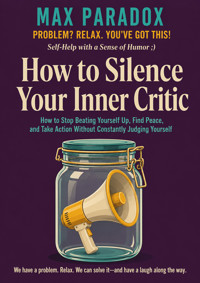
How to Silence Your Inner Critic - How to Stop Beating Yourself Up, Find Peace, and Take Action Without Constantly Judging Yourself ebook
Max Paradox
Uzyskaj dostęp do tej i ponad 240000 książek od 14,99 zł miesięcznie
- Wydawca: ALL-IN Rafał Płonkowski
- Kategoria: Biznes, rozwój, prawo•Biznes, rozwój
- Język: angielski
You make one mistake.
Your brain responds as though an independent commission has been appointed.
Why did you say that? Why didn't you do better? Why are you still like this? Everyone else seems to manage. You should be further ahead by now.
Welcome to life with an inner critic that has apparently been given unlimited office hours.
How to Silence Your Inner Critic is a practical, funny guide to stopping the endless cycle of self-judgment, overthinking, perfectionism, comparison, reassurance seeking, and mentally retrying mistakes that have already happened.
Max Paradox does not ask you to "just love yourself," chant affirmations you do not believe, or pretend every mistake is secretly wonderful. Instead, this book shows you how to become more accurate, more practical, and far less cruel toward yourself - without lowering your standards or abandoning responsibility.
Inside, you will learn how to separate facts from harsh interpretations, recognize the hidden rules that keep self-criticism alive, stop turning ordinary mistakes into identity judgments, respond to negative thoughts without debating them for hours, and take useful action before you feel completely confident.
You will also learn how to handle criticism from other people, reduce destructive comparison, stop seeking endless reassurance, practice "good enough" without becoming careless, rebuild self-trust through small promises, and recover when old patterns return.
Most importantly, you will learn that silencing your inner critic does not mean achieving permanent inner peace while sitting beside a lake.
It means the critic can speak without running your life.
You can make a mistake without turning it into a biography. You can feel insecure and still act. You can receive feedback without collapsing into shame. You can regret something, repair it, learn from it, and move on without scheduling a three-day internal trial.
This book is designed for normal people with jobs, relationships, bills, tired evenings, imperfect habits, and approximately twelve things they should probably have done yesterday.
No gurus.
No magical transformations.
No requirement to wake at 4:30 a.m. and become a completely different person before breakfast.
Just concrete methods, realistic examples, intelligent humor, and practical tools you can use when the voice in your head starts behaving like an unpaid manager with severe quality-control concerns.
You do not need to eliminate every negative thought.
You need to stop treating every negative thought as a verdict.
And then get back to your life.
This publication was prepared with the assistance of tools that support the creative process, including artificial intelligence-based solutions. The final concept, structure, and editing belong to the author.
Ebooka przeczytasz w aplikacjach Legimi na:
Liczba stron: 203
Rok wydania: 2026
Odsłuch ebooka (TTS) dostepny w abonamencie „ebooki+audiobooki bez limitu” w aplikacjach Legimi na:
Podobne



















INTRO
You send an email.
Nothing dramatic. No resignation letter. No confession that you have secretly been living under a false identity. Just a normal email to a normal person about a normal thing.
Then, eleven seconds later, your brain opens an investigation.
“Why did you write ‘Thanks’ instead of ‘Thank you’?”
Was that too cold? Too needy? Too cheerful? Did the exclamation point look desperate? Should there have been no exclamation point? Two? Absolutely not two. Two exclamation points are how people end up on watch lists.
You reread the message. It still looks fine, which is suspicious. You check it again from the perspective of the recipient, then from the perspective of a hostile attorney, then from the perspective of a future historian researching the exact moment your professional reputation collapsed.
The recipient replies: “Sounds good.”
Case closed?
Of course not.
Now your inner critic would like to discuss the absence of a smiley face.
This is the strange thing about having a loud inner critic: the outside world can be completely calm while your internal quality-control department is setting fire to the building. You make one small mistake, forget one detail, say something awkward, eat something you planned not to eat, skip a workout, lose patience, miss a deadline, or simply fail to perform like a perfectly optimized human appliance—and the commentary begins.
“You always do this.” “You should know better.” “That was stupid.” “Everyone else can handle this.” “You’re behind.” “You’re lazy.” “You’re embarrassing.” “You should have done more.”
Your brain does not merely review the event. It hires a disappointed headmaster, an aggressive sports commentator, and a lawyer for the prosecution.
None of them appear to have hobbies.
The inner critic often disguises itself as usefulness. It says, in effect, “I am only being hard on you because standards matter.” This can sound reasonable. If you never noticed your mistakes, never corrected anything, and responded to every failure with, “Magnificent. No notes,” life would become complicated rather quickly.
But there is a difference between useful self-correction and turning every imperfection into a character trial.
Useful self-correction says, “That presentation was too long. Next time, cut ten slides.”
The inner critic says, “That presentation was too long because you are fundamentally incapable of understanding time, audiences, communication, and perhaps PowerPoint as a concept.”
One gives you a next step.
The other gives you an identity crisis with transitions.
That distinction matters because many people try to motivate themselves by attacking themselves. They assume harshness creates discipline. If they stop calling themselves lazy, weak, stupid, irresponsible, undisciplined, pathetic, or “a complete disaster,” perhaps they will become complacent and spend the rest of their lives eating cereal directly from the box while ignoring emails.
So they keep the pressure on.
Unfortunately, constant self-judgment often creates the exact conditions that make action harder. You hesitate because the task has become a test of your worth. You procrastinate because starting means risking proof that you are not as capable as you “should” be. You replay conversations because apparently the sentence you said at 2:17 p.m. deserves a twelve-part documentary series. You avoid trying new things because being a beginner feels less like learning and more like appearing in court without representation.
Then, because you delayed, avoided, overthought, or froze, the inner critic receives fresh material.
Excellent. The system has become self-sustaining.
This book is about breaking that system without replacing it with fake positivity. You will not be required to stand in front of a mirror at sunrise and announce that you are a limitless cosmic force. You may be. I have not reviewed the paperwork. But if you are staring at three overdue tasks and calling yourself useless, “I am infinite abundance” is probably not the most urgent sentence.
We are going to aim for something far more practical: a mind that can notice a mistake without turning it into a biography.
You will learn how to separate facts from insults, standards from punishment, responsibility from self-attack, and reflection from rumination. You will learn what to do when your brain starts replaying old failures as if it has purchased the premium streaming package. You will learn how to act before you feel completely confident, how to make decisions without conducting a six-hour internal referendum, and how to recover from mistakes without adding a second injury by attacking yourself for making the first one.
Most importantly, you will practice replacing the question “What is wrong with me?” with better questions.
What happened? What part was actually under my control? What can I do next? What would be useful now?
These questions are less dramatic, which is precisely why the inner critic dislikes them. It prefers sweeping declarations. “I handled that badly” is specific and repairable. “I ruin everything” has excellent theatrical lighting but very poor instructional value.
The goal is not to silence every negative thought forever. That would be an ambitious project even for someone with a private island and no notifications. Thoughts appear. Old habits return. Some days your brain will still produce a review of your performance that sounds like it was written by someone denied a refund.
The goal is to stop treating every critical thought as a verdict.
A thought can be loud and still be wrong. A feeling can be uncomfortable and still be survivable. A mistake can be real and still not define you.
And you can take action while your inner critic is talking.
That last part matters. Many people wait to feel kinder toward themselves before they begin. They assume peace must arrive first, like a delivery window. Once they stop doubting, stop judging, stop feeling embarrassed, stop worrying what the mistake “means,” then they will finally send the application, have the conversation, return to the gym, finish the project, ask the question, set the boundary, or try again.
But your inner critic may not voluntarily approve the plan.
It has concerns.
It always has concerns.
So we are not going to build your life around getting unanimous approval from the least satisfied member of the committee.
We are going to make the critic smaller by giving it a different job. Instead of chief executive officer, judge, prosecutor, historian, and emergency broadcaster, it can become what it should have been all along: one source of information. Sometimes useful. Sometimes ridiculous. Occasionally worth listening to. Frequently in need of fact-checking.
You do not need to become someone who never judges themselves.
You need to become someone who does not automatically obey the judgment.
That is a much more achievable project.
And unlike rereading the same email fourteen times, it may actually help.
Chapter 1 - The Voice That Sounds Like You
You drop a glass in the kitchen.
It slips, hits the floor, and breaks. This is not ideal, but civilization will probably survive.
Before you have even found the broom, however, a familiar voice arrives.
“Of course.”
That is all it needs.
Of course you dropped it. Of course you were careless. Of course you somehow possess the unique ability to turn carrying a glass from the counter to the sink into an incident requiring protective footwear.
You clean up the pieces, but the commentary continues. Maybe you were rushing. Maybe you should have been paying attention. Maybe this is what happens because you are always distracted. Maybe you are simply hopeless with things.
The glass broke once.
Your brain has now broken it seventeen additional times for educational purposes.
This is one of the first things worth understanding about the inner critic: it rarely introduces itself as an opinion. It sounds like a fact.
“You’re terrible at this.”
“You always mess things up.”
“You have no discipline.”
“You’re awkward.”
“You’re not smart enough.”
“You should be further ahead.”
The sentences arrive in your own internal voice, so you assume they belong in the same category as “I need milk” or “The car is low on gas.” They feel like information.
But many of them are interpretations wearing a fake mustache.
Your Brain Is Not a Court Transcript
Suppose you give a presentation at work. You lose your place once, rush through one section, and answer one question less clearly than you wanted.
Those are facts.
Your inner critic may produce something slightly more ambitious:
“That was embarrassing. Everyone noticed you had no idea what you were doing.”
Now we have left the land of observable reality and opened a theme park.
Did everyone notice? Probably not. Did you have no idea what you were doing? Clearly not, because you gave the rest of the presentation. Was it embarrassing? Perhaps you felt embarrassed. That is real. But feeling embarrassed and having publicly revealed yourself as an incompetent fraud are not quite the same event.
Your inner critic loves upgrading small facts into large conclusions.
You forgot something.
Therefore, you are irresponsible.
Someone disagreed with you.
Therefore, you sounded stupid.
You did not finish the workout.
Therefore, you have no discipline.
A date went badly.
Therefore, you will die alone surrounded by houseplants that have also lost respect for you.
Notice the leap.
The critic rarely says, “Here is one limited event that may contain useful information.”
That would be far too efficient.
Instead it prefers:
“Ladies and gentlemen, we have discovered what this means about you as a person.”
This habit causes trouble because identity statements are difficult to act on. If the problem is “I sent the report late,” you can change when you begin the next report. If the problem is “I am useless,” the action plan becomes less obvious.
Buy a new personality?
Reboot?
Return yourself under warranty?
Useful correction describes behavior. Destructive criticism attacks identity.
That distinction will appear throughout this book because it is one of the simplest ways to reduce unnecessary suffering without becoming delusional.
You are allowed to admit that you handled something badly.
You just do not have to turn it into a character reference.
The Critic Is Very Fond of Words Like “Always”
Your inner critic has a small vocabulary and enormous confidence.
It particularly enjoys:
always;
never;
everyone;
no one;
completely;
obviously;
should;
must.
“I always procrastinate.”
Do you?
Always?
Have you literally never completed anything on time?
If that were true, you would currently be living inside a growing pile of unopened mail while waiting for someone to switch off your electricity.
“I never stick to anything.”
Again, impressive claim.
You have presumably maintained at least several behaviors long enough to remain alive.
“I should have known.”
Based on what information?
“The signs were obvious.”
Were they obvious before the event or only after your brain received the answer key?
Hindsight is one of the inner critic’s favorite employees. It arrives after something goes wrong and confidently explains that the outcome had been visible from space.
Of course you should have known the investment would fall.
Of course that person was wrong for you.
Of course the project would take twice as long.
Of course you should have said something different in the meeting.
Once the outcome is known, the brain quietly edits the past and pretends the uncertainty was never there.
Very convenient.
Next week’s lottery numbers remain unavailable.
When Standards Become Weapons
Having standards is not the problem.
Standards help you improve your work, keep promises, learn skills, repair mistakes, and avoid becoming the kind of person who says, “Good enough,” while a shelf slowly detaches from the wall.
The problem begins when the standard stops measuring the work and starts measuring your worth.
Imagine you planned to exercise four times this week. You exercised twice.
A useful response might be:
“I planned four sessions and completed two. What got in the way?”
Maybe your schedule was unrealistic. Maybe Wednesday became chaos. Maybe you were tired. Maybe your plan required ninety-minute workouts even though your actual life currently supports thirty-five minutes and a sandwich.
The inner critic skips all that.
“No discipline.”
Short. Elegant. Completely useless.
It sounds tough, which is often why we trust it. Harsh language creates the illusion of seriousness. If you speak to yourself severely enough, surely improvement must be happening.
This is similar to standing beside a broken printer and shouting.
The intensity is undeniable.
The repair remains incomplete.
Real accountability is more specific. It asks what happened, what you controlled, what you did not control, and what you will change next time.
Self-attack feels more powerful because it hurts more.
Pain, however, is not proof of usefulness.
The Critic Often Copies Someone Else
Not every harsh sentence in your head was invented by you.
Some arrive through repetition.
Perhaps a parent used to respond to mistakes with, “How could you be so careless?” Perhaps a teacher made one bad grade sound like evidence that civilization had made a regrettable investment in your education. Perhaps a former partner criticized how you looked, spoke, spent money, cleaned, worked, rested, laughed, or loaded a dishwasher.
Years later, nobody needs to say anything.
The branch office is now fully internal.
This does not mean every critical thought can be blamed on childhood, society, your seventh-grade math teacher, capitalism, Instagram, or a disappointing soccer coach. Humans are wonderfully capable of developing new forms of self-torture without outside assistance.
But it is useful to notice borrowed language.
If your inner critic says, “You should be ashamed,” ask yourself:
Whose sentence does that sound like?
If it says, “Stop being lazy,” who used to describe rest that way?
If it says, “Nobody will take you seriously looking like that,” where did that rule come from?
You are not trying to build a criminal case against everyone who influenced you. The point is simpler.
Familiar does not mean true.
A sentence can live in your head for twenty years and still be nonsense.
I have had old cables in a drawer for longer than that.
Longevity proves very little.
The First Skill: Separate the Event From the Verdict
For now, do not try to become positive.
That is too large a jump.
If you currently think, “I completely failed,” replacing it with “I am magnificent and everything I do is perfect” will probably make your brain laugh at you.
Instead, practice becoming accurate.
Take one self-critical thought and split it into two parts:
The event: What actually happened?
The verdict: What did I conclude about myself?
For example:
Event: I interrupted someone twice during the meeting.
Verdict: I am socially hopeless.
Or:
Event: I spent more money this month than I planned.
Verdict: I am terrible with money.
Or:
Event: I have delayed this task for five days.
Verdict: I am lazy and unreliable.
Now examine the verdict.
Does it describe the event, or does it expand the event into your identity?
That one question begins creating distance.
Not enormous spiritual distance.
We are not levitating above the kitchen.
Just enough distance to see that a thought is a statement your mind produced, not a legal document you are required to sign.
Try the Camera Test
When you are unsure whether you are dealing with fact or judgment, use what I call the camera test.
Ask:
Could a camera have recorded this?
A camera could record you arriving twenty minutes late.
It could not record “I am a terrible person.”
A camera could record you eating three cookies after deciding to eat one.
It could not record “I have absolutely no self-control.”
A camera could record you stumbling over a sentence.
It could not record “Everyone thinks I’m an idiot.”
Cameras are annoyingly uninterested in your dramatic interpretations.
They record behavior.
This is useful because behavior can usually be changed.
Identity insults mostly create fog.
The camera test will not settle everything. Life includes intentions, emotions, relationships, context, and invisible factors that no camera can capture. But when your inner critic begins producing sweeping judgments, the question often brings you back toward reality.
What would the footage actually show?
Usually much less than the prosecution claims.
Stop Arguing With the Entire Speech
A common mistake is trying to defeat every critical thought through debate.
“You’re going to mess this up.”
“No, I’m not.”
“Yes, you are.”
“I’ve prepared.”
“You missed something last time.”
“That was different.”
“You looked nervous.”
“I was tired.”
“Excuses.”
Congratulations.
You are now trapped in a meeting with yourself, and nobody remembered to book lunch.
You do not need to win every argument.
Sometimes the better response is:
“Maybe. What is the next useful action?”
That question changes the game.
The critic says, “This proposal probably isn’t good enough.”
Maybe.
Read the first page and improve one weak section.
The critic says, “You’re going to sound nervous on the call.”
Possible.
Write down the first two sentences and make the call anyway.
The critic says, “You should have started earlier.”
Correct.
The time machine remains unavailable.
What can you do in the next twenty minutes?
The critic wants a trial.
You want movement.
A Two-Minute Exercise
Today, catch one critical thought while it is happening. Do not wait until you are in a peaceful mood with a journal, herbal tea, and the emotional stability of a mountain.
Catch the thought in normal life.
Then write four short lines:
What happened?
What did I tell myself about it?
Which part is observable fact?
What is one useful next action?
Suppose you forgot to respond to an important message.
What happened?
“I saw the message yesterday and did not reply.”
What did you tell yourself?
“I am unbelievably disorganized.”
What is fact?
“The reply is one day late.”
What is the next action?
“Reply now and apologize briefly if needed.”
Notice how little philosophy is required.
The critic may continue speaking while you do this.
Let it.
You are not trying to achieve perfect inner silence in Chapter 1.
You are simply learning that the loudest voice in the room does not automatically get the chair.
Takeaway: Describe what happened before deciding what it means about you.
Today, catch one verdict and turn it back into a fact.
Your inner courtroom can remain open.
We are simply reducing its jurisdiction.
Chapter 2 - Why Your Brain Keeps Doing This
You are lying in bed at 11:48 p.m.
This is exactly the time your brain chooses to remember something you said six years ago.
Not the useful thing you learned last Tuesday.
Not the password you created three hours ago.
No.
It would like to revisit a joke you made at dinner in 2020 that received a slightly weaker laugh than expected.
“Do you think they thought that was weird?”
Wonderful timing.
You were hoping to sleep, but apparently the Department of Historical Embarrassment has located a new file.
You replay the scene. Someone looked away. Was that because of you? Maybe. Someone drank water. Highly suspicious. Another person changed the subject four minutes later.
Evidence is mounting.
By midnight you have reconstructed the evening like a detective who has been removed from active duty for being too intense.
Why does the brain do this?
Why keep criticizing, replaying, predicting, comparing, correcting, and warning when the process feels terrible and so often changes nothing?
Because your inner critic is not usually trying to ruin your life.
It is often trying, very badly, to protect you.
That does not make it correct.
A smoke alarm can be designed to protect you and still scream because you made toast.
The Critic Usually Has a Job
Underneath many harsh thoughts is an attempted function.
“You’re going to embarrass yourself.”
Possible job: prevent social rejection.
“You need to work harder.”
Possible job: prevent failure.
“You cannot make another mistake.”
Possible job: prevent consequences.
“You look terrible.”
Possible job: protect you from judgment.
“Do not say anything until you are completely sure.”
Possible job: protect you from being wrong.
The method is crude, but the intention often makes sense.
Your mind discovers that criticism creates vigilance. If you stay alert to everything you might do wrong, perhaps you can stop bad things before they happen.
This is the psychological equivalent of appointing a security guard who tackles you every time someone walks past the building.
Technically, security is being taken seriously.
Daily operations have become difficult.
Fear Is Excellent at Pretending to Be Quality Control
Suppose you are about to submit an important piece of work.
You check it once.
Good.
Twice.
Reasonable.
A third time.
Fine.
Then you check whether you attached the correct file, whether the file opens, whether page six has a typo, whether your name is spelled correctly despite having possessed it for several decades, whether the recipient is correct, whether your greeting sounds professional, and whether sending the document at 4:41 p.m. communicates something troubling about your character.
Now the inner critic says:
“Just being thorough.”
Maybe.
Or maybe you are trying to purchase certainty.
The problem is that certainty is extremely expensive and rarely in stock.
There is almost always another check you could perform, another possibility you could analyze, another opinion you could request, another revision you could make. When self-criticism is driven by fear, “better” quietly becomes “safe,” and “safe” becomes “impossible to criticize.”
Nothing created by a human being qualifies.
Even bridges require maintenance.
Your quarterly report does not need to achieve immortality.
Perfectionism Makes a Fantastic Costume
Sometimes the inner critic dresses itself as high standards.
“I’m just a perfectionist.”
This sounds much nicer than:
“I am terrified that a normal mistake will reveal something unacceptable about me.”
Perfectionism is not simply caring about quality. Plenty of people care about quality and still finish things.
The problem appears when mistakes become emotionally expensive.
If a typo is just a typo, you fix it.
If a typo means you are careless, incompetent, and possibly not deserving of your position, the stakes become absurdly high.
Now even small tasks carry hidden emotional risk.
Writing one paragraph becomes a referendum on your intelligence.
Cooking dinner becomes proof of whether you can manage your life.
A workout becomes evidence of whether you are disciplined.
A difficult conversation becomes a final examination in emotional maturity.
No wonder you procrastinate.
You have turned Tuesday into the Olympics.
Self-Criticism Can Create the Illusion of Control
There is another reason people beat themselves up after something goes wrong: blame can feel safer than uncertainty.
Suppose a relationship ends.
There may be many factors: compatibility, timing, communication, needs, expectations, circumstances, the other person’s choices, your choices, and the mysterious human talent for misunderstanding sentences that seemed perfectly clear when spoken.
That complexity is uncomfortable.
So the critic offers a simpler explanation:
“You ruined it.”
Painful?
Yes.
But strangely tidy.
If everything was your fault, then perhaps everything was controllable. If you can identify the exact defective part of yourself and repair it, maybe nothing like this will ever happen again.
The mind often prefers a painful certainty to an uncertain reality.
This is why self-blame can become addictive. It makes the world feel more predictable.
“If I had been smarter…”
“If I had noticed sooner…”
“If I had been more attractive…”
“If I had worked harder…”
“If I had said the exact correct sentence on March 14 at 7:26 p.m…”
Then the outcome would have been guaranteed.
Except life does not offer guarantees that easily.
Sometimes you made mistakes and should learn from them.
Sometimes you did a reasonable thing and still got a bad result.
Sometimes another person made a choice you could not control.
Sometimes there was no perfect move.
This is deeply irritating.
The brain would prefer a spreadsheet.
Comparison Feeds the Machine
Your inner critic also gathers evidence from other people.
This was difficult enough when comparison required physically knowing someone. Now you can compare yourself with eight hundred people before breakfast.
You open social media while drinking coffee.
Someone has launched a company.
Someone has run twelve miles.
Someone has renovated a kitchen the size of your entire first apartment.
Someone is in Bali holding a coconut with suspicious confidence.
You are wearing one sock and trying to remember whether you paid the electric bill.
The comparison feels objective because both lives appear on the same screen.
They are not.
You are comparing your full internal footage with someone else’s selected highlights. You know your fears, delays, boring Tuesdays, failed attempts, awkward conversations, financial worries, arguments, and the drawer you refuse to organize.
You see their promotion photo.
This is not a fair trial.
The prosecution has access to your entire archive and only the defendant’s press release.
The “Should” Factory