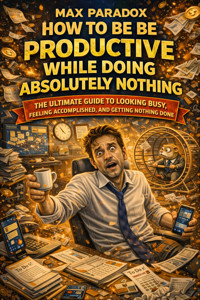
How to Be Productive While Doing Absolutely Nothing - The Ultimate Guide to Looking Busy, Feeling Accomplished, and Getting Nothing Done ebook
Max Paradox
Uzyskaj dostęp do tej i ponad 240000 książek od 14,99 zł miesięcznie
- Wydawca: ALL-IN Rafał Płonkowski
- Kategoria: Poradniki•Styl życia
- Język: angielski
You don’t need another productivity system.
You already have too many.
You plan.
You optimize.
You track.
You feel busy.
You feel tired.
And somehow… nothing actually gets done.
This book is a parody of modern productivity culture - the apps, the planners, the routines, the focus hacks - and the uncomfortable truth hiding behind them.
Inside, you’ll discover:
why planning feels safer than doing,
how two hours of preparation can replace twenty minutes of work,
why focus apps destroy focus better than social media,
how checklists, streaks, and systems keep you busy without results,
and how burnout now happens without anything to show for it.
This is not a guide to getting more done.
This is a guide to looking productive while doing absolutely nothing.
No motivation.
No life hacks.
No fake discipline.
Just painfully accurate observations, sharp humor, and the quiet relief of realizing:
it’s not just you.
Perfect for:
people drowning in productivity tools,
anyone who feels busy but stuck,
readers tired of motivational nonsense,
and anyone who has ever said, “I’ll start tomorrow.”
You won’t become more productive after reading this book.
But you’ll finally understand why.
And somehow, that feels productive enough.
This publication was prepared using tools that support the creative process, including solutions based on artificial intelligence. The final concept, structure, and editing are the work of the author.
Ebooka przeczytasz w aplikacjach Legimi na:
Liczba stron: 55
Rok wydania: 2026
Odsłuch ebooka (TTS) dostepny w abonamencie „ebooki+audiobooki bez limitu” w aplikacjach Legimi na:
Podobne



















INTRODUCTION - Congratulations. You’re Already Doing It.
If you’re holding this book, opening it on your phone, or just scrolling past the introduction while telling yourself “I’ll read it later” - congratulations.You are already being productive in the most modern way possible.
This is not a book about getting things done.This is a book about feeling like you’re getting things done, which - let’s be honest - is what most productivity books quietly promise anyway.
You live in a world where:
planning feels safer than action,
tools feel more important than outcomes,
and being
busy
is often rewarded more than being
effective
.
Somewhere along the way, productivity stopped being about results and became a lifestyle aesthetic.
You don’t work anymore.You optimize.
You don’t procrastinate.You prepare.
You don’t avoid tasks.You build systems around them.
This book exists because modern productivity has mastered one incredible skill:making you feel exhausted without actually producing anything.
And it does it beautifully.
You download focus apps.You color-code checklists.You plan tomorrow so thoroughly that there’s no energy left to live it.You spend two hours organizing twenty minutes of work - and somehow feel accomplished afterward.
No one questions this.Everyone nods.Your calendar is full.Your to-do list is long.Your results are… abstract.
And that’s okay.Because this book isn’t here to fix you.
It won’t:
motivate you,
push you,
teach you discipline,
or help you “unlock your potential.”
There are already thousands of books doing that.Most of them are unread.Some of them are quoted.None of them changed much.
This book does something different.
It tells the truth.
It celebrates the strange comfort of:
rewriting the same task list every day,
tweaking systems instead of using them,
and mistaking motion for progress.
It’s a guide for people who:
love productivity tools more than productivity,
feel busy but suspiciously unchanged,
and know, deep down, that something here is slightly ridiculous.
You don’t need another system.You don’t need better habits.You don’t need to wake up at 5 a.m.
You just need honesty.
And maybe a checklist.Color-coded.That you’ll never complete.
Welcome to How to Be Productive While Doing Absolutely Nothing.
You’re doing great.Nothing has changed.
CHAPTER 1 - You Don’t Need to Work. You Need a System
The first and most important lie of modern productivity is this:you don’t have a work problem - you have a system problem.
You’re not behind because you didn’t do the thing.You’re behind because the thing wasn’t properly framed, structured, tracked, tagged, color-coded, synced, reviewed, and emotionally processed.
Work is dangerous.Work can fail.
A system, on the other hand, is safe.A system can always be improved later.
That’s why the moment something feels hard, unclear, or uncomfortable, your brain doesn’t say “let’s do this.”It says:
“Wait. Before we start… shouldn’t we design a better system?”
And just like that, the work disappears - replaced by something far more respectable.
You open a new note.You create a framework.You sketch a workflow.You feel smart.
Nothing has happened.But something feels like it has.
Systems are wonderful because they:
give you the illusion of progress,
postpone responsibility,
and turn action into a future problem.
A system says:
“I’m not avoiding this. I’m preparing for it.”
And preparation sounds mature.Responsible.Almost professional.
You’re not someone who rushes in blindly.You’re someone who thinks things through.
That’s why you can spend an entire evening:
choosing the right task manager,
migrating tasks between apps,
redesigning categories,
renaming folders,
and reorganizing priorities…
…without touching the actual task.
And when you’re done, you’re tired.
Which is important.Because tired people deserve rest.
You didn’t fail today.You worked on the system.
The system just isn’t ready yet.
And it never will be.
Because the perfect system is a moving target.The moment you almost finish building it, you learn about:
a better app,
a cleaner layout,
a more elegant method,
or a YouTube video titled
“The Only Productivity System You’ll Ever Need.”
You click it.Obviously.
Systems don’t ask uncomfortable questions like:
“Why are you avoiding this?”
“What if it doesn’t work?”
“What if you try and fail?”
Systems ask safe questions:
“How should this be structured?”
“What’s the optimal flow?”
“Should this be a tag or a project?”
Real work produces results.Systems produce potential.
And potential is infinite.Which makes it perfect.
So no - you don’t need to work.
You need a system.And maybe another system to manage that system.Just to be sure.
CHAPTER 2 - Planning Is Safer Than Doing
Doing things is risky.
Planning things is not.
Planning is where ambition goes to hide from reality.
When you plan, everything works.Deadlines behave.Energy is unlimited.Motivation shows up on time.You are calm, focused, and slightly superior to your current self.
Future You is incredible.
Future You wakes up early.Future You doesn’t check the phone.Future You starts immediately.Future You finishes things.
Planning allows you to spend time with that version of yourself - without ever having to become them.
That’s why planning feels productive.
You sit down to plan “just for 10 minutes.”Two hours later, you have:
a detailed daily schedule,
a weekly overview,
monthly goals,
quarterly intentions,
and a vague sense of achievement.
The task itself remains untouched.But now it’s beautifully planned.
And that matters.
Because planning has no consequences.
If a plan fails, nothing bad happens.You simply plan again.
A failed action hurts your ego.A failed plan becomes Version 2.
Planning also creates emotional distance.
Instead of facing:
“I don’t want to do this”
You face:
“How should I approach this optimally?”
This feels smarter.Cleaner.Less personal.
Planning turns discomfort into design.
It also creates hope - which is dangerously addictive.
Every plan is a promise that:
tomorrow will be better,
next week will be different,
and this time, it will finally work.
Not because you changed -but because the plan did.
And if it doesn’t?
No problem.The problem wasn’t you.
The problem was:
unrealistic time blocks,