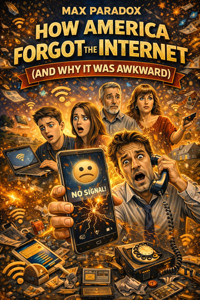
How America Forgot the Internet (And Why It Was Awkward) - A Month Without Wi-Fi, Algorithms, and Constant Validation ebook
Max Paradox
Uzyskaj dostęp do tej i ponad 240000 książek od 14,99 zł miesięcznie
- Wydawca: ALL-IN Rafał Płonkowski
- Kategoria: Poradniki•Styl życia
- Język: angielski
What would happen if the internet disappeared for a month?
Not slowed down.
Not glitching.
Just… gone.
How America Forgot the Internet (And Why It Was Awkward) is a sharp, funny, and slightly uncomfortable look at what happens when modern life loses its digital crutches.
America is suddenly forced to:
work without notifications,
meet without slides,
date without apps,
parent without comparison,
argue without comment sections,
shop without reviews,
and wait without distraction.
Parents remember how life used to work.
Everyone else panics quietly.
Through short, absurd, observational chapters, this book explores boredom, silence, focus, human interaction, and the strange realization that life doesn’t actually collapse without constant connection.
This is not a guide.
This is not a self-help book.
And it definitely won’t teach you how to unplug.
It’s satire.
It’s recognition.
And it’s a reminder of how awkward - and human - life becomes when the internet steps aside.
Read it online.
Preferably without checking your phone.
This publication was prepared using tools that support the creative process, including solutions based on artificial intelligence. The final concept, structure, and editing are the work of the author.
Ebooka przeczytasz w aplikacjach Legimi na:
Liczba stron: 65
Rok wydania: 2026
Odsłuch ebooka (TTS) dostepny w abonamencie „ebooki+audiobooki bez limitu” w aplikacjach Legimi na:
Podobne




















Chapter 1. A Month Without the Internet - The Announcement That Changes Everything
The announcement comes quietly, which is the first mistake. A short press release. A calm spokesperson. Carefully selected words like “maintenance,” “unexpected issue,” and “temporary disruption.” No alarms. No countdown. Just reassurance. America has heard this tone before and learned absolutely nothing from it.
The internet will be shut down. Completely.Not slow.Not unstable.Not “working, but only on one bar.”Off. For a month.
At first, nobody panics. Americans are professionals at denial. We assume it’s a joke, a test, a beta version of reality. People restart routers with religious devotion. They restart phones. They restart laptops. Some restart their entire personality and pretend they’re fine with it. Nothing happens. No bars. No Wi-Fi symbol. Just a blank screen and the uncomfortable realization that your device has absolutely nothing to say to you.
That’s when the panic begins. Not the loud, dramatic, end-of-the-world panic. The quiet kind. The kind that creeps in slowly, when people realize they don’t know anyone’s phone number. Not their partner’s. Not their kids’. Not even their own.
Families sit in living rooms, staring at each other like strangers trapped in the same elevator. Someone suggests talking. No one knows how long that’s supposed to last.
Society Splits in Two
Within the first 24 hours, America divides itself into two very clear groups.
People who remember life before the internet and are suspiciously calm, almost smug, because they survived boredom, paper maps, and waiting for photos to be developed.
People who have never lived without the internet and are now experiencing what doctors will later describe as “unexpected character development.”
The older generation reacts first, and oddly, with confidence. They’ve been preparing for this moment their entire lives. They remember a world where information was optional, silence was normal, and not knowing something didn’t cause physical pain.
They say things like:
When we didn’t know something, we either guessed, waited, or asked someone who sounded confident enough to be wrong.
We didn’t have GPS, we just drove until something looked familiar or emotionally acceptable.
If someone didn’t answer for three days, it meant they were busy, not that they hated you.
Their children do not find this comforting.
The Collapse of Instructions
By day two, the real problems appear. Not food. Not electricity. Instructions.
Everything in America comes with instructions now, and all instructions live online. People stand helpless in kitchens, staring at coffee machines that refuse to cooperate without an app. Washing machines turn into abstract art installations. Smart TVs become extremely confident pieces of black glass.
People try to remember how their parents lived and fail almost immediately.
They attempt activities like:
Sitting on the couch and “just thinking,” which lasts about forty seconds before existential dread kicks in.
Reading books found on shelves, only to discover books do not scroll, zoom, update, or suggest similar books you didn’t ask for.
Visiting neighbors by knocking on doors, which feels illegal even though no law technically forbids it.
Life Without Screens
Outside, the streets change. People walk slower. They look up more. Not because they’ve become mindful, but because there’s nothing left to look down at. Eye contact becomes aggressive. Small talk returns like a disease everyone thought had been eradicated.
Parents suffer the most. Not because of the outage itself, but because children start asking questions without first checking a video tutorial.
Questions like:
Why is the sky blue?
How do you know that?
Who told you?
Parents respond with phrases they swore they would never use, phrases passed down through generations like a curse.
Phrases like:
Because that’s how it is.
Because someone smarter figured it out.
Because not everything has a tutorial.
Teenagers: Alive but Unposted
Teenagers enter a state of silent despair. They are alive, but undocumented. Their outfits go unseen. Their jokes expire in the room where they were spoken. For the first time in their lives, something happens and stays there.
No likes.No shares.No validation.
Just reality.
It’s unbearable.
Work Without the Internet
Workplaces collapse politely. Meetings still happen, but without slides, charts, or screen sharing, people are forced to explain ideas using words alone. This exposes a dangerous truth.
Some jobs exist only because the internet exists.
Emails disappear. Along with them disappear excuses like “I didn’t see the message” and “let’s circle back.” Offices grow quieter. Real work accidentally happens. Nobody knows how to react.
Adaptation Phase
By the second week, something unexpected occurs. People adapt. Not gracefully, but effectively.
They start writing things down. On paper.
They remember appointments.
They show up on time because there’s nothing else to distract them.
Arguments happen face to face and end faster, because storming off is much less dramatic when there’s nowhere to scroll afterward.
Parents tell stories about how they met without dating apps. Children listen in disbelief, as if hearing war stories from a hostile environment.
Friendships either deepen or end completely. There is no mute button anymore.
The Return of the Internet
By the fourth week, the internet comes back.
Notifications flood in like delayed emotions. Messages arrive from people you forgot existed. Trends restart. Feeds refill. America exhales collectively and silently agrees never to talk about this month again.
Except the parents smile quietly.
Because for a brief moment, the world accidentally remembered how they lived.
And it terrified everyone.
Chapter 2. Talking to People Without a Screen - The Return of an Ancient Skill
On day three, America makes a shocking discovery.People exist outside the internet.
Not avatars.Not profile pictures.
Actual humans. In physical form. With voices. And faces. And opinions that arrive without warning.
At first, no one is prepared for this.
People stand too close. Or too far. They don’t know where to look. Eye contact lasts either half a second or an eternity. Every interaction feels slightly aggressive, like a confrontation that hasn’t decided what it’s about yet.
Conversation, it turns out, is not intuitive anymore.
Silence Becomes a Threat
Without phones, silence returns. And silence is loud.
In elevators, nobody knows what to do with their hands.In lines, people stare at the floor like it might start entertaining them.In living rooms, families discover that sitting together does not automatically generate content.
Parents try to fill the gaps.
They ask questions like:
So… how was your day?
What did you do today?
Did anything interesting happen?
Children respond with confusion. Nothing was documented. Nothing was shared. How are they supposed to remember it?
Adults panic internally because they realize something terrifying.
They don’t know how to talk without a purpose.
Conversations Without an Exit Button
Before the outage, every conversation had an escape route.A vibration.A notification.A sudden need to “just check something.”
Now, there is no escape.
If you start a conversation, you have to finish it.If it gets awkward, you have to stay in it.If someone tells a boring story, you have to hear the ending.
People begin to understand why their parents used to say things like “don’t interrupt” and “let people finish.”
It wasn’t politeness.It was survival.
Parents, the Unexpected Experts
Parents suddenly become authorities again.
They remember how conversations used to work:
You listened, even when it wasn’t interesting.
You responded, even when you didn’t have a strong opinion.
You accepted that not every interaction needed to be entertaining.