


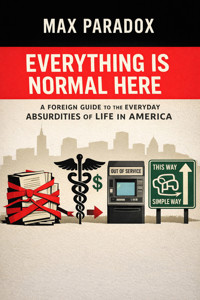
Everything Is Normal Here - A Foreign Guide to the Everyday Absurdities of Life in America ebook
Max Paradox
Uzyskaj dostęp do tej i ponad 240000 książek od 14,99 zł miesięcznie
- Wydawca: ALL-IN Rafał Płonkowski
- Kategoria: Poradniki•Styl życia
- Język: angielski
What if nothing in America is broken-
it just works like this?
This book is a sharp, dry, and painfully familiar satirical journey through everyday life in the United States, seen through the eyes of someone who still remembers that things can work differently elsewhere.
Healthcare that feels like a financial puzzle.
Customer service that apologizes without fixing anything.
Freedom that comes with instructions.
Convenience that requires planning.
Normal life that slowly trains you to stop asking questions.
This is not a guide.
This is not advice.
This is not outrage.
It is recognition.
Written in short, precise observations, ironic bullet points, and calm, tired humor, Everything Is Normal Here exposes the quiet absurdities Americans live with daily-often without noticing anymore.
You will laugh.
You will feel exposed.
You will think: “Yes. That’s exactly it.”
If you’ve ever felt that life here is strangely complicated, politely exhausting, and perfectly functional in all the wrong ways-this book already understands you.
This publication was prepared using tools that support the creative process, including solutions based on artificial intelligence. The final concept, structure, and editing are the work of the author.
Ebooka przeczytasz w aplikacjach Legimi na:
Liczba stron: 136
Rok wydania: 2026
Odsłuch ebooka (TTS) dostepny w abonamencie „ebooki+audiobooki bez limitu” w aplikacjach Legimi na:
Podobne



















INTRO
America is a place where everything works—until it doesn’t.Which is often.And loudly.With paperwork.
From the outside, it looks efficient. Streamlined. Logical.From the inside, it feels like living inside a pop-up notification that never closes.
You arrive expecting chaos to be accidental.You quickly realize it is structural.
Daily life in the United States is not absurd because people are strange.People are normal. Tired. Mostly polite. Slightly confused.The absurdity comes from systems that insist on being taken seriously while behaving like they were designed during a coffee break that went on too long.
In other countries, daily life contains inconveniences.In America, inconvenience is monetized, branded, and upsold as a premium experience.
You don’t just wait in line.You wait in a line that has a policy.The policy has a QR code.The QR code leads to a form.The form asks you to call a number.The number plays music from 2006.
And everyone acts like this is normal.
This book is not about America being “worse.”It is about America being louder in its normality.More confident.More committed to doing simple things in the most complicated way possible.
Other countries also have rules.But they often exist to make life tolerable.
Here, rules exist to protect the rule.
• In some countries, you show your ID once.• In America, you show it repeatedly to prove you are still you.• The system remains unconvinced.
You will notice patterns.
Healthcare that feels like a subscription service you forgot to cancel.Customer service that apologizes sincerely while doing absolutely nothing.Technology that promises convenience and delivers new forms of anxiety.Freedom framed as choice, but only between identical options.
People elsewhere complain about bureaucracy.Americans schedule it.
They block time for it.They mentally prepare.They bring snacks.
There is an impressive optimism embedded in all of this.A belief that if you follow the steps correctly, the system will reward you.
It won’t.But it appreciates your effort.
What makes the absurdities sharper is comparison.
In one country, you miss a train and wait for the next one.In another, you miss a train and fill out a form explaining why you missed the train.In America, you miss a train and are offered a refund minus fees, taxes, emotional damage, and a sense of dignity.
• Somewhere else, silence is neutral.• Here, silence means something went wrong.• You just don’t know what yet.
This is not a guide.It will not help you navigate America better.It will not make systems easier or faster.
It will simply sit with you in the discomfort and say:“Yes. That thing you noticed. That was weird.”
The goal is not outrage.Outrage requires energy.
This book operates on recognition.
That moment when you laugh quietly because someone else finally said it.That uncomfortable nod when you realize you’ve defended the indefensible just to get through the day.That relief of knowing the confusion wasn’t personal.
• You didn’t misunderstand.• You adapted.• That was the problem.
America functions.It just does so theatrically.
And once you see it, you can’t unsee it.
Chapter 1 – Everything Is Fine, Please Hold
In other countries, when something goes wrong, it feels accidental.A mistake.An exception.
In America, when something goes wrong, it feels scheduled.
You don’t ask if it will fail.You ask when and how politely.
The first lesson you learn is patience.Not calm patience.Administrative patience.
The kind that requires snacks.
You call a number because the website told you to.The website exists because the office no longer does.The office closed because “most people prefer online.”
No one you know prefers online.
The call connects instantly.This surprises you.You are immediately punished for your optimism.
The voice thanks you for calling.It assures you your call is important.It then places you on hold.
Forever-adjacent.
• The music is loud enough to prevent thought.• The volume resets every time the message repeats.• The message repeats often.
In some countries, waiting is passive.You stand.You sit.You wait.
In America, waiting is interactive.
You must confirm you are still waiting.You must press buttons.You must listen carefully “as our menu options have changed.”
They have not.
The menu options have never changed.But hope has.
When a human finally appears, they are kind.Disarmingly kind.They apologize preemptively.
They do not solve anything.
They explain the process.
America loves processes.
Processes are where responsibility goes to rest.
The person you’re speaking to is not empowered to help.They are empowered to explain why help is impossible.
• They understand your frustration.• They validate your concern.• They offer no outcome.
In other countries, bureaucracy feels cold.Here, it feels friendly.
That makes it worse.
You are thanked repeatedly while being denied.You are congratulated for your patience while losing time.You are told you are valued while being transferred.
Transfers are a form of cardio.
You begin to recognize the pattern.
No one says “no.”They say “unfortunately.”
No one makes decisions.They reference policies.
Policies are treated like natural disasters.Unavoidable.Nobody’s fault.
You ask for a supervisor.
This is not aggressive.It is ceremonial.
The supervisor arrives with the same information, delivered more slowly and with confidence.
• They restate the policy.• They apologize again.• They thank you for understanding, regardless of whether you do.
In some countries, escalation means resolution.In America, escalation means repetition.
You tell the story again.You become better at telling it.You remove emotion because it slows things down.
This is personal growth.
The system rewards emotional neutrality.It punishes urgency.
If you sound calm, you might be taken seriously.If you sound distressed, you are routed to a different department.
That department is closed.
Everything is closed.
Except the hold music.
America excels at being available without being accessible.
Stores are open late.Support is 24/7.Help is theoretical.
You can always reach someone.That someone can always redirect you.
• Access is infinite.• Resolution is finite.• Accountability is abstract.
You begin to plan your day around this.
You don’t say, “I’ll fix that today.”You say, “I’ll call about that.”
Calling is an activity.It has duration.It requires recovery time.
People schedule calls the way others schedule meetings.They block calendars.They warn coworkers.
“Wish me luck” is said without irony.
In other countries, systems feel human-built.Flawed, but comprehensible.
Here, systems feel self-aware.They anticipate resistance.They redirect it.
Forms lead to forms.Forms reference other forms.Some forms are no longer accepted, but remain available for emotional realism.
You fill everything out correctly.
This is crucial.
It will not matter.
You will still be asked to resubmit.You will still be missing a document you’ve already provided.You will still be thanked.
• Efficiency is promised.• Friction is delivered.• Surprise is reserved for newcomers.
After a while, you stop fighting it.
You learn the language.
You say “No worries” when there are worries.You say “I understand” when you don’t.You say “That’s fine” when it clearly isn’t.
This is not surrender.It is adaptation.
America does not require obedience.It requires compliance.
Compliance looks cheerful.
You smile while waiting.You nod while being redirected.You accept the explanation because rejecting it would require energy you no longer have.
And here’s the thing.
Everyone knows.
The agent knows.The supervisor knows.You know.
The absurdity is not hidden.
It is mutually acknowledged and collectively ignored.
• The system doesn’t work well.• Complaining won’t fix it.• Acting like it’s normal keeps things moving.
In other countries, when something fails, people complain loudly.Here, people optimize their tone.
They aim for “pleasant but persistent.”They measure politeness like a strategy.
Too nice, and you are ignored.Too firm, and you are flagged.
The sweet spot exists briefly, like a software glitch.
Sometimes, miraculously, something works.
You get the refund.The form is accepted.The issue resolves.
This feels less like success and more like weather.
You do not celebrate.You remain suspicious.
Because you know.
If you ever need to do it again, the process will be different.The rules will have shifted.The policy will be updated without announcement.
And someone will still say:
“Everything is fine.”
They will mean it.In the American way.
Which is to say:Nothing is on fire.Yet.
And if it is,there’s probably a department for that.
Chapter 2 – Freedom of Choice (Between These Two Options)
In other countries, choice is something that happens quietly.You choose bread.You choose milk.You move on.
In America, choice is ceremonial.
You are not just offered options.You are reminded you are choosing.Constantly.Aggressively.
Every decision is framed as empowerment.
This is important, because the options are usually identical.
You don’t buy internet.You select a plan.
The plan has a name.The name implies speed, strength, or ambition.The speed is the same.
• One option is called “Basic.”• One option is called “Unlimited.”• Both stop working during storms.
The illusion of choice is maintained through vocabulary.
Upgrade.Customize.Optimize.
You are encouraged to feel agency while being gently pushed in one direction.
That direction costs more.
In some countries, there is one service.It works badly, but consistently.
Here, there are many services.They all work badly in different ways.
This is called competition.
You select a healthcare provider.
This is not a doctor.This is a network.
The network includes doctors you are allowed to see.Some of them are accepting new patients.Some of them have retired but remain listed for historical reasons.
You choose carefully.
The choice is invalid.
Your doctor is “out of network.”
• The building is covered.• The hallway is covered.• The doctor is not.
You pay anyway, because you are already there.Leaving would feel inefficient.
Efficiency is a trap.
In other countries, you choose a bank because it exists nearby.Here, you choose a bank because it has an app.
The app is excellent.The bank is fictional.
It allows you to move money instantly.It cannot explain where the money went.
Customer support is available.They admire your situation.
They suggest you check your account.
You have.
Choice extends into areas that do not benefit from it.
There are 40 types of toothpaste.None of them address the underlying issue.
You are expected to have preferences.
You are expected to know them.
If you hesitate, help appears.
The help is a person trained to upsell.
• They ask lifestyle questions.• They interpret your hesitation as curiosity.• They recommend the premium version.
Simplicity is suspicious.
If something is easy to choose, it must be low quality.
This applies to everything.
Streaming services offer thousands of titles.You watch none of them.
Decision fatigue is treated as a personal weakness.
You scroll longer.You add things to a list.You abandon the list.
Somewhere else, television just starts.
Here, entertainment requires planning.
You choose your phone carrier.
This is not about coverage.All carriers claim coverage.
It is about promotions.
You are offered a deal.
The deal requires a trade-in.The trade-in requires a pristine device.The pristine device must have normal signs of use.
• Cracks are unacceptable.• Scratches are subjective.• Judgment is final.
You sign anyway.
Commitment is expected.
Freedom includes contracts.
Long ones.
In other countries, choice is limited but honest.Here, choice is abundant but conditional.
You are free to choose as long as you choose correctly.
Correctly means within policy.
Policy is not visible.
You discover it later.
Usually through fees.
Fees are the punctuation of American choice.
You chose parking.You also chose a processing fee.
You chose delivery.You also chose a service fee.
You chose freedom.You also chose responsibility for everything that follows.
This creates a specific anxiety.
Not fear of losing choice.Fear of choosing wrong.
Every mistake is framed as user error.
• You selected the wrong plan.• You didn’t read the fine print.• You should have known.
The fine print is extensive.
It is written in confident language that explains nothing.
In other countries, advice is unsolicited.Here, advice is monetized.
You are offered guidance packages.Consultations.Premium support.
The assumption is clear.
If you struggle, you didn’t invest enough.
Even choices meant to be relaxing become strategic.
You don’t just book a vacation.You compare platforms.
The platforms compare prices.The prices change during comparison.
You feel watched.
• The deal expires in 3 minutes.• Other people are viewing this option.• You hesitate and are punished.
Choice is time-sensitive.
Freedom comes with a countdown.
In some places, the waiter asks what you want.Here, they ask if you’ve had a chance to review the menu.
The menu is a book.
You are expected to curate an experience.
If you choose poorly, it is your fault.
If you choose well, it was inevitable.
Satisfaction is framed as success.
Regret is framed as learning.
This logic extends everywhere.
Career paths.Education.Insurance deductibles.
You are told you can be anything.
But only if you choose early.And correctly.And affordably.
Mistakes are expensive.
America does not punish failure.It invoices it.
Choice becomes exhausting.
Not because there are too many options.But because every option carries consequence.
You begin to crave defaults.
Something preselected.Something assumed.
This is dangerous thinking.
Defaults remove agency.
Agency is sacred.
Even if it’s tiring.
So you keep choosing.
You choose subscriptions you forget about.You choose notifications you mute.You choose silence because engaging would require another decision.
Eventually, you stop feeling empowered.
You feel managed.
By menus.By prompts.By interfaces designed to keep you active.
• You are free to choose.• You are responsible for the outcome.• The system remains neutral.
In other countries, systems feel paternal.Annoying, but protective.
Here, systems feel libertarian.
They don’t stop you.They watch.
And if you fall,they offer options.
Two of them.
Neither ideal.
Both expensive.
You choose one.
You always do.
Because not choosing is also a choice.
And in America,that one costs the most.
Chapter 3 – Healthcare, But Make It a Puzzle
In other countries, healthcare is something you enter reluctantly and leave quietly.It is not pleasant.It is not fun.But it is understandable.
In America, healthcare is an interactive experience.
You do not receive care.You navigate it.
Navigation begins before you are sick.
You choose insurance.
This is not a feeling-based decision.This is a financial prediction game played with incomplete information.
You select a plan based on words you don’t fully understand.Deductible.Copay.Out-of-pocket maximum.
These sound reassuring.
They are not.
• The deductible is higher than expected.• The copay applies selectively.• The maximum is theoretical.
You assume you are covered.
This assumption is optimistic.
You get sick.
Not dramatically.Nothing cinematic.
Just enough to need help.
You hesitate.
Is this worth it?
This is the first symptom.
In other countries, you ask, “How soon can I be seen?”Here, you ask, “Will this financially ruin me?”
You call your provider.
They ask for your insurance information.
You give it.
They pause.
This pause is meaningful.
They explain that they accept your insurance.They do not explain what that means.
You make the appointment.
The appointment is weeks away.This suggests you are not dying.
This is comforting.
On the day of the visit, you arrive early.You are efficient.
You fill out forms.
These forms ask questions your doctor will not read.
They ask for emergency contacts.You list someone calm.
You are taken to a room.
You wait.
This waiting feels different.
It feels expensive.
• The room is clean.• The equipment is advanced.• The clock is loud.
A nurse arrives.
They are kind.
They measure things.They record them.
They leave.
Time resumes its normal pace.
The doctor enters.
They are efficient.They are professional.
They spend six minutes with you.





