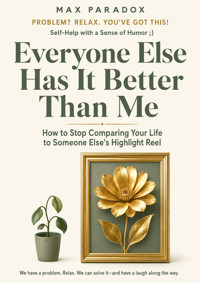
Everyone Else Has It Better Than Me - How to Stop Comparing Your Life to Someone Else's Highlight Reel ebook
Max Paradox
Uzyskaj dostęp do tej i ponad 240000 książek od 14,99 zł miesięcznie
- Wydawca: ALL-IN Rafał Płonkowski
- Kategoria: Biznes, rozwój, prawo•Biznes, rozwój
- Język: angielski
Everyone seems to be doing better.
Someone got promoted. Someone bought a house. Someone is in Italy again. Someone has visible abs, a perfect relationship, an organized pantry, and apparently enough emotional stability to prepare overnight oats in matching glass jars.
Meanwhile, you are doing reasonably well until you look at everyone else.
Everyone Else Has It Better Than Me is a practical, funny guide to breaking the comparison habit without pretending you will never notice another successful human being again.
Max Paradox shows why comparison feels so convincing even when the evidence is terrible. You see someone else’s polished outcome while knowing every unfinished, embarrassing, ordinary detail of your own life. You compare your raw footage with their trailer-and then wonder why you appear less impressive.
This book will help you understand when comparison is useful, when it becomes distorted, and what to do before somebody else’s promotion accidentally causes you to reconsider your career, house, body, relationship, savings, and kitchen cabinets before lunch.
Inside, you will learn how to:
separate facts from the story your brain adds;
stop treating other people’s milestones as deadlines for your life;
identify borrowed goals and competitions you never chose;
use envy as useful information instead of evidence against yourself;
reduce social media and real-life comparison triggers;
build your own definition of “enough”;
compare processes instead of identities;
turn useful comparison into concrete action;
stop constantly checking whether you are ahead or behind;
deal with comparison inside friendships, families, relationships, and workplaces;
recover quickly when old habits return;
build a life interesting enough that you spend less time monitoring everybody else’s.
There are no instructions to “just be grateful,” repeat affirmations at the mirror, or pretend money, status, appearance, career progress, and relationships do not matter.
Sometimes they matter a lot.
The goal is not to convince yourself that everybody else is secretly miserable. Some people really are doing extremely well. Let them.
Their success does not require your failure.
With practical exercises, realistic Plan B options, and Max Paradox’s trademark observational humor, this book helps you stop using strangers, coworkers, siblings, friends, and people from high school as measuring devices.
You do not need to win life.
You need to know what you are actually trying to build.
And perhaps stop letting somebody else’s kitchen island participate in the decision.
This publication was prepared with the assistance of tools that support the creative process, including artificial intelligence-based solutions. The final concept, structure, and editing belong to the author.
Ebooka przeczytasz w aplikacjach Legimi na:
Liczba stron: 202
Rok wydania: 2026
Odsłuch ebooka (TTS) dostepny w abonamencie „ebooki+audiobooki bez limitu” w aplikacjach Legimi na:
Podobne




















INTRO
You open Instagram for one perfectly innocent reason. Maybe someone sent you a message. Maybe you want to check the weather, even though Instagram has never once been responsible for meteorology. Three minutes later, you are looking at a former coworker standing on a beach in Greece with a drink that appears to contain its own tropical ecosystem.
She looks fantastic.
Her husband looks fantastic.
Their hotel looks fantastic.
Even the decorative towel swan looks emotionally stable.
You are sitting on your couch wearing sweatpants that have entered the “technically still clothing” phase of their life, eating crackers directly from the box because plates create unnecessary bureaucracy. Suddenly, a thought arrives:
Why does everyone else seem to be doing better than me?
This thought is rarely improved by further investigation.
You keep scrolling. Someone bought a house. Someone got promoted. Someone ran a marathon. Someone has apparently discovered the exact morning routine required to become wealthy, calm, muscular, fluent in Italian, and finished with email before 7:15 a.m. Another person posts a photo of their child calmly painting at a beautiful wooden table while sunlight enters the room at an angle normally reserved for luxury furniture catalogs.
Meanwhile, your family’s creative activity this morning involved someone stepping on a charger and shouting a word that will not appear in the school newsletter.
Excellent.
You were reasonably satisfied with your life fourteen minutes ago. Nothing about your actual life has changed. Your job is the same. Your relationships are the same. Your bank account has not moved. Your kitchen still contains exactly the same suspicious container you have been avoiding since Tuesday.
But now your life somehow feels worse.
That is the strange power of comparison. It can turn an ordinary Tuesday into evidence that you have failed at existence.
The problem is not that you notice other people. Human beings have always compared themselves with one another. Your ancestors probably did it too.
“Gary has a better cave.”
“Gary’s fire is bigger.”
“Gary’s family seems happier.”
“Yes, but Gary was nearly eaten by a bear yesterday.”
“Still. Nice cave.”
Comparison itself is not automatically harmful. Sometimes it helps. You see someone doing something well and think, I’d like to learn that. You notice a colleague earning more and realize you should negotiate your salary. You watch someone become healthier and decide that perhaps vegetables deserve one final chance before you formally classify pizza sauce as a serving of produce.
Useful comparison gives you information.
Unhealthy comparison gives you a verdict.
And the verdict is usually delivered by a judge who has reviewed approximately six percent of the evidence.
You compare your ordinary day with someone else’s exceptional moment. Your kitchen on Wednesday morning versus their anniversary dinner. Your career uncertainty versus their promotion announcement. Your relationship after an argument about dishwasher loading strategy versus their vacation photo captioned My person. My best friend. My everything.
Nobody posts:
“Here is my best friend refusing to admit that bowls go on the top rack.”
That does not mean the happy photo is fake. Most of the time, it probably is happy. The mistake is not assuming that other people experience good moments. They obviously do. The mistake is quietly turning those moments into a complete biography.
You see the promotion. You do not see the six years of boring work before it, the difficult manager, the applications that went nowhere, the Sunday-night anxiety, or the fact that the promoted person may now spend three evenings a week attending meetings titled “Strategic Alignment Sync.”
You see the beautiful house. You do not see the mortgage payment.
You see the vacation. You do not see the delayed flight, the argument at the airport, the credit card bill, or the thirty-seven failed photos taken before the one where everybody appears naturally joyful near a fountain.
The internet has not invented comparison, but it has industrialized it.
Once, you compared yourself mostly with people you actually knew: relatives, coworkers, neighbors, maybe the annoyingly competent parent from your child’s school who somehow brings homemade muffins to an event at 8:00 a.m. Today, your comparison group includes celebrities, entrepreneurs, fitness influencers, strangers in apartments you cannot afford, people ten years younger than you, people twenty years older than you, and a man in California who apparently sold his software company at twenty-six and now writes philosophical posts from a cold plunge.
This is not a fair competition.
It is not even technically the same sport.
Your brain, unfortunately, does not always care. It sees evidence of somebody succeeding and performs a quick audit of your own life. Career. Money. body. Relationship. Home. Travel. Social life. Parenting. Productivity. Hair.
Hair has somehow entered the annual review.
The result is a moving target. Even when you catch up in one area, someone else appears ahead in another. You finally earn more money and discover that everybody seems to be traveling more. You take a good vacation and meet someone who has already visited forty-three countries. You renovate the kitchen and immediately encounter a person online whose pantry has individual glass containers labeled LENTILS in matching typography.
You own lentils too.
They are in a torn plastic bag behind the rice.
Apparently civilization has passed you by.
The deeper problem is that comparison often hides inside respectable-looking thoughts. It does not always announce itself as jealousy. Sometimes it arrives dressed as analysis.
“I’m just wondering whether I’m behind.”
“I’m only trying to understand what I should be doing.”
“I’m using other people for motivation.”
Perhaps.
But if your “motivation” regularly ends with you feeling inadequate, frozen, resentful, panicked, or suddenly convinced that you need a new career, new apartment, new body, new relationship, and possibly new kitchen storage containers before Thursday, we may want to inspect the method.
This book is not going to tell you to stop comparing yourself with anyone forever.
That would be excellent advice if your brain were an obedient Labrador.
It is not.
Your brain compares automatically. The practical goal is different: learn to notice when comparison is useful, when it is distorted, and when it is quietly stealing your satisfaction without giving you anything valuable in return. You will learn how to separate information from self-judgment, stop using strangers as measuring devices, choose better reference points, reduce the situations that trigger useless comparison, and make decisions based on what you actually want rather than what appears to be winning online.
We will also deal with the irritating situations in which comparison feels justified.
What if your friends really are earning more?
What if someone younger really is further ahead in your career?
What if you genuinely have neglected something important?
Good. Then we deal with reality.
The solution is not to protect your self-esteem by pretending everybody else is secretly miserable. That is just reverse comparison wearing sunglasses.
Some people really do have more money than you. Some are fitter. Some have calmer marriages, bigger houses, better jobs, more impressive passports, nicer skin, and kitchen drawers that close on the first attempt.
Fine.
Their existence is not an accusation.
You do not need to win against every person you encounter in order to have a good life. You do not even need to enter most of the competitions your brain keeps registering you for.
That is where we are going.
Not toward a magical state where you see somebody’s incredible life and feel absolutely nothing. You are a person, not a decorative stone.
Toward something much more useful: being able to see what somebody else has without automatically converting it into evidence that you are behind.
Because the goal is not to convince yourself that your life is better than everyone else’s.
The goal is to finally notice that it does not have to be.
Chapter 1 - You Are Comparing Raw Footage to a Trailer
You are having a normal evening when your phone informs you that someone you vaguely know has achieved something impressive.
A former classmate has launched a company. A cousin has bought a house. A coworker is celebrating ten years of apparently uninterrupted marital bliss in a restaurant where the chairs look more expensive than your first car. You look at the photo, tap the little heart, and continue with your evening.
Except you do not continue with your evening.
Your brain opens a spreadsheet.
At first, the comparison seems harmless. Good for them. Then comes the second thought: Wait. What am I doing? Five minutes later, you are mentally reviewing your income, career trajectory, relationship status, retirement savings, physical condition, travel history, and whether buying an air fryer three years ago counts as personal development.
It does not.
But it made excellent potatoes.
The first major problem with comparison is not that you compare yourself with other people. It is that you usually compare two completely different kinds of information.
You know your own life from the inside.
You know the embarrassing parts, the unfinished plans, the stupid decisions, the mornings when you achieved nothing before noon except moving a pile of laundry from one chair to another. You know which goals you abandoned, which conversations you handled badly, which purchases you regret, and how often you search “easy healthy dinner” before ordering something that arrives with fries.
Other people, however, are usually presented to you from the outside.
You see outcomes.
You see announcements.
You see finished kitchens, accepted job offers, engagements, vacations, graduation photos, race medals, business launches, anniversaries, smiling children, polished presentations, and people standing beside expensive objects with captions about gratitude.
You rarely receive the complete production archive.
Nobody sends you a seventeen-minute documentary called Tuesday: We Nearly Canceled the Vacation Because Mark Forgot the Passports.
You receive the beach photo.
This creates a simple but powerful distortion: you compare your entire dataset with someone else’s selected evidence.
Imagine applying this method anywhere else.
You are choosing between two restaurants. For Restaurant A, you receive every review written in the last five years, including the person who gave one star because it rained. For Restaurant B, the owner sends you six photographs of beautifully plated food and a note saying, “People love us.”
You would not call that a rigorous comparison.
Yet this is approximately how we evaluate lives.
Your Brain Fills in the Missing Parts
The problem becomes worse because your brain dislikes incomplete stories. When information is missing, it does not calmly leave a blank space and write insufficient data.
It invents something.
You see someone announce a promotion and unconsciously complete the rest of the picture:
They must be doing incredibly well.
They probably earn much more now.
Their career is clearly moving faster than mine.
They must feel confident.
Their boss respects them.
They know where their life is going.
That is an impressive amount of information to extract from one photograph of a person holding a glass of champagne.
Perhaps all of it is true.
Perhaps none of it is.
Perhaps they got the promotion because the previous manager resigned unexpectedly and now they spend their evenings answering emails with subject lines such as “URGENT: Q4 RESOURCE ALIGNMENT.”
The point is not to imagine hidden misery behind every visible success. That would be equally dishonest. If someone succeeds, you are allowed to believe they succeeded.
Just stop automatically supplying all the additional benefits.
A promotion is a promotion.
It is not proof of permanent happiness, emotional stability, excellent digestion, a satisfying marriage, wise financial decisions, and eight hours of sleep.
Your brain frequently buys the bundle when only one item was advertised.
The Selected Moment Problem
Most public information about other people is naturally selective because nobody communicates every moment of life equally.
You probably do this too.
If you spend a weekend in Chicago, you might post a photo from the riverwalk, a great dinner, or a rooftop with a nice view. You are less likely to post the forty-six minutes you spent looking for parking while saying increasingly philosophical things about urban planning.
That is normal.
You are not committing fraud. You are sharing something interesting.
But when thousands of people do the same thing, your feed becomes a strange artificial environment consisting mostly of moments worth showing.
Promotions.
Celebrations.
New purchases.
New relationships.
Big trips.
Personal transformations.
Milestones.
Nobody announces:
“Today was structurally acceptable.”
Yet structurally acceptable describes a large percentage of adult life.
You woke up. You worked. You answered messages. You bought groceries. Nothing exploded. You watched something. You went to bed.
Perfectly fine day.
Terrible content.
That difference matters because repeated exposure changes your sense of what is normal. When your brain sees fifty exceptional moments every day, ordinary life can start to feel suspiciously unsuccessful.
Your Saturday contains laundry, errands, and possibly a trip to the hardware store.
Their Saturday appears to contain Bali.
Again.
Of course, “their Saturday” actually means one post from one person among hundreds of people you have accumulated online since approximately the invention of the smartphone.
Your mind combines them.
One person has the impressive career.
Another has the beautiful relationship.
Another has the perfect body.
Another travels constantly.
Another owns the beautiful house.
Another cooks elaborate meals using herbs that apparently require individual introductions.
Then your brain quietly merges them into one fictional competitor.
This imaginary person earns $250,000 a year, runs half-marathons, raises emotionally sophisticated children, has a flawless marriage, spends six weeks annually in Italy, owns a beautifully organized home, remembers everyone’s birthday, makes sourdough, and has somehow already completed their taxes.
You are competing against Frankenstein’s lifestyle.
Nobody can win.
Not even Frankenstein.
The Comparison Audit
The fastest way to weaken this distortion is not to repeat positive affirmations in the mirror.
You can, if you enjoy them.
But if you have just spent twenty minutes feeling inadequate because someone bought a cabin in Colorado, looking yourself in the eyes and saying, “I am abundant” may create a second problem: now you feel inadequate and slightly ridiculous.
Instead, use evidence.
When a comparison hits hard, separate what you actually know from what your brain added.
Take a simple example:
My friend Lena has just become a director. I’m behind.
Stop.
What do you actually know?
You know Lena became a director.
That is the fact.
What do you not know?
You may not know her salary, workload, stress level, long-term plans, satisfaction, financial situation, relationship with her manager, or whether she even wanted the role as much as you assume.
Then ask the useful question:
What does her promotion actually tell me about my life?
Perhaps it tells you that you want more responsibility.
Perhaps it reminds you that you have avoided asking for a raise.
Perhaps it reveals that career progress matters more to you than you had admitted.
Good.
Now you have information.
Or perhaps, after thinking about it, you realize you do not want Lena’s job at all. You want the prestige attached to it, but not the twelve-person team, the travel, the budget meetings, or the Sunday-night emails.
Also good.
You have just avoided spending six months pursuing a trophy you do not want to carry.
Use three questions:
What exactly did I observe?
What story did I add?
Is there anything useful here for me?
That is enough.
Do not turn this into a fourteen-page journaling ritual involving scented candles and a dedicated comparison notebook. We are trying to reduce unnecessary mental activity, not open a regional office.
Stop Comparing Categories
Another common mistake is comparing one area of your life with somebody else’s entire perceived success.
You see a friend earning more money and conclude:
They are doing better than me.
Better at what?
Income?
Possibly.
Life?
That is a rather ambitious conclusion.
If a neighbor runs faster than you, you would not say, “This proves Daniel is superior across all known categories.”
You would say Daniel runs faster.
Perhaps Daniel also cannot assemble a bookshelf without entering a personal crisis.
People are uneven.
You are uneven.
Everybody is uneven.
One person may be far ahead financially and lonely. Another may have a fantastic relationship and dislike their job. Another may be extremely fit and permanently worried about money. Another may seem successful professionally while dreaming of leaving the career you envy.
Again, you do not need to search for their weakness to make yourself feel better.
The important step is narrower: keep the comparison inside the correct category.
“They earn more than I do.”
Fine.
“They have a larger house.”
Fine.
“They seem further along professionally.”
Fine.
“Therefore, they have a better life and I am failing.”
Objection.
Evidence not admitted.
Use Comparison as a Question, Not a Sentence
Bad comparison ends with a conclusion.
She is ahead.
I am behind.
They are doing better.
I should have achieved more.
Useful comparison begins with a question.
What exactly do I envy here?
That question is surprisingly powerful because envy is often imprecise.
You may think you envy someone’s house.
What you actually envy is space.
You may think you envy someone’s business.
What you actually envy is autonomy.
You may think you envy someone who travels constantly.
What you actually envy is novelty.
You may think you envy a friend’s promotion.
What you actually envy is recognition.
Now we have something usable.
“Become that person” is not a practical plan.
“Create more autonomy in my work” is.
“Acquire their life” is difficult to schedule between lunch and a dentist appointment.
“Take one weekend trip every two months” is considerably easier.
This is where comparison stops being a weapon and becomes a clue.
Try the Twenty-Four-Hour Rule
Some comparisons are strongest immediately after exposure. You see something, feel a sharp reaction, and suddenly want to redesign your entire life before dinner.
Do not.
If a post, announcement, conversation, or encounter makes you think you urgently need a major change, give it twenty-four hours before deciding anything.
You may still want the change tomorrow.
Excellent.
Then investigate it.
But emotional comparison loves instant conclusions. You see someone leave corporate life to open a bakery and suddenly think, That’s it. I’m done. I need freedom.
Tomorrow morning, after imagining yourself waking at 3:45 a.m. to produce 180 croissants, you may discover that what you actually want is one Friday off.
Much cheaper.
Far less butter.
The twenty-four-hour rule does not mean suppressing your reaction. Notice it. Write down the specific thing that caught you.
Then wait.
Strong comparison often contains information, but the first interpretation is not always the best one.
What If the Comparison Is Accurate?
Sometimes the uncomfortable comparison is factually correct.
Your friend has saved more.
Your colleague has progressed faster.
Your sibling exercises regularly while your running shoes have become decorative objects.
Fine.
Reality is allowed to be inconvenient.
The goal is not to argue with every comparison until you win. The goal is to extract the useful part without turning it into a judgment about your worth.
Suppose your friend has built a $50,000 emergency fund and you have $2,000.
Do not say:
“I’m terrible with money.”
Say:
“I want a larger emergency fund.”
Now the problem has changed.
The first statement is an identity verdict.
The second is a project.
Projects are much easier to solve.
You can calculate a target, automate a monthly transfer, reduce a few expenses, increase income, or create a two-year plan.
“Become less terrible” is harder to enter into a banking app.
That distinction will appear repeatedly throughout this book. Comparison becomes dangerous when a measurable difference becomes a global judgment.
They achieved X.
You have not achieved X.
That does not automatically produce:
Therefore, you are less successful as a human being.
Humans are not ranked with one number.
Fortunately.
Imagine the annual ceremony.
Your Action
The next time you catch yourself thinking that somebody “has it better,” do not argue with the feeling.
Translate it.
Write one sentence describing only the visible fact.
Then write one sentence naming what you are assuming.
Finally, decide whether there is a useful action hidden inside the comparison.
For example:
Fact: Ryan bought a bigger house.
Story: He is more successful than I am and has made better choices.
Useful information: I want an extra room because working from the kitchen is annoying.
Now you can solve a real problem.
Maybe that means moving eventually. Maybe it means reorganizing your current space. Maybe it means renting a small office. Maybe you discover that you would rather keep your smaller mortgage and tolerate the kitchen.
All four are legitimate answers.
The important thing is that Ryan no longer gets to run your housing policy without knowing he has the job.
See the evidence.
Remove the invented biography.
Keep whatever is useful.
The highlight reel can give you ideas.
It does not get to grade your life.
Chapter 2 - Who Put You in This Race?
You hear that someone your age has become a vice president.
Interesting.
Then you hear they are thirty-four.
You are thirty-six.
Suddenly this is no longer information. It is an attack.
Nothing about your career changed during the previous eleven seconds, yet your brain has detected a serious scheduling problem. Apparently there was a timeline. Apparently you missed a checkpoint. Apparently an invisible official has been waiting beside the road with a clipboard.
“Thirty-six and still not vice president?”
The official shakes his head.
“Unfortunate.”
You did not know you were participating in this event until somebody else crossed a finish line.
This is one of the most exhausting forms of comparison: discovering competitions you never consciously entered.
Someone gets married.
Should I be married?
Someone buys a house.
Should I own a house?
Someone becomes a manager.
Should I be a manager?
Someone has a baby.
Should I have children?
Someone’s child starts reading at four.
Should my child be reading at four?
Someone retires at forty-five.
Should I have made significantly better financial decisions in 2009, when I was primarily concerned with finding a decent pizza?
The answer is often unclear because many of our standards were never deliberately chosen.
We inherited them.
The Invisible Scorecard
Most people carry around a private scorecard containing things that are supposed to happen by certain ages.
Career by thirty.
House by thirty-five.
Marriage by whenever your relatives begin asking questions with suspicious frequency.
Certain income.
Certain lifestyle.
Certain amount of travel.
Certain body.
Certain level of confidence.
Certain progress.
The exact numbers vary, but the mechanism is similar: you evaluate yourself against a standard you may never have examined.
Sometimes the standard came from family.
Sometimes from friends.
Sometimes from your profession.
Sometimes from your neighborhood.
Sometimes from the internet, which has very strong opinions about what you should achieve before breakfast.
The interesting question is:
Who wrote your scorecard?
Not metaphorically.
Actually.
If you believe you “should” own a house by now, where did that expectation come from?
Your parents?
Your friends?
Your culture?
A financial influencer standing in front of a rented Lamborghini?
If you think you should be in senior management, is that because you genuinely want leadership, or because advancement has become synonymous with success?
There are people who spend fifteen years climbing toward jobs they eventually discover consist largely of approving vacation requests and asking why the quarterly dashboard is red.
Prestige can be extremely persuasive from a distance.
“Behind” Requires a Destination
When people say, “I feel behind,” I usually want to ask:
Behind on the way to where?
Because “behind” only makes sense if two people are traveling toward the same destination under roughly the same conditions.
If we are both driving from Boston to New York and you are already in Connecticut while I am still looking for my keys, yes, I am behind.
But life is not one road.
Maybe you want a large family.
Maybe I do not want children.
Maybe you want to build a company.
Maybe I want a stable job that ends at five.
Maybe you want a house in the suburbs.
Maybe I would rather live in a small apartment in the city and never personally encounter a lawn mower.
Which one of us is ahead?
The question breaks immediately.
And yet people constantly compare progress without checking whether the destinations match.
You see someone rising quickly in a demanding career, but you value flexibility.