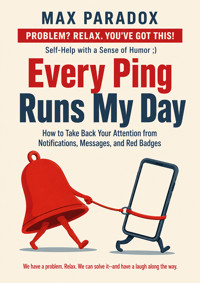
Every Ping Runs My Day - How to Take Back Your Attention from Notifications, Messages, and Red Badges ebook
Max Paradox
Uzyskaj dostęp do tej i ponad 240000 książek od 14,99 zł miesięcznie
- Wydawca: ALL-IN Rafał Płonkowski
- Kategoria: Literatura popularnonaukowa•Nauki ścisłe
- Język: angielski
You pick up your phone to answer one message. Ten minutes later, you have checked email, dismissed three notifications, opened two apps, read a headline, and completely forgotten why the phone was in your hand.
Sound familiar?
Every Ping Runs My Day is a practical, funny guide to taking back control of your attention without deleting every app, disappearing into the woods, or pretending your phone is not genuinely useful.
Max Paradox looks at the everyday machinery behind constant distraction: notifications that make everything feel urgent, red badges that turn unread information into guilt, group chats that never close, inboxes that quietly become to-do lists, breaking news that keeps breaking all day, and the compulsive habit of checking even when nothing happened.
More importantly, the book shows you what to do about it.
You will learn how to decide which notifications deserve immediate access and which can wait, create clear routes for real urgency, batch messages without becoming impossible to reach, protect focused work, reduce compulsive checking, redesign your lock screen and home screen, use Focus modes properly, create useful friction around distracting apps, and keep important people reachable without giving every app the same privileges.
There is no demand for perfect discipline. The methods are designed for normal life: work deadlines, family messages, noisy group chats, busy days, tired evenings, travel, meetings, and the occasional afternoon when your brain develops the concentration of a potato.
You will also learn what to do when the system fails. Because it will sometimes. A good attention system is not one you follow perfectly. It is one you can restore quickly after work gets chaotic, habits drift back, or you suddenly discover that fourteen apps have notifications enabled again.
This is self-help for people who want practical solutions without being lectured by someone who wakes at 4:30 a.m. to journal beside a waterfall.
The goal is not to use your phone less at any cost.
The goal is to use it on purpose.
Messages can wait. News can wait. Most badges can disappear entirely. Important people can still reach you. Your job can still function. Your social life can survive.
And your attention can stop behaving like public property.
If your day is currently being scheduled by pings, banners, vibrations, inbox counts, and the mysterious power of “just checking,” this book will help you rebuild the rules.
Your phone can notify you.
It does not get to prioritize your life.
This publication was prepared with the assistance of tools that support the creative process, including artificial intelligence-based solutions. The final concept, structure, and editing belong to the author.
Ebooka przeczytasz w aplikacjach Legimi na:
Liczba stron: 205
Rok wydania: 2026
Odsłuch ebooka (TTS) dostepny w abonamencie „ebooki+audiobooki bez limitu” w aplikacjach Legimi na:
Podobne



















INTRO
You pick up your phone to check one message. That is the entire mission. A clean operation. In, out, thirty seconds.
Seven minutes later, you have replied to two people, dismissed four notifications, checked your email because apparently that became urgent, opened Instagram because a red badge was sitting there like a tiny digital fire alarm, read half of a news headline, looked at the weather for a city you are not currently in, and somehow discovered that a person you went to high school with has bought a new kitchen.
You still have not answered the original message.
This is not because you are weak, lazy, irresponsible, or uniquely incapable of operating a rectangle made of glass. Your attention is being asked to report for duty approximately every seventeen seconds by devices and apps designed to make interruption feel important. Sometimes it is important. Your kid needs something. Your boss sends a message. Your delivery driver is outside and has apparently decided that finding your front door is an advanced navigation challenge.
But most of the time?
Ding.
Someone liked something.
Buzz.
An app you have not opened since February has news.
Red circle.
There are six things you have not looked at yet, and your phone would like to make sure you understand the seriousness of this situation.
The number “6” is not information. It is psychological glitter with a tiny siren attached.
The problem is not only that notifications interrupt you. The bigger problem is that they train your brain to expect interruption. After enough repetition, you stop needing the phone to distract you. You become perfectly capable of doing it yourself.
You sit down to work. Nothing happens for maybe two minutes. Then your brain quietly asks, “Should we check something?” You do not know what. There is no specific reason. No emergency. No message you are expecting. The urge simply appears, like a bored intern wandering into your office to see if anybody needs help creating a problem.
So you check.
Nothing important.
Back to work.
Thirty seconds later: maybe now?
This is where people usually blame themselves and announce a dramatic reform. “That’s it. I’m turning everything off.” They disable notifications, uninstall three apps, put the phone in a drawer, and briefly become a person who lives in a monastery but somehow still pays for Spotify.
Then real life arrives.
Your partner messages you. Work uses Slack. The school sends updates. The bank sends fraud alerts. Your calendar reminds you about the dentist appointment you booked six months ago and had completely erased from human memory. You reinstall the apps, turn things back on, and within a week the lock screen once again looks like Times Square.
The goal of this book is not to make you unreachable.
It is to make you interruptible on purpose.
That difference matters because your phone is not the enemy. Messaging is useful. Notifications are useful. A reminder that your flight gate changed is excellent. A notification informing you that an online store has “something special just for you” for the fourth time this week is less essential to civilization.
The problem begins when every category of information is given the same delivery method.
Important message?
Buzz.
Coupon?
Buzz.
Security alert?
Buzz.
Someone posted a new video?
Buzz.
Your attention receives all of these through the same front door, often with the same sound, the same vibration, and the same visual badge. Your nervous system is expected to calmly separate genuine importance from promotional nonsense while you are trying to finish a spreadsheet, cook dinner, talk to another human, or remember why you walked into the kitchen.
This system is not working brilliantly.
And here is the irritating part: even when you know that most alerts are useless, you still want to check them. Knowledge does not automatically cancel conditioning. You can know perfectly well that the red badge means “three emails, probably two newsletters and a receipt,” while another part of your brain reacts as if the Pentagon has requested your immediate attention.
That little pull is powerful because notifications combine several things the brain finds difficult to ignore: novelty, uncertainty, possible reward, social relevance, and unfinished business. You do not know what is behind the alert until you look. It might be nothing. It might be interesting. It might matter.
So your brain says, reasonably but unhelpfully, “We should probably check.”
Your brain is excellent at generating probably.
Probably someone replied.
Probably something changed.
Probably this will take ten seconds.
Probably you can get back to what you were doing immediately afterward.
You know where this is going.
The problem is not just lost minutes. A notification may take five seconds to check, but your attention does not always return on the same schedule. You were writing, thinking, reading, planning, solving something, or having a conversation. Then the alert arrived and your mind changed rooms. Even after the phone is back on the desk, part of your attention may still be standing in the hallway wondering whether it should go back.
Repeat that all day and you get a strange kind of exhaustion.
You were busy.
You answered things.
You checked things.
You cleared things.
You moved through a long series of tiny digital obligations.
And yet the one thing you actually wanted to finish is still sitting there, untouched, like an employee who watched management spend the entire day attending meetings about productivity.
This book is about changing that without requiring you to become a digital hermit.
You will learn how to decide which notifications deserve immediate access to you and which can wait. You will separate true urgency from manufactured urgency. You will reduce the visual bait of badges and lock-screen clutter, change how you handle messages, create periods of protected attention, and make your phone quieter without making your life less functional.
More importantly, you will stop treating every incoming signal as a command.
Because that is what a ping becomes when you respond automatically.
A command.
Look here.
Open this.
Read me.
Answer now.
Come back.
Check again.
And the ridiculous thing is that many of those commands come from apps selling socks.
We are going to reverse the relationship. Your phone can still notify you, but it does not get to decide your priorities. Messages can still arrive, but arrival will no longer automatically mean action. Red badges can exist without becoming unpaid managers of your nervous system.
You do not need perfect discipline for this. You need better defaults.
That is good news, because discipline is unreliable. Discipline is the friend who enthusiastically agrees to help you move and then texts at 8:14 a.m. saying something came up.
Defaults are better.
If the wrong things cannot interrupt you, you do not have to resist them all day. If messages are checked at deliberate times, you do not have to negotiate with yourself every six minutes. If your home screen is not covered in red numerical accusations, you can open your phone without immediately beginning twelve unrelated missions.
The goal is not silence.
The goal is control.
By the end, your phone should still work. Your relationships should still work. Your job should still work. The world will continue operating even if you do not learn about every promotional email within eleven seconds of its arrival.
You may even discover something radical.
A notification can wait.
Nothing explodes.
And eventually, your attention starts feeling like yours again.
Chapter 1 - Your Phone Is Not Waiting Politely
You are in the middle of something that requires actual thought. Maybe you are writing a report, reading a contract, preparing a presentation, fixing a budget, or composing an email that needs to sound professional despite the fact that your real first draft was, “No, absolutely not.”
Then the phone lights up.
You do not touch it.
This is progress.
You keep working for approximately four seconds.
Then a small part of your brain begins lobbying.
Maybe it is important.
You continue typing.
Maybe someone needs you.
You try to ignore it.
Maybe there is a problem.
You look.
A clothing store would like you to know that selected items are now 20% off.
Excellent.
Civilization has been saved.
The strange thing about modern notifications is that they do not need to contain anything important to interrupt something important. They only need to create uncertainty. Your attention sees a signal before it knows the meaning of the signal, so the interruption happens first and the evaluation happens second.
That order matters.
Imagine if your front door worked this way. Every few minutes someone rings the bell. Sometimes it is your partner. Sometimes it is a package. Sometimes it is the fire department. Sometimes it is a stranger holding a flyer for discounted patio furniture.
You would quickly ask why the patio furniture guy has the same access method as the fire department.
On your phone, however, everybody gets the bell.
That is the first thing you need to understand: notifications are not just information. They are delivery mechanisms. And delivery mechanisms shape behavior.
An email sitting quietly inside your inbox is one thing. An email that appears as a banner across the screen while you are doing something else is another. Same message. Different psychological effect.
One waits.
The other arrives.
Arrival feels urgent even when the content is not.
This is why “I’ll just ignore the notifications” is usually a weak strategy. Ignoring requires attention too. Every alert creates a tiny decision:
Look or do not look?
Respond or wait?
Swipe it away or leave it there?
Remember it or forget it?
Even if you choose correctly and continue working, you still had to choose. Repeat that enough times and your day becomes a long series of micro-decisions made on behalf of apps that are extremely concerned about engagement and surprisingly unconcerned about your quarterly report.
The goal is not to become better at resisting interruptions.
The goal is to receive fewer interruptions that require resistance.
That sounds obvious, which is usually a sign that humans will avoid doing it for several years.
We prefer heroic solutions. We imagine becoming the kind of person who can sit beside a flashing phone while twenty-seven notifications accumulate and remain perfectly serene. Our future self will apparently have the concentration of a surgeon, the emotional stability of a mountain, and no curiosity whatsoever about why three people are typing in the family group chat.
That person does not need to exist.
You can change the environment instead.
Start by looking at your notifications not as one giant category, but as four different classes.
The first class is immediate and important. These are the alerts where delay could genuinely create a problem: security warnings, certain calls from close family, perhaps messages from specific people during specific situations, calendar alerts you truly rely on, or work alerts connected to something genuinely time-sensitive.
The second class is useful but not immediate. Your bank confirms a transaction. A package is arriving. A school app posts an update. A project tool tells you someone commented. Helpful information, yes. Must it cross your screen while you are concentrating? Usually not.
The third class is convenience. A restaurant app reminds you about loyalty points. A weather app announces tomorrow’s forecast even though weather still exists when you decide to check it later. A shopping app tells you an item is back in stock. Fine. Potentially useful. Not entitled to interrupt dinner.
The fourth class is attention bait.
You already know this category.
“Someone posted for the first time in a while.”
“Your weekly recap is ready.”
“Don’t miss this.”
“Prices dropped.”
“You have memories to look back on.”
“We miss you.”
The app does not miss you.
The app is software.
It has not been sitting by the window holding a photograph.
Attention bait exists mainly to make you reopen something you were not planning to open. It turns absence into a marketing problem.
Your first practical move is simple: stop giving all four classes the same access.
Do not begin by turning off everything. That often creates panic, then reversal. Instead, spend ten minutes performing notification triage.
Open your notification settings and look at the list of apps.
For each app, ask one question:
“If this app could not interrupt me, what real problem would that create?”
Not “Could I miss something?”
Of course you could miss something. You could also miss an article about seven vegetables that may secretly be ruining your sleep.
Ask what actual problem would occur.
If the answer is “none,” disable the interruption.
If the answer is “I still want the information, just not immediately,” remove sound, vibration, banners, or lock-screen visibility while leaving the information available inside the app or notification center.
If the answer is “this one really matters,” keep it.
The test is consequence, not habit.
That distinction is useful because habit will defend everything.
“But I always keep email notifications on.”
Why?
“So I know when I get an email.”
You have successfully described notifications.
The question is why you need to know immediately.
For most people, email is not an emergency system. It became one accidentally because email was installed on phones, phones traveled everywhere, and eventually everyone began acting as if a message sent at 2:13 p.m. required a response at 2:16 p.m.
Sometimes it does.
Usually it does not.
If your job truly requires rapid email response, keep the alerts you need. But be precise. Maybe work email matters during work hours and not during dinner. Maybe messages from your boss or a key client matter, while newsletters titled “Five Trends You Can’t Ignore” can survive quietly until later.
You are allowed to be selective.
Your phone has spent years training you to think in binary terms: notifications on or notifications off.
Real control lives in the middle.
Keep calls from favorites.
Silence most group chats.
Allow transaction alerts.
Hide promotional banners.
Keep your calendar.
Remove social media badges.
Allow delivery updates without sound.
Turn off notifications from games unless the game contains a hostage negotiation.
This is not about creating the perfect setup today. It is about reducing unnecessary access.
A good rule is this:
People may deserve interruption privileges.
Information usually does not.
That means your child, partner, parent, close friend, boss, or specific coworker may be able to reach you quickly when necessary. It does not mean every app those people happen to use deserves the same privilege.
This is where messaging apps become tricky because one app can contain everything from “Mom is in the hospital” to “Here is a meme about a raccoon stealing cat food.”
The solution is not necessarily to silence the entire app. It is to control the conversations.
Mute noisy groups.
Keep priority contacts.
Turn off reaction notifications if the platform allows it.
Disable alerts for channels that are useful but not urgent.
You do not need your phone to vibrate because Kevin added a thumbs-up to a message you already read.
Kevin has contributed enough.
There is another important part of this: visual notifications count.
People often turn off sounds but leave badges everywhere. Then they open the phone and see:
99+.
The screen looks like an accountant has been murdered.
Those numbers create unfinished business. They whisper that there are things waiting for you, things accumulating, things you should clear. Even without sound, the phone becomes a dashboard of obligations.
This is why red badges deserve more suspicion than they usually get.
A badge should exist only if the number helps you make a decision.
For example, seeing that you have two missed calls may matter. Seeing that you have sixty-three unread promotional emails does not help. You already know email exists. The number adds pressure, not usefulness.
Try removing badges from the apps you compulsively open.
Social media is the obvious target. Email may be another. News apps too. Shopping apps absolutely.
You can still open them.
You simply stop letting them advertise unfinished content every time you unlock your phone.
This sounds almost too small to matter, which is exactly why it works so well. Big behavior changes often fail because they demand energy every day. Small environmental changes quietly remove triggers before the battle begins.
No badge, no tiny accusation.
No banner, no new decision.
No vibration, no reflexive hand movement toward your pocket like you are participating in a very boring Western.
You may notice discomfort at first.
That is useful information.
If turning off one app’s notifications makes you anxious, do not immediately turn them back on. Ask what you are afraid of missing.
Be specific.
A message from someone important?
Breaking news?
A work problem?
An invitation?
A social reaction?
Then create a better route for the important thing.
If you are worried about family emergencies, let family calls through.
If you are worried about work, keep specific work channels.
If you are worried about missing social media activity, that is not an emergency. That is a habit wearing a tiny emergency hat.
You are not trying to prove that you can live without information.
You are deciding when information is allowed to arrive.
The difference is enormous.
The Minimum Viable Version is even easier. If changing every setting sounds exhausting, choose the three apps that interrupt you most often and reduce their access today.
Only three.
Turn off what is clearly unnecessary.
Remove badges if they pull you in.
Mute one noisy group.
That is enough for the first pass.
If you later realize you silenced something important, adjust it. This is not a blood oath. Phone settings are reversible, which is fortunate because otherwise half the population would still be using the ringtone they selected in 2012.
Your first job is not to become more disciplined.
It is to stop letting patio furniture ring the fire alarm.
Today’s action: reduce interruption privileges for your three noisiest apps.
Your attention does not need tougher security guards.
It needs fewer people on the guest list.
Chapter 2 - The Urgency Costume
A message arrives at 9:07 a.m.
“Hey, when you get a chance, can you send me the numbers from last month?”
You see it immediately.
Your body behaves as if “when you get a chance” means “the building is surrounded.”
You stop what you are doing, open the spreadsheet, find the numbers, double-check them, send the reply, notice another message, answer that too, see an email while switching apps, deal with that, and twenty minutes later return to your original task carrying the faint emotional exhaustion of someone who has been managing an airport.
Nothing urgent happened.
It merely arrived.
Modern communication has created a dangerous shortcut in the brain:
If a message appears now, it feels like it belongs to now.
But arrival time and required response time are not the same thing.
That distinction may sound ridiculously obvious when written in a book. In practice, many people have completely lost it.
A text comes in.
We answer.
Slack lights up.
We check.
Email arrives.
We open it.
A notification appears.
We investigate.
We have gradually allowed other people’s sending schedules to become our working schedule.
They send when convenient for them.
We respond as if scheduled by them.
This would be a strange arrangement in any other context.
Imagine someone mailing you a letter and then standing outside your home yelling, “I HAVE PLACED INFORMATION IN YOUR MAILBOX.”
You would not sprint to the mailbox.
You would probably close the curtains.
Digital messages feel different because they arrive directly into a device that is already beside us. Proximity creates pressure. The sender feels present even when they are not waiting.
And most of the time, they are not waiting.
This is one of the most useful things to remember: a message can be important without being urgent.
Important means it matters.
Urgent means delay creates a meaningful cost.
Those are different categories.
Your insurance renewal may be important. It is probably not urgent at 3:42 p.m. while you are driving.
A funny message from your best friend matters socially. It does not require a response while you are presenting quarterly results unless the message contains the phrase “I accidentally joined a cult,” in which case we may review the policy.
Most incoming communication sits somewhere between trivial and important-but-can-wait.
The problem is that phones are bad at displaying that nuance.
They are excellent at arrival.
They are terrible at context.
A message from your boss saying “Can we talk tomorrow?” can appear on the lock screen with exactly the same visual confidence as “The sneakers you viewed are almost gone!”
Your brain supplies the drama.
This is why notifications create false urgency so effectively. They remove the natural distance that used to exist between communication and response.
Before constant connectivity, people regularly received information later.
A voicemail waited.
A letter waited.
An email waited until you sat at a computer.
Even instant messaging once required you to be sitting in front of the thing.
Now almost every channel has followed us into our pockets, watches, cars, tablets, laptops, and occasionally refrigerators, because apparently milk was not stressful enough.
When every channel is immediate, you have to recreate delay intentionally.
The first method is called response windows, although the name makes it sound much more sophisticated than it is.
You choose when you normally check certain types of communication.
That is all.
For example:
Email at 9:30 a.m., 1:00 p.m., and 4:30 p.m.
Non-urgent team messages once each hour.
Personal messages during breaks and after work.
Social media when you deliberately open it, not when it summons you.
Your exact schedule will depend on your job and life. The principle is the important part: communication gets a place in the day instead of being allowed to dissolve the day into fragments.
If your work requires fast responses, your windows may be closer together.
Maybe every thirty minutes.
Maybe you monitor one urgent channel continuously but check everything else less often.
Again, the point is not purity.
The point is design.
You want fewer situations where you are deep in one task and suddenly become available for every other task in existence.
This is especially important for knowledge work because many tasks require mental setup. You have to load information into your head, remember what you were doing, hold multiple pieces of the problem at once, and then make progress.
A message interrupts that setup.
Then you return and need to rebuild it.
Sometimes quickly.
Sometimes not.
The message itself may take fifteen seconds. The real cost is that you were mentally somewhere else.
This is why “I only checked for a second” is one of technology’s most successful lies.
You did only check for a second.
Then your brain had to find its coat, locate the car, drive back to the original thought, and remember which exit to take.
There is also a social reason we respond too quickly: we are afraid of appearing rude, lazy, unavailable, or difficult.
This fear is often exaggerated.
Most people do not need instant responses from you. They simply become accustomed to whatever response speed you consistently provide.
If you answer everything in two minutes, two minutes quietly becomes normal.
Then one day you take twenty-five minutes and feel guilty, despite the fact that twenty-five minutes is an astonishingly fast response in the long history of human communication.
For several thousand years, twenty-five minutes would have qualified as sorcery.
Your response habits train other people too.
If colleagues know that you answer non-urgent messages in reasonable batches but respond quickly to true emergencies, the system becomes clearer.
If you answer everything immediately, no one needs to distinguish.
They can simply send.
You will sort out the urgency for them.
Congratulations.
You have become middleware.
A better system gives urgent communication a specific lane.
Maybe phone calls are for genuine urgency.
Maybe a particular messaging channel is.
Maybe important people can bypass Do Not Disturb.
Maybe your team uses a simple convention: if something genuinely needs an immediate response, call.
This works because it separates “I am sending you information” from “I need your attention now.”
Without that distinction, every message competes as if it were urgent.
You can create this system explicitly.
At work, you might say:
“I’m trying to keep longer focus blocks, so I’ll be checking routine messages in batches. If something is genuinely urgent, call me.”
That sentence does several useful things. It sets expectations, explains your behavior, and gives people a clear emergency route.
It also sounds normal.
You do not need to announce:
“Effective immediately, I am reclaiming sovereignty over my cognitive resources.”
People will begin avoiding you for a different reason.