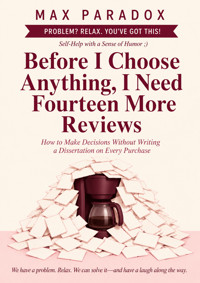
Before I Choose Anything, I Need Fourteen More Reviews - How to Make Decisions Without Writing a Dissertation on Every Purchase ebook
Max Paradox
Uzyskaj dostęp do tej i ponad 240000 książek od 14,99 zł miesięcznie
- Wydawca: ALL-IN Rafał Płonkowski
- Kategoria: Literatura popularnonaukowa•Nauki ścisłe
- Język: angielski
You need a new laptop, hotel, vacuum, pair of headphones, or coffee maker.
Easy.
Then you open the internet.
Three reviews become fourteen. Three options become seventeen. You discover specifications you did not know existed, problems affecting one buyer in Ohio, a Reddit debate from 2022, and a thirty-minute video explaining why the product you were about to buy is apparently a catastrophic mistake.
Two hours later, you know more.
You understand less.
Before I Choose Anything, I Need Fourteen More Reviews is a practical and funny guide for anyone who turns ordinary purchases into research projects, keeps reopening decisions after making them, or believes one more opinion might finally create perfect certainty.
Max Paradox explains why more information often makes choosing harder, how fear of regret keeps you trapped in comparison mode, and why the internet can always provide enough contradictory evidence to make every product look simultaneously excellent and terrible.
More importantly, this book shows you exactly how to stop.
You will learn how to:
decide how much research a purchase actually deserves;
define must-haves before marketing invents new needs for you;
limit options before comparison becomes overwhelming;
read reviews for useful patterns instead of reacting to every horror story;
separate facts from preferences;
recognize when research has turned into reassurance seeking;
use simple decision rules when several good options remain;
handle expensive upgrades and sale pressure;
use trials, return policies, and real-life tests instead of endless speculation;
close a decision without immediately reopening it;
make shared decisions without receiving seventeen new links from the family group chat;
create personal stopping rules that still work when you are tired;
accept “good enough” without feeling as though you have failed an intelligence test.
This is not a book about making reckless decisions.
It is about matching the effort to the stakes.
A house deserves more thought than a phone case. A major financial commitment deserves stronger due diligence than a toaster. But most everyday choices do not need to consume your evening, your weekend, and a spreadsheet called FINAL_COMPARISON_v7.
You do not need perfect certainty.
You need enough useful information to make a sensible choice, accept the trade-offs, and move on.
Because eventually the coffee maker has to make coffee.
It does not need a dissertation committee.
This publication was prepared with the assistance of tools that support the creative process, including artificial intelligence-based solutions. The final concept, structure, and editing belong to the author.
Ebooka przeczytasz w aplikacjach Legimi na:
Liczba stron: 205
Rok wydania: 2026
Odsłuch ebooka (TTS) dostepny w abonamencie „ebooki+audiobooki bez limitu” w aplikacjach Legimi na:
Podobne

















INTRO
You need a new coffee maker.
This should be simple. Your current machine has begun producing coffee with the emotional warmth of a hospital vending machine, and yesterday it made a noise suggesting one of its internal components had resigned. So you open a shopping site, type “coffee maker,” and discover 847 options.
Excellent.
You narrow it down to three. One has 4.7 stars from 12,000 people. Another has 4.8 stars but only 2,300 reviews, which suddenly feels statistically suspicious. The third costs forty dollars more and includes something called “Precision Aroma Technology,” which sounds important despite the fact that you have no idea what it does. Apparently, until seven seconds ago, your mornings had been suffering from dangerously imprecise aromas.
So you start researching.
You read the five-star reviews first. People love Coffee Maker A. It changed their mornings. It makes beautiful coffee. One reviewer says, “Best purchase I’ve ever made,” which seems excessive unless this person has never purchased a home, a comfortable mattress, or antibiotics.
Then you read the one-star reviews.
This is where civilization collapses.
One machine leaked after six months. Another arrived with a cracked water tank. Someone named Brandon says the coffee “tastes weird,” but provides no additional information, leaving you to wonder whether the problem is the machine, the beans, Brandon, or the entire concept of taste.
You move to YouTube. A man with perfect lighting spends twenty-three minutes comparing the machines. He recommends Coffee Maker B.
Good. Decision made.
Then you scroll to the comments.
Bad. Decision reopened.
Apparently the reviewer is biased. Apparently Coffee Maker B used to be good but the manufacturer changed something in 2024. Apparently Coffee Maker C is better if you use medium-roast Ethiopian beans at exactly 198 degrees. Apparently anyone who buys Coffee Maker A has “clearly done zero research.”
You have now done research.
Unfortunately, you no longer know anything.
Two hours ago you wanted coffee. You are currently examining pump pressure, heating elements, warranty claims, water dispersion patterns, and the long-term ethical implications of plastic filter baskets. You have three comparison tabs open, two Reddit threads bookmarked, and a spreadsheet has begun to seem reasonable.
At some point, you realize you have not bought anything.
You have, however, completed the first semester of a degree in Domestic Beverage Engineering.
This book is for that moment.
Not because reading reviews is bad. Reviews are useful. Comparisons are useful. Research can save you money, prevent stupid purchases, and help you avoid buying a toaster that requires an app, a subscription, and apparently your date of birth.
The problem begins when research stops helping you decide and starts helping you postpone deciding.
That distinction is annoyingly easy to miss because excessive research feels responsible. You are not procrastinating. Certainly not. You are gathering information. You are being careful. You are performing due diligence on a $39 desk lamp as if shareholders will demand an explanation during the quarterly earnings call.
And because the internet can always provide one more opinion, there is no natural stopping point.
There is always another review.
Another comparison.
Another video titled DON’T BUY THIS UNTIL YOU WATCH THIS.
Another forum where a person named LaserWolf1978 has written 4,600 words explaining why everyone else is wrong about vacuum cleaners.
The modern shopping problem is not lack of information. It is the exact opposite. We have so much information that deciding which information deserves attention has become a second decision layered on top of the first one.
You are no longer choosing between two pairs of headphones. You are choosing which reviewer to trust, which specifications matter, whether a 0.2-star rating difference is meaningful, whether the negative reviews represent a pattern, whether the positive reviews are fake, whether the product changed recently, and whether some better version will be released eleven minutes after you click Buy.
It is exhausting.
And underneath all that research is usually something more interesting than enthusiasm for technical specifications.
You are trying to avoid regret.
You want to make the right choice—not merely a good enough one. You want the purchase to arrive and confirm that your research was intelligent, disciplined, and perhaps worthy of a small academic citation. You do not want to discover that another model was cheaper, better, quieter, faster, more durable, or came in a slightly nicer shade of gray.
Because then the terrible thought appears:
I chose wrong.
That sentence has acquired far too much authority.
Choosing the second-best blender is not a moral failure. Buying a jacket and later seeing another jacket you also like does not mean the first jacket was a catastrophic strategic error. Sometimes two options are both fine. Sometimes five options are fine. Sometimes the difference between “best” and “almost best” exists mainly in a comparison table created by someone earning affiliate commission from your anxiety.
Your brain does not always find this comforting.
It prefers certainty.
Ideally, absolute certainty.
Preferably with free shipping.
The trouble is that certainty becomes more expensive as you chase it. The first ten minutes of research may dramatically improve your decision. You eliminate the obvious junk, learn the important criteria, and find several reasonable choices. The next twenty minutes may still help.
Then something changes.
You stop finding useful new information and start finding exceptions.
A battery that works brilliantly for nearly everyone but disappointed Kevin in Ohio.
A hotel with 3,700 excellent reviews and one guest who says the pillows “ruined Europe.”
A restaurant loved by ninety-six percent of diners but described by one furious customer as “the worst experience of my adult life,” apparently because the soup arrived lukewarm.
At this stage, more information does not necessarily create clarity. Often it creates more branches in the decision tree.
What if Kevin is right?
We must investigate Kevin.
This book will not teach you to stop researching everything and begin making purchases based on vibes, astrology, and whichever box has the nicest font. The goal is not recklessness. It is proportion.
You will learn how to decide how much research a decision actually deserves, identify the few criteria that matter before the internet invents seventeen more, distinguish useful warning signs from random review noise, set stopping rules, and choose without needing complete certainty.
We will also deal with the part nobody mentions when they tell you to “just decide”: what happens after the decision.
Because for some people, clicking Buy does not end the research.
It begins the appeals process.
You buy the laptop and continue reading laptop reviews for four days. You book the hotel and immediately search for better hotels nearby. You order shoes, then revisit the product page to confirm that strangers still approve of your shoes.
This is an impressive system for turning a completed decision back into an unfinished one.
We are going to stop doing that too.
The practical goal is not to become someone who makes every decision instantly. Some choices deserve thought. A house deserves more research than a phone case. A medical decision deserves different standards from choosing a restaurant. Spending $12,000 is not the same as spending $12, although the internet is fully capable of making both feel equally historic.
The goal is to match the effort to the stakes.
Research enough to make a solid decision.
Know when the research has stopped improving the decision.
Choose.
Then move on with your life before you become the world’s leading unpaid authority on electric kettles.
You do not need the perfect choice.
You need a good choice made with enough information, reasonable confidence, and enough time left in the day to actually use the thing you bought.
Because eventually, the coffee maker needs to make coffee.
It does not need a dissertation committee.
Chapter 1 - You Are Not Researching Anymore
You need a new set of wireless earbuds.
You know roughly what you want. Good sound, decent battery life, comfortable fit, nothing that makes you look as if you are receiving instructions from an aircraft carrier. You find three sensible options within your budget.
At this point, a normal purchasing process could end.
Yours does not.
You open another tab because there may be a fourth option. Then another because one reviewer says Option B is “excellent for the price,” which sounds encouraging until you start wondering whether this is polite reviewer language for “not actually excellent.” You search for direct comparisons. You watch a video. You read the comments beneath the video because apparently the person who spent three weeks testing the earbuds cannot be trusted until verified by Craig_77.
Forty-five minutes later, you are reading about Bluetooth codecs.
You did not know Bluetooth had codecs this morning.
You were happier then.
This is the first thing to understand: not all research is research.
Sometimes research is useful information gathering. Sometimes it is anxiety wearing glasses.
The difference is not how many tabs you have open. It is whether the next piece of information is likely to change your decision in a meaningful way.
At the beginning, research has enormous value. You learn what options exist, what they cost, which features matter, what common problems appear, and which products should probably be avoided unless you enjoy returning things.
This stage is productive.
Then the useful information begins repeating itself.
The same two products keep appearing at the top. The same strengths and weaknesses show up across multiple sources. The major complaints are already known. The price range is clear.
The decision is now mature enough to be made.
But your brain does not say, “Excellent, we have sufficient information.”
It says, “Perhaps one more review.”
This sounds harmless because one more review takes only three minutes.
The trouble is that there has never been only one more review in the history of the internet.
One review links to another. That review mentions a competing model. The competing model is newer. The newer model has a Reddit thread. The Reddit thread mentions a firmware issue. The firmware issue was apparently fixed, unless it was not, according to someone whose username contains three numbers and the word “dragon.”
Now you have a new problem to solve.
This is how a $120 purchase becomes a research program.
The shift from productive research to compulsive research usually happens quietly. You do not suddenly announce, “I will now stop learning useful things and begin collecting increasingly irrelevant opinions.”
That would at least be efficient.
Instead, the extra research continues to feel responsible because each individual action seems reasonable. Reading one more review is reasonable. Checking one more comparison is reasonable. Looking up a known issue is reasonable.
So is adding one teaspoon of salt.
Continue long enough and dinner becomes a geological event.
The key is not whether each individual search is defensible. The key is whether the total process is still improving your decision.
A simple test helps.
Ask:
What specific question am I trying to answer with this next search?
Not “I just want to be sure.”
That is not a question. That is anxiety requesting unlimited broadband.
A real research question sounds like this:
Does this laptop support two external monitors?
Is this stroller too large for a standard car trunk?
Does this hotel have reliable air conditioning in summer?
Are replacement filters for this purifier expensive?
Is there a recurring defect mentioned across multiple independent reviews?
Those questions have answers.
“Is this definitely the best possible choice?” does not.
That question can keep you busy until the product is discontinued.
The Information Gain Test
Before opening another review, ask yourself:
What new information could I realistically learn here, and would it change what I choose?
If you already know that Product A has better battery life, Product B is cheaper, and Product C is more comfortable, the seventeenth reviewer repeating those facts adds almost nothing.
Your decision has not become seventeen times smarter.
It has become older.
Useful research changes the shape of the decision. Repetitive research merely adds emotional weight to information you already have.
Imagine you are choosing between two office chairs.
After thirty minutes, you know:
Chair A is more adjustable.
Chair B has softer cushioning.
Both have strong warranties.
Both are well reviewed.
Chair A costs $80 more.
You prefer Chair A’s design.
That is enough information to make a decision.
Then you read another forty reviews.
Review 31 says Chair A is great.
Review 32 says Chair B is great.
Review 33 says Chair A changed someone’s posture.
Review 34 says Chair B squeaks.
Review 35 says Chair A also squeaks.
Review 36 says neither squeaks.
Congratulations. You have discovered manufacturing variance.
Civilization can continue.
The information is no longer moving you toward a decision. It is merely increasing the number of possible realities you feel obligated to account for.
That is the trap.
When people over-research, they often believe they are reducing uncertainty. After a certain point, they are actually increasing it because more sources expose more exceptions, edge cases, individual preferences, and random failures.
A product with 10,000 reviews will contain almost every imaginable human experience.
Someone will love it.
Someone will hate it.
Someone will say it broke after two days.
Someone will say they have used it daily since the Clinton administration, even though the model was released last year.
Large pools of opinions do not create perfect certainty. They create noise.
Reviews Are Not Votes From a Jury
Another mistake is treating reviews as if each one carries equal evidentiary weight.
It does not.
A review saying, “Stopped working after three weeks; manufacturer replaced it; replacement failed too,” contains useful information.
A review saying, “One star. Box was blue,” contains less.
This seems obvious until you notice how easily one vivid negative review can outweigh hundreds of ordinary positive ones in your mind.
The dramatic review is memorable because it gives your brain a story.
“This thing is unreliable” is abstract.
“Mine caught fire during Thanksgiving dinner” is cinema.
Even if the event is extremely rare, you can now picture it. Your peaceful family meal has become a potential appliance documentary.
This is why individual reviews should be read for patterns, not emotional intensity.
You are looking for repeated signals.
If fifty unrelated people mention the hinge cracking in the same place, pay attention.
If one person writes a furious fourteen-paragraph account about how the delivery driver placed the box three feet to the left of their preferred porch location, you may safely continue with your life.
The same principle applies to positive reviews.
“Best thing ever!” is pleasant but not terribly informative.
“It has survived daily use for eight months, the battery still lasts about seven hours, and the microphone works well outdoors” is much more useful.
Look for specifics.
Specifics are evidence.
Adjectives are decorations.
Your Brain Wants Closure Without Responsibility
Here is the uncomfortable part.
Sometimes you are not searching for information.
You are searching for someone else to make the decision for you.
You want a reviewer, expert, friend, ranking, comparison chart, or anonymous stranger to say:
“This is the correct one. Buy it. You are safe.”
Then, if the product disappoints you, you can quietly blame the source.
You did not choose badly.
The internet chose badly.
Very convenient.
The problem is that no review can absorb the responsibility of choosing for you because your preferences are still yours. A headphone reviewer may care intensely about soundstage. You may mostly care whether the earbuds stay in your ears while walking the dog.
These are different constitutions.
The “best” product is often just the product that best satisfies the reviewer’s priorities.
That does not make the review useless. It means you have to separate objective facts from preference.
For example:
“Battery lasts six hours” is information.
“Six hours is disappointing” is evaluation.
“Bass is heavily emphasized” is information.
“The bass sounds fun” is evaluation.
“Firm mattress” is information.
“Unbearably hard” may be preference unless half the reviews report sleeping on what appears to be municipal infrastructure.
Your job is not to find the reviewer whose opinion is officially correct.
Your job is to identify which facts matter to you.
Use the Two-Repeat Rule
Here is a practical way to notice when research has stopped being productive.
When you encounter the same major conclusion from two or three credible independent sources, mark it as known.
For example:
Source 1: Camera A has better autofocus.
Source 2: Camera A has better autofocus.
Source 3: Camera A has better autofocus.
You do not need Sources 4 through 19 to establish that Camera A probably has better autofocus.
At some point, evidence stops strengthening the decision and starts decorating it.
Use this rule:
If the same important conclusion has appeared repeatedly and no credible source is presenting a major contradiction, stop researching that point.
This does not mean ignoring new safety information, serious defects, or major differences. It means refusing to reopen settled questions because the internet still has pages left.
The internet always has pages left.
That is its main business model.
Give Research a Job
Before researching, write down what you need to know.
Not everything that could possibly be known.
Only what you need.
For a pair of running shoes, that might be:
Are they suitable for my type of running?
Do they fit true to size?
Is durability acceptable?
Is the price within my budget?
Is there a common defect?
For a washing machine, you may need more.
For a $14 phone stand, you need considerably less unless the stand will also be performing surgery.
This turns research from wandering into a task.
Once the questions are answered, the research is finished.
You are not required to remain on the internet until every stranger has expressed a view.
The Five-Minute Reality Check
If you suspect you have crossed from research into delay, stop and answer these three questions:
What do I already know?
What important uncertainty remains?
Will another twenty minutes realistically change my choice?
Be strict with the word important.
Not “I still do not know whether the black version attracts fingerprints under fluorescent kitchen lighting.”
Important.
If the remaining uncertainty is minor, you are not missing information.
You are missing permission to decide.
Give yourself the permission.
Choose the option that best fits the criteria you already established and move on.
If you are genuinely missing one critical fact, search only for that fact.
Do not reopen the whole case.
You are buying headphones.
The Supreme Court is not expecting oral arguments.
Practical action: The next time you catch yourself opening “just one more” review, state the exact question that review is supposed to answer. If you cannot name one, stop researching.
Research is useful when it produces new decision-relevant information.
After that, it is often just procrastination with citations.
Chapter 2 - The Fantasy of the Perfect Choice
You are choosing a hotel for a four-day trip.
Hotel A is in a better location.
Hotel B has nicer rooms.
Hotel C has breakfast included.
All three have good ratings, reasonable prices, and enough photos for you to know that none appears to operate from an abandoned gas station.
This should be manageable.
Instead, you begin searching for Hotel D.
Hotel D is not a real hotel yet.
Hotel D is the imaginary hotel combining Hotel A’s location, Hotel B’s rooms, Hotel C’s breakfast, a rooftop pool, silence, flawless Wi-Fi, charming staff, zero carpet, late checkout, airport transportation, and a price normally associated with sleeping in your cousin’s basement.
Hotel D must exist.
You simply have not searched hard enough.
This is perfectionism disguised as shopping.
And the modern marketplace is very good at feeding it.
When there were five available options, choosing meant accepting that each one had advantages and disadvantages.
Now there may be 5,000 options.
This creates a dangerous impression:
If there are this many choices, surely one of them must be perfect.
No.
There are merely more ways to become dissatisfied.
Every real option comes with trade-offs because real products, services, and people are built inside reality, which remains stubbornly unwilling to provide maximum quality, minimum price, perfect convenience, beautiful design, zero risk, and free returns simultaneously.
Something gives.
Usually your evening.
“Best” Is Often a Meaningless Word
Search for almost any product and you will find pages titled:
THE 10 BEST…
Best laptop.
Best mattress.
Best vacuum.
Best carry-on suitcase.
Best blender.
Best desk chair.
Best toothbrush, presumably for people whose oral hygiene has become competitive.
These lists are useful when they help you discover options, but “best” becomes misleading when you treat it as an objective crown sitting on one product.
Best for what?
Best for whom?
Best at what price?
Best under which priorities?
The best camera for a professional sports photographer is probably ridiculous for someone who wants better vacation photos.
The best mattress for a 230-pound side sleeper may be wrong for a 120-pound stomach sleeper.
The best laptop for video editing may have battery life that makes a frequent traveler want to throw it into the sea.
There is rarely a universally best option.
There is an option that best fits a specific set of priorities.
That is much less glamorous.
It is also much easier to choose.
Every Choice Has a Cost
Suppose you are choosing between two phones.
Phone A has the better camera.
Phone B has the better battery.
You care about both.
This creates discomfort because choosing one means deliberately accepting less of something you value.
That is what a trade-off is.
Overthinkers often respond by continuing to search until they can avoid the trade-off.
Maybe Phone C has both.
Phone C does have both.
Unfortunately, it costs $400 more.
Fine. Maybe Phone D.
Phone D has both and is cheaper.
Unfortunately, it is enormous and appears designed for someone with hands the size of garden tools.
Phone E?
Excellent camera, excellent battery, reasonable size.
It also has software you dislike.
And so the pilgrimage continues.
At some point you have to accept that choosing means sacrificing something.
This is not evidence that you have failed to research enough.
It is evidence that alternatives are different.
The only way to avoid all trade-offs is to buy every option.
This solution is not recommended by financial planners, spouses, storage closets, or common sense.
Define “Good Enough” Before You Start
One of the best ways to prevent endless searching is to decide in advance what would count as a successful choice.
This is much harder to do after you have spent two hours exposing yourself to every feature available in the category.
Before research, your requirement may be:
“I need a reliable robot vacuum that handles pet hair and costs under $500.”
After forty-five minutes online:
“I also require advanced obstacle recognition, dual spinning mop pads, automatic detergent dispensing, heated mop washing, 3D structured-light navigation, voice control, edge extension, and perhaps diplomatic immunity.”
Your needs have expanded.
The products did not manipulate you personally. That would require staff.
But the comparison process continuously reveals additional features, and once you know those features exist, they begin to feel relevant.
This is feature inflation.
You start by solving a problem.
You end by shopping for capabilities you did not know existed yesterday.
To prevent this, define the minimum successful outcome first.
For example:
Laptop
Runs my work software smoothly.
Battery lasts at least eight hours.
Under four pounds.
Under $1,300.
Hotel
Safe area.
Under $220 per night.
Within twenty minutes of the main sights.
Strong cleanliness reviews.
Private bathroom.
Winter coat
Actually warm.
Fits properly.
Works in rain.
Under $250.
Does not make me look like a mobile sleeping bag unless conditions require it.
These criteria protect you from being seduced by irrelevant excellence.
A product can be amazing and still wrong for you.
Separate Must-Haves From Nice-to-Haves
This sounds almost insultingly simple.
It is also one of the most effective decision tools.
Create two categories:
Must-haves: If this is missing, I should not choose the option.
Nice-to-haves: Useful, pleasant, attractive, but not required.
People get stuck when they quietly promote every nice-to-have into a requirement.
Suddenly the hotel must be central, quiet, cheap, luxurious, large, historic, modern, close to nightlife, far from nightlife, and have breakfast included.
Your hotel is now a paradox.
Use three to five must-haves at most for ordinary purchases.
If you have twelve must-haves for a desk lamp, we may have wandered off course.
Your criteria need hierarchy.
Imagine choosing a restaurant.
Must-haves:
good food,
within budget,
can accommodate dietary restriction,
available tonight.
Nice-to-haves:
beautiful interior,
easy parking,
outdoor seating,
impressive desserts.
If the best restaurant has no parking but everything else works, that is a manageable inconvenience.
If you treat parking as equal in importance to being able to eat the food, the decision becomes harder for no good reason.