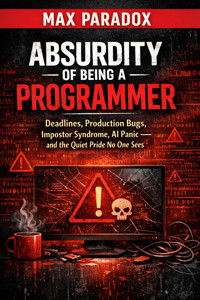
Absurdity of Being a Programmer - Deadlines, Production Bugs, Impostor Syndrome, AI Panic - and the Quiet Pride No One Sees ebook
Max Paradox
Uzyskaj dostęp do tej i ponad 240000 książek od 14,99 zł miesięcznie
- Wydawca: ALL-IN Rafał Płonkowski
- Kategoria: Poradniki•Styl życia
- Język: angielski
Being a programmer sounds impressive.
Until you actually become one.
Behind the hoodies and high salaries lives a strange world of:
• production incidents at 2 a.m.
• meetings that should have been emails
• “just one small change” requests
• legacy systems nobody understands
• AI that might replace you (any minute now)
• and temporary fixes that become permanent architecture
This is not a programming manual.
This is not a productivity guide.
This is not motivational nonsense.
This is intelligent, sharp, painfully accurate satire about modern developer life.
If you have ever:
• said “it worked on my machine”
• survived a broken deployment
• argued about tabs vs spaces
• questioned your own competence despite years of experience
• opened a side project that will “definitely change everything”
-you will feel exposed.
This book captures the emotional, psychological, and absurd reality of being a programmer in today’s tech culture.
You will laugh.
You will recognize yourself.
You will whisper, “Someone finally said it.”
Welcome to the profession where logic is optional, deadlines are fictional, and burnout arrives politely.
📖 KRÓTSZY OPIS (pod reklamę / Amazon A+ / social)
Programming is not about code.
It’s about:
• surviving chaos
• negotiating with deadlines
• pretending you understand legacy systems
• and debugging reality at 2 a.m.
This book is a brutally honest satire about modern developer life.
If you work in tech - this will hurt.
In a good way.
🧠 ALTERNATYWNE PODTYTUŁY (jeśli chcesz testować A/B)
A Brutally Honest Satire About Modern Developer Life
A Cynical Look at Coding, Deadlines, and Digital Survival
Life in Tech Without the LinkedIn Filter
Why “It Worked on My Machine” Is a Lifestyle
📦 MOCNIEJSZE FRAZY KLUCZOWE (KDP - zoptymalizowane)
programmer burnout book
software engineer satire
developer life reality
coding humor book
tech industry satire
agile sprint burnout
impostor syndrome developer
AI replacing programmers
life as software engineer
corporate tech humor
remote work developer
IT workplace satire
legacy code problems
production bug stories
developer mental health
📚 PROPOZYCJA SERII (jeśli chcesz budować brand)
Seria:
The Absurdity Series by Max Paradox
• The Absurdity of Being a Programmer
• The Absurdity of Startups
• The Absurdity of Corporate Life
• The Absurdity of Being a CEO
• The Absurdity of AI
To buduje skalowalny brand.
📱 INSTAGRAM - WERSJA BARDZIEJ AGRESYWNA
You don’t “write code.”
You:
• negotiate with broken systems
• survive fictional deadlines
• debug at 2 a.m.
• and explain why “it’s not just one line”
📘 ABSURDITY OF BEING A PROGRAMMER
by Max Paradox
A satire for everyone who works in tech and feels slightly tired all the time.
#książkowe #satyryczne #programmerlife #developerlife #softwareengineer #techculture #burnout #codinghumor #impostorsyndrome #aitools #review #opinie #readers #bookstagram #czytam #czytambolubie #itlife #legacycode #agile #corporatelife #techsatire #nowosc #maxparadox
This publication was prepared using tools that support the creative process, including solutions based on artificial intelligence. The final concept, structure, and editing are the work of the author.
Ebooka przeczytasz w aplikacjach Legimi na:
Liczba stron: 104
Rok wydania: 2026
Odsłuch ebooka (TTS) dostepny w abonamencie „ebooki+audiobooki bez limitu” w aplikacjach Legimi na:
Podobne


















INTRO
Being a programmer sounds impressive right up until you say it out loud in a normal conversation.
People nod.People smile politely.People immediately assume you either make millions or fix printers.
Sometimes both.
Programming is one of those professions that exists mostly in other people’s imaginations. In those imaginations, you sit in a dark room filled with glowing screens, typing aggressively while green text scrolls down like a movie hack. You solve problems in seconds. You drink coffee like a personality trait. You wear a hoodie that signals intelligence instead of laundry neglect.
None of this is true.All of this is somehow also true.
Being a programmer is not about writing code. It is about negotiating with reality using a keyboard. It is about convincing machines to do extremely simple things in the most complicated way possible. It is about spending eight hours explaining to a computer what you meant, and another eight hours explaining to humans why it took that long.
Programming is the only job where you can break everything without touching anything.
You don’t move desks.You don’t lift boxes.You don’t even leave your chair.
Yet somehow, production is down, sales are frozen, and someone in management is asking if this was “a simple change.”
It never is.
The absurdity begins early. Usually with the belief that programming is logical. Clean. Rational. A profession governed by rules, certainty, and if-then statements. This belief lasts until your first real project. Or your second. Or about fourteen minutes into your career.
After that, you learn the truth.
• Logic is optional.• Consistency is aspirational.• Documentation is a myth passed down orally and immediately forgotten.
You learn that code does not age like wine. It ages like milk left in a warm car. You learn that the thing you wrote six months ago was clearly written by a different, less intelligent person who should no longer be trusted.
That person was you.
You also learn that programming is never done. It is merely abandoned in a temporarily functioning state. Features pile up. Bugs mutate. Workarounds become core architecture. The system keeps running mostly because everyone involved is afraid to touch it.
Especially you.
There is a quiet exhaustion baked into this profession. Not the dramatic kind. Not burnout with flames and breakdowns. Just a low, constant tiredness from thinking too much about things that should not require thinking.
• Why does this work only on Tuesdays.• Why does changing one line break something unrelated.• Why does it work in production but not on your machine.
You stop asking “how” and start asking “how long until this fails again.”
And yet, you stay.
You stay because somewhere between the bugs, the meetings, and the polite panic, there is a strange satisfaction. A moment when something finally works and no one knows why. A brief, fragile silence where the system behaves, users don’t complain, and you are allowed to exist without explaining yourself.
It never lasts.
Soon enough, someone asks for a “small tweak.” Someone else adds urgency. Someone mentions scalability. Someone forwards an email that ends with “should be quick.”
You take a deep breath.You open the code.You remember why you drink coffee.
This book is not here to teach you programming.It assumes you already suffer from it.
It is here to observe.To point.To linger uncomfortably on the parts everyone pretends are normal.
Because being a programmer is absurd.And pretending it isn’t takes more energy than fixing the bug.
Chapter 1 – The Myth of the Logical Profession
The first lie you were told about programming was that it is logical.
Not creative.Not emotional.Not chaotic.
Logical.
You were promised a world of precision. A universe where inputs lead to predictable outputs. A professional environment governed by reason, clarity, and clean structure.
You believed it.
You imagined yourself living inside a perfectly structured mind palace made of brackets and semicolons. A world where everything makes sense because you made it make sense.
Then you joined your first real project.
And suddenly logic became… negotiable.
Programming is logical in the same way that cooking is precise. In theory, recipes are clear. In reality, someone always eyeballs the salt and forgets the oven was already preheated to chaos.
Codebases are not temples of order. They are archaeological sites.
• There are ancient ruins no one dares to touch.• There are mysterious layers built on top of older mistakes.• There are comments written in languages no one on the team speaks anymore.
Somewhere inside this structure, you are told, there is logic.
You just have to find it.
The myth of the logical profession collapses slowly. It doesn’t explode. It erodes. One meeting at a time.
In theory, requirements are clear.
In practice, requirements are feelings.
“We want it to be more dynamic.”“Can it feel faster?”“It should be intuitive.”
You nod like you understand. You do not understand.
You translate vague human emotion into binary decisions. You reduce “vibes” into conditional statements. You try to convert “make it pop” into something that compiles.
This is where the logic begins to sweat.
• The backend logic is clean.• The frontend logic is complicated.• The business logic is imaginary.
No one tells you that programming is less about writing code and more about interpreting ambiguity. You are not building systems. You are decoding unclear intentions from people who believe software is magic.
They assume the machine understands context.
The machine does not understand context.
The machine understands exactly what you tell it. Nothing more. Nothing less. And often not even that.
This is where the absurdity sharpens.
You write something perfectly logical. Elegant. Structured. Even beautiful. Then someone uses it in a way you never predicted.
Because humans are not logical.
They click the wrong button. They refresh at the wrong moment. They enter their birth year as their password and then complain about security.
And somehow this becomes your problem.
The myth says programmers live in rational isolation.
The reality is different.
You are constantly negotiating between three incompatible worlds:
• What the machine requires.• What the business demands.• What the user does at 2:13 a.m. on a slow connection.
These worlds do not align.
The machine wants precision.The business wants speed.The user wants magic.
You are the translator.
And translators are always blamed.
Then there is “clean code.” The holy grail. The promise that if you follow certain principles, your world will remain orderly and pure.
You try.
You name variables responsibly. You separate concerns. You refactor. You test. You even comment your intentions.
Six months later, someone adds a “temporary fix.”
Temporary fixes have an average lifespan longer than most startups.
One quick workaround becomes a dependency. That dependency becomes architecture. That architecture becomes sacred because “it works, so don’t touch it.”
Logic did not fail. It was slowly negotiated into something survivable.
You begin to notice patterns.
• Every project starts clean.• Every project ends complicated.• Every team swears this time will be different.
It never is.
Even your own logic betrays you. You look at code you wrote a year ago and wonder who allowed this person near a keyboard.
You open a file and feel personally attacked by your past self.
• Why did you do this.• What were you thinking.• Did you even test this.
You did. Probably.
But logic is fragile when exposed to time. Deadlines reshape it. Meetings distort it. Fatigue bends it into creative shapes that made sense at 1:47 a.m.
You start to understand something uncomfortable.
Programming is not a logical profession.
It is a profession where logic is constantly under siege.
From urgency.From ambiguity.From people who say, “It’s just a small change.”
You will spend years chasing clarity.
You will refactor to restore order.
You will introduce patterns to protect yourself from chaos.
And then someone will ask if you can “quickly add AI to it.”
The myth persists because it sounds better. “I work in logic.” It feels stable. Controlled. Intelligent.
But the truth is quieter.
You work in compromise.
You build rational systems inside irrational environments. You create strict rules in a world that resists them. You try to enforce structure in an ecosystem fueled by impatience.
And still, somehow, it runs.
Not because it is perfectly logical.
But because it is just logical enough to survive.
That is the real profession.
Not clean logic.
Managed absurdity.
Chapter 2 – It Worked on My Machine
There is a sentence every programmer says at least once.
Usually quietly.Sometimes defensively.Often with visible confusion.
“It worked on my machine.”
This sentence contains hope.This sentence contains denial.This sentence contains the beginning of a very long afternoon.
You tested it.You ran it locally.You saw it function exactly as expected.
It behaved.It responded.It respected your authority.
Then it met the real world.
Production does not care about your local environment. Production is a different universe. It has different variables. Different configurations. Different moods.
Production wakes up angry.
You deploy confidently. The tests passed. The build was green. The code review had only minor passive-aggressive comments.
Five minutes later, Slack explodes.
• “Is anyone seeing this error?”• “The checkout page is blank.”• “Why is the database on fire?”
You open your laptop again. You run it locally. It works. Of course it works. Your machine is loyal.
Your machine believes in you.
Production does not.
The absurdity of modern programming is that we build systems meant to run everywhere, yet we secretly hope they only behave where we can see them.
You try to replicate the issue.
You pull the logs.You compare versions.You stare at environment variables like they personally betrayed you.
• The API key is different.• The timezone is different.• The operating system is… why is it Windows.
Suddenly, you are not debugging code. You are debugging reality.
You learn the difference between “works” and “works here.”
You learn that the phrase “it works on my machine” is not a defense. It is a confession. It means your machine is a carefully curated ecosystem of accidental dependencies and invisible assumptions.
Your machine has:
• The correct version of Node installed three years ago and never updated.• A global package you forgot existed.• A cached file quietly fixing your mistakes.
Production has none of that. Production is brutally honest.
You begin to respect containers.You begin to fear them too.
Because containers promise consistency. They promise that what runs locally will run the same in production. They promise harmony.
Then you discover that your Dockerfile is also a creative interpretation of reality.
Someone changed the base image.Someone added a layer.Someone forgot to rebuild.
And now the container works everywhere except anywhere useful.
The phrase evolves.
“It worked on staging.”“It worked before the merge.”“It worked until we added that small feature.”
Small features are never small.
The deeper absurdity is that modern development encourages speed over understanding. Continuous integration. Continuous deployment. Continuous hope.
Push.Merge.Pray.
You build pipelines to automate safety. You write tests to prevent mistakes. You configure alerts to warn you.
And still, at 11:38 p.m., something breaks in a way that feels personal.
You discover that production has:
• Real traffic.• Real users.• Real edge cases that never existed in your imagination.
Your local machine has none of these.
Your local machine does not simulate the user who double-clicks everything. It does not simulate the person refreshing mid-transaction. It does not simulate the one browser version still running on a laptop from 2012.
Production does.
And production never forgets.
Eventually, you stop saying “it worked on my machine” out loud. You think it instead. Quietly. With resignation.
Because you understand the hidden truth.
Your machine is not the standard. It is a fantasy.
It is a controlled environment where you are in charge. You control the data. You control the inputs. You control the timing.
Production is democracy.
Everyone gets a vote.
And some of them are chaotic.
So you adapt.
You test more.You log more.You simulate environments that resemble reality.
But deep down, you know something.