


Uzyskaj dostęp do tej i ponad 240000 książek od 14,99 zł miesięcznie
- Wydawca: Michael McClung
- Kategoria: Fantastyka•Fantasy
- Język: angielski
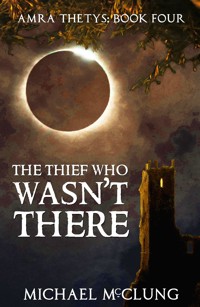
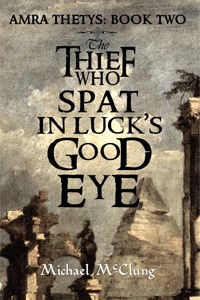
After surviving Thagoth and returning rich to Lucernis, Amra and Holgren have settled down to a very comfortable, if decidedly unexciting life -- until the night Amra receives an old enemy's head in a box. A longstanding debt calls her back home to Bellarius, the scene of many childhood horrors she would much rather forget about.
But as bad as memories of the past might be, present-day Bellarius is rapidly becoming worse, for the Eightfold Goddess has not forgotten about Amra, and another of Her Blades, the Knife that Parts the Night, has been discovered and threatens to tear the very fabric of reality apart.
All that stands in the way of utter destruction is one small, scarred thief and her mage companion...
Ebooka przeczytasz w aplikacjach Legimi na:
Liczba stron: 336
Rok wydania: 2026
Odsłuch ebooka (TTS) dostepny w abonamencie „ebooki+audiobooki bez limitu” w aplikacjach Legimi na:
Podobne









THE THIEF WHO KNOCKED ON SORROW’S GATE
Amra Thetys: Book 3
MICHAEL McCLUNG
© 2014 by Michael McClung. All Rights Reserved.
DEDICATION
For my crazy chickens.
CONTENTS
The Knife
Chapter One
Chapter Two
Chapter Three
Chapter Four
Chapter Five
Chapter Six
Chapter Seven
Chapter Eight
Chapter Nine
Chapter Ten
Chapter Eleven
Chapter Twelve
Chapter Thirteen
Chapter Fourteen
Chapter Fifteen
Chapter Sixteen
Chapter Seventeen
Chapter Eighteen
Chapter Nineteen
Chapter Twenty
Chapter Twenty-One
Chapter Twenty-Two
Chapter Twenty-Three
Chapter Twenty-Four
Chapter Twenty-Five
Chapter Twenty-Six
Chapter Twenty-Seven
Chapter Twenty-Eight
Holgren
THE KNIFE
I
t did not know impatience.
It had existed for more than a thousand years. It had been created to fulfill a single purpose. After a thousand years waiting for the proper conditions, then a century of stealthy, careful manipulation, and then twenty years of outright meddling in the affairs of mortals, its purpose was now very nearly fulfilled.
The Knife that Parts the Night had instigated two wars, along with all the plague, famine, and suffering that followed. It was responsible for tens of thousands of deaths.
It did not know impatience, and it did not know remorse.
The Knife had manipulated events to ensure that hundreds, perhaps thousands, of refugees, mainly war orphans, would flee to Bellarius, hoping the City of the Mount would be a refuge from the madness further south. Those hopes proved to be worse than false. The Knife made sure of it.
The Knife did not have a conscience. It had purpose, frightening intelligence, and vast power.
The Knife observed with keen interest the children who flooded the city, found no aid, and, crushed by the weight of destitution, desperation, and hunger, became petty thieves, then cunning criminals, then—as often as not—cold-eyed killers. But most keenly, it observed the handful that became consummate survivors. Those who died were not, of course, mourned though the Knife remembered them. The Knife remembered everything.
It had to be children, or so the Knife had determined centuries before. Adults simply weren’t malleable enough. And the Knife needed to mold an individual with a very specific set of characteristics.
Someone quick-witted.
Someone with an almost inhuman will to survive.
Someone who could inspire loyalty, even love.
Someone with the ability to overcome desperate, brutal situations against hopeless odds.
Someone who, under the right set of circumstances, could be manipulated into doing what the Knife required of them.
And that someone had to be female.
The Knife that Parts the Night did not know impatience or most of the other basic human emotions. But it did know satisfaction and anticipation. As it set the final series of events into frightful motion, it felt both.
Its purpose was very nearly fulfilled.
CHAPTER 1
O
n Halfa’s Night, one of the rowdiest of Lucernis’ festival nights, someone sent me Borold’s head in a cedar box.
I was home alone, savoring a nice Gol-Shen red and rereading Dubbuck’s epic and amusing Iron Witch, when someone came knocking at the door. At first, I ignored it, thinking it was a group of drunken revelers come to serenade the big houses on the Promenade in hopes of festival largess. Then, whoever it was found the bell-pull and started pulling. And pulling. And pulling.
I sighed and went to answer the door, cursing all drunkards and wondering, not for the first time, whether it really wouldn’t be best if Holgren and I hired some sort of live-in servant. I was the one who had wanted the big house on the Promenade. I’d never considered how much effort it would take to keep even a small manse in something approaching a decent state. It was built to be run by a staff, and there was just Holgren and me knocking about the place. Sometimes, I felt like a squatter in my own house. Usually, it was when the neighbors stared at me with disdain.
Holgren couldn’t have cared less one way or the other, but I had a sort of bone-bred repulsion toward the idea of a maid or serving man. I suppose I’d seen my mother scrub too many floors she wouldn’t otherwise have been allowed to walk on, wash and mend and embroider too much in the way of clothing she would never be able to afford to wear. And I’d seen my father drink away what little she made, which brought my thoughts back to the drunk fools outside. I had the sudden, strong urge to cut the bell pull and wrap it around somebody’s throat.
But when I opened the door, it wasn’t a group of wine-sotted minstrels. It was a sailor, a merchantman by his scruffy port jacket and ragged canvas pants. Under one arm, he held a wooden box.
“Ye’r Amra Thetys, then?” he said with a distinct Bellarian accent.
“What do you want?”
“I’m here to give you this, then, amn’t I?” He held the box out to me. “If ye’r Amra Thetys.”
“What is it? Who sent it?”
“As to what it is, it’s a box, innit? I don’t know the tall chappy’s name what give me the box neither. He only said give it to Amra Thetys, who lived down by the Dragon Gate. And even with that, I had a time finding you.”
“What did he look like?”
“Not really sure, mistress. He were all wrapped up in a night-black cloak, an’ I might’ve had overmuch to drink.”
“And you’ve come from Bellarius?”
“I come from all ‘round the Dragonsea, mistress, if you take my meaning, but that’s where I was given this to give to you. Are you goin’ to take it, then?” He glanced over his shoulder at the lamp-lit, boisterous crowd staggering up and down the Promenade, clearly itching to spend his leave out there on the street rather than at my door. I couldn’t really blame him. The wine and the ale flowed freely, and the revelers, both men and women, seemed to have abandoned anything approaching morals or common sense. Many had also abandoned important parts of their attire, though everyone I could see still had on a mask of one sort or another.
“Fine,” I said, more to myself than to him. I wasn’t born naturally suspicious, but I picked up the trait fairly early. I took the box gingerly, surprised at the weight of it, and set it down on a dusty table there in the entry hall. When I turned back to close the door, the sailor was still there, hand half-out. I dug a silver mark out of a pocket and put it in his grimy palm. He looked like he was going to ask for more, but I closed the door in his face. Maybe if he hadn’t been so energetic with the bell.
I took my time with the box, checking for nasty surprises. There was nothing obvious. Just a well-put-together box, about two hand-spans square. The only way to be truly sure it was safe was to have somebody else open it with me in another room, but what can I say? The list of people I would use that way had grown remarkably short. Eventually, I shrugged to myself and pried open the lid with a knife, holding my breath. The breath-holding part turned out to be a good idea.
The first thing I saw was a loop of brown hair, braided and tied off just like it was meant for a handle. What it was a handle to was down in gray oakum fibers, the stuff that’s left over when you pick apart ships’ ropes once they’d outlived their usefulness. I briefly considered slapping the lid back on and just living with the curiosity, but even as I was thinking it, I put three fingers into the loop and lifted.
The reek of Borold’s decaying flesh invaded the room. There was no note, only Borold’s noggin, open eyes gone squishy and his heavy, vaguely pig-like face slack and greenish-gray. I recognized him almost immediately despite the decay and the intervening years.
I gagged a little. I’m not exactly squeamish. I’ve seen and done some foul things, but you get a rotting head sent to you and see how you handle it.
After I got my stomach under control, I took a good look at my grisly package. The cut itself was amazingly clean, as if Borold’s head had been severed with one blow. While this was certainly possible, it was by no means an easy thing to accomplish. Unfortunately, I’d had first-hand experience at decapitation—but that’s another story. Such a cut spoke of either an experienced headsman or a wicked-sharp blade. Perhaps both.
There was a brand on his forehead. It had been done, it looked like, while he was still alive. Or at least while he was still fresh. Not that I’m an expert on such things. I’d seen the brand somewhere, something much like it at any rate. It was the Hardish rune for “traitor.” Well, almost. Something like a downward-pointing dagger with three successive cross guards, or quillons, of equal length. Except the middle quillon was missing from the brand. I set the head back on top of the now-loose oakum fibers it had been packed in and backed away into the next room to get a clean breath.
Who had sent it? Who had done the deed? Probably, but not certainly, the same person. Someone who knew that I knew Borold, who had cause to believe I would care whether his head had parted ways with the rest of him. Did I? Not particularly. Not anymore.
And who was Borold? In years past, he had been a wharf-rat in Bellarius, a tough, and a bully. An altogether unpleasant boy who, I was sure, hadn’t grown any more likeable with age. He’d hurt me once. Badly. I’d been one of the few gutter children he couldn’t cow into giving him “tribute”—scraps of scrounged food or pilfered coin. I suppose I set a bad example, so one afternoon, he’d sneaked up behind me as I sat on the sea wall, watching the waves crash against the rocks, and damn near knocked my head in with a paving stone.
I had reason to wish Borold dead, but fifteen years or thereabouts had dulled the edge on that particular desire.
Someone else, it seemed, had decided that late was better than never. And I had a fair idea who it might be.
Damn.
I took a few deep breaths and went back to Borold. I don’t know exactly what I was looking for. Something, anything else to tell me my suspicions were wrong. Or right for that matter.
There was just the head, the cut, the brand, the box. And the oakum, old rope fiber used mainly for caulking boats. Maybe there was something in that, maybe not. It was common enough stuff though not generally used for packing.
The brand drew my eye again. If there was a message in all of this, that was it. I just wasn’t sure I knew the language. If it meant Borold was a traitor, well, that wouldn’t have surprised me. But who goes to the trouble of making a brand and gets it wrong? It could be some noble’s chop, I supposed, or some warlord’s, as unlikely as that was in Bellarius. More likely it was the symbol of one of the crews, the street gangs in Bellarius that made up the bulk of the shadow guild there. I just didn’t know. It didn’t even occur to me that it might be some magical symbol until I traced a fingernail over where that missing middle stroke of the rune would have been if it were indeed “traitor.”
Borold started screaming then, a shrill, tortured scream that didn’t stop, never had to draw breath from lungs no longer attached. It was a scream that spoke wordless volumes about agony and mindless terror. I should know. I’ve heard the like.
The hairs on the back of my neck stood up; whether from the magic or the shock, I couldn’t say. I pushed Borold’s face into the oakum so that it would dampen the sound somewhat and slammed the lid back on, hastily hammering nails back in with a knife pommel. I could still hear him. Kerf’s beard, the neighbors could probably still hear him, and I no longer lived in the Foreigner’s Quarter, where screams of pain were most often met with shouted curses to shut the hells up.
I dumped out one of Holgren’s countless chests, put the box in it, and padded it all around with blankets and pillows from around the house. Then, I went looking for a shovel.
~ ~ ~
Holgren dragged himself in from the workshop about an hour before dawn, smelling of chemicals and singed wool. He found me in the bedroom. I’d already packed and made all the preparations necessary for my trip. Money can make things happen, whatever the hour. It just takes more money on Halfa’s Night.
He took one look at me, at my bags, opened his mouth, closed it again. A twinkle sprang up in his smoke-reddened eyes. “There’s a hack waiting outside. Was it something I said?”
“I should give you hells about spending all your time down there at that madhouse of yours,” I replied. It didn’t actually bother me. He’d given up magic, the Art, after being forced to use it on me—painfully. If experimenting and inventing one silly thing after another made him happy and kept him occupied, who was I to complain? I had my own interests to keep me amused.
He came over and put his arms around me. I leaned into him briefly, but the fumes coming off him made my eyes water. I gave him a quick kiss and pushed him away.
“I have to go to Bellarius. An old friend may be in trouble. It might be nothing, but I have to make sure.”
“I’ll throw a few things in a bag—”
“No. Just me. My ship leaves in two hours with the tide. I was going to stop by the workshop if you hadn’t arrived in time.”
“But I’ve always wanted to see Bellarius.”
“Nobody wants to see Bellarius, Holgren. It’s a pit. And it’s best if I go alone. There are people I’ll have to deal with who won’t say mum if you’re with me. You’d wind up sitting on your hands in some inn or public room when you could be here, trying to blow up half the city.”
“Unfair. We haven’t had a fire in months.”
I pointed to the charred hole in his shirt. He glanced down at it. “Not a large fire, in any case.”
“I’ll be back in a month, hopefully less. Assuming this is all just me worrying for nothing.”
“When you worry, it’s never for nothing.” Holgren stripped off the shirt and sat down on the edge of the bed, his chest pale and lean. “What’s this all about then? Who’s this friend who’s in trouble?”
“He may not be in trouble at all. But I received a disturbing message tonight.” Which was now buried in the back garden. I could have told Holgren about it, could have used his magical expertise, I supposed. But he’d left magic behind, and had a good and sufficient distaste for his former profession. I respected that. “I’m just going to check things out is all. I owe Theiner that much.”
“A childhood friend, then.” Holgren knew something of my childhood. Enough to know it wasn’t dolls and skip-rope.
“Yes. Now, come here and give me a kiss. I’ve got to go.”
He got up, but instead of kissing me, he went to one of the many chests that lined the walls. An inveterate pack rat, was my Holgren. So long as nothing exploded, it didn’t bother me. He’d been doing lots of experiments with gunpowder. Enough that I’d made him promise to keep the stuff out of the house.
He rummaged around for a few moments then came to me holding a black velvet bag and a smallish wooden case.
“Traveling gifts,” he said and smiled. He handed the box to me and took a silver necklace with a bloodstone pendant out of the bag.
“No thanks, lover.” I’d had a bad experience with a certain necklace not so long ago in the Silent Lands. I wasn’t fond of jewelry in general anymore.
“Wear it for me, Amra. If it leaves your skin for more than a day, I will know. And I will come.”
“Dabbling in magic again?”
“It still has its uses. Someday, it will fail utterly, but until then, I will use it if it can help keep you safe.”
I was touched. Holgren hadn’t wanted to be a mage even when he was a practicing one despite his formidable power. “What’s in the box? More mystical artifacts?”
“Oh, no. Something I take much more pride in.”
“Guns?” I knew he’d been working on some smaller version of an arquebus. And he knew my low opinion of firearms.
He shook his head. “Open it.”
Inside was a brace of throwing knives, ivory-handled, single-edged, elegantly simple. I picked one up. It was perfectly weighted for my hand.
“I was saving them for a special occasion. You’ll find they hold an edge quite well.”
“You made these? They’re beautiful.”
“Helped make them. I owe you a few knives, no?”
“All right. Thank you. I’m certain I won’t need them or the necklace, but thank you.”
“I don’t like seeing you in danger,” he said, face tightening briefly.
We were a pair. Even after a year together, we both found it hard to share our emotions. But then, after the things we’d been through, most times, that wasn’t necessary.
“I’ve got to go.” I slipped the necklace on, feeling it warm to my skin almost instantly, and put the knife case into a graceful old sabretache I’d lifted from an annoying cavalry officer. The fashionable idiot had worn it low enough that it had slapped his knee. I wore it higher up, against my thigh, like the non-idiot I was. The knife case didn’t leave much room for anything else.
I’d have to have sheaths made for them once I’d reached Bellarius; they wouldn’t fit in my current rig. I stripped it off and hung it on a hook. Over the last year, I’d decided to limit myself to two knives on my person at any one time in an effort to better play the respectable woman of business role. It wasn’t easy. I felt, if not naked, at least under-dressed.
It was time to go, or I’d have to wait another day at a minimum for the next outbound berth.
“Come back soon,” he said. “You know how I fret.”
I kissed him, letting my mouth say in one way what it had trouble saying in another. It occurred to me, as his hands tangled themselves in my hair, that a month was really rather a long time to be apart. I let my hands run down his bare, pale chest. Lean, but muscled, and scarless since being regenerated by Tha-Agoth’s blood. My own body was nearly as unblemished save for the stain that Abanon’s Blade had left on my palm and the scars on my face that were far older and apparently beyond the power of a demigod to erase.
“A month,” I said, grabbing his waist. “That really is quite a long time.”
Judging from his reaction, it seemed the same thought had occurred to him.
An hour later, the hack I’d hired was making unusual speed down to the docks. I wondered as the cobbled streets jounced me around inside the carriage if I’d miss my boat. Just at that moment, I didn’t really care.
CHAPTER 2
I
’d sent a messenger to secure the first berth available to Bellarius. It happened to be on a ship called Horkin’s Delight, a three-masted carrack, lateen rigged. It reeked of turpentine and dried fish. I had a hunch that it was both faster and more maneuverable than it looked. I was sure it was at least sometimes a smuggling ship. Not that that bothered me, especially. I wouldn’t have to deal with any nonsense about a woman traveling on her own. I would have to keep a sharp eye on my belongings, but I would have done that in any case.
I climbed up the rope ladder thrown over the Delight’s side, grateful to be off the bobbing, pitching deck of the lighter I’d hired to row me out. False-dawn was creeping up on the sky. I was met by a small, paunchy man in stained finery much too big for him. Horkin, I assumed.
“You’re almost late,” he said, taking in my disheveled hair and mis-buttoned shirt as my traveling chest was whipped up from the lighter by two of the sailors.
“And you’re almost making a point,” I replied.
He laughed, a surprisingly rich, deep laugh. “Oh, we’ll get along fine, you and I.” He hooked a thumb toward one of the sailors roaming the deck, preparing to get underway. “Haemis will show you your berth after you show me your coin.”
I produced three gold marks and put two into his palm.
“Right fine,” he said, smiling. “I’m Captain Horkin. Just remember, you’re cargo. Stay out of the way.”
“I know my way around a boat.”
“Then you’ll know when you’re in the way,” he replied, and whistled up Haemis to lead me below decks. Haemis lifted my chest without even grunting, and I followed the silent, muscle-bound sailor down into the depths of the Delight. After surveying the dark, filthy closet that was my cabin, I decided that Horkin was far too easily delighted. And that I’d be sleeping above deck when the weather permitted.
~ ~ ~
Night on a ship. It always made me feel small. The wind and the waves and the creaking of wood and rope, and nothing else for miles and miles. And, as a passenger, nothing to do but think.
I was sure it was Theiner. No one else knew what Borold had done to me that day. And while Theiner might have told someone else, I doubted it—and doubted too that anyone besides Theiner would think I’d want such a grisly favor. Come to think of it, I couldn’t see why Theiner would think I’d want Borold’s head, not after all these years.
I shook my head, tried to clear away all the questions that couldn’t yet be answered. Theiner was mixed up in all this somehow; that much was fairly certain. Just what “all this” was about, I had no idea. Nor would I until I got to Bellarius. But something was wrong. Theiner wasn’t the type to bestow grisly presents, like a cat bringing home some gutted toad or thrush. Nor was he the kind to send cryptic messages. Certainly not magical ones. Theiner was shrewd, plainspoken, and practical. That’s how I remembered him, at least. But it had been years.
Theiner, the Theiner I’d known so long ago, was as decent a boy as the streets of Bellarius allowed him to be. I could still recall his broad, farmer’s face, the shock of blond hair that stuck up from the back of his head, and the dusting of freckles across his nose and cheeks. He looked slow, almost simple, but there had been a sharp mind inside that thick skull of his. Sharp enough to keep him alive for years on the streets of Bellarius after war and plague and famine had dumped hundreds, perhaps thousands of unwanted children onto a city already bursting at the seams.
He’d never let the constant grind of survival take away his sense of right and wrong. If it hadn’t been for him, I wouldn’t have made it through my first week on the streets there. He’d taught me how to survive, and taught me too, that there were some things worse than not surviving.
“Two things you never do for money, little one,” he’d told me. “You never sell your body. And you never take a life. The one you give away or maybe it gets taken, and the other you do if you have to, and do it smart and quick and sure. But you don’t sell such things. Some things are worse than dying, eh?”
I’d just nodded, then, taking on faith that what he said was true. And after all these years, I’ve still never sold my body or my blade.
I sighed, tried to get comfortable in the moldy hammock I’d got Horkin’s grudging permission to string up on the quarterdeck, stared out at the stars above the Dragonsea. Whatever Theiner was up to, unless he’d changed far more than I thought possible, he was driven to it by some sense of right and wrong, some sense of justice. Or because he was forced somehow. But still, it wasn’t adding up.
Despite myself, I thought back on those bleak, terror-filled days before I finally escaped Bellarius for good, before Theiner helped me stow away on an outbound ship. I remembered the Blacksleeves roaming the night streets, slaying the gutter children where we slept in doorways, ferreting us out of rooftop hideaways and abandoned buildings and deserted cemeteries. They said that a mage was working with the Blacksleeves, that it didn’t matter where we hid. I believed it then. Hells, I believed it now. It was why I took the chance of being found out as a stowaway and tossed overboard, meat for pheckla or gray urdu.
The Syndic and the Council of Three had finally had enough of our petty depredations, I suppose, or maybe it was the shadow guild culling the herd, getting rid of those too stupid or unlucky to eventually recruit. In any case, someone in power had finally had enough and decided starvation and disease and abject poverty just weren’t doing the job fast enough. And so came what was referred to in polite society as “the Purge” when it was referred to at all. Such a simple phrase for the mass murder of street children.
I looked out into the night, and the slow rocking of the Delight showed me stars and water, stars and water. I drifted off to sleep and dreamed of hundreds of head-sized boxes floating on the swells of the Dragonsea, and a shadow darker than the night that moved across the stars. It laughed, that shadow, and the laugh was like distant thunder.
~ ~ ~
It was a cloudless, golden autumn morning when we came in to Bellarius’ wretched port. It took nearly two hours to warp in to the dock; enough time for me to remember just how much I loathed the place. When it had been over the horizon, I could loathe it in an abstract sort of way. Once it was in front of me, my disgust became more visceral. I wanted to just turn around and go back to Lucernis.
The Bay of Bellarius is a natural, deep-water harbor, sheltered by the bulk of Mount Tarvus to the east. The Mount’s western slope is—was—covered by increasingly fine houses, and then the spire-tipped towers of the Gentry, and then the Riail, the Syndic’s palace as you neared the summit and the Citadel. To the north, the bay is sheltered from the worst weather by the black face of the Rimgurn Cliffs, which are really an extension of the mount. Lining the cliff top and the narrow stretch of land beyond are more houses of the well-to-do and then the Lesser Lighthouse and the sea. Perhaps there had been a Greater Lighthouse at one time; now, the Lesser was also the Only.
To the south is Hardside proper, a low, muddy spit of land good for little except growing shanties and generation after generation of poverty. Beyond Hardside are the marshes, home to smugglers and fugitives and the odd witch or black magician. Between Hardside and the Mount is Bellarius proper, known to one and all as the Girdle.
Every few years, the sea would rise up to sweep away most of Hardside, which is, I suppose, why those of means never bothered much with it in land-short Bellarius. It was Hardside where I was born and bred. It was Hardside where my father had killed my mother, and I had killed him.
I looked out at it all as we made our slow, tedious way to port. The Girdle and the high houses of the Gentry were ugly. Bellarius was an ugly city, no way around it. Graceless and cramped. Hardside though—Hardside just looked diseased.
~ ~ ~
I paid Horkin his other gold mark and climbed down onto the bleached boards of the pier, which was already filling with beggars, hawkers, thieves, working girls, and the occasional family member waiting to greet the Delight. My chest would follow shortly, but I kept Holgren’s box of knives on me in my sabretache.
Some people keep talismans. Some kids have a favorite doll. Knives comfort me, and I needed a bit of comfort, coming back to Bellarius. Don’t judge.
As soon as my foot met the tar-stained wood, I felt an instant of sickening dizziness. For a moment, I couldn’t seem to draw a breath. It passed almost instantly though, and at the time, I put it down to suddenly solid footing after eight days aboard ship.
“Aya, lass!” Horkin called, leaning over the rail. “We’ll be in port for a fortnight. Make your way down to the Pint and Anchor if you want to lose some marks at dice.”
I waved to him then paid a burly fellow with the body of a war god and the face of a simpleton to toss my sea chest on his shoulder and follow me. Then, I weaved through the crowd toward the Girdle to the north of the docks. I was a little unstable due to my newly acquired sea legs. Dicing wasn’t on my mind. I wanted a decent meal, a bath, and a glass of wine while I mulled over what to do next.
I’d made it about halfway down the pier when I heard my name being called over the babble of the crowd. At first, I thought it was Horkin again and turned back a little impatiently. It wasn’t Horkin. A scabby, black-haired youth was swaggering toward me, face set in a practiced scowl. I was familiar with the look. I’d worn it myself at his age. He was carrying a letter.
I let him get close, my hand dipping idly into the sabretache. He had the letter in his left hand; his right swung free. As he came toward me, I shifted so that I was a little to his right. Before he could say anything, I hooked my left arm through his right. Instantly, we were two friends easy in each other’s company. Except my other arm, extended across my midriff, had a knife at the end of it that poked firmly but gently into his scrawny side. He stiffened.
“Keep your mouth shut, and don’t make trouble,” I said, my tone pleasant and calm, “and you won’t get punctured.” I led him down the pier, my hulking porter following along, mindful of nothing but what foot came next.
“Look, lady–”
“Shut it,” I said again, and poked him a little. He shut it. Smart kid.
Someone—Theiner? —knew I was coming, and maybe on what ship. It could have been good guesswork, or the kid could have been staked out here, waiting for someone who fit my description to show up. Or it could have been magic at work, or something else that hadn’t occurred to me yet. The boy, or to be fair, young man, had to know something. I glanced around, trying to see if anyone had been set to watch him but saw no one who showed interested in us. Didn’t mean a thing. Have I mentioned my suspicious nature?
My first thought was to haul the kid into the first dark alley I came across and make him talk, but I couldn’t be sure he didn’t have someone set to watch him. I didn’t want our private conversation interrupted by his mates or employers. I just wanted answers.
“Who sent you?” I asked him as we neared the end of the dock. I glanced at his face, noting the first growth of downy beard on cheeks and chin and above his upper lip, the stubborn set of his jaw. I poked him again with my knife.
“Thought you wanted me to keep my gob shut,” he muttered.
“I’m a woman. I get to change my mind. Get used to it.”
He snorted, and I liked him a little better for it.
“Who?” I asked again.
I felt the chill hand of unleashed magics grope the back of my neck just as he opened his mouth to speak. Whatever the kid was going to say was lost in the crumping roar of the dock behind us being blown to bits.
CHAPTER 3
M
ost believe the eleven hells are all savage infernos. I happen to have it on authority that at least one of them is in fact bitterly cold; but in any case, it was as if a huge hand had risen up out of some flaming hell-pit of the more traditional sort and slapped me and the boy sprawling.
I must have flown a dozen feet before touching down again and skidded a dozen more across splintered planking that bucked and swayed and peeled skin from my arms and face. Smoldering chunks of wood and flesh rained down around me. Someone close by was shrieking in short, sharp, monotonous bursts. I smelled burning cloth and hair, realized it was coming from me, from my shoulder and the back of my head. I patted out the flames with stupid, trembling hands and looked around me, trying to understand what had happened.
Nothing would hang together at first. The world was screams and smoke and fire and people running, some away from the dock, some toward. I looked back and saw that the dock that I had just walked down was flaming wreckage, most of it floating in the Bay. The Delight was on fire, as were two or three other ships. There were bodies and parts of bodies everywhere, lying on the remains of the dock, floating in the water, tossed into the burning rigging of the nearest ships. It was wholesale slaughter, and I felt—knew—that it had been meant for me.
The youth was a yard or so away from me, unmoving. His arm was folded under him at an unnatural angle. The letter he’d carried was nowhere to be seen. My knife, miraculously, was right next to me rather than in me. I picked it up and put it in my belt while absently still staring at the boy. As I looked at him, a woman rushed past, her face sheeted with blood. Unseeing, she kicked the boy in the face. Uncaring, she stumbled on. I dragged myself up and grabbed him by the collar. I wanted to get him off what was left of the dock or at least to one side so he wouldn’t be trampled to death. He was my only source of information, after all.
He proved to be heavier than he looked. A balding merchant in gaudy, singed velvets stopped to help. His face was white, and his hands shook, but he got the boy’s good arm around his thick neck and dragged him off the dock and onto gray cobbles and, after a quick nod in my direction, hurried back toward the conflagration. I felt the odd urge to follow him, to help where I could well up inside me, but common sense overruled it. If the fire had indeed been meant for me, the best thing I could do for all involved would be to go far away as fast as I could.
Bells were ringing now, clamoring, being taken up throughout the city. I could see several Blacksleeves, members of the watch, pushing their way through the frantic wharf-side crowd like fish swimming upstream. Fish with truncheons that they used freely. It was time to go. Bellarius’ peacekeepers were brutal and efficient when it suited them.
The youth was twitching and moaning now at my feet. I gave him an open-handed slap to the face that had his eyes open and his good hand searching for the knife at his belt. The one I’d already made disappear.
“Blacksleeves are coming,” I said. “Can you walk?”
He nodded, face gray with pain, and I helped him climb to his feet.
~ ~ ~
It was to Hardside that we made our way. The place I’d lived until I was ten. The place I’d killed my father. The place he’d killed my mother.
It felt like going home, and I dreaded it. But Hardside was the closest and easiest place in Bellarius to go to ground.
I thought that I knew Bellarius, particularly Hardside, but as we stumbled and shambled down refuse-littered, grimy “streets,” I realized that more than a decade had changed details I remembered. I don’t know why this should have surprised me, but it did. Perhaps because my memories were so vivid if mostly horrid. I felt a strange sense of indignation that the streets and buildings were not trapped in amber. Stupid. Nonsensical. Would you curse a knife that gave you a scar for growing dull or rusty? Gods only knew how many times Hardside had been washed away by flooding and rebuilt since I'd left.
The youngster, whose name was Keel, directed me to a dingy, once-whitewashed cottage with the bleached bone hanging above the lintel that denoted a chirurgeon. It was dilapidated as all hells and probably one of the nicest buildings in Hardside. I banged on the door, heard snores and then muttered imprecations from inside, and banged harder. Eventually, an evil-looking, foul-smelling troll of a man poked his head out. His gray hair stood up in kinks above his sallow face, and I could tell by his bloodshot eyes and drink-reddened nose that he was more than halfway down the neck of a bottle. But once he saw my bloodied face and Keel’s ashen one, he got it together and hustled us into his lair, which was far cleaner and more orderly than I had expected.
“You have coin?” was the only question he asked, and once satisfied as to the answer, he went about examining and then setting the boy’s arm with expert, if trembling hands. He was efficient about it, though not particularly gentle. He had me hold Keel still while he aligned the bones. For his part, Keel bit his lip bloody but did not cry out. Stupid bravado, but I knew well enough that stupid bravado could be an asset on the streets of Bellarius.
“You’ve got a two in three chance of this healing straight and true,” he told Keel as he bound the splinted arm to the youngster’s chest, “and the Lord Councilors’ healers could do little better. As for you,” he said, addressing me but not looking away from his work, “There’s a stack of clean rags in that cabinet and a basin of fresh water on the table to your left, though no mirror. Clean off the blood as best you can, and I’ll see if you need stitches presently.”
I did as he instructed and realized after most of the dried blood was off my face and palms that, beyond having to pull a few splinters and wearing scabs for a time, I had escaped remarkably unharmed. When the bone-setter came to look at me, I waved him off.
“What’s your name?” I asked him.
“Hurvus. You’ll need unguent and plaster for that cheek unless you want to chance scarring.”
“Do I look like I care about scars?” I asked. He just stared at me. “Fine. How much?”
“Two silver.” It was an outrageous sum for what he’d done.
“You’ll have four, but we’ll need a room for the night. And a meal that you’ll go and get from someplace that serves edible food.”
“This isn’t an inn, woman.”
“No, but it isn’t exactly a thriving practice either, now is it? Five silver.”





