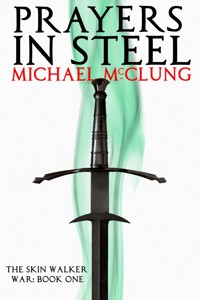
Uzyskaj dostęp do tej i ponad 240000 książek od 14,99 zł miesięcznie
- Wydawca: Michael McClung
- Kategoria: Fantastyka•Fantasy
- Język: angielski
I am a wheel whose edge is death.
This is the mantra that Andines are taught from their first day as novices. Their swords are their souls, and their patron saint, Andos, was the living embodiment of their tenets - Protect the helpless. Obey the emperor in Axumwiste. Pray for guidance in times of peace, and pray with steel in times of strife.
A time of strife has come once more.
Brother Caida is sent on a quest to rescue a princess kidnapped by bandits en route to her wedding. Armed with a great sword and armored in his faith, Caida soon finds both tested beyond endurance - for nothing is as it seems, and it is the world that needs to be rescued from the princess, not the princess from anything or any one. And waiting in the darkness, behind stolen faces, are the skin walkers - an ancient evil long thought banished from the world of men...
Ebooka przeczytasz w aplikacjach Legimi na:
Liczba stron: 267
Rok wydania: 2026
Odsłuch ebooka (TTS) dostepny w abonamencie „ebooki+audiobooki bez limitu” w aplikacjach Legimi na:
Podobne
















PRAYERS IN STEEL
The Skin Walker War: Book 1
MICHAEL McCLUNG
Copyright 2018 Michael McClung
Dedication
For my crazy chickens.
Acknowledgments
I would like to thank the members of the Ministry of Fiction for their patience and invaluable insights during the process of writing this book. They are, in no particular order: Jonathan Dearman, Rob Hayes, Agnes Conway, Jason M Waltz, Julia Kitvaria Sarene, Laura Wolterstorff, Edea Baldwin, Braden Bunch, James Latimer, Adrian Bridges, Thomas James Clews, Michael Champion, Letty Gradillas-Pugh, Amy Hanson, Chris Fisher, Belle McQuattie, Francesca Sharp, and Jeff Hotchkiss.
Contents
Chapter One
Chapter Two
Chapter Three
Chapter Four
Chapter Five
Chapter Six
Chapter Seven
Chapter Eight
Chapter Nine
Chapter Ten
Chapter Eleven
Chapter Twelve
Chapter Thirteen
Chapter Fourteen
Chapter Fifteen
Chapter Sixteen
Chapter Seventeen
Chapter Eighteen
Chapter Nineteen
Chapter Twenty
Chapter Twenty-One
Chapter Twenty-Two
Chapter Twenty-Three
Chapter Twenty-Four
Chapter Twenty-Five
Chapter Twenty-Six
Chapter Twenty-Seven
Chapter Twenty-Eight
Chapter Twenty-Nine
Chapter Thirty
Chapter Thirty-One
Chapter Thirty-Two
Chapter Thirty-Three
Chapter Thirty-Four
Chapter Thirty-Five
Chapter Thirty-Six
Chapter Thirty-Seven
Chapter Thirty-Eight
Excerpt: An Unclean Strength
About the Author
~ 1 ~
T
he woman’s slippers were silk, that much he could tell, and embroidered with seed pearls. There was no way to know what color they might once have been, since her feet were soaked to the ankles in blood.
Blood was spattered across her hideously expensive dress, as well. He could still see portions of that one’s original color. He’d have called it a cream, if forced to call it anything. Hard to be certain in flickering torchlight. But it wasn’t the dress, nor the woman, nor yet the carnage around her that she’d caused that his eyes kept sliding back to. It was the slippers.
For the life of him he couldn’t say why.
A hundred imperial troopers lay messily dead all around the young woman facing him, their armor and flesh rent and torn as if they had fought an enemy ten times their number and a hundred times their skill. Jaga had seen and caused death for most of his life. He could read battle-sign as well as any three of his men. The imperials had been caught wholly unawares, and had almost certainly died all at once. Which was impossible, of course, but there were all the corpses to tell him he was wrong. It was hard to argue with decapitations, torn off limbs and spilled intestines.
Jaga’s eyes fell once again on the woman’s slippers. He felt a shudder coming on, and suppressed it ruthlessly. He’d never got used to the sight of violent death, though he had learned early to throw on a mask of indifference. But those slippers. Those bloody, hideously expensive slippers…
Torches bathed the fortified imperial encampment in a shifting, untrustworthy light, but there was more than enough illumination to reveal the extent of the slaughter – and the small smile of satisfaction on the Roumnan princess’s beautiful, cold face. She stood alone among corpses, swaying slightly, with a small smile of what Jaga had to call satisfaction on her beautiful, delicate face. The kind of smile you might wear when a tricky or difficult task is finished.
“What the fuck is this?” muttered Arle, Jaga’s second in command, who pitched his voice low enough not to be heard by the Roumnan witch, or the troops behind them. They had both pulled their horses up short when the slaughter inside the imperial encampment had become evident. Arle rubbed at the stump of his left arm, as he sometimes did when he was unhappy. “They were supposed to be sleeping, not decomposing.”
Jaga shook his head slightly and nudged his horse through the open gate of the encampment. It snorted, disliking the stench of blood, but it did not balk.
“Jaga Khun,” the witch said, looking up from the blood and corpses. “Perfectly on time. I appreciate that in a servant.”
“I’m not your servant, princess. I’m a hireling. You wanted an army, and you have one. For as long as you can pay, of course.”
The princess arched a brow and tilted her head. “You doubt my word?”
“I seem to recall that we were supposed to collect you from a camp full of sleeping imperials. Yet here we are, collecting you from a slaughterhouse. Perhaps I misunderstood your words when I agreed to them originally. Or perhaps they were relayed imperfectly.”
Anya frowned. “You will find your pay in my tent, Jaga Khun. The iron chest. Have your men collect the rest of my belongings and saddle my horse. Or do hireling not do such things?”
“We do what we are paid to do, princess. Nothing less and nothing more. Which is why you turned to us to begin with, is it not?”
“You are a clever man, Jaga Khun. Try not to be too clever.”
“Would you like us to do anything with the bodies, princess?”
She pulled a ring from her finger and tossed it up to Jaga, who caught it in a leather gauntleted fist. He didn’t have to look at it to know it was worth a fortune. “Put that in the commander’s mouth,” she told him. “Then burn the encampment.”
Jaga passed the ring to Arle who, efficient as always, took command of the situation. Jaga turned his horse around and walked it back out into the breezy Wyeth night. The stench of death and dark magic had begun to turn his stomach. The twenty troopers selected by Arle to collect the princess passed him and entered the encampment. Many gave him questioning looks on the way. He ignored them.
The wind came from the north, from the Kash, and so it was a brittle thing, drying the land even as it chilled the night air. It was the signal that autumn was coming. The end of the growing season was nearly here – though precious little by way of crops was grown in Wyeth, nor had been for years. Farmers in Wyeth could and had survived much. Droughts, floods, crop plagues. Worse. But they hadn’t been able to survive a decade of war and chaos. Plows rusted and blades were bloodied. Green Wyeth had slowly turned red as the landsmen had fled, or died, leaving behind villages abandoned or in ashes, and leaving the land to mercenaries and bandits, to men of the sword. To men who dealt in death.
Men like Jaga himself.
And now, it seemed, to women such as the Roumnan princess. The Roumnan witch.
Would Wyeth change its color once again? mused Jaga. Wyeth the Black? Wyeth the White of Bones?
“Try not to think too much,” the witch said. She was quiet in those bloody slippers.
Jaga looked down and gave her a long, grim look. As big as he was and as small as she was, him sitting astride his warhorse and her flat-footed in slippers meant for marble tiles, he should have felt some advantage. Every advantage. He did not. And if she felt disadvantaged, not a sliver of it showed on her unnaturally pale face.
“They were supposed to be sleeping, not dead,” he said to her.
“I’m sorry if you were misinformed.”
“You’ll bring down the wrath of the empire on my troop. Roumney and Ardesh as well.”
“I’m not paying you to polish your sword.”
Jaga raised a meaty arm and slowly pointed a thick finger back toward the encampment. “I wouldn’t have accepted any payment at all, had I known it was connected to that.”
“Try not to think too much,” she said again. “There is method to my madness, Jaga Khun. You’ve taken my coin, and now you must take my word.”
He locked eyes with her. His “Do I?” was unspoken, but communicated clearly nonetheless.
“You have no choice now,” she continued, or replied. “The die is thrown, and I am the only chance you have of living long enough to see what face is uppermost when it comes to rest. And if you try to betray me, I will kill you and all your men in a fashion that makes what I did to those imperials seem like sweet mercy.”
Jaga looked away first, because he realized he believed her.
“There are two men out there,” she said after a short pause, pointing her chin towards the night-veiled rolling hills a little way to the northeast. “They are both hiding in an abandoned village beside a stream, a quarter-league distant. One is a hireling of mine, and the other is an imperial scout. They will not be together. Have your men collect them both. Alive.”
“Need it be said that your hireling shouldn’t be killed?”
“He may be reluctant to continue his employment after this evening.”
Jaga tried, and failed, to keep his mouth shut. “I know just how he feels,” he said, and nudged his horse away from her.
~ 2 ~
I
n the sun-hammered courtyard of the Andine monastery just outside the meager imperial city of Drum, brother Caida gasped in lung-searing breaths as he turned thrust after viper-quick thrust from his opponent’s blade. His own great sword grew increasingly heavy. Sweat ran down in rivulets from his bristle-covered scalp to sting his eyes, and his brown robes were darkened and heavy with perspiration. He had never crossed blades with anyone as good as this sinewy, sun-darkened man from the Ardesh steppes.
The horse warrior wielded a short, serrated blade that Caida was unfamiliar with—and Caida had made it a point to learn as much about Ardesh arms and armor as he could during his early years with the order.
Even dismounted, the man moved with blinding speed. Caida had the advantage of reach, but time and again the Ardesher had danced out of sword-reach only to fly back in at another angle, probing, testing, pushing. It seemed as if he spent more time inside Caida’s guard than out.
The Andine monk had begun to doubt his ability to best the man; after a glass under the hot sun the native steppelander seemed indefatigable, while his own reactions had slowed noticeably. After two glasses, Caida found it difficult to breathe. As Caida struggled for air, the Ardeshi simply smiled at him, the corners of his long black mustache twitching upwards.
Caida began to understand that if he did not try something unexpected, the match would end in the Ardeshi’s favor. Once decided on trying a new, more dangerous tack, the Andine did not give it much conscious thought. During the next round of thrust, cut and parry he risked a dangerous feint to the lower left quadrant that left him exposed from brow to navel, hoping his opponent would believe him too slow to recover. Hoping in fact that he wasn’t too exhausted in truth.
The horse-warrior danced in with one of the dust-raising stutter-steps that Caida had learned so recently to respect, drawing his strange blade up parallel to the ground, waist level. From that set position the Ardesher would have a launching point at Caida’s head, heart, and the length of his left side. He would only have a split second to wrestle with momentum and bring his achingly heavy great sword up from its downward arc. Too soon, and the Ardesher would simply dance back out of reach. Too late, and this contest of will and skill would be over. He prayed silently and wordlessly to Andos.
As their shadows touched and merged on the dusty, hard-packed earth of the courtyard, Caida whipped up five gleaming feet of southron steel and pinked the bandy warrior’s sword wrist. The man yelped and dropped his serrated blade, then unleashed a stream of curses sworn in the language of the steppes nomads. After a time that Caida spent recovering his breath, the horseman picked up his blade rendered the customary obeisance. Caida saluted with his own great sword, then moved forward to check the man’s injury.
“You are good, monk,” the Ardeshi said. “You would be better if you used a sword sized for men, not giants.”
“We wield the blades that choose us, friend. I thank you for the privilege of sparring with you. I have learned much. Now let me bandage that cut.”
The Ardesher waved away the suggestion. “Just a scratch. It took me by surprise more than anything.”
“Even a scratch may let in infection. You’ve tested my martial ability, now let me prove my medicinal skill. Andos was more than a warrior – he was also a healer.”
“Neh, monk. I have tested your blade and found it sharp. That is all I came to do. I need no coddling for a scratch, and no sermons.” With that, the man picked up his sword and walked over to his shaggy mount. He pulled out a small doeskin purse and tossed it at Caida’s feet. The ching of coin was unmistakable as it landed.
“We take no pay for sparring, friend,” said Caida.
The Ardeshi’s smile was sour. “That’s for your abbot. His winnings. Though I’m sure he’ll call it my offering.” With that the man mounted and rode out of the monastery’s sandstone gateway.
Caida stood for a moment, watching the horseman’s receding form disappear into the sparse crowds that moved along Drum’s dusty streets. Each day at noon the gates to the drill yard were opened, and each day one or more armsmen came to ring the bell and challenge one of the order to spar. So it had gone for all the years Caida had been at the monastery, and so it had gone for centuries, if the monastery’s historical documents were accurate. So, too, would it go for all the years that the Andine monastery stood, Caida supposed, with the same result. Those fully trained in the Andine arts were the best single swordsmen in the world. Their blades were the physical manifestations of their faith. How could skill alone prevail over faith, and years spent learning and then transcending the forms?
Caida’s musings were interrupted by the call to namah, afternoon prayer. His match had lasted far longer than was usual–he hadn’t yet swept the courtyard or removed the clapper from the gate bell. He hurried over to the well, filled and drew the bucket, then poured a ladle’s worth of cold well water over the bristly stubble that adorned his head. Then he dipped again from the well’s oaken bucket and drank deep. When the edge of thirst had been blunted, he set the ladle down on the stone lip of the well and hurried about his tasks.
Usually one or more brothers would have been there to witness the match and help with the tasks, but it was the season of doubt, the time when Andos had faced his own shortcomings, and had nearly been overwhelmed by them. Caida and the other brothers would stare into the dark pit of their own fallibility over the next week, and try to come to terms with past failures and errors in judgment. Caida let the somber notes of the call to namah wash over him as he swept away the footprints of his challenger and himself, bemusedly taking up the Ardeshi’s coin purse in the process, wondering what to do with it. Finally, he remembered the existence of the dusty, cobwebbed offertory on the wall outside the gate. He’d been detailed once, as a boy, to clean it. He remembered finding three stones, a bent, discolored copper coin and the dried carcass of a lizard the size of his little finger. He dropped the purse in and thought no more about it.
He did not notice the two figures that looked down on him from the abbot’s third floor balcony, nor had he noticed that they had been watching while the match took place. If he had, he surely would have dwelt on it during his prayers. An Andine was charged with being fully aware of his surroundings at all times.
✽✽✽
When Caida stepped into his cell to change his sodden, sweat-stained robes for prayer, brother Kordus was waiting for him.
“Good day, brother,” said Caida, slightly perturbed. Kordus was the Abbot’s secretary; an ancient, shriveled man with piercing blue eyes glinting beneath bushy white brows. Caida had never spoken to him directly in all the years he’d been at the abbey. Kordus rarely ventured outside the abbot’s quarters except for prayer and meals, and never, as far as Caida knew, had he visited a brother’s cell. Caida began to hang his sword on the pegs above his mat, but was interrupted by Kordus.
“The abbot summons you, Caida. Follow me, and bring your sword.”
“Certainly, brother. Have I done something wrong?” Would he be stripped of his sword, driven out of the order? Caida could think of no other reason why the abbot would want to see him while he wore steel, nor could he fathom what he might have done to deserve such punishment.
“Not that I know of, Caida. But it is not your place to question the orders of the abbot, nor is it mine. Remember your vows.”
Protect. Obey. Pray. The core of Andos’s teachings. Caida nodded and strapped his great sword on his back again. Then he followed Kordus’s slow progress through deserted hallways and the empty refectory to the stairs that led to the abbot’s quarters. There Kordus paused.
“Which do you value more, brother Caida—the martial training you’ve received here, or the spiritual?”
“The spiritual, of course.” Though Caida had to admit, it had not always been so.
Kordus shook his head. “We shall see, young man. We shall see. Go on ahead. The abbot waits, and I am not swift on stairs.”
Caida nodded and made his way up the stone steps.
When Caida knocked on the abbot’s door, he was greeted by the man himself. The abbot was a tall, slender, middle aged man whose gentle eyes were at odds with the sinister cast given to his countenance by the deep, puckered scar that ran from temple to jaw down the right side of his face, narrowly missing his eye socket. He was a battle-hardened veteran, and had served two emperors personally.
Caida dropped to one knee there in the hallway, a position made awkward by the length of his sheathed great sword. He bowed his head and raised his hands palm up.
“Rise, Caida. I am sorry to call you away from namah, but there are matters to be discussed.”
“I serve and obey, Lord Abbot.”
“Come into the study, and take a seat.” The abbot led him into a stark room lined with shelves, and sat down behind a simple, unadorned desk covered with neat stacks of parchment and papyrus scrolls. Caida took a seat on the polished wooden bench before the desk, worry and curiosity eating at him.
“Do you know who it was you sparred with today?” the abbot asked.
“An Ardeshi horse warrior, Lord Abbot. He did not give his name.”
“Do you not think it curious that a steppe warrior would come all this way just to test the mettle of the order?”
Caida shrugged, unconsciously. “We have many who come to do just that, Lord Abbot, from many parts of the world. It has always been so. I did not question.... Should I have?”
“It is always prudent to question an adversary’s motives, though such questions often go unanswered. But in this case, I must admit to a degree of slyness. The man you sparred with today was summoned here to test your skills. He is one of the most successful bandit chiefs within a hundred leagues. His name is Winst Temor.”
Mindful of his vows, Caida said nothing.
“It was not my idea that you be tested so,” the abbot continued. “I find no need for it – but others insisted, and I too, must obey at times.”
The abbot rose and walked around his desk to face Caida directly.
“When you came to us, you were a boy sick with rage over the deaths of your family, and the destruction of your village. Brother Lehet brought you to this monastery to remove you from the constant reminders of your village, of your loss. He hoped that Andos’s teachings would be a balm to your tortured soul. He hoped that your hate would cool in this spiritual environment. I ask you plainly, Caida—has it?”
Caida thought back over the eight years he’d been with the order. He remembered the venom-filled boy that had begged the mendicant Andine monk, Lehet, to teach him to fight. Only the Andine order gave martial training to commoners in Wyeth, except for mercenary companies such as the one that had destroyed his village in the disputed slice of land between Ardesh and Roumney. He thought about how he had felt then, impotent rage eating at his soul, and the significant amount of peace he had attained in the years since. The order had replaced his lost family as much as anything ever could. When he had taken his vows, it had been wholeheartedly.
“It has cooled, Lord Abbot. I wish only to use the skills I have learned in service to the order, not to further my own ends.” But a cool wind blew through Caida’s soul, carrying with it a chilling question–had the man he’d sparred with today been a part of the massacre of Myed?
The abbot searched Caida’s face with compassionate, if weighing, eyes. When he finally looked away, Caida had no idea whether he was satisfied with what he saw.
“You are the best of us, Caida, when it comes to sword-work. At least on a technical level. No,” he said waving away Caida’s silent protest, “no false modesty. You outstripped your tutors a year and more ago. Still, you have never wielded your sword in anger, or in a life-or-death encounter.” He paused, shrugged his shoulders slightly. “Skill with a blade is the least of Andos’s teachings, though the world may think otherwise. Remember, Andos defeated the skin walker lords with his blade, but he destroyed the skin walker threat with his faith. What I am about to burden you with, I do with some misgiving.” So saying, the abbot walked to a side door and opened it.
A portly man dressed in purple velvets edged in tiny, sewn pearls stepped into the room, obviously uncomfortable. He mopped his forehead with a lace kerchief and smiled at Caida. Caida stood and bowed.
“This is Sier Olvera, a knight of Axum, courtier to the Emperor in Axumwiste. He has come to us requesting the service of a brother in a matter that he will explain.” With that, the abbot took his seat behind the desk. To Caida, it seemed that the abbot was less than pleased with the man, or perhaps the situation.
“Yes, well,” Olvera began, voice surprisingly deep. “As the lord abbot mentioned, I’ve come to secure the services of an Andine at the request of certain parties, in a matter of some delicacy, not to say secrecy.” He harrumphed, glanced sidelong at the abbot who sat calmly at his desk, then cut his eyes back at Caida, who remained standing.
“Good match, by the way. I’d have liked to see you face him mounted, though, with that great long blade of yours. Though now that I think on it, I imagine it would be most dangerous to your own horse.”
“Sier Olvera,” said the abbot in a patient voice.
“Yes, of course. I apologize. I’ve never been one for getting right to the point.” Olvera mopped his brow again, took a deep breath, then stuck his kerchief up his sleeve.
“It’s this way. Some few weeks ago the king of Roumney asked Axumwiste to aid him in certain matters concerning the cessation of hostilities between Roumney and Ardesh. As you must know, they have been fighting over the same strip of land for decades with nothing to show for it but dead peasants and salted earth.”
Those dead peasants are my people. That salted earth is Wyeth, my homeland. It had been a long time since he’d felt the sharp stab of anger and loss that rose up at the portly man’s words. But Caida let none of it show.
“Brother Caida is aware of the hostilities,” said the abbot, an undercurrent of steel in his voice.
“Of course, of course. Well, the situation is this: A peace has been brokered, involving the marriage of the daughter of King Crechney and the son of the Khun of Ardesh. It only remains for the King’s daughter to travel to Ardesh for the ceremony.”
Caida’s curiosity finally got the better of him. Everything that had happened since he’d finished the bout was so unlike anything that had ever happened before, he wondered if he was taking a fever. He spoke despite willing himself to silence. “May I ask how this concerns me, Sier Olvera?”
“Oh yes, I was just getting to that. You see, the khun and the king, while earnestly desiring peace in my opinion, don’t trust each other farther than they can spit. Neither could agree who was to escort the lady Anya from her home in Roumney to her new husband and abode in Ardesh.”
“I see. May I ask why Roumnan soldiers couldn’t escort her to the border, and then Ardesh troops guard her the rest of the way?”
“A fine question. A sensible question. The answer is that neither side could agree on where the border is. Silly, prideful and dangerous as it is, the entire peace process had stalled over the question of where Roumney ends and Ardesh begins. Or vice versa. And the borderlands have become a lawless, violent region over the past decade, home to reavers and outlaws. No place for a lady to be unescorted. So it was decided that a troop of imperial soldiers would escort the princess across the disputed territory as a neutral force.” Olvera went back to mopping his brow.
“Again, may I ask how this concerns me, Sier Olvera?”
“Our troopers were slaughtered, brother, and Lady Anya has disappeared.”
Caida’s heart went out to the woman. He knew all too well the tender mercies of the reavers who inhabited Wyeth.
“I grieve for the lady, Sier Olvera. You must know she is more than likely dead.”
“No, brother. She’s too rich a prize. She is alive, somewhere in the disputed territory. She must be. Imperial scouts will find her. They are already looking, and it is not an empty boast to say that they are the best at what they do. We need an Andine to bring her out of Wyeth, though, or war will be declared on the empire by Roumney for a certainty and Ardesh in all likelihood. The death of the lady Anya will unite those bitter enemies, and what remains of the empire will suffer.” Olvera stared at Caida, his bumbling manner vanished in the intensity of his words. “We have less than a fortnight to deliver her into safe hands. Already Roumney is mustering forces along our northern border, and Ardesh will not lag behind in a fight.
“We would not win such a war, brother, and so at the emperor’s command, I’ve asked your abbot for help. He named you as the brother with the best chance to succeed, and after seeing you fight, I believe him.”
Caida bowed his head in thought, trying to make sense of the situation. When he looked up again at Olvera, it was with a new question.
“Why can’t the Roumnans or the Ardesh send in troops? Neither side has had any trouble riding roughshod over the land in the past. Or even an imperial cohort—”
“No. While we can’t speak for Roumney or Ardesh, the emperor has decided not to send more troops. The fear is that an armed force would only drive the reavers to kill the lady and cut their losses. That is, if they could find her at all, in time. And to be honest, the danger of rival troops sent into the disputed territory clashing with each other is real, and to be avoided if possible. It would touch off the war we are trying to avoid, you see. That is why it has been decided that rescue party should be a small party, or even one man, someone who knows the area. In short, it must be an Andine, and that Andine should be you, by all accounts.”
“Surely another brother, one with more experience—”
“No, Caida,” said the abbot. “You know the terrain and the dialect better than any here. Your skill at arms, untried as it is against true foes, is unrivaled by any here. You spent your first three years at the monastery poring over maps of the region–yes, I am aware of your forbidden forays in the library. You are the princess’s best hope, and by extension the empire’s best chance to avoid war.”
“But surely I should not go alone? Brother Aelsephas—”
“You know our tenets, Caida. What were Andos’s words after the battle of Faventus?”
“‘One man, armed with righteousness and armored in faith, is equal to all the armies of the world,’” Caida recited, heart heavy. He was an Andine, but he was not Andos.
“I will not compel you take up this task, Caida. Search your heart.” The abbot folded his hands on the desk and sat, still and patient as a stone. Olvera fretted the edges of his kerchief with nimble fingers.
Caida shook his head to clear his thoughts. He had no desire to leave the monastery, to revisit the land where his family had been cut down, where his village had been burned to the ground. He had no desire to revisit the past, and a small, mean-spirited portion of his soul rebelled at the notion that so much bloodshed should cease simply because of a wedding. That part of him still thirsted for revenge. He knew it, and recognized the feeling as unworthy. He searched his spirit remorselessly, and beneath the petty desire for revenge, beneath the spite he found another emotion, a truer emotion down at the bottom of the well of his soul. It squatted there, a cold bloated toad that stared back up at him unblinkingly.
Fear. Fear of failure.
“I honor my vows,” he said, “and follow the path of Andos.”
~ 3 ~
T
he stars over Wyeth were the brightest she had ever seen. At the nunnery in the Kash, the inmates were never allowed outside, and the windows were arrow-slits in the thick sandstone walls, no wider than a hand-span and higher than a young girl could reach without climbing on something. And at the royal palace in Roumney, windows were shrouded in layers of curtains that were rarely fully drawn back. Why give a would-be assassin a clear target? It had happened before; a crossbow quarrel through an open window had ended the life of a crown prince decades earlier.
Anya stood atop the central keep, the highest point in Thunderhead, bathed in the light of an ocean of stars. Five nights she had been in the crumbling fortress, and five nights the stars had called her forth from her room. If the nights had been less chill, she might have stripped down to her naked flesh to bathe in their light, she reveled in it so much. It was one of a countless number of freedoms she was determined to savor until the day she died.
That day might arrive in less than a week. Or, possibly, a thousand years or more in the future.