Uzyskaj dostęp do tej i ponad 240000 książek od 14,99 zł miesięcznie
- Wydawca: Fosforos Ltd
- Kategoria: Religia i duchowość•Religie
- Język: angielski
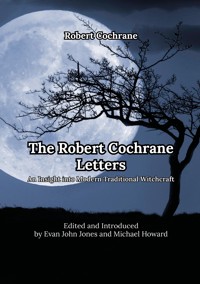
A rare insight into the ideas, beliefs, and inner world of one of the most influential figures in modern Traditional Witchcraft.
The Robert Cochrane Letters brings together the surviving correspondence of Robert Cochrane, founder of the Clan of Tubal Cain and one of the most enigmatic voices in twentieth-century British Witchcraft.
Written in the 1960s, these letters reveal Cochrane’s distinctive approach to the Craft—poetic, mystical, demanding, and deeply rooted in folklore, myth, symbolism, and personal experience. Through his correspondence, he discusses ritual, initiation, the nature of the witch, the relationship between tradition and invention, and the spiritual discipline required of those who seek to follow the Old Craft.
Far from being a straightforward manual, this collection offers a glimpse into a living, evolving tradition expressed through private reflection and dialogue. Cochrane’s writings are often challenging and deliberately ambiguous, inviting readers to look beyond literal meanings and engage with the deeper symbolic structure of his thought.
These letters have become essential reading for students of Traditional Witchcraft and for anyone interested in the development of modern pagan and occult movements in Britain. They also provide valuable historical context for understanding Cochrane’s influence on later practitioners, writers, and magical traditions.
This edition is recommended for readers interested in:
- Traditional Witchcraft and the Old Craft
- Robert Cochrane and the Clan of Tubal Cain
- British folklore, myth, and ritual
- Paganism and occult history
- Initiation, symbolism, and esoteric spirituality
Robert Cochrane was the public name of Roy Bowers, a British occultist whose teachings helped shape modern Traditional Witchcraft. Although his life and career were brief, his writings continue to inspire debate, interpretation, and practice among seekers of the Craft.
Ebooka przeczytasz w aplikacjach Legimi na:
Liczba stron: 280
Rok wydania: 2026
Odsłuch ebooka (TTS) dostepny w abonamencie „ebooki+audiobooki bez limitu” w aplikacjach Legimi na:
Podobne







Contents
Introduction
Chapter One: The Wilson Letters
Letter One
Second Letter
Letter Three
Letter Four
Letter Five
Letter Six
Chapter Two: The William Gray Letters
Letter One
Letter Two
Letter Three
Letter Four
Letter Five
Letter Six
Letter Seven
Letter Eight
Letter Nine
Letter Ten
Letter Eleven
Letter Twelve
Letter Thirteen
Chapter Three: The Gills Letters
Letter One
Letter Two
Letter Three
Letter Four
Letter Five
Letter Six
Letter Seven
Letter Eight
Letter Nine
Letter Ten
Letter Eleven
Letter Twelve
Bibliography and further reading
Introduction
Robert Cochrane (1931–1966), or to give him his real name, Roy Bowers, is still one of the most controversial figures in the modern witchcraft revival nearly forty years after his premature death. He claimed to belong to a hereditary witch tradition passed down through his family in Warwickshire and Staffordshire and that two of his ancestors had been hanged as witches. Unfortunately it seems his grandparents converted to Methodism and this upset other members of his family who were still Craft and they were cursed. Cochrane was allegedly taught by his mother, who had been the Maid of an old coven in Windsor, and by his Aunt Lucy, who he describes in one of the letters in this book as ‘a terrible old woman’. During the 1960s Cochrane ran his own coven called the Clan of Tubal Cain or the Royal Windsor Covine and it still practices today.
Cochrane only became publicly known when he contributed a letter about witchcraft to the Spiritualist newspaper Psychic News in 1963 complaining about the press coverage of Hallowe’en that year. He was to follow this up with a series of articles in Pentagram, the newsletter of the short-lived Witchcraft Research Association, and one in the occult magazine New Dimensions. In these articles, reprinted in The Roebuck in the Thicket (Capall Bann 2001), he presented an alternative version of witchcraft that was very different from modern revivalist neo-pagan Wicca. Generally, as can be seen in this book, Cochrane had very little time for the Wiccan tradition and its public leaders and he regarded Gerald Gardner as a sexual degenerate, fake and charlatan. Obviously such strong views upset the Gardnerian faction in the WRA and the resulting differences of opinion eventually led to its demise.
However, in the December 1965 issue of Pentagram, Cochrane had read an advertisement placed by a young man in Kansas called Joseph Wilson asking for information about the Old Religion. Cochrane wrote to Wilson, apparently in the hope of contacting Americans whose Craft ancestors had migrated to the United States from the British Isles. A short correspondence developed and as a result of it, and Wilson’s trip to England in the early 1970s courtesy of the US Air Force, the so-called 1734 tradition was founded in the States broadly based on the few teachings in Cochrane’s letters. Today this tradition is followed by several independent covens across the country.
Photocopies of these letters and others written by Cochrane have been freely circulating for many years and, more recently, have been posted by various members of the American 1734 tradition on the Internet. Unfortunately several of the letters have been reproduced out of context or subjected to a ‘cut and paste’ process that has created some confusion and even led to arguments over the true authorship of the material they contain. In 2001, Cochrane’s widow legally handed over the copyright of all his letters and articles to Evan John Jones, a member of his coven in the 1960s and more recently the magister or master of the Clan of Tubal Cain. A decision was then taken to publish the Cochrane letters in one volume to include his correspondence with Joe Wilson, with the ceremonial magician and Cabbalist William G. Gray and with a traditional witch called Norman Gills. This book is the result.
Bill Gray was well known as a ritual magician in the 1960s when the two men corresponded. Gray, who passed to the spirit world in the 1980s, wrote several books on magick and the Cabbala that have become classics because of his unique literary style. He was financed in this work by the Sangreal Foundation run by a Texan oil millionaire, the late Carr Collins. For several years Collins organised and paid for an annual private gathering for occultists and witches in London where they could come together to wine and dine in a relaxed social atmosphere. The one the writer was invited to some years ago featured lunch at the famous Old Cheshire Cheese public house in Fleet Street and a buffet supper at Goldsmiths Hall in the City.
Gray also encouraged different traditions to meet and work together through his publication of a series of seasonal occult rituals in 1970. The idea was to produce and work rituals for each of the seasonal festivals of the year that were universal and could be practised by anyone. In her autobiography, One Witch’s World (Robert Hale 1998), Patricia Crowther, the high priestess of the Sheffield coven, has noted that critics said ‘the rites were too pagan for Christians and too Christian for the pagans’. However Crowther also says the rites were very helpful for newcomers and those seeking initiation into Wicca. (85–86).
Although in print Gray was vitriolic about witches and witchcraft paradoxically he also worked with many of the leading personalities in the revival including Patricia and Arnold Crowther, Sybil Leek, Doreen Valiente and, of course, Robert Cochrane. Gray’s book The Rollright Ritual (Helios Books 1975), describing an initiation at the famous stone circle on the Warwickshire-Oxfordshire border, is rich with symbolism that is similar to Traditional Craft workings. It was probably heavily influenced by his contact with Cochrane. Although the book contains one of his characteristic attacks on witches, who he describes as ‘wicked’ and ‘anti-social’, it features a ritual involving hooded and robed figures using basic elemental symbolism represented by a magical sword, a horn cup, a cord, a stang or forked rod and a shield of Anglo-Saxon design decorated with runes.
Cochrane wrote the final set of letters reprinted in this volume to the late Norman Gills. He lived in an old 16th century cottage in Abingdon, Oxfordshire and was a ‘cunning man’ of the old type with Romany blood. Gills had a well-stocked herb garden and when the writer visited him in 1969 or 1970 he was making a living selling plants. He was also an artist and photographer and specialised in taking pictures of scantily dressed young women in his garden. The idea behind this was to capture the faery folk on film and from the photographs the writer has seen he was very successful using this method. Gills hinted at our meeting that he knew witches in the village of Long Compton near the Rollright Stones and claimed it was the home of the ‘the oldest coven in England.’
Coincidentally, the writer’s Gardnerian initiator knew both Gills and Cochrane. She had been introduced to Cochrane by Doreen Valiente while living at Peacehaven in Sussex and later she became a member of The Regency, the group founded after his death to carry on his work. She had also been a student of Norman Gills and related to the writer how he had taken her all over Oxfordshire and Berkshire introducing her to certain ‘old ladies’ who were solitary witches. Their relationship ended abruptly after she was attacked by an escaped mental patient while staying in his cottage one weekend while he was away.
Unlike the correspondence with Wilson and Gray, the letters to Gills indicate that Cochrane was dealing with someone on more equal terms to himself. In the Wilson letters the relationship was of a teacher and his pupil and in the Gray correspondence they are discussing more philosophical matters and the differences between the Craft and ceremonial magick. With Gills it is obvious that each of them has a wide knowledge of traditional witchcraft matters and there is a ‘cat and mouse’ game going on to find out who knows more! Gills and Gray were to work with Cochrane and his coven, while Wilson never met him.
During the time Cochrane was the magister of the Clan of Tubal Cain (as it was known during his lifetime) it worked outdoors near his home on a London overspill council estate in Slough, Berkshire or, after he had met Doreen Valiente, on the Sussex Downs, in the Mendip Hills, in Somerset, or in the Brecon Beacons in Wales. The coven wore black hooded robes and ‘called down the power’ by dancing and chanting around a bonfire in the middle of the ring or circle. They worshipped both the Horned God and the Goddess. The God was ‘the goat-foot god of fire, craft, and death’, while the Goddess was represented in triple form as the Wyrd Sisters of Anglo-Saxon/Norse mythology who ruled life, fate and destiny. Between them these two cosmic male and female principles had created the Horn God or young solar deity.
Cochrane was a very controversial person when he was alive and is more so since his passing. It seems even some of his coveners were unsure whether he was genuine or a charlatan. To complicate matters, Cochrane encouraged this ambiguity for his own personal ends. In common with other traditional witches, he liked to play the role of trickster and was capable of practising what has been called his ‘grey magick’ to cast a glamour around himself. This trickery he regarded as a real part of the Old Craft, as were the riddles he scattered through his letters for others to interpret in their own way.
From the content of some of the letters in this volume (and the sections edited out) it is pretty obvious that Cochrane had flaws and personality defects, which ultimately were to have a bearing on his destiny and wyrd. He was honest enough to recognise these and in fact he openly refers to them on more then one occasion in his writings. Doreen Valiente, who had become a member of his group several years after leaving Gerald Gardner’s coven because of his flair for self-publicity, recognised these defects. Although she eventually became disillusioned with some aspects of his character she declared that working with Cochrane gave her the opportunity to take part in some of the best rituals she had ever attended as a witch. Another of Cochrane’s associates, the writer and editor of Quest, Marian Green, has echoed this view. She has said:
‘Cochrane may not have been all the things he claimed, or that have been claimed for or about him since his death, but he really knew the way to work with the forces of the land, and with time, and with elemental beings in what feels like an authentic ancient way.’ (2001: 37)
Evan John Jones has also asked the question about Cochrane: ‘Was he one of the few remaining hereditary witches, or was he just an out-and-out fake?’ Jones mentions how Cochrane told one of his correspondents that while he was the Devil or master of a small clan he also recognised ‘the authority of others who are higher then myself.’ (1997:166). Although there is some doubt about whether Cochrane was actually talking about his discarnated brethren, John has suggested that in his travels around the country Cochrane may have met ‘a few remaining old-timers who held what was left of the old lore.’
In another of his letters, Cochrane himself hinted that he had inside knowledge of the magical practices of the renowned Long Compton coven that had allegedly met at the Rollrights until the 1950s. Increased public interest in the site and the so-called ‘ritual murder’ of a farm labourer in a nearby village is said to have eventually driven them away. Cochrane also told Jones about a network of six witch clans who had meeting places along the ancient ‘green roads’ or prehistoric trackways that crossed southern England from the Welsh border in the west to East Anglia. It is suggested that these clans may have been the eminence gris behind Cochrane’s own tradition and the ‘higher authority’ he was talking about.
Cochrane’s version of the Craft was never sanitised and references in his letters to such taboo subjects as invocations to Lucifer, the magical use of deadly nightshade, rituals in churchyards, warlocks and cursing are likely to give modern Wiccan fluffy bunnies the frights. It is however pretty clear to anyone who reads the accounts of historical witchcraft that since Gardner’s day there have been serious attempts to whitewash the Craft. Today this has created a safe, politically correct vanilla form of witchcraft that bears little resemblance to Cochrane’s version or other surviving branches of what is generally known as the Old Craft. The introduction of such modern innovations as the Wiccan Rede and the Law of Threefold Return, frequently quoted by modern authors as if they are ancient writ, completely ignores the fact that old-time witches had a dual role as healers and hexers. In fact if one is looking for historical continuity in the Craft then the use of the poppet or wax image to blast the soul of one’s enemies has an ancient magical providence dating back thousands of years.
Cochrane had little or no time for the modern ideas about witchcraft being a nature religion or the survival of an ancient fertility cult. In his article ‘The Faith of the Wise’, published in Pentagram in August 1965 he says that we are told by various “authorities” that the Faith of the Wise...is a simple matter: a pre-Christian religion based upon whatever Gods and Goddesses are the current vogue - full of simple, hearty peasants doing simple, hearty peasant-like things...things that in some cases complex, nervous sophisticates also enjoy doing in urban parlours. Consequently we have an interesting phenomenon: civilised sophisticates running around like simple peasants - and simple peasants who have never heard of such things!’ In fact Cochrane’s beliefs about the Craft are so challenging and different to the stereotypical image of today’s neo-pagan Wicca that one publisher rejected The Roebuck in the Thicket on the grounds that it had nothing to do with (modern) witchcraft!
It should also be noted that although the terms ‘traditional witchcraft’, ‘Traditional Craft’ and ‘Old Craft’ are used throughout this book, they are generic for several different groups and traditions operating in a traditional way or claiming an hereditary lineage. In fact in North America the term ‘British Traditional Craft’ refers to any form of organised witchcraft using a coven structure including initiation and training. In this respect it can, and does, include Alexandrian and Gardnerian Wicca. In this book the term is used exclusively to describe forms of witchcraft that claim a pre-modern provenance and excludes neo-pagan Wicca as it exists today, although we know Gerald Gardner was inducted into a ‘traditional coven’ in the New Forest. When referring to Traditional Craft or Old Craft both practitioners and observers can only relate their experience to the particular tradition or group they have had contact with. Many of these have more similarities then differences, but to talk of the Traditional Craft as if it was some nation-wide monolithic organisation as some people do is a fallacy.
Robert Cochrane died in mysterious circumstances at the summer solstice in 1966. Controversy still continues as to whether his untimely death was a tragic accident or suicide. However he did tell Evan John Jones shortly before his death that he ‘would soon be hunting from the Other Side’ (Jones 1990:17). According to Doreen Valiente, she was told in early 1966 that Cochrane was telling his followers he was going to commit ritual suicide at midsummer. She also says she received a letter after he died from Cochrane telling her that by the time it arrived he would be dead. (1989: 133-135) An astrological analysis of his death chart, published in The Roebuck in the Thicket, suggests it was suicide and he had been suffering serious emotional problems for months before he died.
Cochrane’s early departure to the Summerland robbed modern witchcraft of one of its most important, colourful and creative figures. One can only speculate at what he could have achieved had he lived longer. It is true that towards the end of his life Cochrane was tiring of the coven set-up and wanted out. He was seeking instead a more solitary practice and leaning towards a mystical approach to his spiritual expression. It is doubtful he would have abandoned the Old Faith all together, but he certainly might have gone off in a radical new direction that might have alienated his followers and left them behind.
Despite the small amount of written material he left behind (his family burnt many of his papers after his death), Cochrane did leave a lasting legacy. We have already mentioned the 1734 tradition in the States and after his death two of his friends and associates, Ronald ‘Chalky’ White and George Winter, founded a neo-pagan group called The Regency broadly based on Cochrane’s teachings and the clan mythos. This group held its meets in a studio in Islington and in Queens Woods, Highgate in North London, in the back garden of a house in Purley, Surrey (rented by the writer’s Gardnerian initiator), a flat in Ealing, West London (owned by the actress and drama coach Ruth Wynn-Owen) and at the Rollright Stones. Both its founders have joined Cochrane in the spirit world.
Some modern groups working in a traditional way claim to be in contact with Cochrane, who seems to be acting as an ancestral spirit guide. It’s therefore possible he has joined the ranks of the Hidden Company - those departed witches who elect to stay close to the Earth plane to guide and teach others. Today there are over fifteen websites on the Internet dedicated to Cochrane and his work and the recent publication of The Roebuck in the Thicket has attracted even more interest in the man and his tradition.
Recently Evan John Jones retired as the magister of the Clan of Tubal Cain and he handed over the cup and stang to younger hands to carry on the tradition into the 21st century. It seems certain that Robert Cochrane and his contribution to modern witchcraft, known only to a few people some years ago, will now never be forgotten.
It should be noted that some of the letters reproduced in this volume are incomplete. Others have been deliberately excluded or edited because they contained sensitive material relating to people who are still alive or to Cochrane’s private life. These details are of little interest in relation to his Craft career and it is not the task of the editors to gratify the public’s desire for the sensational. Another important point to note is that Cochrane often wrote in riddles. This may be annoying to some in an age where people demand instant gratification at the push of a button (even in spiritual matters) and generally have the attention span of a gnat. However it is a legitimate aspect of Traditional Craft teaching as the apprentice is expected to work for the knowledge on offer. Also, paradoxically, Cochrane sometimes seems to have been more open with the information he supplied to his correspondents than he was to members of his own coven at the time. Of course, except in the case of the first letter to Joe Wilson, we do not have the replies of his correspondents so the picture will always be incomplete. Hopefully the notes to the letters provided in this volume by the editors will help elucidate some of the contents.
More biographical and historical information on Robert Cochrane, the rituals of the Clan of Tubal Cain and The Regency can be found in the companion volume to this book called The Roebuck in the Thicket, published by Capall Bann in 2001.
Acknowledgements:
The writer would like to thank Gavin Semple and Iain Steele for providing their copies of the Robert Cochrane letters for cross-referencing purposes with those already owned by the editors.
Michael Howard
Midsummer 2002.
Chapter One The Wilson Letters
Letter One
20th December 1965
Dear Mr Wilson
I have read your advertisement in Pentagram with considerable interest, being somewhat interested and involved in the Faith of the Wise.1
I have recently been delving into the symbolism of the ley systems and the corresponding Herme [sic] posts that are scattered throughout Europe - and also America.2 I wonder if you have any knowledge of the Amer-Ind [sic] system that was a marked part of the Sioux religion, and which appears to have extended from Mass. throughout the Great Plains, and into South America. I appear to have worded that rather badly - I meant the tradition of the ley-path, not the actual system itself. The South American maze leys are of particular interest, since they correspond very closely to part of a tradition that exists in Britain today; albeit the symbolism used is of a somewhat different origin.
I understand from your advertisement that you are also interested in Druidism, an interesting thing is that the original Druids still appear to exist - since I am in contact with an old man, born inside the pale of the Faith, who claims hereditary knowledge of the druidical beliefs - and it appears that what he was taught as a child and young man and what is claimed to be druidism by modern sects and historians are two very different things.
Are you a member of admission3, and do you understand the order of 1734. A somewhat rude question, but since I cannot ask the traditional three questions in writing, I have to ask somewhat impolite questions.
I understand from the family that there was at one time quite a considerable influx of the Faith into America - in settlements in the Mid-West. The symbols used by the state of Texas point towards this being a fact. Some of the neo-pagan tradition of the hill folk also point towards a considerable belief in the religion of the Three Mothers4, Kansas being one of the states in which this appears. The Horsemen5, of which my father was a member, appear to have settled in force in the cattle and sheep areas, so it is very possible that the clan system is still present in the Mid-West.6
I appear to have asked many questions and given you no information about myself. I am male, married, a member of the People7 of two admissions and aged 35.8 I know the right and left hand language, the story of the Flood, and of the child that survived, I have seen One become Seven and Seven One, ‘Wheeled without motion between three elements’, as Gwion said9 - and am still learning how many beans make five, and the number of steps in a ladder.10 I come from the country of the Oak, Ash and Thorn.11 I am against the present form of Gardnerism12, and all kindred movements, although, like ‘Taliesin’, I believe they could become something far greater. My religious beliefs are found in an ancient song, Green Grow the Rushes O, and I am an admirer, and a critic, of Robert Graves.13
Robert Cochrane
Flags, Flax and Fodder
Second Letter
12th Night [January 6th] 1966
Dear Mr Wilson
Many thanks for your letter, which I read with great interest. You obviously have a deep interest for the Faith, and I will attempt to explain something of it to you - this will be a difficult task, since talking about the People (we describe ourselves as such) is a matter that every hereditary group trains out of its members. The religion is even more mystical than most - so words are very poor approximations of what we actually discover or feel about our beliefs.
A ‘driving thirst for knowledge’ is the forerunner of wisdom. Knowledge is a state that all organic life possesses, wisdom is the reward of the spirit, gained in the search for knowledge. Truth is variable - what is true now will not be true tomorrow, since the temporal truths are dependent upon ethics and social mores - therefore wisdom is possibly eternal truth, untouched by man’s condition. So we come to the heart of the People, a belief that is based upon eternity, and not upon social needs or pressures - the ‘witch’ belief then is concerned with wisdom, our true name, our true name then is the Wise People and wisdom is our aim.
Some groups seek fulfilment in mystic experience - this is correct if one does not forget the duty of ‘involvement’ - the prime duty of the Wise. It is not enough to see The Lady, it is better to serve Her and Her will by being involved in humanity and the process of Fate (the single name of all Gods is ‘Fate’). In fate, and the overcoming of fate, is the true Graal, for from this inspiration comes, and death is defeated. There is no fate so terrible that it cannot be overcome - whether by a literal victory gained by action and in time, or the deeper victory of spirit in the lonely battle of the self. Fate is the trial, the Castle Perilous in which we all meet to win or to die. Therefore the People are concerned with Fate - for humanity is greater than the Gods, although not as great as the Goddess. When man triumphs, fate stops and the Gods are defeated - so you understand the meaning of magic now. Magic and religion are aids to overcome Fate, and Fate is a cradle that rocks the infant spirit.
Now you know what witches are.14
You are confusing ‘lay’, a story told to music, with ‘ley’, which means in Keltic [sic] ‘flat’. The ley-paths were drover’s roads used by the Neolithic herdsmen to drive sheep and other cattle. They were designed to go from one part of a country to another in an absolutely straight line. If you are in what was Indian country, and look along the horizon of hills or plains, you will sometimes see an artificial nick out in the plains or hills. If you go to that point, you will notice that that mark corresponds to another within eyesight, and so on until you would have travelled wither the whole length of Great Britain or Northern America.
These ley-paths are very strongly connected to the religion of the Wise, since the sheep-herders who carved out the hills also made the stone circles such as Stonehenge, Avebury, the Rollrights and so on. The Herme [sic] post is the solitary altar stone that one often finds upon these ancient roads, and if they are approached correctly may be used as places to gain whatever you desire by means of power and of magic. There are sites of ancient power now nearly forgotten, but still places where more than one world meets. I will see if I can send you some photographs later of such places, since they will help you to find the Amer-Ind [sic] equivalent - and there you will find the answers to all your questions, although the form it will take at an Indian site will be somewhat different to how it comes to me. It is at such places that one may see the Goddess become as Seven, and then return to One. The Seven are hinted at in the days of the week - consider these days as feminine, not masculine. Likewise the order of 1734 is not a date of an event, but a grouping of numerals that mean something to a ‘witch’.
One that becomes Seven states of wisdom - the Goddess of the Cauldron. Three that are the Queens of the Elements [earth, air and water] - fire belonging alone to man and the Blacksmith God. Four that are queens of the Wind Gods. The Jewish orthodoxy believe that whomever knows the Holy and Unspeakable Name of God has absolute power over the world of form. Very briefly the Name of God spoken as Tetragrammaton (‘I am that I am’) breaks down in Hebrew to the letters IHVH, or the Adom Kadomon (The Heavenly Man). Adom Kadomon is a composite of all archangels - in other words a poetic statement of the names of the Elements. So what the Jew and the Witch believe alike, is that the man who discovers the secret of the Elements controls the physical world. 1734 is the Witch way of saying IHVH.15
The language of the hands is complex and I will deal with it much later. The Oak, the Ash and the Thorn are the Names of the Three Elemental Mothers. All this is quite a complex philosophy - I will deal with it much later.
Gardnerism is the title given to the work of the late and unlamented Gerald Gardner - who, driven by a desire to be whipped, and to prance around naked, devised his own religion, which he called ‘Witchcraft’. As you by now have gathered - we do nothing like this. Since the Gardnerians are very publicity conscious - they tend to give us a very bad name, and will one day possibly restart the persecution. Hence, they are thoroughly disliked.16
Graves’ White Goddess contains the Prediu Annwn - this will answer many questions if meditated upon - not only does it speak of the seven worlds, but it also tells you how to get there. ‘Where the evening star and the dark of night meet’ is one way.
Green Grow the Rushes O is an archers’ song from the Middle Ages. It is somewhat corrupt now from Christian influence, but parts of it are still original - ‘One is One and all alone - and ever more shall be.’
The stars on the American flag are pentagrams - The steer skull of Texas is another witch sign - as is the star within a circle. Diagonal bars and ‘V’ shaped bars are also witch in origin, like triangles, fleur-de-lis [sic], roses etc. of heraldic tradition. Coats-of-arms contain many pagan memories.
The man I work with is called John Armstrong and he is an actual descendent of the Armstrong’s of Cumberland and Durham. Armstrong was not only a bandit, but also a chieftain of no small merit.
My regards to your, wife and children.
Flags, Flax, Fodder(I bless thee by water,by air and by earth)
Robert Cochrane
Letter Three
Dear Joseph
Many thanks for your letter, which I read with interest. You appear to learn with speed. Your interpretation of 1734 is correct. The dialect name for this principle in Shropshire is the Broom, or the Seven Whistlers (so named because some of the Family summoned with a silver whistle).17 These first and feminine principles are Earth, Air and Water. Translated into the Broom they become Ash, Birch and Willow - the besom broom that the Family ‘Turn without motion between three elements upon.’18 Which is the basic substance of magic and mysticism. The fourth, and some postulate the fifth, metal, element is the one substance of power given freely to man - fire. With fire, and its many spiritual and intellectual ramifications, man conquered the world of appearance.19
Therefore the four elements conjoined come to mean Female and Male in One - represented by the figure of eternity, 8 or union. Fire as such is the province of the Alder [tree], the God of the underworld - Time - that which creates and destroys the world of appearances - finally Bran or Brian/Baal, the God of fire, of craft, of lower magic and of fertility and death. All things that are of this world belong to him, the star-crossed serpent.20 So you come to the true meaning of the cauldron. Bring forth the star-son, and you have Dionysus, the Horn Child and Jesus Christ in one.21 So the Cauldron is Generation and regeneration. Taliesin asked: ‘What two words were not spoken from the Cauldron?’ A question I now ask you, giving these pointers. The Cauldron at this level means movement, a becoming of life - ever giving birth, ever creating new inspiration. There is within the Cauldron all things and all future - fate. Therefore there is one state the Cauldron cannot be - what is it? In finding the answer you will come to understand the Cauldron.
As you have gathered, we teach by poetic inference, by thinking along lines that belong to the world of dreams and images. There is no hard and fast teaching technique, no laid down scripture or law, for wisdom comes only to those who deserve it, and your teacher is yourself seen through a mirror darkly. The answers to all things are in the Air-Inspiration, and the Winds will bring you news and knowledge if you ask them properly. The Trees of the Wood will give you power, and the Waters of the Sea will give you patience and omniscience, since the Sea is a womb that contains a memory of all things.
Obviously you wish to know how one asks correctly - This is known as ‘Approaching or Greeting the Altar.’ There are many altars, one is raised to every aspect you can think upon, but there is only one way to approach an altar or Godstone.22