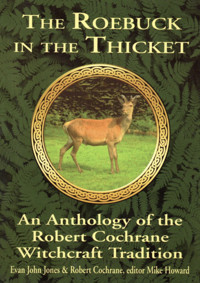
The Roebuck in the Thicket An Anthology of the Robert Cochrane Witchcraft Tradition ebook
Robert Cochrane, Evan John Jones, Michael Howard
Uzyskaj dostęp do tej i ponad 240000 książek od 14,99 zł miesięcznie
- Wydawca: Fosforos Ltd
- Kategoria: Religia i duchowość•Religie
- Język: angielski
What lies behind the legend of Robert Cochrane?
Few figures in modern witchcraft have inspired as much fascination, controversy, and speculation as Robert Cochrane. Revered by some as the visionary behind the Traditional Craft, criticized by others as an enigmatic mystic, Cochrane left behind teachings that continue to shape practitioners of Traditional Witchcraft, Tubal Cain Craft, and British folk magic around the world.
Drawing on rare articles, personal recollections, unpublished material, and historical analysis, this book explores Cochrane's philosophy, magical worldview, and enduring influence with remarkable depth.
Inside you'll discover:
- The authentic teachings of Robert Cochrane
- The origins of the Clan of Tubal Cain
- Traditional Witchcraft beyond Gardnerian Wicca
- The mysteries of the Maid and the Master
- The Cave of the Cauldron, the Chapel of the Grave, and the Stone Stile
- Fate, the Goddess, and the spiritual foundations of the Traditional Craft
- Cochrane's magical philosophy and "grey magic"
- His relationship with Doreen Valiente, Bill Gray, and other leading occult figures
- Rare essays originally published in The Cauldron
- An appendix analysing Robert Cochrane's birth chart and occult symbolism
- Extensive bibliography for further study
Unlike many books that repeat myths and second-hand stories, this volume presents Cochrane's ideas through the words of those who knew him and through writings that have become increasingly difficult to obtain.
Whether you are a practitioner of Traditional Witchcraft, a student of British occultism, a follower of the Clan of Tubal Cain, or simply fascinated by the history of modern paganism, this book offers an invaluable insight into one of the twentieth century's most influential and mysterious magical teachers.
Discover the tradition behind the legend.
Ebooka przeczytasz w aplikacjach Legimi na:
Liczba stron: 277
Rok wydania: 2026
Odsłuch ebooka (TTS) dostepny w abonamencie „ebooki+audiobooki bez limitu” w aplikacjach Legimi na:
Podobne




Contents
Chapter One The Master of the Clan
Chapter Two Witches’ Esbat
Chapter Three Witchcraft Today
Chapter Four Cord Magic
Chapter Five The Faith of the Wise
Chapter Six The Witches’ Stang
Chapter Seven The Rose Beyond the Grave
Chapter Eight The Ritual of the Castle
Chapter Nine The Roebuck in the Thicket
Chapter Ten The Spirals of Existence
Chapter Eleven The Making of a Working Site
Chapter Twelve The Rite of the Two Circles
Chapter Thirteen Not of This World
Chapter Fourteen Child’s Play
Chapter Fifteen Floating the Candle
Chapter Sixteen The Morning and Evening Star
Chapter Seventeen Candlemas & Hallowe’en
Chapter Eighteen Will of the Gods
Chapter Nineteen The People of Goda
Appendix The Birth-Chart of Robert Cochrane
Bibliography and further reading
Chapter OneThe Master of the Clan
‘Robert Cochrane’ (1931-1966) was one of the most fascinating and enigmatic figures in the history of the modern witchcraft revival, yet he was only in the public eye for less then three years, from 1963 to his premature death in 1966 at the age of only thirty-five. He wrote no books and the only written sources of his beliefs are a few articles he contributed to obscure, small circulation magazines and the letters to his correspondents. Cochrane claimed to have been a hereditary witch who could trace his family tradition back several hundred years. Such ‘granny stories’ are something of a cliché in the witchcraft revival and are often difficult for their claimants to prove to the satisfaction of others. In this respect Cochrane’s ‘family tradition’ was no different. It seems even the members of the Royal Windsor Cuveen he ran in the 1960s were unsure if Cochrane was genuine or a charlatan. This debate still continues today with people taking sides either way.
Factual details about Robert Cochrane’s early life are scant. The sparse information that is available can be gleaned by personal references in his letters and comments to friends and more recently by his nephew Martin Lloyd. By his own admission, Cochrane said he had been born into a large family in a London ‘slum’. However his family deny this and say he was referring to his latest years as an art student living as a squatter in empty houses. His birth had been registered at Chelsea Registry Office which covers Fulham so he lived in West London. It is believed that some members of his family emigrated to Australia. In his youth Cochrane seems to have had a violent temper that got him into trouble. In a letter to the Cabbalistic magician W. G. ‘Bill’ Gray, he describes himself as a young man as “a walking threat to anything or anybody.” He goes on: “The broken nose and scars upon my face are constant reminders of the time when it was easier for me to kick out and fight about anything...” He says this violent period ended when he met his wife.
As a young man Cochrane spent some time in the Army, probably doing his compulsory National Service as all male teenagers had to after the war, and was based at Colchester barracks in Essex. He allegedly went ‘absent without leave’ and spent some time in a military prison as a result. Involvement in the military ran in the family. His grandfather was a Regimental Sergeant Major and his father fought at the Battle of the Somme in the First World War and was decorated for bravery.
In the 1950s Cochrane had an early job as a blacksmith in a foundry working for London Transport on the Underground railway system. Later he and his wife worked as bargees transporting coal on the narrow boats along Britain’s canal network. He says they nursed one of the narrow boat people through an illness and as a result were accepted into this close-knit and insular community. Cochrane was later to claim that traces of the ‘Old Faith’ could be found in folklore traditions, old crafts such as that of the smith, and in closed communities like the canal folk. He especially mentioned the folk-art on the canal boats and significant symbols used to decorate them, such as the rose and the castle, that were also found in traditional witchcraft.
In the 1960s Cochrane and his wife and young son were living on a modern council housing estate in Berkshire. It had been built by the old Greater London Council to take the overspill from the Capital and, from comments in his letters, it would appear that Cochrane and his wife felt out of place there. At that time he was working for a company in Slough as a typographical draughtsman working on typefaces or fonts for letterheads. He was fairly philosophical about his lot and talking about office work said: “I personally would rather walk behind the plough then be in my present job, but this at least is skilled and offers me some escape from the run of work that is open to people like myself.” By this comment he may have been suggesting that as a product of a working class environment he may not have had a good education.
In November 1963 Cochrane first came to public notice when he contributed a letter to the Spiritualist newspaper Psychic News. This may seem to be an odd public arena to choose, but both Cochrane and his wife had been flirting with Spiritualism and were probably regular readers. Allegedly the Spiritualists had rejected them because of their witch beliefs. However, Cochrane had been told he had the potential to be a very good physical medium. This is a rare form of mediumship where the person can bring through spirits from the Other Side and they physically manifest.
In his letter Cochrane was responding to recent articles that had been published in the newspapers to coincide with Hallowe’en. Cochrane stated his belief (strongly contested by most modern Wiccans by the way) that witchcraft is not paganism per se, although he said that it ‘retains the memory of ancient faiths.’ He went on to say that it was in fact a mystery religion with a puritanical attitude and the last real mystery cult to survive. He added that it had a very complex and evolved philosophy with strong affinities to Christian beliefs. Again this was something disputed by Wiccans. The most controversial statement he made in the letter was that he was a practising witch himself and came from a family of witches. He claimed: ‘My mother told me things that had been told to her grandmother by her grandmother.’ He also said that two of his ancestors had been hanged for practising witchcraft.
Cochrane was later to make other claims about his alleged ‘family tradition’ in the letters he wrote to Bill Gray. Foremost Cochrane said that his great-grandfather was ‘the last Grand Master of the Staffordshire witches’. He further claimed that the Craft had been in his family since at least the 17th century ‘since there are definite records from that period.’ Nobody has ever seen these ‘records’, although his relatives burnt most of his private papers after he died and there is always the slim possibility that they were included among them. In a letter to Robert Graves, Cochrane said his grand-grandfather presided over his coven as the ‘Old Man’ wearing a ritual costume made from animal skins and a horned headdress.
According to Cochrane, his grandparents renounced witchcraft and became Methodists. For this act of treachery, his great-grandfather cursed them. Cochrane claims this curse ‘decimated my family through the years and generations. Nearly all of them died in misery and violence.’ Although allegedly his parents still practiced the Craft, his father made Cochrane’s mother swear she would not tell him about his heritage. She kept this promise, he said, until her husband died and then she told Cochrane the truth about the family. Allegedly, Cochrane’s mother had links with ‘the old Windsor cuveen [sic]’ whose last member had died in late Victorian times. Cochrane said that as a young woman his mother had helped this old lady, a Mrs Blomfield, in the role of Maid and Scryer. In one of his letters, to the Oxfordshire cunning man Norman Gills, Cochrane mentions Mrs Blomfield and suggests that Gills might know or have heard of her.
In one of his letters, Cochrane says he was taught about the Craft by his Aunt Lucy, who he described as ‘a terrible old woman’, and also by a male relative. He showed people a photograph of an elderly man sitting on a park bench who he said had also taught him. His aunt apparently had a collection of ‘witchy’ objects that one presumes had been handed down through the family. Presumably she is the same person he mentions in another letter. He says: ‘I was taught by an old woman who remembered the great meetings and she took not a terrible oath from me, but just an understanding that I would be discreet. She did not require silence, only a description of what I had seen and what I had heard and said when I was admitted.’
In 2007 Cochrane’s nephew Martin Lloyd, using the pseudonym of ‘Strimstrum’, posted several messages on an Internet forum run by The Crooked Path magazine in the United States. He said ‘Aunt Lucy’ was in fact the sister of Cochrane’s father. She had been married to a train driver in Willenhall in the West Midlands and was not a witch. She had a room full of ‘curios’ but none were associated with witchcraft. In fact it was claimed that none of Cochrane’s family, who originated from Staffordshire, were involved in the Craft. This would appear to confirm a comment made to Doreen Valiente by Cochrane’s wife after his death. She said that Cochrane had invented the story about being a hereditary witch and belonging to a family tradition.
In another letter Cochrane had the following to say about his alleged ‘family tradition’: ‘ I come from the country of the oak, ash and thorn...I describe myself as a ‘pellar’ [a Cornish term for a healer]. The People [witches] are formed in clans or families and describe themselves by the local name of the Deity. I am a member of the Clan of Goda – of the clan of Tubal Cain. We were known locally as ‘witches’, the ‘Good People’, ‘Green Gowns’ (females only), Horsemen and finally as ‘Wizards’”. By describing himself as a ‘Horseman’ Cochrane was linking his beliefs with the Guild of the Horseman’s Word, a rural secret society whose members included blacksmiths and farriers. He also claimed his father had been a member.
Was Cochrane then a fake because his claims to be an hereditary witch belonging to an ancient family tradition were false? Not necessarily. In the early 1960s it has been claimed that Cochrane had an independent contact with a Hereditary Craft group. A source who says they been in contact with this group at the time, and prefers to remain anonymous for personal reasons, has advised me of this fact. My informant says that they were present in either 1961 or 1962 at witch meets held in Cheshire, on the Derbyshire border and in Shropshire that Cochrane also attended. This informant claims that Cochrane obtained some of the concepts of ritual and belief he later used in his coven from attending these gatherings. He was apparently rather impatient with the progress of the teachings he was receiving and for this reason, my informant says, he did not attend any further meets.
Evan John Jones, who was a member of Cochrane’s coven in the Sixties, has also suggested that he knew other ‘old’ Crafters to whom he himself owed some allegiance. Jones refers to a letter from Cochrane to Bill Gray in which he says that he recognises the authority of others who are higher than himself (Jones 1997:166). John Jones told this writer these unnamed people were associated with witch groups operating along the old ‘green roads’ like the Ridgeway. In a letter to Norman Gills, Cochrane also hinted at some inside knowledge of the famous Long Compton witches in Warwickshire, who allegedly belong to ‘the oldest coven in England.’
Following the letter he had submitted to Psychic News, Cochrane contributed an several articles to in 1964 and 1965 to Pentagram, the newsletter of a newly formed organisation called the Witchcraft Research Association (WRA). This group had been formed by a witch using the pseudonym of ‘John Math’ who had been a captain in the Royal Marines during the Second World War. In the Sixties he had been initiated into modern Wicca and was working in the public relations department of a well-known company in London.
In the first issue of Pentagram, published in August 1964, Doreen Valiente had an open letter published in which she expressed her hope that the WRA would become ‘an United Nations of the Craft’. She hoped that it would be able to research and record traditions of witchcraft that otherwise would be lost. More optimistically, she also hoped that it would work for a mutual understanding and unity of purpose within the Craft so as to make such research possible. As it was to transpire, these words were to prove optimistic.
His critics have suggested that Robert Cochrane was some kind of sinister eminence gris behind the formation of the WRA. It has been claimed that from the beginning it was a conspiracy against Gardnerian Wicca. In fact Cochrane was accused of trying to use the organisation to declare himself ‘King of the Witches’, ironically a title that was to be claimed in the 1970s by Alex Sanders. However, from his correspondence with Bill Gray, it is evident the magician introduced him to the WRA by sending Cochrane a copy of the first issue of Pentagram. At that time he had never met ‘John Math’ and in fact he wrote back to Gray expressing an interest in doing so.
Cochrane subsequently contributed several articles and letters to Pentagram and these are reprinted in this book. As he had hinted in his earlier letter to Psychic News, he presented a version of the Craft that was in direct contrast to the Wiccan form promoted by the contemporary revivalist movement. In private, and to a lesser degree in public, Cochrane had always been highly critical and dismissive of modern Wicca. He regarded Gerald Gardner as an “out and out fake” who came into witchcraft because of “various [sexually] degenerative habits” (i.e. sado-masochistic practices including flagellation and bondage) and had invented his own form of the Craft to indulge them. Such allegations and outspoken views naturally did not go down well with Gardner’s dedicated followers and it is not surprising that they retaliated in kind by accusing Cochrane of being a fake himself.
A friend of Cochrane’s, who used the nom-de-plume of ‘Taliesin’ after the famous Celtic bard, shared his views of Wicca and he also contributed articles to Pentagram. He claimed to belong to a traditional witch group in the West Country that shared some of Cochrane’s beliefs, although this did not stop Taliesin from criticising him. In the March 1965 issue he stirred the cauldron by supporting Cochrane and denouncing the Gardnerians (a term that incidentally was invented by Cochrane as a form of abuse). Matters came to a head in the December issue when John Math published letters from the Gardnerian media witches Patricia and Arnold Crowther of the Sheffield Coven and a pseudonymous High Priest of a Suffolk coven attacking both Taliesin and Cochrane. Taliesin responded in typically forthright terms to both letters in what was to be the last issue of Pentagram in its newsletter format. One or two more issues appeared in magazine form, but their contents had a wider subject matter. At the time ‘John Math’ told me that he could not continue to produce the magazine just featuring witchcraft because there was not enough to write about on the subject. Shortly afterwards the magazine and the WRA vanished from sight.
‘Taliesin’ was the son of a well-known Greek-born composer and big band leader who worked for the BBC in the 1940s and 1950s. In fact he did not live in the West Country, but with his wife and children in Buckinghamshire. According to Doreen Valiente, in an entry in one of her notebooks now held in the archive of the Museum of Witchcraft in Boscastle, Cornwall (where she gives his real name), despite his hatred of Gardnerians Taliesin had been initiated into Wicca by Lois Pearson (Bourne) in 1962. She states that Pearson wrote to Jack Bracelin, then the High Priest of Gerald Gardner’s coven at Brickett Wood in Hertfordshire, saying that Taliesin wanted to start his own group. With Bracelin’s permission, she raised him to second degree at midsummer of that year so he could ‘hive off’. Taliesin was later to tell Cochrane that he had been ‘planted’ in Pearson’s coven, but he does not say by whom (Valiente 08.03.1966).
Controversy has always raged over claims that Robert Cochrane himself had been initiated into Gardnerian Wicca. Until recently it has always been my belief that there was no truth in this allegation. However, in June 2008 I was told by a reliable source that Cochrane received a first-degree initiation from a couple who were well-known witches running a small Gardnerian coven in London. The name of the woman in this couple is mentioned in Doreen Valiente’s notebooks in an entry dated 23.02.1966. She allegedly took Cochrane and his wife to meet Jack Bracelin at Brickett Wood. Apparently Bracelin liked Cochrane’s wife, but thought he was a ‘weirdie’. Cochrane and Bracelin corresponded for a while, but Bracelin dismissed the content of his letters as nonsense (ibid).
The last issue of Pentagram was interesting for a number of reasons. Firstly, in his reply to the High Priest from Suffolk, Taliesin suggested that the medieval witch cult had been influenced by Middle Eastern spiritual concepts. Interestingly, Cochrane had also expressed a similar view in his correspondence with Bill Gray. He said that he believed that up until the 12th century Roman Catholicism and the pagan survivals in this country had mingled and tolerated each other. Then he claimed that during the time of the first crusade Persian emissaries or pilgrims had entered the British Isles and converted the surviving bardic and druidic orders. It was at this time, he said, that the worship of the Horned God became ascendant in the witch cult. Cochrane had also mentioned this in his letter to the Psychic News claiming that an influx of Islamic mysticism had infiltrated witchcraft in the 13th and 14th centuries. Cochrane believed that the Roman Church had reacted adversely to this development and this reaction had triggered the witch-hunts.
This theory is not original. It had already been put forward in the 1930s by the Egyptian-born magician Rollo Ahmed and by the Sufi master Idries Shah in 1961. More recently in the 1970s it was been mentioned as part of the legendary corpus of the Pickingill Craft by E.W. Liddell, although this should not be taken as meaning that there is any connection between it and the Cochrane tradition. It was Cochrane’s belief that pagan survivals such as nature worship and fertility rites died out in the Craft in the 12th century. Other writers such as Dr Carlos Ginsberg have put forward this idea in a slightly different form by claiming that pagan survivals were absorbed into medieval witchcraft and seasonal folk traditions.
In the December 1965 issue of Pentagram was also an advertisement from a Joseph B. Wilson from Wichita, Kansas,USA. Wilson wanted to correspond with ‘anyone interested in the Old Religion, Druidism etc.’ He said that he published ‘...a duplicated news-sheet ‘ and would send a copy to enquirers for a British shilling (a modern five pence). Cochrane replied to this advertisement and the two men began a short yet ultimately famous correspondence. Eventually the copies of Cochrane’s letters to Joe Wilson would form the basis for the creation of the new American ‘1734’ witchcraft tradition.
Joe Wilson’s version of why he placed his advertisement and how the correspondence with Cochrane came about was published on the Internet before his death. Wilson claims that he had a Craft teacher who he calls ‘Sean’ and been a member of his so-called ‘Wichita Group’ since 1962. Before meeting ‘Sean’ Wilson had been a devout Baptist, had been ordained as a lay preacher and was planning to attend a seminary What Sean practised seems to have been a mixture of Native American beliefs and European folk magic and he ‘initiated’ Wilson during a trip to his parents’ ranch using a form of ‘vision quest’. Wilson sent off for a copy of Pentagram and when he received it he showed it to Sean. His teacher allegedly pointed out the similarities between his tradition and the material described in the writings of Cochrane and Taliesin. As a result of reading the British newsletter, Wilson was inspired to start his own called The Waxing Moon. In the 1970s this magazine was briefly published in the UK when Wilson joined forces with Tony Kelly of the Pagan Movement in Wales.
At the time Joe Wilson was writing to Robert Cochrane he was twenty-three, married to his wife Daisy with three small children and was serving in the US Air Force. In December 1965, when his correspondence with Cochrane began, Wilson persuaded the USAF to change his personnel records and dog tags to show his religion as ‘druid’ as he did not know how else to describe himself at the time. Although Wilson never met Cochrane, he did later travel to England courtesy of the USAF. He was a staff-sergeant based at RAF Upper Heywood in Oxfordshire and rented a house in Cirencester. During his time here he was able to meet with several people who had known and worked with Cochrane, including Norman Gills.
Unfortunately Staff-Sergeant Wilson’s stay in England was abruptly cut short in dramatic fashion and in a blaze of sensational and negative publicity. Wilson appeared as a prosecution witness in the court martial of a number of his fellow servicemen who had spoken out against the ongoing Vietnam war. During the trial Wilson refused to take the oath on the Bible because he said he was a pagan. This came to the attention of the British media and the case was splashed all over the newspapers.
It was alleged by the defence that Wilson had been employed by US military intelligence to spy on his colleagues. Later he was to claim that he was coerced into working for them. After the court hearing Wilson was shipped out of the country to Greece to avoid any further publicity. Several prominent British Wiccans, including John Score, the founder of the Pagan Front (now the Pagan Federation) denounced Wilson as a ‘traitor’.
On his eventual return to the United States, Joe Wilson circulated copies of his correspondence with Cochrane among the members of several existing covens he was friendly with. As a result over a period of time the 1743 tradition was born. Most of the covens and individuals concerned used the Cochrane letters as a basis for the teachings they gave to their initiates. Some were either already using or adopted existing Wiccan concepts to give their rituals a structure. Since 1990 the 1734 groups have also had a slightly more authentic ritual structure provided by Evan John Jones, with the assistance of Doreen Valiente, in his book Witchcraft: A Tradition Renewed. However the rituals in that book bear little resemblance to what was actually practised in Cochrane’s old coven when Jones was a member.
Probably the best known of the 1734 groups in the United States is the Roebuck Coven based in the Los Angeles area and founded by Ann and Dave Finnin in 1976. The Finnins had been involved in the American Craft for a year before they met Joe Wilson in 1975 and had joined the group he was running. Their first ritual together was at Hallowe’en when they attempted to call up Cochrane’s spirit. At the winter solstice in 1976 they founded the Roebuck Coven and claim that in 1977 Wilson ‘officially’ handed over the 1734 tradition to them. In 1982 the Finnins visited Britain and met with Bill Gray and some of the witches who had known Cochrane, including Evan John Jones. Eventually, and somewhat reluctantly he was later to admit to me, Jones adopted them into the Clan of Tubal Cain and recognised them as the leaders of its American branch. In 1989 the Roebuck Coven was incorporated under Californian law as a legal, tax-exempt religious organisation known as the Ancient Keltic [sic] Church. Its website used to boast a very fetching photograph of the Finnins clad in Highland costume.
Although Ann and Dave Finnin describe their group as ‘the Clan of Tubal Cain’ they do not accept the authority of Evan John Jones’ successor and, by their own admission, say that in the 1990s they went their own way. Today magical training in the Roebuck Coven is based on Neurolinguistic Programming (NLP), gestalt therapy and guided meditations or pathworkings. (Finnin 2008) These have nothing to do with the traditional Old Craft as practised by Robert Cochrane and his original coven. The only ritual structure that has been kept from the English version of the Clan is that the circle is cast by the Magister, Summoner or Master of the Rites (the presiding priest) using the coven sword and beginning in the north. The Summoner then leads in the celebrants. The second element of the ritual that has been retained is the consecration of the cakes and wine using a knife and a cup. Finally, at the end of the rite, the Magister or Summoner tosses a coin back over his shoulder on to the working ground after everyone has left the circle. This custom is called ‘paying for the site’ and traditionally was the payment made by the man representing the sacred king (ibid:58)
Some confusion has existed in the United States regarding the number sequence ‘1734’ used to denote the American tradition. It has been suggested that Cochrane could trace his ‘witch blood’ or family lineage back to 1734. This misconception probably dates back to the introduction by John Math to Cochrane’s article in the August 1965 issue of Pentagram, which makes this unsubstantiated claim. More fantastically, it has been suggested that 1734 was the street number of the house of Cochrane’s famous ‘Aunt Lucy’! A grammatical error in a reference to the number in his letter has also created a totally imaginary secret society called the ‘Order of 1734’ from whom he is supposed to have got his teachings. In fact Cochrane says quite plainly in one of his letters to Joe Wilson that 1734 is a number that is associated with the Goddess as Fate, who he described as the true object of a witch’s worship.
Pentagram was also influential in bringing Cochrane’s beliefs to a wider audience. The November 1964 issue had an open letter from a newspaper journalist called Enid Corrall who used the nom-de-plume of ‘Justine Glass’. She wrote articles for the old Daily Sketch newspaper on women’s issues and health matters and also contributed to the popular astrological magazine Prediction. In her letter, Glass said that she had been approached by a publisher (Neville Spearman Ltd) to write a book on modern witchcraft and she was seeking help from witches who would be willing to help her in this task.
As a result of her letter being published Justine Glass met Robert Cochrane and even became a guest at meetings of his covine. She lodged at the London house of the leader of the druidic Order of Bards, Ovates and Druids, Ross Nichols, who was a friend of Gerald Gardner and also knew Cochrane. He owned a plot of woodland in Buckinghamshire and allowed Cochrane to use it for the handfasting ceremony of Evan John Jones and his wife (Heselton 2003:130 and Valiente 1989:133). Cochrane contributed an anonymous article to Glass’ subsequent book Witchcraft, the Sixth Sense & Us. He described himself as a hereditary witch and explained the alleged Craft symbolism in the carvings on a Christianised menhir or prehistoric standing stone in Brittany. It has since been claimed that Cochrane misled her and Doreen Valiente claimed that he ‘pulled poor Justine Glass’ leg unmercifully and shamelessly admitted that he had done so’ (ibid:121).
It is also alleged that there was serious doubt about the provenance and authenticity of some of the ‘witch tools’ that Cochrane allowed to be photographed from his collection and published in Justine Glass’ book. Specifically one of these was a copper plate that was supposed to have been in his family for generations. In fact Valiente said she had bought this plate in a Brighton antique shop and had given it to Cochrane when she was a member of his coven because he wanted something ‘suitable for the ritual meal of cakes and wine.’ (ibid:122). Evan John Jones even told me that the whole concept of ‘1734’ mentioned in the letters is bogus and was based on this plate, which had this number incised on it, presumably by Cochrane. In Jones’ view the 1734 tradition in America was just a sham based on an untruth. He also dismissed Cochrane’s chapter in the book by Justine Glass as something he had made up because he did not like her and had regretted agreeing to be involved.
Cochrane explained the confusion with the plate away by saying that the publisher had got the caption to the photograph wrong. Valiente did admit that Glass’ book ‘seems to have been got out in a hurry and teems with misprints and statements which in my opinion are sheer nonsense’ (ibid 121). Despite Jones’ claim to the contrary, the chapter that Cochrane contributed to the book does contain genuine material that is recognisable as coming from his corpus of teachings as expressed in his correspondence and articles. Cochrane also told Joe Wilson in one of his letters that what he wrote about the Breton megalith was an accurate description of the male and female mysteries of the Old Craft as he knew it. (letter dated April 1966). Certainly Cochrane did not have a high opinion of Justine Glass. He described her to Wilson as ‘a fool and her book is a shame to read since it is only interested in the sensational and not in wisdom’. This was probably a reference to the many purple passages in it devoted to so-called ‘black magic’ and ‘black witchcraft’. Valiente however believed Cochrane’s poor opinion of Glass was the product of his natural misogynistic attitude.
In November 1964 Cochrane had an article published in a small esoteric journal called New Dimensions edited by Basil Wilby (aka Gareth Knight) and published by Helios Books in Cheltenham, Gloucestershire. At that time Knight was working with the owner of Helios, John Hall, in a small magical group based on the work of Dion Fortune. Cochrane’s article was called ‘The Witches Esbat’ and is reprinted in this book. Basically it describes a ritual that was part of Cochrane’s mythic system and was a working known as ‘The Cave and the Cauldron’. Cochrane was a keen caver and pot holer and its symbolism would have appealed to him.
In a letter to Bill Gray Cochrane said that the article was largely fictional and ‘upside down and the wrong way up.’ It is probably this comment that has led his critics to say that when Cochrane was describing rituals they were either not as they were actually performed in real life, but romantically as he wanted them to be, or even made up. However Cochrane said that the idea behind the article was to describe the feelings that a working of this type engenders in the participants. He certainly achieved that aim for this atmospheric article is still one of the best descriptions of a traditional witchcraft ritual in print.
What exactly did Robert Cochrane and his covine practice and believe in? Doreen Valiente has given us some idea from an insider’s viewpoint. She met Cochrane in 1964 and had been introduced to him by mutual friends. She was soon accepted into his group and they worked outside in the Berkshire countryside, often at Burnham Beeches, or if the weather was inclement inside at his house in Slough. After Valiente joined rituals were also held on the Sussex Downs above the Long Man of Wilmington hill figure near Eastbourne or on Newtimber Hill outside Brighton. Afterwards the covine stayed at Valiente’s basement flat on the seafront in the town, sleeping on the floor. During rituals they wore black robes or cloaks with hoods and therefore were known as a ‘robed coven’, a common term for traditional witchcraft groups in the 1950s and 1960s. Most of the ‘power raising’ was done in a circle by either dancing or walking around a small bonfire in the centre and chanting. This was known as ‘turning the Mill.’