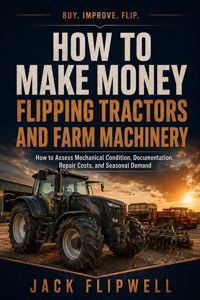
How to Make Money Flipping Tractors and Farm Machinery - How to Assess Mechanical Condition, Documentation, Repair Costs, and Seasonal Demand ebook
JACK FLIPWELL
Uzyskaj dostęp do tej i ponad 240000 książek od 14,99 zł miesięcznie
- Wydawca: ALL-IN Rafał Płonkowski
- Kategoria: Biznes, rozwój, prawo•Biznes, rozwój
- Język: angielski
How to Make Money Flipping Tractors and Farm Machinery is a practical guide for readers who want to turn secondhand-market knowledge into a disciplined and profitable process. How to Assess Mechanical Condition, Documentation, Repair Costs, and Seasonal Demand. The book takes the reader from sourcing and condition assessment through cost control, listing preparation, negotiation, safe delivery, and responsible scaling.
The author explains how to make decisions with numbers, reduce avoidable risk, and protect margin. Instead of promising effortless profit, the book provides concrete buying criteria, inspection routines, documentation practices, and methods for presenting an item so buyers can decide with confidence. The chapters form a repeatable system that can be adapted to different budgets, local markets, and available time.
This guide is written for first-time resellers, people building an additional income stream, and experienced operators who want a more consistent workflow. It helps readers separate a low price from a genuine opportunity, plan the work before buying, and build the credibility needed to complete sales with fewer disputes.
This publication was prepared using tools that support the creative process, including AI-based solutions. The final concept, structure, and editorial work belong to the author.
Ebooka przeczytasz w aplikacjach Legimi na:
Liczba stron: 78
Rok wydania: 2026
Odsłuch ebooka (TTS) dostepny w abonamencie „ebooki+audiobooki bez limitu” w aplikacjach Legimi na:
Podobne

















INTRO
Flipping tractors and farm machinery is very different from trading cars, electronics, or small tools because the financial exposure of each decision is much larger. One good transaction can justify substantial effort, but one serious mechanical mistake can absorb much of the expected margin. Finding equipment listed below similar machines is therefore not enough. You need to understand why it is cheaper, what it will realistically cost to make it saleable, and whether there is enough demand to move it without locking up capital for months.
Farm machinery is a working asset, so buyers evaluate it differently from most consumer products. Appearance matters, but operating condition, suitability for a specific job, maintenance history, completeness, parts availability, compatibility, and expected future costs usually matter more. A farmer may accept faded paint, scratches, or a worn seat while rejecting a tractor with uncertain hydraulics, transmission problems, or questionable documentation. A profitable seller should therefore improve genuine usefulness and confidence rather than spend money trying to make worn equipment look deceptively new.
The market extends far beyond tractors. Opportunities can include loaders, balers, mowers, spreaders, sprayers, cultivators, plows, trailers, seed drills, forage equipment, and many other categories. Each has its own critical inspection points, transportation requirements, buyer profile, and seasonal demand pattern. A beginner should not try to become competent in every category at once. Starting with a small number of machine types makes it easier to recognize common failures, understand values, and learn what buyers actually care about.
One of the most important distinctions in this business is the difference between cheap equipment and undervalued equipment. A cheap tractor may need a repair worth a substantial percentage of its value, have an unpopular configuration, be missing essential components, or appeal to only a small number of buyers. An undervalued machine has problems that can be identified and reasonably estimated while still leaving enough room for transport, diagnosis, parts, qualified labor, preparation, selling costs, and uncertainty. That distinction will form the foundation of the buying process throughout this book.
Inspection should be a repeatable procedure rather than a quick walk around the machine. On a tractor, important areas may include cold starting, engine operation, transmission behavior, drivetrain, hydraulics, three-point linkage, PTO, steering, brakes, tires, electronics, leaks, and the accuracy of the advertised equipment. Implements require a different approach and may involve frames, bearings, gearboxes, shafts, working components, hydraulic hoses, folding systems, metering units, and control systems. A reseller can perform appropriate visual inspections and basic operating checks, but work involving dangerous systems, specialized diagnostics, or safety-critical repairs should be left to properly qualified people.
Documentation forms part of the machine's value. Identification numbers, proof of ownership, purchase records, manuals, service documentation, repair invoices, and records of major work can make both purchasing and resale easier. Missing paperwork does not automatically make every machine unsuitable, but it should increase caution and affect how risk is valued. An unusually low price is never a good reason to ignore uncertainty about ownership, identity, or the seller's right to dispose of the equipment.
Repair cost also means much more than the price of a replacement part. Diagnosis, labor, transportation to a workshop, fluids, seals, additional components, delays, and secondary faults discovered during disassembly can all change the economics of a project. A calculation based on doing every repair personally and at the lowest possible cost is rarely a reliable business model. Braking systems, pressurized hydraulics, electrical systems, drivetrains, structural repairs, and other safety-sensitive work should be handled within the limits of your competence and referred to qualified specialists when necessary.
Seasonality creates both opportunities and traps. Demand for certain machines often increases when buyers begin preparing for the work ahead, not only when that work is already underway. Mowers, balers, drills, spreaders, and other specialized equipment can have very different selling windows, while some tractors have broader demand throughout the year. Buying outside the strongest season may create better opportunities, but only if storage costs, tied-up capital, deterioration, and the time required to prepare the machine still make economic sense.
Before committing money, you should be able to answer several practical questions: - Who is the most likely next buyer for this machine? - What job will matter most to that buyer? - Which faults could prevent the sale entirely? - Which costs are still uncertain? - Are suitable parts and qualified service realistically available? - What could transportation cost in both directions? - How long can the machine reasonably remain in inventory? - What selling price is realistic without relying on the best possible scenario?
A strong sales listing reduces uncertainty for the buyer. It should show the machine from multiple angles and include working parts, tires, cab condition, hitches, connections, common wear areas, controls, and enough identification detail to describe the model and configuration accurately. The description should separate what has actually been tested from what remains unverified. Known defects should be disclosed rather than hidden in the hope that a buyer will miss them. Over time, a reputation for accurately represented machinery can become more valuable than the extra money gained from concealing one problem.
This book follows the complete process in the same practical order used in the Polish edition, from choosing a market segment and finding opportunities through inspection, documentation, cost calculation, transportation, repairs, seasonal timing, pricing, advertising, negotiation, risk management, scaling, and building a repeatable operating system. The goal is not to teach you to buy every inexpensive tractor or implement you find. It is to build a method for rejecting weak deals quickly and investigating promising ones more accurately. In farm machinery flipping, much of the result is determined before the resale listing ever appears, at the moment you decide whether the machine deserves your capital in the first place.
Chapter 1 - Choosing the Right Market Segment
The market for tractors and farm machinery is too broad for a beginner to analyze every category effectively. A simple mechanical implement must be valued differently from an older tractor, and both differ again from modern machinery with complex electronics and hydraulic systems. A practical starting point is to select one or two segments that you can monitor consistently and learn in depth. This makes it easier to recognize whether a specific listing is genuinely attractive or merely looks cheap beside poorly matched comparisons.
The simplest segment does not necessarily mean the cheapest equipment. It means machinery whose condition can be assessed with a manageable number of variables and without depending heavily on hidden systems. Plows, some cultivators, basic trailers, and certain mowers may allow a beginner to focus on the frame, working components, bearings, gearboxes, and completeness. A tractor exposes the buyer to more potentially expensive systems and therefore requires broader knowledge and a larger financial safety margin.
When choosing a category, consider not only how easy the equipment is to inspect but also how many potential buyers exist. A common machine with a typical working width, power requirement, or hitch configuration may appeal to a much larger market than highly specialized equipment. A narrow niche can still be profitable when you understand the users and know how to reach them, but beginners usually face longer selling times. Market liquidity should therefore be treated as part of the value of the machine.
Repeatability is another useful selection criterion. When similar machines appear regularly in listings, it becomes easier to identify differences in pricing, equipment, age, and condition. Over time, you can see which configurations disappear quickly, which remain advertised for months, and which defects repeatedly reduce buyer interest. That knowledge is far more useful than remembering the asking price of one isolated machine.
Logistics should influence the segment you choose. A small spreader, plow, or mounted implement may be much easier to collect and store than a large combine, trailer, or wide cultivator. As equipment becomes larger, transportation can represent a significant part of the total transaction cost. If you do not have your own suitable transport solution, you should know who can move the machine and how that cost affects your maximum purchase price before you make an offer.
Parts availability and access to qualified service also matter. Even an attractively priced machine may be a poor purchase if routine parts are difficult to obtain or if proper diagnosis requires rare equipment or specialist knowledge that is unavailable nearby. Check whether workshops in your area understand the type of machine and whether common wear items can realistically be sourced. You do not need to perform complicated repairs yourself, but you do need to know whether they can be completed at a reasonable cost and within a useful timeframe.
You should also decide what type of value improvement your business is actually capable of delivering. In some cases, the opportunity may come from thorough cleaning, replacing missing simple components, organizing documentation, and presenting the machine properly. In other cases, value may depend on replacing worn service items through an appropriate technician, repairing leaks, or correcting worn mechanisms. The strategy should focus on work that can be understood and controlled, not on buying random broken machines and hoping serious faults will prove inexpensive.