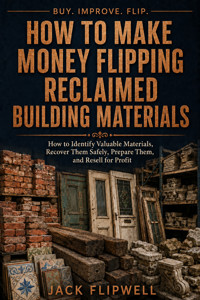
How to Make Money Flipping Reclaimed Building Materials - How to Identify Valuable Materials, Recover Them Safely, Prepare Them, and Resell for Profit ebook
JACK FLIPWELL
Uzyskaj dostęp do tej i ponad 240000 książek od 14,99 zł miesięcznie
- Wydawca: ALL-IN Rafał Płonkowski
- Kategoria: Biznes, rozwój, prawo•Biznes, rozwój
- Język: angielski
How to Make Money Flipping Reclaimed Building Materials is a practical guide for readers who want to turn secondhand-market knowledge into a disciplined and profitable process. How to Identify Valuable Materials, Recover Them Safely, Prepare Them, and Resell for Profit. The book takes the reader from sourcing and condition assessment through cost control, listing preparation, negotiation, safe delivery, and responsible scaling.
The author explains how to make decisions with numbers, reduce avoidable risk, and protect margin. Instead of promising effortless profit, the book provides concrete buying criteria, inspection routines, documentation practices, and methods for presenting an item so buyers can decide with confidence. The chapters form a repeatable system that can be adapted to different budgets, local markets, and available time.
This guide is written for first-time resellers, people building an additional income stream, and experienced operators who want a more consistent workflow. It helps readers separate a low price from a genuine opportunity, plan the work before buying, and build the credibility needed to complete sales with fewer disputes.
This publication was prepared using tools that support the creative process, including AI-based solutions. The final concept, structure, and editorial work belong to the author.
Ebooka przeczytasz w aplikacjach Legimi na:
Liczba stron: 74
Rok wydania: 2026
Odsłuch ebooka (TTS) dostepny w abonamencie „ebooki+audiobooki bez limitu” w aplikacjach Legimi na:
Podobne



















INTRO
Reclaimed building materials can be an attractive market because their value is often unclear to the person trying to remove them. Old boards, bricks, stone, doors, architectural woodwork, metal details, and decorative fixtures may look like demolition waste while still having real demand. Profit does not come from the fact that something is old. It comes from recognizing material that still has a useful market, acquiring it at the right cost, recovering it safely, preparing it efficiently, and connecting it with a buyer who understands what it is worth.
This business works differently from ordinary secondhand resale. Building materials may be heavy, dirty, fragile, difficult to store, and expensive to move. Their value may depend on having enough matching pieces, usable dimensions, a documented origin, a particular surface, or a condition suitable for reuse. An impressive looking batch can still be a poor purchase if recovery requires extensive labor, too much material is damaged during removal, or the finished inventory sits in storage for months.
The most important skill is not finding the oldest materials. It is learning to separate useful, sellable stock from material that will only consume money, time, and space. Throughout this book we will examine reclaimed wood, brick, stone, tile, architectural joinery, metal components, building fixtures, and other materials commonly found during renovation, modernization, and demolition work. The goal is not to memorize a catalog of products. It is to build a repeatable evaluation process that works whenever a new opportunity appears.
Supply can come from private renovations, property clearances, remodeling projects, workshops, farms, warehouses, contractors, and buildings being upgraded or partially dismantled. Sometimes the owner wants to sell the material. In other cases, removing it quickly is more important than receiving the highest possible price. Cheap or free stock is not automatically profitable because recovery labor, loading, transport, pallets, storage, sorting, and eventual disposal of unusable material can cost more than the material itself.
Clear ownership and permission are essential. You should never assume that materials left on a construction site, outside a building, in a skip, or near a demolition area are free to take. Before removing anything, confirm that the person offering it has the right to sell or transfer it and that you are authorized to access the site. For larger jobs, clarify in advance which items become yours, who is responsible for dismantling them, and when they must be removed.
Safety is one of the main limits on what makes a deal commercially sensible. A reseller may be able to perform basic inspection, measurement, sorting, surface cleaning, packing, and handling when those tasks can be done safely. Structural dismantling, work at height, interference with electrical or gas systems, handling unusually heavy elements, and work involving potentially hazardous substances may require qualified specialists. A deal is not attractive if the expected margin depends on taking technical risks you are not equipped to manage.
Older buildings require additional caution because some materials, coatings, adhesives, insulation products, or surface treatments may contain substances that should not be disturbed without proper identification and procedures. Do not cut, sand, grind, burn, or break suspicious materials merely to recover something valuable more quickly. If you cannot establish that a material can be handled safely, obtain competent advice or walk away from the opportunity. Avoiding a questionable batch is often cheaper than dealing with a safety problem after purchase.
A strong deal begins before money changes hands. You want accurate dimensions, approximate quantities, photographs of the full batch, close-ups of typical condition, visible damage, information about previous use, and a clear explanation of access and collection conditions. A photo of one attractive board or one clean brick tells you very little about the whole lot. The more accurately you inventory a batch before committing resources, the easier it becomes to estimate usable yield and true unit cost.
Preparing reclaimed materials for resale usually does not mean fully restoring them. In many cases, the highest return comes from careful sorting, removing loose dirt, separating damaged pieces, taking accurate measurements, counting inventory, and packaging the material in a way that makes collection easier. Excessive restoration can remove features buyers specifically want, such as aged surfaces, natural patina, original tool marks, or signs of previous use. Your job is to improve commercial usability without unnecessarily turning reclaimed material into something that looks new.
Honest condition reporting matters just as much as physical preparation. Old timber may have nail holes, brick may have chipped corners, stone may vary in color, and doors may need adaptation before reuse. Those characteristics do not always reduce value, but buyers need to know about them before committing to a purchase. Accurate photographs, real measurements, visible defects, and a clear description of what is included make sales easier and reduce disputes.
One of the most common beginner mistakes is focusing only on the expected resale price. The full cycle includes acquisition, dismantling, breakage, loading, transport, cleaning, sorting, packaging, storage, selling time, and sometimes final delivery to the buyer. Only after accounting for those costs can you judge whether a batch offers enough room for profit and uncertainty. The heavier, more unusual, or slower moving the material is, the more conservative your purchase decision should be.
Sales channels also need to match the product. A few decorative beams require a different buyer from several hundred reclaimed bricks, a matching set of old doors, or a large quantity of stone. Heavy materials often make the most sense in a local market because delivery can quickly become a large percentage of the buyer's total cost. Smaller architectural details may justify a much wider selling area because their value is high relative to their size.
The objective is not to build a warehouse full of interesting old objects. The objective is to create a repeatable system for finding opportunities, rejecting weak batches, evaluating condition, organizing safe recovery, controlling preparation costs, and selling with complete information. The 20 chapters ahead follow that process in order, moving from market structure and sourcing through material evaluation, safe recovery, preparation, storage, transport, pricing, documentation, sales, supplier relationships, and business scaling. The central principle remains simple: you make money not from what you manage to collect, but from what you can buy intelligently, handle safely, prepare efficiently, and actually sell.
Chapter 1 - How the Reclaimed Building Materials Market Works
The reclaimed building materials market behaves differently from ordinary secondhand resale. Buyers are often not looking for a specific model or brand, but for a particular size, material, finish, age, color, or quantity of matching pieces. Value therefore depends not only on condition, but also on whether the batch can solve a real project need. A reseller has to view each lot as a product, a logistics problem, and a potential technical risk at the same time.
The best opportunities appear when the current owner places little value on the material but another buyer may value it much more highly. A property owner may see old doors, bricks, beams, or stone as something that has to be removed quickly. A restoration contractor, designer, restaurant owner, or homeowner may be actively looking for exactly that kind of material. Your job is to identify that gap and confirm that it is large enough to cover every cost involved in recovery and resale.
Old does not automatically mean valuable. A weathered board may be desirable if it has useful dimensions, strong material, and an attractive surface, but it may also be twisted, weakened, or badly damaged. An old brick may look appealing while being too fragile to survive cleaning and transport. Age is only one characteristic and should never replace an assessment of condition and demand.
The strongest reclaimed materials usually combine several useful qualities. They are durable enough to reuse, available in a quantity that suits real projects, practical to transport, and desirable for functional or decorative reasons. Unusual dimensions, workmanship, surface character, or scarcity can add value. Visual interest alone is rarely enough if the material is difficult to use.
Batch consistency can be more important than the value of a single piece. One decorative tile may be interesting, but a group of matching tiles may allow a buyer to complete an entire feature wall or floor. A coordinated set of doors from the same property can be more useful than a larger number of unrelated doors. In many transactions, the commercial value comes from the lot working as a complete resource rather than as isolated objects.
Different buyers value the same material for different reasons. A restoration contractor may care about matching dimensions and period appearance, while a designer may prioritize surface character and visual impact. A builder or property owner may simply want durable material at a sensible total cost. Understanding the intended use helps you choose what to buy, how to sort it, and how to present it later.