


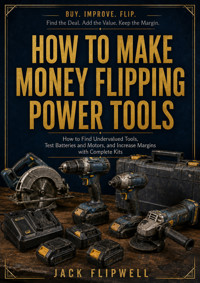
How to Make Money Flipping Power Tools - How to Find Undervalued Tools, Test Batteries and Motors, and Increase Margins with Complete Kits ebook
JACK FLIPWELL
Uzyskaj dostęp do tej i ponad 240000 książek od 14,99 zł miesięcznie
- Wydawca: ALL-IN Rafał Płonkowski
- Kategoria: Biznes, rozwój, prawo•Biznes, rozwój
- Język: angielski
Can used power tools become a repeatable source of resale income? They can, but the advantage does not come from randomly buying cheap drills and listing them for more. It comes from better sourcing, disciplined pricing, safe testing, correct identification, smarter kit building, and understanding where real value sits inside a package.
How to Make Money Flipping Power Tools is a practical guide to buying and reselling drills, impact drivers, grinders, rotary hammers, saws, impact wrenches, batteries, chargers, and other secondhand power tools. It takes the reader through the complete process from finding an opportunity to closing the sale and then shows how individual transactions can become a repeatable operating system.
You will learn how to separate asking prices from realistic resale value and calculate a maximum purchase price that includes transaction costs, preparation expenses, a risk allowance, and your minimum required result. Instead of asking whether a tool looks cheap, you will learn to ask whether the complete transaction still makes sense after every cost and uncertainty is included.
The book explains where undervalued tools can appear and why poorly written listings, misspelled model numbers, mixed tool bundles, renovation clearances, workshop liquidations, and battery-platform switches can create opportunities. You will also learn how to communicate with sellers, what questions to ask before traveling, and how to reduce uncertainty before spending money.
A major section focuses on practical tool assessment. You will learn how to inspect housings, cables, switches, battery interfaces, chucks, guards, accessory-retention systems, and other important components. The book also explains how to observe motors, gearboxes, drivetrain behavior, sound, vibration, temperature, and performance without pretending that an ordinary reseller inspection is a professional service diagnosis.
Battery evaluation receives special attention because batteries can represent a substantial share of the value of a cordless kit. You will learn how to identify packs correctly, inspect housings and contacts, use the correct charger, observe normal charging behavior, compare practical performance, and recognize warning signs. The book does not encourage opening lithium-ion packs, bypassing safety systems, bridging terminals, or using improvised methods to revive damaged batteries.
You will also learn how value can be added without advanced repair work. External cleaning, better organization, correct accessories, improved documentation, useful starter kits, and smarter package configuration can increase the attractiveness of a tool while keeping technical intervention within responsible limits.
The book shows how to decide whether a package should remain complete, be split into individual components, or be rebuilt into several more useful kits. You will learn how to compare body-only sales, complete starter kits, batteries, chargers, cases, and other components based on realistic market behavior rather than assumptions.
The sales chapters cover photography, listing structure, pricing, and negotiation. You will learn how to show real wear rather than hide it, how to describe the exact scope of your tests, and how to avoid unsupported claims about batteries, motors, or future reliability. A practical three-price system using asking price, target price, and minimum acceptable price makes negotiation more disciplined.
Shipping and logistics are treated as part of the margin, not an afterthought. The book covers packaging heavy tools, protecting cases and accessories, handling battery shipments responsibly, documenting higher-value parcels, choosing between shipping and local collection, and reducing transport damage.
You will also learn how to handle returns, complaints, shipping damage, buyer misunderstandings, and after-sale technical problems. The goal is not to eliminate every possible issue. It is to create a professional process based on evidence, accurate descriptions, documentation, current marketplace rules, and appropriate legal obligations.
The later chapters move from individual transactions into inventory and capital management. You will learn why a garage full of profitable-looking tools can still create a liquidity problem, how to track inventory age, how to avoid overexposure to one model or battery platform, and why capital turnover can matter as much as percentage margin.
This publication was prepared with the assistance of tools that support the creative process, including artificial intelligence-based solutions. The final concept, structure, and editing belong to the author.
Ebooka przeczytasz w aplikacjach Legimi na:
Liczba stron: 339
Rok wydania: 2026
Odsłuch ebooka (TTS) dostepny w abonamencie „ebooki+audiobooki bez limitu” w aplikacjach Legimi na:
Podobne
















INTRO
Power tools are an attractive resale category for one simple reason: their value is harder to judge than the value of many ordinary secondhand products. A drill can look heavily used and still perform perfectly well. Another one can look almost new while hiding a weak battery, damaged chuck, failing switch, worn gearbox, or motor that loses performance as soon as it is placed under load. For an inexperienced buyer, those differences create uncertainty. For a seller who learns how to evaluate them, that uncertainty can create opportunity.
That is the foundation of power tool flipping. It is not about buying any used drill and listing it a few percent higher. It is not about opening battery packs, experimenting with damaged electronics, or attempting repairs beyond your competence. The model in this book is built around better sourcing, correct identification, basic safe testing, smarter kit building, accurate presentation, and disciplined control of cost and risk.
In this category, value often sits in details that casual sellers overlook. The same tool body may be worth far more to one buyer than another because the first already owns batteries from the same platform. A charger that seems insignificant to a seller may turn an incomplete listing into a practical starter kit. Two healthy batteries can make a professional buyer more interested in a used tool than a spotless case ever could. An older model may also retain strong demand if thousands of users already own compatible batteries and have no reason to replace an entire system.
The first principle of this market is therefore simple: do not value a power tool as an isolated object. Value the system, the technical condition, the completeness, the compatibility, and the problem the package solves for the buyer.
Why power tools work well for flipping The used power tool market serves many different buyers. Homeowners, DIY users, tradespeople, contractors, mechanics, installers, woodworkers, renovation crews, and people completing a single project can all be shopping for the same general category of equipment. Their priorities, however, are very different.
One buyer may want the cheapest functional drill for a weekend project. Another may need one exact model because it works with batteries already in the workshop. A professional may pay more for a complete set that can go directly into service without searching separately for a charger or spare battery.
This means that price depends on much more than age. Brand, product line, battery platform, generation, motor type, battery capacity, battery condition, accessory availability, visible wear, likely workload, and seller credibility can all affect value. Small details such as a side handle, guard, guide, adapter, belt hook, case, charger, or original insert can materially change how attractive a listing is.
Many secondhand listings present this information badly. A seller uploads one photograph of several tools and writes, "tool set, everything works." No model numbers are given. Battery capacity is missing. The charger is not identified. It may not even be clear what is included in the price.
Those listings are sometimes where opportunity starts. Not because the seller must be unaware of what the equipment is worth, but because poor presentation reduces visibility and makes comparison difficult. A badly structured listing reaches fewer informed buyers and creates more uncertainty.
A flipper can add value without touching the internal construction of the tool. You can identify each item, perform basic safe functional checks, clean external surfaces, organize the kit, add a low-cost missing component where it makes financial sense, take clear photographs, and write a description that answers the questions serious buyers will ask anyway.
In many cases, the information and organization you add create more value than any repair. Margin begins at the purchase The most expensive mistake beginners make usually happens before the first test. They assume that if an item can probably be sold for more than the asking price, it must be a good purchase.
That is not enough. Between the purchase price and the final sale are transport costs, packaging, marketplace fees, replacement accessories, cleaning supplies, failed assumptions, returns, buyer disputes, and time. A tool bought for 300 and sold for 400 has not automatically produced 100 in profit.
The transaction may involve travel, a replacement charger, a shipping box, platform fees, or a battery that turns out to be weaker than expected. The apparent margin can disappear quickly.
For that reason, this book will repeatedly use the concept of the maximum purchase price. Instead of asking, "Is 300 cheap for this drill?" you begin with a realistic resale value. Then you subtract all expected costs, a risk buffer, and the minimum result you want from the transaction. Only then do you decide what you can afford to pay.
A seller who can walk away from a transaction has an advantage over a seller who becomes emotionally attached to every possible deal. You are not buying a brand. You are buying one specific unit
A respected logo on the housing does not guarantee a good flip. Within one brand there may be entry-level tools, professional lines, several generations of the same model, multiple incompatible battery systems, and products with completely different resale behavior.
Two visually identical tools can also have very different histories. An older drill used occasionally in a home workshop may be in excellent condition. A newer unit used every day on construction sites may have completed far more work. The year of manufacture alone does not tell you how much life remains in the machine.
Appearance can be misleading in both directions. Scratches do not necessarily mean serious mechanical wear. A clean housing does not prove that the bearings, gearbox, electronics, or battery are healthy.
You therefore need to separate cosmetic condition from technical warning signs. With higher-value tools, complex electronics, suspected battery damage, water exposure, overheating, or any problem requiring internal inspection, professional diagnosis may be the correct next step. This book does not replace service qualifications. Its purpose is to show how a reseller can make better purchasing decisions and perform basic checks without pretending to be a repair technician.
The battery may matter more than the tool In cordless systems, a large percentage of the value may sit in the power source. A good tool body with a heavily degraded battery can be less useful to a buyer than a scratched tool supplied with two healthy packs. At the same time, battery condition is much harder to evaluate than simply checking whether a motor spins when the trigger is pressed.
A battery can accept a charge and still have poor usable capacity. It may appear normal with no load and collapse under real work. There may be issues with the battery management electronics, temperature behavior, terminals, housing damage, or communication with the charger.
Some battery-related procedures are not appropriate for casual flipping. Opening lithium-ion packs, bridging terminals, bypassing protection systems, manually reviving deeply discharged packs, replacing cells without the proper competence, or experimenting with charging methods can create serious hazards.
If a battery is swollen, cracked, heavily overheated, burnt, wet, leaking, badly deformed, or behaving abnormally, the priority is safety, not margin recovery. The approach in this book focuses on what a responsible reseller can do safely: identify the exact battery, inspect its condition, observe normal charging using the correct charger, compare behavior in controlled use, document practical performance, and describe the limits of that assessment honestly.
You do not need to present a used battery as laboratory tested if it was not. Brushless does not automatically mean better business Words such as "brushless," "professional," "heavy duty," or a manufacturer's premium product-line name can influence buyer interest and resale prices. They can also tempt sellers into paying too much.
A more advanced tool is not automatically a better flip. If a brushless model can realistically be resold for 600 but the seller wants 550, there may be almost no room for error. An older brushed model purchased for 150 and sold for 300 may be a much stronger transaction.
Flipping is not about owning the technically best equipment. It is about the gap between your full cost of entry and the realistic value you can recover from the market.
Sometimes several ordinary, highly liquid tools bought as one package will be far more profitable than one premium professional model. In other cases, an entire collection may be undervalued because the seller is clearing a garage, closing a small business, changing battery platforms, or simply does not want to spend weeks selling pieces individually.
Learning how to value packages will become one of the most important skills in this book. A complete kit can be worth more than a pile of parts Imagine that you own a bare drill body.
For someone already using the same battery platform, that may be exactly what they want. For a first-time buyer, it creates extra work. They still need a battery, charger, and perhaps a case or basic accessories.
If you can combine that body with a tested battery and the correct charger, you are no longer selling only a tool. You are selling readiness. That does not mean every product should be turned into the largest possible kit. Sometimes the highest total return comes from separating the body, batteries, chargers, and cases. Sometimes the missing battery is so expensive that completing the set destroys the margin.
The correct decision depends on the incremental value created by each added component. Throughout this book, we will compare three strategies: selling the original package as one unit, breaking it into separate products, and rebuilding the contents into two or more logical kits.
A strong flipper does not assume which option is best. A strong flipper calculates. The best opportunities are often not the best-looking listings A listing with polished photographs, a precise model number, a detailed accessory list, and an accurate description usually signals that the seller understands the product reasonably well. Such offers can still be profitable, but the chance of obvious mispricing may be lower.
Untidy listings create more uncertainty. "Tools after renovation." "Garage clearance." "Drill set." "Everything in photo." "Do not know much about it." "No charger." "Unable to test." Each of these phrases can hide either opportunity or trouble.
Never translate "unable to test" into "probably works." The correct translation is "technical condition unknown." Unknown condition must affect price. The less you know, the larger the safety margin should be.
Part of your advantage therefore comes not just from finding listings, but from asking better questions. When was the tool last used? Was it used professionally or occasionally? Does the battery charge normally? Does the motor cut out? Is there unusual noise, smell, heat, vibration, or sparking? Does the seller have other tools from the same platform? Would they sell the whole group?
One useful question can either save a deal or save you from a bad one. Flipping is a process, not a hunt for isolated bargains One profitable sale proves very little.
You can get lucky, buy something far below market value, sell it quickly, and conclude that you have discovered a repeatable model. Only a series of transactions shows whether you can consistently source, evaluate, price, prepare, and sell tools without exposing your capital to excessive risk.
That is why this book is built around a system. The system includes category selection, watchlists, model research, maximum purchase prices, seller communication, inspection, battery evaluation, safe functional testing, cleaning, kit building, photography, listing creation, pricing, negotiation, shipping, and problem handling.
Inventory control is equally important. Owning ten tools that appear profitable on paper is not a success if they sit for six months and block your capital. In flipping, percentage margin matters, but capital velocity matters too.
A seller earning slightly less on each tool but recovering money quickly may grow faster than someone waiting months for the highest theoretical price. On the other hand, constantly discounting too aggressively can reduce the business to high-effort, low-margin turnover.
The goal is balance between profit, speed, and risk. Keep records from the first transaction Memory is a poor accounting system. If you want to know whether flipping is genuinely producing money, record every meaningful transaction.
At minimum, track the purchase date, source, exact model, kit contents, purchase price, additional costs, listing price, final sale price, selling costs, final result, and time from purchase to sale. It is also useful to record problems discovered after purchase and the reason you believed the transaction would be profitable.
After enough sales, the data begins answering questions intuition handles badly. You may discover that kits with two batteries generate your best results even though your largest single profits came from expensive tools. You may find that one category sells quickly but creates too many disputes. You may realize that a large share of margin disappears because you drive too far for low-value pickups.
Those conclusions allow you to improve the model instead of repeating the same behavior. You do not need to repair everything One of the most dangerous assumptions in this category is: "I will buy broken tools cheaply, fix them myself, and make the highest margins."
Sometimes a product has a simple problem. An external accessory may be missing. A user-serviceable component may need replacement according to the manufacturer's instructions. Cosmetic cleaning may reveal a perfectly functional tool.
But the deeper the intervention, the greater the technical requirements, safety risks, and potential liability. An incorrectly repaired power tool can expose the next user to electrical or mechanical danger. Damage may involve insulation, wiring, internal safety systems, switches, motor components, electronics, housings, or batteries.
If proper diagnosis or repair requires specialist measurement equipment, electrical knowledge, battery service work, or internal disassembly beyond your competence, hand the task to someone qualified. You do not need to become a technician to make money in this market.
A very strong business model can be built around functional tools that are badly listed, poorly bundled, incomplete, dirty, or sold in inefficient configurations. That model is easier to standardize.
An honest description protects margin Hiding a defect may help move one item. It is a terrible strategy for building repeatable resale activity. Do not describe a tool as "fully functional" if you have not performed enough testing to justify the statement. If you noticed play, unusual noise, a weak battery, switch problems, housing damage, inconsistent operation, or another fault, the buyer should receive that information.
A good listing does not need to pretend that a used tool is perfect. It needs to represent it accurately. You can state exactly which functions were checked, how the test was performed, and what was not assessed. You can photograph wear instead of hiding it. You can explain that battery evaluation was practical rather than a laboratory measurement of remaining capacity.
Precision builds trust, reduces disputes, and can help defend your asking price. Authenticity and provenance matter Popular power tools, batteries, and accessories can also attract counterfeit products, misleading replacement parts, modified components, and equipment with unclear origin.
Be especially careful when supposedly new products are offered in unusual quantities without documentation, when the price is dramatically below normal market levels, or when construction quality and markings seem inconsistent.
Do not describe a replacement battery as original. Do not use a manufacturer's branding in a way that suggests authorization you do not have. If you cannot reasonably establish the authenticity of a high-value component, verify it before resale or walk away from the transaction.
The same principle applies to suspicious provenance. A removed serial number, inconsistent ownership story, unexplained quantities, or other serious warning signs should increase caution rather than excitement. No margin is worth creating a legal problem for yourself.
Start with small capital and small technical risk You do not need shelves full of equipment to begin. At the start, the value of experience is greater than the value of volume. A handful of simple, well-chosen transactions can teach you more than freezing a large amount of money in twenty different devices you do not understand.
Choose one or two categories first. That could be drills and impact drivers, grinders, jigsaws, rotary hammers, or another category whose use you understand. Learn the common models, generations, batteries, chargers, and typical kit configurations.
Then observe the market before buying aggressively. Compare active listings, but where reliable completed-sale information is available, pay more attention to what buyers actually paid. An asking price shows what a seller wants. It does not necessarily show market value.
Once you understand the normal price range of a category, genuine mispricing becomes easier to recognize. Profit comes from several small advantages There is rarely one secret. A strong result often comes from combining several modest improvements.
You buy slightly cheaper because you can evaluate a package quickly. You avoid bad purchases because you use a checklist. You recover extra value because you break apart an inefficient bundle.
You increase the selling price because you already have a compatible charger bought cheaply in another deal. You sell faster because the title contains the correct model and system information.
You have fewer disputes because your photographs show the real condition. You protect the margin because you know your minimum price before negotiating. Each advantage may appear small. Together they create a system that a casual seller will struggle to match consistently.
From isolated deals to a repeatable model This book will take you through the entire process of building that system. We will begin with the economics of power tool flipping and the selection of categories worth learning. Then we will move through sourcing channels, listing analysis, seller communication, model identification, and maximum purchase price calculations.
A major part of the book will focus on condition assessment. You will learn how to structure a safe inspection, what to look for in corded and cordless tools, how to approach batteries and chargers, and how to observe motors and drivetrains without pretending to perform a full service inspection.
We will also cover the warning signs that should lead to a lower offer, professional diagnosis, or a complete decision to walk away. From there, the focus shifts to value creation.
You will see when cleaning makes sense, when to complete a kit, when to break a package apart, how to create practical starter sets, and when an extra battery or charger truly improves the economics.
We will then move into photography, listing structure, pricing, negotiation, packaging, shipping, returns, and inventory management. The final chapters move from individual transactions to capital allocation, sourcing pipelines, data analysis, process design, specialization, and scaling.
The goal is not to own as many tools as possible. The goal is to build a process in which capital returns to you with a controlled margin, while every completed transaction provides information that helps improve the next one.
The most valuable skill is knowing when to say no Power tool flipping often looks like a business of finding what to buy. In practice, one of the most valuable skills is deciding what not to buy.
If a seller will not allow a reasonable basic test of an expensive tool, you can walk away. If the model number does not match the description, you can walk away.
If the battery shows signs of dangerous damage, you can walk away. If the full calculation leaves almost no safety margin, you can walk away. If you do not understand the device well enough to evaluate the risk, you can walk away.
Not every cheap object is a bargain. Not every bargain belongs in your business. Not every possible margin is worth taking. Capital you did not lose on a bad purchase remains available for the next opportunity.
What you are really selling At first glance, the answer seems obvious. A drill. A grinder. A saw. A battery. A tool kit. In reality, a strong reseller sells more than equipment.
You sell confidence that the buyer will receive the item shown in the listing. You sell convenience because the kit has been organized logically. You sell information because the model, compatibility, condition, and included components are clearly described.
You sell saved time because the buyer does not need to decode an incomplete listing. You sell transparency because important wear and defects are not hidden. That added value is what separates flipping from simply moving the same poorly presented product from one marketplace listing to another.
Buy lower not because you are luckier. Buy lower because you evaluate better. Improve not by performing risky interventions, but through information, cleanliness, completeness, organization, testing, and presentation. Sell higher because you have created a better product for the right buyer than the product you originally purchased. That is the foundation of BUY. IMPROVE. FLIP.
Chapter 1 - The Economics of Power Tool Flipping: Where Profit Is Actually Created
The most common mistake in power tool flipping is looking only at the difference between the purchase price and the resale price. If someone buys a rotary hammer for 300 and sells it for 450, it is tempting to say the profit was 150. In reality, the result may be much lower. Travel, packaging, platform fees, missing accessories, cleaning, testing, shipping, and returns can all reduce the apparent margin.
That is why power tool flipping should be treated as a business based on numbers rather than the feeling that something was cheap. A strong transaction begins with the entry price. Everything that happens later can improve or damage the result, but a consistently overpriced purchase is difficult to rescue.
From the beginning, think in four categories: purchase price, total preparation cost, realistic resale price, and the time required to recover your capital. Only when those four elements are considered together can you judge whether a deal is genuinely attractive.
Asking price is not market value One of the easiest ways to make an expensive mistake is to find a few listings, notice the highest price, and use it as your reference point. That is the wrong approach. An asking price shows what a seller hopes to receive, not what the market has proven it will pay.
If five similar drills are listed at 600, that does not mean 600 is the normal selling price. Those listings may have been sitting for weeks while actual transactions occur at much lower levels. Where reliable completed-sale data is available, it is usually more useful than active listings alone.
If that data is unavailable, compare the market more broadly. Look at how long listings remain active, whether sellers are reducing prices, how many comparable models are available, and whether the configurations are actually similar. A bare tool with one weak battery should not be directly compared with a package containing two good batteries, a charger, and a case.
The most useful reference is usually a range rather than a single number. If comparable tools appear to move between 450 and 550, base your purchase calculation closer to the conservative part of that range unless your unit is clearly better equipped or better documented.
Realistic resale price A realistic resale price is the amount an ordinary buyer is likely to pay within a reasonable period, not the maximum amount one unusually motivated person might eventually pay.
This matters because capital tied up for two months has a different economic value than capital recovered in one week. If you can sell a set for 700 quickly or wait much longer for 780, the higher number is not automatically the better result.
During that waiting period, the same money could have funded other transactions. That is why you should estimate realistic resale value before buying. If you purchase first and then search for reasons to justify a higher selling price, you are likely to confirm your own decision rather than assess the market objectively.
A better process is to value the item while you are still free to walk away. Full transaction cost The purchase price is only the first line in the calculation.
Your total cost may include travel, shipping, boxes, protective materials, marketplace fees, paid promotion, replacement accessories, a charger, a case, a side handle, or a user-serviceable component. Not every cost appears in every transaction. The problem begins when they are systematically ignored.
Time should also be considered. You do not need to assign a precise hourly wage to every minute, especially at the beginning, but you should know when a transaction demands too much work relative to its potential return.
A tool bought for 100 with a potential 40 profit may look acceptable until it requires two hours of driving, a long cleaning session, repeated messages, and expensive packaging. The lower the value of the transaction, the more important these fixed handling costs become.
Maximum purchase price The maximum purchase price is one of the most useful tools in the entire flipping process. It should be calculated before negotiation, not invented during it. A simple formula is:
That distinction matters. A good product can be a bad buy. A cosmetically rough product can be a very good buy if the price correctly reflects the condition and risk.
Why the risk buffer matters Used power tools contain uncertainty. Even a tool that appears to operate normally can later reveal a problem that was not obvious during a short inspection. A battery may have less usable capacity than expected. A gearbox may become noisy only after longer use. Electronics may behave inconsistently under certain conditions.
A calculation with no risk buffer is therefore too optimistic. The size of the buffer should depend on the quality of your information. A tool bought from its first owner with a good history and proper testing conditions is different from a tool listed as "untested, no battery."
The more unknowns there are, the lower your acceptable purchase price should be. If the uncertainty is too difficult to price, the correct maximum purchase price may effectively be zero because you decide not to buy.
Beginners often think in the opposite direction. They see untested equipment and imagine an unusually high upside. Experienced resellers see a wider range of possible outcomes. Percentage return and cash profit
Two profitable transactions can look completely different. If you buy a tool for 100 and make 100 after direct costs, the return on your invested capital is extremely strong. If you buy a professional kit for 1000 and make 250, the percentage return is lower, but the cash profit is higher.
There is no universal percentage that works for every category. Your capital level matters. With limited cash, you may prefer smaller transactions with high returns on capital. With more cash, you may accept lower percentage margins if the unit profit is attractive, the risk is low, and the product moves quickly.
Do not chase larger cash profits without considering exposure. A possible 400 profit on a tool that costs 2500 is not automatically better than 200 on a package that costs 500.
Capital velocity Imagine two scenarios. In the first, you buy a tool for 1000 and sell it three months later for a 300 profit. In the second, you use 500 to complete three consecutive quick flips, making 120 each time.
The first deal produces more profit on one item. The second may allow the same capital to be used repeatedly and produce a better result over a similar period. Reality will not be that predictable, but the principle is important.
Capital should move. A tool sitting on a shelf for six months has an opportunity cost even if it eventually sells at a profit. That is why you should record both purchase date and sale date from the beginning.
Liquidity matters more than a full shelf New resellers often measure progress by the number of products they own. A garage full of power tools can look impressive. It can also represent frozen capital.
Inventory only creates value when there is a realistic path back to cash. If most of your products move slowly, your operation may become less flexible even as your shelves become fuller.
You should therefore decide how much of your available capital you are willing to keep invested at one time. Keeping a reserve for exceptional opportunities can be especially valuable. If all your money is tied up in average deals, you may be unable to act when a truly strong package appears.
A reserve also protects you when a buyer returns a product, a tool requires service, or several listings take longer than expected to sell. Package deals change the economics One of the strongest opportunities in power tool flipping is buying multiple items together.
A seller may see five tools, three batteries, two chargers, and a case as one problem they want to remove from the garage. You should see a collection of separate assets with different resale possibilities.
Do not evaluate such a deal only by the package price. Estimate the value of each major component. Then test several resale structures. Perhaps the best outcome is two complete kits and several separate items. Perhaps the batteries and chargers are liquid enough that everything should be broken apart. In another case, keeping the package together may produce a faster sale with less total work.
Package buying can also reduce travel cost per item and create more negotiating room. The seller may value convenience more than the last possible amount of money. The cost of a missing component
An incomplete kit is not always a problem. Sometimes incompleteness is exactly where the opportunity sits. Suppose a drill is sold without a charger. A first-time buyer may ignore the listing because buying the right charger creates extra work. If you already own a compatible charger purchased cheaply in another deal, you may be able to turn the bare listing into a complete starter set.
Do not assume that completing a kit always adds profit. If the missing battery costs 250 and the complete kit sells only 180 higher than the bare tool, adding that battery destroys value.
Every added component has to justify itself. Ask three questions: What does it cost? How much does it increase realistic resale value? Does it materially shorten the time to sale?
Only then should you add it. Information has value Power tool flipping is partly an information business. A listing that says "18V drill, works" tells the buyer very little. A listing with the exact model, battery system, included components, condition, tested functions, and clear photographs reduces uncertainty.
Buyers pay not only for the physical object. They also pay for confidence. That means you can increase the value of a tool without repairing anything. Correct identification, safe testing, useful documentation, and a clear description can materially improve the product from the buyer's perspective.
In this category, good information is part of the product. The cost of mistakes Not every bad transaction ends with a completely broken tool. Sometimes you simply overpay by 100.
Sometimes you sell at break-even. Sometimes you spend several unnecessary hours on a product. Treat those losses as tuition only if they actually teach you something. If you overpay for the same type of tool three times, it is no longer a learning cost. It is a process failure.
After a weak transaction, record what went wrong. Did you assume an unrealistic selling price? Did you underestimate the cost of the charger? Did you ignore unusual noise? Did you forget platform fees?
Did you buy because you were afraid of missing the deal? A mistake log can become as useful as your profit records. When a transaction is good A strong transaction does not require a perfect tool.
It does require that you understand what you are buying. You should know the likely resale range. Costs should be included. Technical and commercial risk should be acceptable. The product should have enough demand that your capital is not trapped indefinitely.
If one of those elements is unknown, either gather more information or reduce the maximum price. The best deals often do not look spectacular. They are simply well calculated. A practical pre-purchase procedure
Before making an offer: Identify the exact model and configuration. Estimate a realistic resale price. Check the cost of missing components. Add expected selling and transport costs. Assess technical uncertainty.
Set your minimum desired result. Calculate your maximum purchase price. Do not exceed it just because the seller creates urgency. This procedure takes only a few minutes once you know the category well.
Those few minutes can protect a meaningful amount of capital. The first economic rule of flipping Profit does not begin when you list the tool higher. It begins when you buy.
If the entry price leaves enough room, you have options. You can sell quickly, complete the kit, separate the package, or adjust the price without destroying the transaction. If you pay too much, every later decision becomes an attempt to recover margin you already gave away.
That is why the strongest defense against losses is discipline before the purchase. Do not ask: "Is this cheap?" Ask: "After costs, risk, and time, is this still a good transaction?" That question will remain relevant throughout the rest of this book.
Chapter 2 - What to Buy: Choosing Categories, Brands, Battery Platforms, and Models with Resale Potential
The power tool market is too broad for a beginner to understand everything at once. Drills, impact drivers, grinders, jigsaws, circular saws, rotary hammers, multi-tools, impact wrenches, workshop vacuums, outdoor equipment, and specialist trade tools all attract different buyers and carry different levels of technical and commercial risk.
If you try to follow everything, you will quickly stop making decisions based on knowledge and start making them based on general impressions. A better approach is specialization. Choose a small group of categories, learn the models, normal configurations, battery platforms, and price ranges, and only then expand.
The goal is not to stay narrow forever. The goal is to build competence one segment at a time. Start with products you understand The best first category is not necessarily the category with the highest possible margin.
It should be something whose use you understand and whose basic operation you can evaluate safely. Cordless drills are a good example. There are many listings, a broad buyer base, and many common kit configurations. At the same time, you still need to understand generations, battery systems, different tool classes, and the difference between bare-tool and complete-kit pricing.
Impact drivers can also be very liquid, but buyers are often technically aware and may compare exact models carefully. Rotary hammers, impact wrenches, and saws can offer higher cash profits, but they may require more caution during testing and a better understanding of wear.
At the beginning, choose products for which you can answer three questions quickly: What exactly is it? Who is likely to buy it? What do comparable units actually sell for?
Categories with a broad market General-purpose power tools have one major advantage: more potential buyers. A tool useful for common renovation work may attract both a homeowner and a professional looking for backup equipment.
Broad demand often improves liquidity. It does not automatically improve margin because competition between sellers may also be stronger. A popular tool can sell quickly while being difficult to buy at a meaningful discount because everyone understands its value.
On the other hand, a large number of listings gives you better data. You can compare generations, kit contents, prices, and the way buyers respond to incomplete packages. Broad categories are often excellent training markets because you can observe many examples.
Specialist tools Specialist tools can produce attractive cash profits, but they usually depend on a narrower buyer group. A tool required by a plumber, carpenter, mechanic, roofer, or installer may be very valuable to the right person and almost irrelevant to everyone else.
Such products may remain listed much longer. If you buy cheaply and have sufficient liquidity, that may be acceptable. If you tie most of your capital up in niche products, your operation can slow dramatically.
Before buying specialist equipment, look not only at the asking prices but also at the number of listings and signs of real transaction activity. If only two similar tools are available across a large market, that might indicate scarcity and demand.
It might also indicate almost no market. Rare does not automatically mean valuable. Brand matters, but not in the way beginners think A recognized brand can help resale because buyers already know the name and have expectations about product quality.
With cordless tools, brand also matters because of ecosystem lock-in. A customer who already owns several batteries from one platform may strongly prefer another compatible bare tool rather than moving to a different system.
That creates real value. But brand recognition alone is not a reason to buy. Popular products are often accurately priced. Some models also lose attractiveness when a newer generation appears.
Do not assume premium brands automatically create higher margins. The market may understand their value so well that there is very little room left for you. Sometimes the better opportunities exist in less glamorous but highly liquid products.
Do not buy the logo. Buy the relationship between price, demand, and risk. The battery platform is part of the product In cordless equipment, the battery platform should be one of the first things you analyze.
The buyer is often not choosing a drill in isolation. They are choosing a tool that fits batteries already in their workshop. That is why two technically similar tools can have very different resale behavior.
A widely adopted platform can generate steady demand for bare tools, batteries, chargers, and replacement units. A less common or discontinued platform may have a much smaller buyer pool even if the actual tool is well made.
Before committing capital to a platform, check whether it is still supported, which current tools use it, and how easy it is to buy compatible batteries and chargers. Do not rely only on memory.
Compatibility can depend on generation, voltage, physical interface, and electronics. When listing a product later, verify compatibility from current manufacturer information if there is any doubt. Older platforms can still have value
A new battery generation does not automatically make the older system worthless. Large numbers of users may still own working batteries and want additional compatible tools without replacing their entire setup.
That can keep older bare tools liquid for years. At the same time, some platforms do genuinely decline. If compatible batteries become expensive, difficult to find, or unreliable, demand for the entire ecosystem may weaken.
Watch the trend. Do not assume that because a model sold strongly last year it will remain equally liquid today. Any fixed list of "best tools to flip" will eventually become outdated.
Your market research has to continue. Bare tools Selling the tool body alone can be very attractive in established battery platforms. A buyer who already owns batteries may actively prefer a bare tool because they do not want to pay for another charger or battery.
Bare tools have advantages for the reseller as well. They are lighter, easier to store, easier to ship, and do not expose you to the condition risk of a used battery.
The downside is that experienced platform users are often price-sensitive. They know current new-tool promotions and may compare your used body with discounted retail prices. Always compare the used market with current new prices.
If a new bare tool regularly appears on promotion only slightly above used prices, your resale room may be limited. Kits with batteries A complete kit attracts a wider group because it can serve someone entering the platform for the first time.
The battery, however, adds another layer of uncertainty. You must consider its age, housing condition, charging behavior, runtime, and performance under normal load. Two batteries with the same model number can have very different practical value.
Do not value a used battery by simply applying a fixed percentage to its new retail price. Evaluate the specific battery. The more of the kit's total value sits in batteries, the more important battery assessment becomes.





