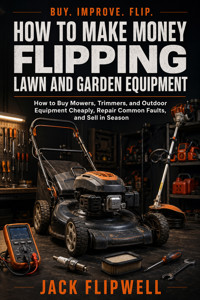
How to Make Money Flipping Lawn and Garden Equipment - How to Buy Mowers, Trimmers, and Outdoor Equipment Cheaply, Repair Common Faults, and Sell in Season ebook
JACK FLIPWELL
Uzyskaj dostęp do tej i ponad 240000 książek od 14,99 zł miesięcznie
- Wydawca: ALL-IN Rafał Płonkowski
- Kategoria: Biznes, rozwój, prawo•Biznes, rozwój
- Język: angielski
Can you make money buying and reselling used lawn and garden equipment? Yes, but not because every non-running mower is a hidden bargain. Real margin appears when you can buy the right machine at the right price, evaluate its condition accurately, control preparation costs, and sell when buyers actually need the equipment.
How to Make Money Flipping Lawn and Garden Equipment is a practical guide to buying, improving, and reselling used mowers, trimmers, brush cutters, blowers, dethatchers, tillers, shredders, cordless tools, and other outdoor equipment.
The book walks through the entire process from the first listing to the final sale, with a strong focus on risk control, realistic numbers, and safe work.
You will learn how to identify machines with real resale potential and how to avoid projects that appear cheap only because they hide an expensive failure. The book shows you how to analyze listings, identify the exact model, check completeness, research parts availability, and calculate a maximum purchase price before emotion takes over.
Corded, cordless, and gas equipment are covered separately because each category carries different risks.
With corded equipment, you will learn what to inspect around cables, plugs, safety systems, working components, and basic mechanics. With battery-powered tools, you will learn how to separate the value of the bare tool from the value of the battery and charger, how to think about battery-platform compatibility, and why a used battery should never be valued optimistically without testing. With gas equipment, you will learn how to evaluate starting behavior, fuel-system symptoms, drive faults, leaks, engine operation, and service economics without automatically assuming the cheapest possible repair.
A major part of the book focuses on safety and the limits of DIY work. Flipping does not require you to become a professional mechanic, electrician, and battery technician at the same time. It does require knowing which jobs are appropriate for your own skill level, when professional service is the smarter option, and when a repair no longer makes financial sense.
You will get practical inspection frameworks for mowers, trimmers, brush cutters, blowers, hedge trimmers, dethatchers, tillers, shredders, pressure washers, and cordless equipment. You will learn to examine corrosion, wheels, self-propelled systems, cutting components, guards, cables, batteries, chargers, gearboxes, and missing accessories before paying.
The book also explains how to clean and prepare used outdoor equipment without hiding defects or damaging sensitive components. You will learn why cleaning is part of diagnosis, how to document before-and-after condition, which preparation tasks often create the best return, and when additional cosmetic work stops adding meaningful value.
One of the most important sections answers the question: repair or walk away?
You will learn how to compare the expected increase in resale value with the cost of parts, service, labor, waiting time, and remaining risk. You will also learn when selling the machine honestly as a repair project or donor can be a better decision than continuing to invest because previous money has already been spent.
Seasonality receives special attention because lawn and garden equipment does not move evenly throughout the year. Mowers, trimmers, dethatchers, tillers, and blowers can each have different demand patterns. The book shows how to buy outside peak demand, prepare inventory in advance, and avoid finishing a good machine after its strongest selling window has already closed.
You will also learn how to build listings that reduce buyer uncertainty. The book covers photography, exact model identification, honest descriptions, documenting tests, showing defects, pricing from current market evidence, and choosing between local collection and shipping.
The financial section goes beyond the simple difference between purchase and selling price. You will learn to track transport, parts, service, marketplace fees, cleaning materials, active time, storage, buyer negotiation, and days to sale. This helps separate projects that genuinely make money from machines that only look profitable because half the costs were ignored.
The final chapters cover complaints, failed flips, dead inventory, mistake tracking, transport systems, storage organization, model specialization, sourcing routines, simple dashboards, and scaling. You will learn how to move from random deals to a repeatable operating system without turning your garage into a warehouse full of unfinished machines.
This is not a book about buying every cheap mower you can find.
It is a book about making better decisions.
BUY. IMPROVE. FLIP.
This publication was prepared with the assistance of tools that support the creative process, including artificial intelligence-based solutions. The final concept, structure, and editing belong to the author.
Ebooka przeczytasz w aplikacjach Legimi na:
Liczba stron: 380
Rok wydania: 2026
Odsłuch ebooka (TTS) dostepny w abonamencie „ebooki+audiobooki bez limitu” w aplikacjach Legimi na:
Podobne



















INTRO
Lawn and garden equipment is one of those secondhand categories where dirt, neglected maintenance, and a relatively small fault can completely change how an item is valued. A mower that refuses to start after winter may be listed as "broken" even though the cause can sometimes be basic neglect rather than a major mechanical failure. A trimmer with a clogged head, a dull blade, an old battery, stale fuel, a damaged cable, or years of grass packed around the working parts can quickly stop looking like a useful machine and start looking like a problem the owner wants gone. For a flipper, the difference between the seller's problem and the next buyer's usable machine is where margin can appear.
That does not mean every broken mower or neglected garden tool is a deal. This category can punish poor buying decisions very quickly. An engine may have serious internal wear, a transmission may be damaged, a deck may be structurally corroded, a battery may be near the end of its useful life, electronics may have water damage, or replacement parts may no longer be available. One of the most expensive beginner mistakes is not performing a repair badly. It is buying a machine that should never have been purchased in the first place.
This book treats lawn and garden equipment flipping as a business process rather than a collection of repair projects. The key question is not whether you can take a mower apart. The key question is whether you can buy the right machine at the right price, assess its condition quickly, estimate a maximum preparation budget, complete only the work that makes economic sense, and sell it when the market actually wants it.
In practice, that requires several skills working together: sourcing, negotiation, condition assessment, basic cleaning and maintenance, cost calculation, sales photography, listing creation, and seasonal planning. You do not need to be a professional mechanic. You do need to understand where safe owner-level maintenance ends and where electrical, mechanical, battery, fuel system, or safety-related work should be handled by someone with the appropriate skills, tools, and qualifications.
Why Lawn and Garden Equipment Works for Flipping
The used lawn and garden equipment market has several characteristics that make it particularly interesting for resale. First, many machines are used intensively for only part of the year. Second, outdoor equipment gets dirty quickly, so it can look far older and more worn than it really is. Third, many owners delay routine maintenance until the machine begins performing badly or stops working altogether.
Storage is another major factor. Mowers, dethatchers, tillers, shredders, and other larger machines take up space. When someone buys a replacement, moves house, gives up a garden, sells a property, or simply decides they no longer need the machine, the old equipment can suddenly become an unwanted object taking up valuable room. At that point, the seller may care more about clearing space than achieving the highest possible price.
That is why it is useful to study not only the machine but also the seller's motivation. Phrases such as "not tested," "has been sitting for two years," "won't start after winter," "needs cleaning," "no time to fix it," or "must be collected quickly" can indicate opportunity. They can also indicate a serious fault. The flipper makes money by learning to tell the difference before paying.
Where the Value Really Comes From
Value in lawn and garden equipment rarely comes from one spectacular repair. More often, it is created through several small improvements performed in the right order. Thorough cleaning, removing packed grass, reinstalling missing or incorrectly fitted parts, replacing an inexpensive wear item, charging a battery, correcting a basic adjustment, verifying the main functions, and taking better photographs can dramatically change how a buyer sees the machine.
It is important not to confuse presentation with concealment. A machine should be sold according to its real condition. If the drive slips occasionally, the housing is cracked, the battery has noticeably reduced runtime, or further servicing is required, the buyer should know before the transaction.
Over time, the most valuable asset a flipper builds is trust. One transaction can produce a good result, but a business only begins when the process can be repeated without creating a growing trail of unhappy buyers, disputes, and hidden problems.
The Most Important Stage Happens Before You Buy
Beginners often start calculating after they have already collected the machine. That is too late. Most of the financial outcome is determined at the moment of purchase. Before driving to see a machine, you should know at least the approximate selling range of comparable working examples, the typical weak points of that type of equipment, the likely cost of basic preparation, and the highest purchase price at which the project still makes economic sense. You do not need a perfect valuation down to the last dollar or pound. You need a limit that protects you from emotional buying.
Season Is Part of the Product
Lawn and garden equipment is strongly tied to the moment when buyers begin needing it. A mower that sells quickly during a period of rapid grass growth may become much harder to move when most people have finished mowing for the year. A dethatcher, leaf blower, snow-related outdoor machine, shredder, or tiller can each have its own demand window.
That does not mean you should buy only when demand is at its highest. Sometimes the opposite is more profitable. Equipment bought out of season may cost less, but it takes up storage space and ties up capital. Seasonality therefore needs to be treated as part of the financial model, not as a minor detail.
A strong flip can have two different sources of advantage. The first is improvement in the physical condition of the machine. The second is moving the product from a time when few people want it to a time when many more buyers actively need it.
Not Every Type of Equipment Is Equally Good for Beginners
The simplest machine does not always produce the biggest profit, but it often gives the best opportunity to learn the process. A basic corded mower may be easier to assess than a complicated gasoline mower with self-propelled drive. A simple trimmer may let you practice sourcing, inspection, cleaning, testing, photography, and selling with less capital at risk.
Over time, you can move into more valuable machines. Gas mowers, cordless systems, dethatchers, tillers, pressure washers, shredders, and professional equipment can offer greater opportunities, but they also demand better diagnosis. As the potential margin increases, so does the cost of a bad assessment.
Extra caution is needed when most of the value is concentrated in an expensive battery, an electronic controller, an unknown engine, or a complicated drive system. A low purchase price provides no advantage if the most valuable component is worn out.
Gas, Corded, and Battery Equipment Are Three Different Worlds
It is a mistake to treat all lawn and garden equipment as one technical category. Corded electric, battery-powered, and gasoline machines have very different sets of common problems. With corded equipment, important areas include the power cable, plug, switches, safety systems, motor, and mechanical components. In cordless equipment, battery condition, charger compatibility, contacts, battery management electronics, and the machine's control system become critical. With gasoline equipment, you add fuel delivery, filtration, ignition, lubrication, and the mechanical condition of the engine.
None of this means a flipper should personally repair every possible fault. Quite the opposite. One of the most important skills is knowing when to stop diagnosing and pass the machine to someone qualified.
The Line Between Preparation and Repair
Cleaning the housing, removing grass, replacing an easily accessible wear item according to the manufacturer's instructions, or correctly fitting ordinary accessories is very different from working inside mains electrical circuits, opening battery packs, modifying fuel systems, or changing safety mechanisms.
Do not perform work that exceeds your knowledge, equipment, or working conditions. Lawn and garden machines can contain high-speed blades, spring-loaded components, hot engine parts, flammable fuel, mains voltage, and batteries capable of delivering very high current. A mistake can damage more than the machine. It can cause serious injury or fire.
If the manufacturer's procedure, local requirements, or the nature of the fault indicates that professional service is needed, include that cost in the deal or walk away. Flipping is not a competition to prove that every repair can be completed at home.
Test the Machine, but Do Not Experiment
Every purchase should have a basic inspection procedure. A cordless trimmer is checked differently from a gasoline mower, and a corded dethatcher is checked differently from both. The purpose is the same: determine whether the machine is complete, whether the main mechanisms show obvious damage, whether it can be tested safely, and whether the symptoms match the seller's description.
If a safe test is not possible, treat the machine as unverified. Do not assume it "will probably work." Your purchase price needs to reflect what you do not know.
It is especially dangerous to start equipment when the blade is loose, guards are damaged, cables are compromised, a battery is physically damaged, or the rotating mechanism appears jammed. Inspection comes before operation.
Completeness Matters More Than It First Appears
A seemingly minor missing part can completely change the economics of a project. It might be a grass bag, guard, cover, key, guide, special fastener, trimmer head, auxiliary handle, battery, or charger.
Do not look only at the main machine. Before buying, find out what was originally included in the working configuration and which parts are necessary for normal use. With older or less common equipment, the cost of a missing component may not even be the main problem. The real problem may be availability. A missing part that takes months to find can turn an easy flip into dead inventory.
Brand Helps, but the Model Matters More
A recognizable brand can increase buyer interest, but it does not automatically create a good deal. The same manufacturer may produce excellent models, difficult models, discontinued platforms with weak parts availability, and machines with very low secondhand value.
Evaluate the exact model, not just the badge on the housing. Check the availability of manuals, basic service parts, wear items, and accessories. With cordless systems, pay special attention to the battery platform. A machine using a battery shared with many current products may be much easier to sell than one tied to an obsolete system.
Do not assume that the market position of a model stays constant. Product ranges, battery platforms, parts support, and secondhand demand change. Current information should always be checked through manufacturer documentation and up-to-date market listings when it affects the buying decision.
The First Margin Is Created in the Conversation With the Seller
Good listings often leave out important details. Instead of immediately asking for the lowest price, you can learn much more by asking about the machine's history. When did it last work normally? Why did the owner stop using it? Did the fault appear suddenly? Was the machine stored outside? Has anything been repaired or replaced? Is the set complete? Can it be tested safely during collection?
The answers are not a guarantee, but they reduce uncertainty. They also give you a better foundation for negotiation. A lower offer should come from identifiable risk and expected preparation cost, not from randomly throwing out a number.
Do Not Buy a Project Just Because It Is Cheap
One of the most expensive phrases in flipping is: "At that price I couldn't leave it." You could. If you do not know what you will do with the machine, where you will store it, how much the parts cost, or who will buy it afterward, a low price alone does not create a deal.
Every item competes for three limited resources: cash, space, and time. A mower bought cheaply but sitting for six months ties up all three. That is why we will look not only at nominal margin but also at turnover. Sometimes a smaller profit on a machine that sells quickly is better than a larger theoretical profit on equipment waiting months for the right buyer.
Cleaning Is Part of Selling
Outdoor equipment responds extremely well to visual preparation. The difference between a mower collected straight from someone's shed and the same mower properly cleaned can be dramatic without any cosmetic restoration.
Removing dried grass, soil, dust, and surface grime lets the buyer see the true condition. It also helps the seller inspect cracks, corrosion, leaks, loose components, and other issues that were hidden beneath dirt.
Cleaning still needs to be controlled. Do not flood motors, electronics, bearings, electrical connections, or other sensitive components simply to make the machine look better in photographs. Check the manufacturer's recommendations and material compatibility before using strong cleaning chemicals.
Good Photographs Sell Confidence
A buyer looking at a used mower on a phone cannot touch it or run it. The photographs therefore have to replace part of the physical inspection. Show the machine from several angles, the working mechanism, wheels, handles, model identification, battery and charger if included, and all meaningful signs of wear. If there is damage, photograph it. Hiding a defect may increase the number of messages, but it does not improve the quality of the transaction. A clean background and good light matter more than sophisticated photography. The buyer should quickly understand exactly what is being sold and what condition it is in.
The Listing Should Answer Questions Before They Are Asked
A strong used-equipment listing should not read like an advertisement for a brand-new product. It should describe the actual machine being sold. Include the exact model, meaningful condition details, the work completed, the result of basic testing, the contents of the sale, and known faults. If you cannot confirm a function, say so instead of guessing.
It can also be useful to explain what was done before sale. "Cleaned, inspected, and tested in the following areas" is more credible than a vague statement such as "excellent condition."
Local Selling Is a Natural Channel
Much lawn and garden equipment is heavy, awkward, or difficult to package safely. A mower or tiller can often be sold much more efficiently locally than shipped. Local transactions have another advantage. The buyer can inspect the machine and, where conditions allow, see an appropriate safe demonstration. That reduces misunderstandings about condition.
Shipping is not always a bad option. Smaller tools may benefit from a national market. But you need to consider packaging, sharp and moving components, carrier restrictions, and rules applying to fuel, oil, and batteries.
Document Your Own Work
Beginners usually remember their first purchase in detail. By the tenth, purchase prices, parts, and selling dates start blending together. From the beginning, keep a simple record for every project.
Record the purchase price, transport, parts, cleaning materials, service costs, platform fees, and other direct expenses. Also record the purchase and sale dates. Over time, this will show which equipment categories genuinely produce strong results and which only appear profitable.
As the activity becomes more regular, you should also check current tax, consumer, environmental, and business obligations. These vary by country, seller status, scale, and product type. Legal information should always be confirmed through current official sources.
You Do Not Need a Huge Workshop, but You Need a System
It is easy to start buying tools "just in case." Before long, workshop equipment can cost more than the first machines you intended to flip. A better approach is to build the setup gradually. Start with the tools needed for safe inspection, cleaning, and basic maintenance within your skill level. Add specialist tools only when your actual inventory justifies them.
Every new tool should solve a recurring problem. The same applies to spare parts and consumables. Inventory should speed up turnover, not create another collection of things that sit unused.
Profit on One Machine Is Not Yet a Business
One good transaction can result from luck. Repeatable flipping begins when the process from sourcing to sale can be described and used again. Over time, you should know how quickly you can evaluate a listing, how long a certain category usually takes to prepare, what purchase budget is safe, and which machines sell most easily in your local market. Your decisions become less dependent on intuition.
The goal is not to own the largest number of machines. The goal is to convert capital into carefully selected products, add value, and recover that capital with a margin.
How to Start Without Taking Unnecessary Risk
Your first few transactions should primarily teach you the process. They do not need to be the most profitable deals you will ever make. Start with machines whose basic operation you understand and where a mistake will not lock up a large share of your available cash.
Before the first purchase, prepare a place for inspection and cleaning, a simple cost log, and a sourcing routine. Set a maximum amount you are willing to risk on one project. That prevents one bad machine from stopping everything.
The main goal of your first few flips is to build your own operating system. After every sale, you should understand more clearly what to buy next, what to avoid, and which activities genuinely increase value.
The JACK FLIPWELL System
The whole book can be reduced to the three steps contained in the series name. BUY. Find equipment that the market currently values below its realistic value after preparation. Before paying, assess risk, parts availability, completeness, and likely demand.
IMPROVE. Remove dirt, complete safe maintenance, and perform minor repairs that fall within your skills. If specialist work is required, include professional service in the economics or walk away. Never conceal faults.
FLIP. Prepare the machine for presentation, take clear photographs, describe the real condition, set the price using the market, and list it at the right time. Complete the sale safely and record the actual result.
That is the meaning of the series motto: Find the Deal. Add the Value. Keep the Margin. The margin does not come from buying cheaply alone. It comes from the entire process.
Book Plan
The next twenty chapters take you from choosing your first machine to building a repeatable system for sourcing, preparation, and resale. Chapter 1. How the Used Lawn and Garden Equipment Market Works You will learn the main equipment categories, buyer types, sources of value, and the factors that determine what makes a good resale candidate.
Chapter 2. What to Buy and What to Avoid You will learn how to assess mowers, trimmers, dethatchers, tillers, blowers, shredders, and other equipment in terms of risk and resale potential.
Chapter 3. Seasonality and the Best Time to Buy and Sell We will build a strategy for buying when competition is lower and selling when real demand appears. Chapter 4. Where to Find Deals We will examine local listings, clear-outs, auctions, broken equipment, bundles, and other sourcing channels.
Chapter 5. How to Analyze a Listing Before Contacting the Seller You will learn to spot warning signs, missing information, and poorly presented listings where hidden value may exist. Chapter 6. How to Inspect Equipment Before Buying You will build a practical inspection process covering condition, completeness, safety systems, corrosion, wear, and the possibility of safe testing.
Chapter 7. Negotiating Price and Setting a Maximum Purchase Budget We will connect technical risk with purchase calculations so you do not destroy the margin before the work begins. Chapter 8. Corded Electric Mowers and Basic Mains-Powered Equipment We will cover common issues involving cables, mechanical systems, cutting components, and the limits of safe electrical diagnosis.
Chapter 9. Battery Equipment and Evaluating Used Batteries We will focus on battery platforms, chargers, battery condition, replacement costs, and the risks associated with lithium battery systems. Chapter 10. Gas Mowers and Gas-Powered Equipment You will learn the main areas of diagnosis, common causes of starting and running problems, and when professional service becomes necessary.
Chapter 11. Trimmers, Brush Cutters, Blowers, and Smaller Equipment We will examine compact equipment that is easier to transport, its typical wear points, and its potential for faster flips. Chapter 12. Dethatchers, Tillers, Shredders, and Specialist Equipment You will learn how to approach larger, more seasonal machines with smaller pools of potential buyers.
Chapter 13. Cleaning, Maintenance, and Safe Preparation for Sale We will build a preparation routine that improves condition and presentation without unsafe modification or concealment. Chapter 14. Minor Repairs, Parts, and the Repair-or-Walk-Away Decision You will learn which repairs make economic sense and which turn a good flip into an expensive project.
Chapter 15. Calculating Full Cost and Real Margin We will include purchase price, parts, transport, fees, time, storage, service, and risk so your profit is not an illusion. Chapter 16. Photos, Descriptions, and Building an Effective Listing We will create a repeatable standard for presenting used equipment clearly, honestly, and attractively.
Chapter 17. Pricing and Local Selling Strategy We will cover market comparisons, buyer negotiation, collection, demonstrations, and safely closing the transaction. Chapter 18. Storage, Transport, and Inventory Management You will learn how to reduce clutter, damage, frozen capital, and logistical problems as your inventory grows.
Chapter 19. Mistakes, Complaints, Risk, and Failed Flips We will examine the most common causes of losses and how to make decisions when a purchase turns out worse than expected.
Chapter 20. How to Build a Repeatable Lawn and Garden Equipment Flipping Business We will combine sourcing, seasonality, preparation, sales, performance tracking, and capital management into a system that can be scaled.
This book is not designed to teach you how to buy as many lawn mowers as possible. It is designed to teach you how to make better decisions. A good flipper does not ask only, "Can I fix this?"
A good flipper asks, "Should I buy this, how much can I afford to spend preparing it, who will buy it, and after the entire transaction, will enough margin remain to justify my money and time?" That is where professional lawn and garden equipment flipping begins.
Chapter 1 - How the Used Lawn and Garden Equipment Market Works
The used lawn and garden equipment market is far more diverse than it first appears. It includes corded electric machines, battery-powered tools, gas equipment, smaller handheld devices, larger seasonal machines, and semi-professional or professional equipment. Each group has different price dynamics, technical risks, buyer expectations, and resale potential. A flipper's first job is not to search for "cheap stuff." It is to understand where the gap exists between the current asking price and the machine's realistic value after proper preparation.
Lawn and garden equipment works well for flipping because owners often misjudge its real condition. A mower covered in dirt and grass can look nearly worn out even when the underlying machine is still mechanically sound. On the other hand, a machine with a clean housing and polished handles may hide expensive problems in the drive system, engine, electronics, or battery. The flipper's advantage comes from assessing the actual condition more accurately than the average market participant.
The Market Is Really a Collection of Smaller Markets
One of the biggest mistakes is treating all outdoor equipment as one category. A buyer looking for a lightweight cordless trimmer has very different priorities from someone maintaining a large property with a self-propelled gas mower. A person shopping for a dethatcher may use it only a few times per year, while someone looking for a professional brush cutter may expect heavy-duty performance.
For a flipper, that means segmentation matters. You do not need to understand every machine on the market. It is often more effective to master two or three categories so well that you can quickly recognize normal prices, common failure points, and models worth avoiding.
For example, you might focus on small electric mowers and battery platforms. Another flipper may specialize in gas mowers with self-propelled drive. Someone else may prefer brush cutters, trimmers, and blowers because they are easier to transport and store.
Specialization reduces bad buying decisions. Once you have watched dozens of similar listings, patterns become obvious. One model appears frequently and sells quickly. Another seems to sit for weeks. A third repeatedly appears in broken condition. That kind of specific market knowledge is more valuable than broad mechanical knowledge alone.
Who Sells Used Lawn and Garden Equipment
Sellers usually fall into several recurring groups. Each has a different motivation, and motivation often affects negotiation. The first group consists of owners replacing a working machine with a newer one. These items are often complete and easier to test. The price may be higher, but the technical risk is lower.
The second group consists of owners whose equipment has stopped working. Some know exactly what the fault is and do not want to pay for repair. Others have no idea what happened. This group can produce excellent opportunities, but it requires careful diagnosis.
The third group is clearing out a garage, shed, vacation property, or garden. For these sellers, reclaiming space may matter more than maximizing the price of every item. This can produce strong buying opportunities.
The fourth group includes people selling after moving, selling a home, giving up a garden, or changing how a property is used. The machine may be perfectly usable but suddenly unnecessary.
The fifth group includes regular traders and resellers. It is usually harder to find heavily undervalued equipment here because the seller understands the market better. However, bundles or repair projects can still be interesting.
Who Buys
Understanding the buyer is just as important as understanding the seller. You are not simply selling a mower. You are selling a solution to a specific problem. A buyer looking for a basic used mower may simply want an inexpensive way to maintain a small lawn. They are not looking for collector condition or flawless paint. They want something that starts, works predictably, and feels safe.
A buyer looking for cordless equipment may care heavily about battery compatibility. If they already own several tools from one platform, they may be happy to buy the bare tool without a battery. Another customer may need a complete ready-to-use kit.
An owner of a larger yard may care more about cutting width, drive assistance, and durability than cosmetic condition. A professional buyer may focus on parts support, maintenance history, and long-term serviceability. The better you understand the natural buyer for a machine, the easier it becomes to decide whether the machine deserves your money.
What Creates Value
The resale value of used outdoor equipment is rarely determined by one factor. The first factor is function. A machine that can be safely started and tested is usually easier to sell than one with an unknown condition.
The second is completeness. A mower without a grass bag, a cordless tool without the correct charger, or a trimmer without its guard can lose far more market appeal than the missing part's size might suggest.
The third is cosmetic condition. The machine does not need to be perfect, but clean, organized equipment inspires more confidence. The fourth is the brand and exact model. A recognizable name can help, but the specific model, parts support, and buyer reputation matter more.
The fifth is season. A mower can be easy or difficult to sell depending on when it is listed. The sixth is local demand. Large mowers may sell better in suburban or rural areas than in dense urban centers.
The seventh is the cost of a comparable new product. Every buyer has an alternative. If the price gap between used and new is too small, the used product becomes less compelling.
Technical Condition Is Not the Same as Cosmetic Condition
Lawn and garden equipment can be visually misleading. A machine may be covered in dust, grass, and mud while remaining mechanically sound. The reverse is also possible. A mower that has been carefully washed before sale may still have serious internal problems.
That is why it is useful to separate two evaluations. The first is cosmetic condition. This includes dirt, fading, scratches, surface corrosion, plastics, paint, and general appearance. The second is functional condition. This includes the motor or engine, transmission, bearings, cutting system, electrical cable, battery, charger, controls, and safety components.
The strongest flipping opportunity often appears when cosmetic condition is poor but functional condition is good or can be improved cheaply. The greatest risk appears when excellent cosmetics distract you from an expensive technical fault.
Poorly Presented Listings Can Create Opportunity
Some of the best deals do not look attractive in search results. A dark garage photograph, vague title, missing model number, or description such as "mower for repair" may reduce competition.
That does not mean every badly presented listing is worth buying. It means presentation affects the number of buyers who investigate the item. A flipper should learn to separate listing quality from product quality. A badly photographed machine can be excellent. A beautifully presented machine can be overpriced.
Searching with broad terms can also create an advantage. A seller may list "electric mower" without a brand or model. If you recognize the machine from the photograph, you may be able to evaluate it more accurately than buyers using only exact model searches.
Unknown Condition Is Not the Same as a Minor Fault
Phrases such as "not tested" or "I have no way to check it" need to be treated carefully. They do not mean "easy repair." Unknown condition means exactly that. The machine may have a small issue. It may also have a failure that destroys the economics of the entire project.
For untested equipment, you need a larger safety margin in your purchase price. The less you know before buying, the less you should be willing to pay. This is especially important with battery-powered and gasoline equipment. A worn battery, electronic failure, or serious engine problem can completely change the value.
Useful Condition Categories
A simple condition classification makes it easier to analyze listings quickly. Working and ready to use. The machine can be safely started and tested, and no obvious major faults are present. The flipping opportunity comes mainly from price, cleaning, presentation, and timing.
Working but neglected. The machine functions but is dirty, needs routine maintenance, has worn low-cost consumables, or is badly presented. This is often an excellent beginner category. Broken with a specific reported problem. The seller describes an issue or claims to know the diagnosis. Treat the information as a lead, not as proven fact.
Untested. There is no reliable confirmation of function. Risk is higher, so purchase price should be lower. Seriously damaged or incomplete. This may make sense as a parts donor or specialist project, but beginners should be cautious. This framework helps you decide which listings deserve deeper analysis.
Asking Price Is Not Market Value
A major beginner mistake is estimating value from the highest active listings. A seller can ask any amount. Until a buyer pays it, that number is only an expectation. When estimating the market, look at a larger group of comparable machines. Compare:
exact model,; power system,; drive,; completeness,; visible condition,; age,; accessories,; location. If a marketplace provides sold-price history, that is usually more useful than active asking prices. If you cannot see completed transaction prices, stay conservative. It is safer to assume a slightly lower selling price than to build the project around the most optimistic listing you can find.
Turnover Matters as Much as Margin
Imagine two projects. The first may produce a modest margin but similar machines sell quickly. The second has a much larger theoretical margin, but it is unusual and may take many weeks to find the right buyer.
Beginners often choose the second because they focus on nominal profit. Experienced flippers also think about how long their cash will be tied up. Fast turnover means the same capital can work repeatedly. Slow turnover creates storage, repeated buyer messages, price reductions, and less ability to buy new deals. That is why it is useful to record not only margin but also the number of days between purchase and sale.
The Value of Your Time
Time is a cost even if you do not pay yourself an official hourly wage. If you spend several evenings fixing one machine and the final margin is small, the project may be profitable on paper but weak as a business.
You do not need to calculate every minute precisely from day one. But it is useful to record the approximate time spent on: collection,; cleaning,; diagnosis,; sourcing parts,; repair,; photography,; listing,; meeting the buyer.
After a few transactions, you may discover that some machines are technically easy but absorb too much time. Others may require more capital but move through the process much faster.
Space Also Has a Cost
Outdoor equipment takes up room. One mower is not a problem. Ten mowers, several tillers, and a few shredders can completely block a garage. Do not buy equipment simply because it is cheap.
Every item should have a realistic path to sale. Be particularly careful with off-season inventory. Buying in the fall may produce attractive purchase prices, but the machine may sit until spring. If storage is limited, space becomes a serious economic factor.
Local Market Differences
The used lawn and garden market can vary greatly by location. Areas with many detached homes, gardens, and larger properties may have stronger demand for bigger machines. Dense urban areas may favor compact, lighter equipment that is easier to store.
Supply also varies. One region may have a large number of older gas machines. Another may be shifting quickly toward cordless platforms. Do not build your strategy only from national trends. The most valuable market information comes from the area where you are actually willing to buy and sell.
How to Build Your Own Market Map
Before buying aggressively, spend some time observing your target categories. Record: brand and model,; power type,; asking price,; condition,; included accessories,; location,; date listed,; date removed or last observed,; your own assessment of attractiveness.
After a while, patterns begin to appear. Some models will show up often and disappear quickly. Others will sit for weeks. That observation is one of the simplest ways to build a real local advantage.
The First Rule of This Market
You do not make money because you know how to repair equipment. You make money when you buy below a realistic post-preparation value and control the cost required to reach that value.
Sometimes the value comes from repair. Sometimes from cleaning. Sometimes from completing the set. Sometimes from better photographs and a clearer description. Sometimes from buying in the quiet season and selling when demand rises.
The best deals are often boring. The machine is easy to understand, the problem is simple, the cost is predictable, and the buyer is obvious. Those are exactly the kinds of projects worth finding repeatedly.
Chapter 2 - What to Buy and What to Avoid
The financial result of a flip is largely determined before the machine is purchased. You can clean beautifully, take excellent photographs, and negotiate strongly with buyers, but none of that will rescue a project whose economics were wrong from the beginning. In lawn and garden equipment, making money starts with rejecting most opportunities.
A good resale candidate does not have to be the cheapest machine. It should have a predictable resale value, acceptable technical risk, available parts, an identifiable buyer, and preparation costs that make sense relative to the likely selling price.
Five Questions Before Every Purchase
Before you drive to see a machine, answer five questions. Do I know what a comparable working machine can realistically sell for?; Can I identify the most likely technical risks?; Are basic replacement parts and consumables available?; Can I safely transport, store, and prepare the equipment?; Is there enough room between purchase price and realistic selling price to cover costs and risk?
If several answers are "I don't know," the machine is not automatically a bad deal. But you are buying more uncertainty. That uncertainty needs to be reflected in the price.
A Good Beginner Category: Simple Electric Mowers
A small corded mower can be a sensible entry point. The construction is often simpler than a gas mower, transport is manageable, and the buyer pool can be broad. The most interesting examples are complete but neglected.
Dirt, a clogged grass box, worn cosmetics, and poor listing photographs may reduce the seller's price without indicating a major failure. Be cautious, however, with damaged cables, plugs, switches, or signs of overheating. Mains-powered electrical equipment can create shock or fire risk. Repairs involving internal electrical circuits should be handled by someone with the appropriate competence and according to relevant safety requirements. Do not assume a machine that "only hums" has a minor problem. The same symptom can have several causes.
Battery Equipment: Attractive, but the Battery Changes Everything
Cordless equipment can be attractive because buyers often build entire tool collections around one battery platform. A mower, trimmer, blower, and hedge trimmer may all use the same batteries. This means the bare tool may have value even without a battery.
At the same time, the battery is one of the most expensive and difficult components to assess. A battery can look perfect, accept a charge, and still have poor usable capacity. It can also fail under load.
When buying, pay attention to: exact battery platform,; voltage system,; number of batteries,; rated capacity,; correct charger,; physical battery damage,; swelling,; overheating marks,; unusual odors,; behavior during normal operation. Do not open lithium battery packs or attempt experimental cell repairs without proper qualifications, tools, procedures, and safety conditions.
Damaged lithium batteries can present a serious fire risk. If the battery condition is uncertain, do not build the entire deal around the assumption that it is still highly valuable.
Trimmers Can Produce Fast Turnover
Trimmers are easier to transport and store than mowers. During the growing season they serve a broad range of users who need to finish edges, work around fences, and reach areas a mower cannot.
Interesting examples are often complete but neglected. A dirty head, missing line, or a worn easy-to-replace consumable may be a manageable problem. Be more careful with: cracked guards,; bent shafts,; excessive vibration,; damaged cutting heads,; abnormal gearbox noise,; failed safety controls.
Gas brush cutters add more risks through the engine, clutch, gearbox, and drive shaft. Their long shape also affects shipping. The machine may be light but awkward and expensive to package.
Gas Mowers: More Potential and More Risk
Gas mowers are one of the most important used-equipment categories. They have a large buyer base and can retain practical value for many years when maintained correctly. They also contain more expensive failure points.
Areas to assess include: engine,; fuel system,; ignition,; self-propelled drive,; bearings,; cables,; height adjustment,; deck corrosion,; cutting system. For beginners, machines that can be started and tested are generally safer than equipment sold as "won't start." Do not assume every mower that fails after winter only needs fresh fuel. That is possible. It is not the only possibility.
Self-Propelled Drive Can Change the Economics
Self-propelled mowers are attractive to many buyers, especially on larger or sloped properties. The drive system also creates another layer of risk. If the drive is weak or nonfunctional, the problem might involve:
adjustment,; cable,; belt,; wheels,; gearbox,; another drive component. Do not guess the repair cost from the symptom alone. On a low-value mower, a failed transmission can consume most of the potential margin. A faulty drive should therefore reduce your maximum purchase price substantially.
Dethatchers: Seasonal but Interesting
Dethatchers are a good example of equipment with a relatively narrow high-demand window. Owners use them less often than mowers. That creates both opportunity and risk. Outside the main demand period, sellers may be motivated to clear storage space.
During the right seasonal window, a good machine can attract buyers quickly. The important areas include: working shaft,; springs or blades depending on design,; depth adjustment,; motor,; housing,; grass collection system if fitted. Do not build a large inventory of these machines without a plan. Missing the seasonal sales window can leave them sitting for months.
Tillers: Higher Value, Higher Cost of Error
Tillers can offer attractive margins because individual machines may have higher resale values. They are also heavier, harder to transport, and more heavily stressed mechanically. Before buying, carefully inspect: working tines,; gearbox,; wheels,; handles,; frame,; engine if gas powered.
A serious gearbox failure can completely destroy the deal. Beginners should be particularly cautious with tillers showing: loud gearbox noise,; major oil leakage,; seized working systems,; heavy structural damage,; unclear repair history. Transport also matters. Do not buy until you know how you will move the machine safely.
Shredders: Focus on the Working Mechanism
Garden shredders can have good resale value, but the working mechanism deserves careful attention. Internal components operate under significant load. Do not start a shredder if: guards are damaged,; cutting parts are loose,; the mechanism appears severely jammed,; required safety components are missing.
The machine should be checked according to manufacturer procedures before testing. Completeness matters heavily. A missing collection box, pusher, safety cover, or dedicated component can reduce both usability and buyer interest.
Blowers and Garden Vacuums
Blowers are easier to store and transport than larger machines. Cordless blowers can be especially interesting if sold with a battery belonging to a popular platform. Check: fan condition,; housing,; tubes,; controls,; battery system,; unusual noise,; vibration. Machines combining blower, vacuum, and shredding functions have more systems to fail. More functions mean more things you need to verify before purchase.
Hedge Trimmers
Hedge trimmers are attractive from a logistics perspective, but mechanical condition matters greatly. Blades can be: dull,; bent,; corroded,; chipped,; damaged through misuse. Check guards, handles, and safety controls as well.
A machine with a failed safety mechanism should not be treated like a simple cosmetic project. Do not experiment with blade alignment or cutting components unless you understand the exact machine and proper procedure.
Pressure Washers as a Related Category
Pressure washers are not always classified strictly as garden equipment, but they often appear in the same secondhand channels and serve the same buyers. They can be interesting flipping products.
Important areas include: pump,; high-pressure hose,; trigger gun,; lance,; connectors,; leaks,; pressure behavior. A missing dedicated accessory can require an expensive replacement. Do not assume that "the motor runs" means the machine is fully working. A meaningful test requires normal operating conditions and appropriate water supply according to the manufacturer's instructions.
Robotic Mowers Are Not a Beginner Category
Robotic mowers can have high values, but their diagnosis is significantly more complex. You may need to evaluate: battery,; electronics,; sensors,; charging system,; base station,; software,; account ownership,; perimeter system,; installation accessories.
Some models may be linked to user accounts, anti-theft systems, or manufacturer services. Before purchase, confirm that the machine can be legally and properly transferred to a new owner. Do not buy with the plan of bypassing account security, anti-theft protection, or access restrictions.
A robot mower without its base station, with an unknown battery, and without a complete test can look cheap only because the new version is expensive. That does not make it a good flip.
Professional Equipment
Professional mowers, brush cutters, and other machines can retain high resale value. They can also have far more operating hours than domestic equipment of the same age. A clean appearance does not tell you how hard the machine has worked.
Professional buyers are often more demanding. They may care about: mechanical condition,; parts availability,; service history,; productivity,; durability. This category makes more sense when you understand the equipment or have access to a competent service partner. Randomly buying expensive professional equipment is unnecessary risk for a beginner.
Budget Brands and Unsupported Equipment
Very cheap machines can look attractive because the purchase price is low. But the value of a used machine is limited by the cost of a new replacement. If a similar new machine is regularly sold cheaply, a used one may not leave enough room for meaningful margin.
Parts availability can also be poor. With some products, it may be easier for a buyer to purchase a new machine than for you to source one specific replacement part. That does not mean budget brands should never be flipped. A working, clean machine bought very cheaply may sell quickly. You simply need realistic expectations.
An Older Quality Machine Can Beat a New Budget Model
Age alone does not determine value. An older, durable machine with strong parts support may be more attractive than a cheap new alternative. But do not romanticize old equipment. It may suffer from: corrosion,; mechanical wear,; parts scarcity,; outdated battery systems,; difficult serviceability. Evaluate the exact machine. Do not buy merely because "they used to build them better."
What Beginners Should Usually Avoid
Several groups deserve especially strong caution. The first is equipment with fire, major overheating, or flood damage. Even if parts of the machine look fine, the extent of hidden damage can be difficult to determine.
The second is equipment with serious safety-component damage. Missing guards, bypassed switches, or improvised safety repairs are major warning signs. The third is heavily corroded equipment where corrosion affects the structure.
The fourth is severely incomplete equipment that cannot be properly tested. The fifth is machines modified by unknown previous owners, particularly with improvised wiring, nonstandard safety systems, or poorly fitted components. The sixth is equipment with questionable ownership or origin. Missing or deliberately destroyed serial identification, inconsistent ownership stories, or other suspicious circumstances should make you walk away.