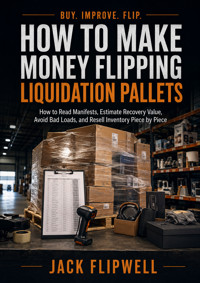
How to Make Money Flipping Liquidation Pallets - How to Read Manifests, Estimate Recovery Value, Avoid Bad Loads, and Resell Inventory Piece by Piece ebook
JACK FLIPWELL
Uzyskaj dostęp do tej i ponad 240000 książek od 14,99 zł miesięcznie
- Wydawca: ALL-IN Rafał Płonkowski
- Kategoria: Biznes, rozwój, prawo•Biznes, rozwój
- Język: angielski
Liquidation pallets can look like ready-made profit. A manifest may show dozens of products and an impressive retail total while the auction price sits far below the original store value. The real problem begins after delivery, when part of the inventory turns out to be damaged, incomplete, untested, difficult to sell, or far more labor-intensive than the original spreadsheet suggested.
How to Make Money Flipping Liquidation Pallets is a practical guide to building a resale business around customer returns without relying on luck, mystery-box excitement, or unrealistic retail-value calculations.
JACK FLIPWELL shows how to separate retail value from market value and recovery value, how to identify the products that actually drive the economics of a pallet, and how to calculate a disciplined maximum bid before an auction begins. Instead of buying based on a simple percentage of retail, you will learn how to build base, optimistic, and stress scenarios and test whether a load still makes sense when several high-value products fail.
The book walks through the complete operating process. You will learn how to evaluate liquidation suppliers, understand grading systems, read manifests, identify value concentration, prepare a receiving area, audit incoming inventory, assign internal product IDs, and run triage.
You will also learn how to test products within safe competence boundaries, clean and prepare returns properly, evaluate missing accessories, decide whether repair is economically justified, and determine when an item should instead be sold damaged, used for parts, or removed from normal resale.
A major part of the book focuses on piece-by-piece resale. You will learn how to price individual units using current market data, choose the correct sales channel, create honest photographs and descriptions, define target, fast-sale, and floor prices, package products correctly, manage shipping costs, and handle customer returns without losing track of the true pallet result.
Separate chapters cover inventory aging, dead stock, cash flow, break-even, ROI, result per hour, predicted versus actual recovery, and supplier-level performance. The goal is to stop judging the business by warehouse volume or gross sales and start measuring how quickly capital is recovered, how accurately loads are valued, and how much profit remains after real costs.
The book also shows how to build your own database of suppliers, categories, and SKUs so that every purchase becomes better informed than the one before it. You will learn when specialization improves your edge, when to pause buying, how to control backlog, and how to scale through better throughput instead of simply buying more pallets.
Safety, compliance, and responsible resale are also built into the model. The book covers issues such as account locks, previous-user data, batteries, counterfeit risk, product recalls, professional repair boundaries, marketplace restrictions, and changing legal or tax obligations. It does not encourage hiding defects or performing unsafe repairs. The business model is based on better information, better operations, transparent listings, and controlled risk.
This is a book for readers who want to approach liquidation pallets as a business rather than a lottery.
If you want to learn how to:
• read liquidation manifests,
• estimate recovery value,
• identify bad loads,
• set a MAX BID,
• process customer returns,
• resell inventory piece by piece,
• control cash flow,
• measure the true result of each pallet,
this guide takes you through the full cycle from auction analysis to final closeout.
BUY. IMPROVE. FLIP.
Find the Deal. Add the Value. Keep the Margin.
A practical guide to making money with liquidation pallets and customer returns. Learn how to read manifests, estimate real recovery value, set a maximum purchase price, avoid bad loads, test and prepare products, sell inventory piece by piece, manage aging stock, control cash flow, and measure the true result of every pallet.
A pallet with $20,000 in stated retail value is not automatically a deal.
The real question is:
How much can you actually recover?
In How to Make Money Flipping Liquidation Pallets, JACK FLIPWELL shows how to analyze manifests, verify secondary-market prices, estimate recovery value, and calculate a maximum bid before you enter the auction.
You will learn how to:
• spot red flags,
• evaluate condition and completeness,
• receive and sort pallet inventory,
• test products safely,
• create honest listings,
• choose the right sales channel,
• control returns, aging, and dead stock,
• measure the true result of every load,
• scale without destroying liquidity.
This publication was prepared with the assistance of tools that support the creative process, including artificial intelligence-based solutions. The final concept, structure, and editing belong to the author.
Ebooka przeczytasz w aplikacjach Legimi na:
Liczba stron: 316
Rok wydania: 2026
Odsłuch ebooka (TTS) dostepny w abonamencie „ebooki+audiobooki bez limitu” w aplikacjach Legimi na:
Podobne















INTRO
A Pallet Is Not a Deal. A Properly Priced Risk Might Be
Liquidation pallets can look like one of the simplest resale models available. You buy a large batch of merchandise far below its stated retail value, unpack it, list the individual items, and keep the difference. The photos may show televisions, power tools, coffee machines, headphones, toys, household appliances, and stacks of cartons. The spreadsheet beside the listing may show an impressive total retail value. It can look like a warehouse full of ready-made margin.
The problem is that retail value is almost never the same thing as the amount you can actually recover. Some products may have been used. Some may be damaged. Others may be missing power supplies, remotes, accessories, packaging, or mounting hardware. Some may work perfectly but show enough wear that their realistic resale price is far below the current price of a new unit. A manifest may be highly detailed, only partially accurate, or little more than a rough inventory list. In some loads, you do not truly understand the merchandise until the pallet arrives and the boxes are opened.
That is why liquidation pallet flipping is not a business of buying as much merchandise as possible for as little money as possible. It is a business of buying uncertainty at a price low enough to leave room for mistakes.
That distinction matters. A disciplined buyer does not begin with the question, "What was this merchandise worth at retail?" The better question is, "How much money can I realistically recover from this specific load after accounting for condition, missing parts, selling fees, transportation, returns, labor, and inventory that may never sell?" Only after answering that question should you ask what you are willing to pay. That is the mindset this book is built around.
What You Are Really Buying
When you buy one used item from an individual seller, you can usually inspect photographs of the exact unit, ask questions, check the model number, and decide whether the asking price justifies the risk. A liquidation pallet is different. One purchase can transfer dozens, sometimes far more, individual resale problems into your business at once.
Every product has its own condition, demand, price, handling cost, and probability of being returned. A pallet should therefore be viewed not as one product, but as a portfolio of small assets with different levels of quality.
Inside the same load, you may find items that sell quickly with strong margins. Others may work properly but have weak demand. Some may only become attractive after a missing accessory is replaced. Others may have value strictly as parts. A few may have almost no commercial value at all.
The result of the pallet is the sum of all those outcomes. This means a good pallet does not need to contain only perfect merchandise. A batch with some defective units can still make sense if the purchase price properly reflects the true risk profile. If you buy low enough and recover value efficiently from the better units, the load can still perform well.
The opposite is also true. A pallet full of attractive brands can be a terrible purchase if the price is too high. The products may be good. The pallet may look good. The listing may sound good. The deal can still be bad.
A Customer Return Does Not Describe Condition
One of the most expensive beginner mistakes is treating the phrase "customer return" as a condition grade. It is not. A return might be an almost unused product that a buyer sent back after briefly opening the box. It might be a product with damaged packaging. It could also be a heavily used item, an incomplete unit, a defective device, or a product returned because the buyer believed something was wrong with it.
Exact classifications vary by supplier, marketplace, retailer, and liquidation source. The terminology is not universal. A label used by one company may mean something entirely different at another. Never base your valuation on the condition label alone.
If a source uses terms such as customer returns, overstock, shelf pulls, open box, untested, salvage, or a proprietary grading system, read the supplier's actual definition before buying. If you operate in a market that uses different terminology, the same principle applies. What matters is the supplier's definition, not what you assume the label means.
The word "untested" does not mean "working." It means the result of a proper test has not been confirmed. That distinction is critical because beginners often turn missing information into optimistic assumptions. Professional buying does the opposite. The less you know, the more safety margin you need.
A Manifest Is a Tool, Not a Promise of Profit
A manifest is a list of merchandise assigned to a load. Depending on the supplier, it may include product names, model numbers, SKUs, quantities, stated retail values, condition classifications, categories, and other identifying information.
A strong manifest is extremely useful. It allows you to analyze the pallet before spending money. You can identify which items have active resale markets, which are expensive to ship, which are losing value quickly, which depend on costly accessories, and which few products account for most of the economic value of the load.
But a manifest should never be treated like a spreadsheet of guaranteed future revenue. The retail value shown may be MSRP, an old selling price, an internal system value, or some other reference figure. It does not automatically represent the price you can obtain for a returned unit today. Even if the model is identified correctly, the actual item may be incomplete, damaged, or nonfunctional.
A more developed model can include multiple outcomes. The item may sell as fully functional, incomplete, cosmetically worn, defective, parts-only, or not sell at all. A better analysis therefore does not depend on one perfect outcome. It considers several possible states and either assigns reasonable weights to them or uses a deliberately conservative base case. The goal is not mathematical perfection. The goal is to stop pricing uncertainty emotionally.
Recovery Value Matters More Than MSRP
The liquidation business makes it very easy to become impressed by a large number labeled retail value. If a pallet supposedly contains merchandise worth many times the asking price, the opportunity can look obvious.
That number can be almost useless without context. Imagine a manifest containing an older device that once sold at a high price. If the market is now full of newer versions, the true resale value of the old model may be dramatically lower. If the returned unit is also missing packaging and accessories, the difference becomes larger still.
That is why we will repeatedly return to the concept of recovery value. The important question is not what the merchandise was worth in the past. The important question is how much cash you can reasonably recover from it now.
Do Not Buy a Percentage of Retail
In liquidation, you will often hear thinking such as, "This pallet is only a small percentage of retail." That ratio can be useful as a quick reference, but it says very little by itself about the quality of a purchase.
Two pallets can carry the same declared retail value and still have completely different economics. One may contain popular, compact, easy-to-test merchandise. The other may be filled with bulky, seasonal, incomplete, or difficult-to-ship products.
The first may convert into cash quickly. The second may occupy warehouse space for months. This book will not build a buying strategy around the idea that a specific percentage of retail is automatically a good deal. Every load has to be evaluated according to its actual inventory, liquidity, condition profile, and operating cost. The purchase price should be the result of the expected economics. Not the starting assumption.
Profit Is Created After the Purchase, but Protected Before It
A large amount of the work begins only after the pallet arrives. The load must be received, documented, counted, matched to the manifest, visually inspected, tested where safe, cleaned, completed, photographed, described, priced, listed, packed, and shipped.
But one of the biggest influences on the final outcome was decided before you clicked Buy or placed the winning bid. You can be excellent at photography and listing copy, but if you paid too much for the pallet, operational skill alone may not be enough to rescue the margin.
That leads to one of the core principles of this book: You build margin through resale, but you protect it at purchase. Your advantage should not be confidence that you can somehow sell everything.
Your advantage should be the discipline to walk away from loads whose economics do not leave enough room for uncertainty. The best purchase you make on a given day may be no purchase at all.
Piece by Piece Is Where Value Is Created
Pallets are purchased in bulk, but much of the value is usually recovered at retail. That is the core of the piece-by-piece model. You buy one load and then break it into dozens of individual transactions. Every product receives its own condition assessment, price, photographs, description, and selling channel.
That takes work. But the work is exactly what separates you from the buyer who wants to flip the entire pallet unopened. Value can be added through very simple activities: correctly identifying a model, safely cleaning the exterior, sourcing the right cable, taking clear photographs, documenting a defect, separating a valuable set into more logical pieces, or combining compatible components into a more useful bundle.
Not every improvement requires repair. In many cases, information creates the biggest increase in value. An item sold in bulk as untested carries a high degree of uncertainty. The same item, after a proper and safe functional test, may become much easier to sell because the end buyer no longer has to absorb the same level of risk.
But competence boundaries matter. Basic visual inspection, organizing accessories, manufacturer-recommended cleaning, and simple user-level functional testing are one thing. Repairs involving mains electricity, high-risk batteries, gas systems, refrigeration circuits, or other systems requiring specialized knowledge should be left to people with the proper qualifications and equipment. Do not increase recovery value by creating a safety problem.
The Biggest Profit Does Not Always Come From the Most Expensive Items
Beginners naturally focus on the most expensive products in a manifest. If a pallet includes a television, laptop, premium tool kit, or other high-ticket item, it begins to dominate the entire analysis.
That can be dangerous. If the economics only work when two or three expensive units are in excellent condition, the risk is heavily concentrated. One failed unit can change the result of the entire load.
A healthier pallet may rely on a broader group of products that can produce value independently of one another. This does not mean you should avoid high-ticket items. It means you should know how much of your expected result depends on them. Throughout this book, we will analyze not just total value, but value concentration. If five products account for most of the expected recovery, you should know that before buying.
The Costs You Cannot See in the Pallet Photo
The purchase price is only the beginning. You may have to pay for inbound freight, your own pickup costs, storage, packaging, marketplace commissions, payment processing, customer shipping, parcel insurance, missing accessories, replacement parts, test equipment, and proper disposal of unsellable merchandise.
There is also the cost of mistakes. A customer may return the item. A package may be damaged. A product may fail a deeper test. The market price may decline before you get the listing live.
Then there is the cost of time. A pallet can show an attractive percentage margin and still be a poor business decision if it takes hundreds of low-value individual transactions to recover that margin. That is why we will look beyond percentage profit. We will also look at the speed of cash recovery and the amount of work required to produce it.
Capital Sitting on a Shelf Is Not Profit
A spreadsheet may show that your remaining inventory is worth a large amount, but until those products sell and the money returns to the business, part of that profit exists only on paper.
Pallets can freeze working capital surprisingly quickly. You buy another load before the previous one is mostly sold. Then another appears. The warehouse fills. Some products still have not been tested.
Others are waiting for photographs. New auctions continue to look attractive. This is why inventory control is essential. It is not enough to know what your warehouse is supposedly worth.
You need to know what the inventory cost, how much cash has already been recovered, how much remains unsold, how long it has been sitting, and whether the original recovery estimate is still realistic.
Inventory that does not move needs a decision. Maybe the price should come down. Maybe the channel should change. Maybe the product should be bundled. Sometimes accepting a small loss on one unit is better than keeping money trapped in an item that has little chance of selling at your original target. The goal is not to win every individual transaction. The goal is to operate a profitable portfolio of inventory.
The Worst Pallet Is Often the One You Really Want to Win
Auctions and limited-time offers create pressure. You see attractive brands. The price rises. You calculated a limit, but begin telling yourself that adding a little more will not matter. You already spent time analyzing the load, so walking away feels like wasted effort.
That is exactly when discipline matters most. Before the bidding starts, you should already know the maximum amount you are willing to pay after accounting for all additional costs. Once the market moves above that number, your participation ends.
Do not change your valuation because you want to win. Winning the auction is not the objective. Buying inventory at a price that properly compensates you for the expected recovery and risk is the objective.
The Supplier Is Part of the Business Model
The same category of liquidation pallet can have a completely different risk profile depending on the source. What matters includes: how manifests are created,; how condition is graded,; whether the listing shows the actual load,; how missing units are handled,; the claims process,; pickup terms,; transport arrangements,; transaction history.
That means we will evaluate suppliers, not just products. Before buying, read the current terms of sale. Pay particular attention to whether quantities are guaranteed, how manifest discrepancies are treated, whether merchandise is sold as is, what claims are allowed, and who bears responsibility for freight damage. Those terms change and differ from seller to seller. Do not assume that experience with one source automatically applies to another.
Less Transparency Requires More Margin
Not every pallet comes with a manifest. Sometimes you are buying based on photographs, a broad category description, or a short list of example items. That does not automatically make the pallet bad.
It does mean you have less information. Less information should not create a more optimistic valuation. It should create a lower maximum purchase price or a decision to pass. We will return to this rule repeatedly: Uncertainty has a price. If the seller transfers more unknowns to you, those unknowns should reduce what you are willing to pay.
Product Category Can Decide the Outcome
There is no single operating procedure that works equally well for every type of return. Clothing behaves differently from electronics. Power tools require different testing from toys. Small kitchen appliances have different shipping economics from furniture.
Children's products may involve additional safety and completeness concerns. Electronics may arrive with accounts, activation locks, missing power supplies, or batteries of uncertain condition. That is why category selection is part of strategy.
At the beginning, understanding one or two groups deeply is often more valuable than buying everything that looks cheap. Specialization creates advantages. You recognize models faster. You price more accurately.
You know which accessories matter. You learn the common failure patterns. You can build more efficient testing stations and keep the right materials on hand. Over time, you can expand. You do not need to become an expert in every item on the pallet on day one.
Receiving Is as Important as Buying
Delivery is the moment when uncertainty begins turning into data. Do not open everything randomly. First document the condition of the shipment. If the pallet, wrap, cartons, or outer packaging are damaged, photograph them before unpacking. Then count the merchandise, compare it to the manifest, assign your own internal identifiers, and move each item into an appropriate operational category.
A basic triage system might include: ready for sale after basic inspection,; needs testing,; incomplete,; needs safe cleaning,; needs further diagnosis,; suitable for parts,; supplier claim candidate where the purchase terms allow it,; unsellable or requiring proper disposal. This is a real operating checklist. Not a decorative list. If tested and untested inventory is mixed together, warehouse control will deteriorate quickly.
Test Only What You Can Test Safely
One of the best ways to increase the value of a return is to reduce the end buyer's uncertainty. If you can truthfully state that specific functions were tested, the offer becomes more credible. But the scope of the test should be clear.
Do not write "fully working" if you only confirmed that the device powers on. Describe exactly what was verified. For example, instead of claiming complete functionality after a short startup test, identify the specific functions checked and clearly state what was not tested.
Do not perform diagnosis or repairs beyond your competence, equipment, or qualifications. This matters especially with mains-powered devices, damaged batteries, heating elements, gas appliances, refrigeration equipment, and any other system that can create a safety hazard. If the product needs a specialist evaluation, use a qualified professional or sell it in its actual unverified condition where lawful and appropriate.
Honest Descriptions Increase Business Value
Flipping returns is not about hiding the reason an item ended up in liquidation. It is the opposite. A professional reseller often creates value by describing the product more accurately than the supplier who sold it as one anonymous unit in a large lot.
If the housing is scratched, show it. If the remote is missing, say so. If a test revealed a fault, describe it. If you are selling the item as defective or for parts, do not imply that it "probably only needs a simple fix" unless you have a factual basis for that statement.
Good photographs and clear condition descriptions reduce misunderstandings. They also attract the correct buyer, someone who accepts the real condition of the item. Do not build margin by exploiting information asymmetry against the customer. Build margin because you bought earlier in the chain, added useful information, organized the product, reduced uncertainty, and found the correct buyer.
Multichannel Selling Creates an Advantage
Not every product belongs on the same platform. Popular electronics may perform well on one marketplace. Bulky products may make more sense locally. Replacement parts may have their best audience in a specialized channel.
That is why the sales channel should be evaluated together with the product. Before listing, check current marketplace fees, return rules, seller protections, restricted product categories, and any other terms that affect the transaction. Platform policies change over time, so do not rely on assumptions from old experience.
The highest sale price is not always the best channel. If one marketplace produces a higher gross price but also carries higher fees, shipping costs, and return risk, a lower-priced channel may leave more money in your business. Always compare what remains after the transaction.
Speed Matters
Every product sitting in your warehouse is competing for your capital, space, and attention. The faster you can move it from delivery to an active listing, the sooner it has the chance to turn back into cash.
That is why the operating flow in this book will look like this: receive -> document -> identify -> triage -> test -> prepare -> photograph -> list -> sell -> ship -> reconcile
Every delay between those steps lengthens the cash recovery cycle. If you buy faster than you can process inventory, you create a backlog. A backlog in this business is paid-for merchandise that is not even available for customers to buy yet. That is one of the most expensive forms of inventory.
Do Not Scale Chaos
Your first pallets can be tracked in a simple spreadsheet. Record: purchase cost,; inbound freight,; products,; condition,; expected selling price,; actual selling price,; marketplace fees,; shipping,; final recovery. As inventory grows, control becomes more important.
Every item should be traceable to the load it came from. That way, several weeks or months later, you can calculate whether the pallet truly produced a good result instead of relying on the vague feeling that sales have been strong.
This becomes especially important when money from several loads begins to mix. You may sell one very profitable item from Load A, use the cash to buy Load C, and then incorrectly feel that Load C has already paid for itself because the account balance looks healthy. You need pallet-level accounting. Each load is its own investment project.
What We Will Measure
You do not need dozens of sophisticated metrics. You need a few measurements that improve decisions. One is actual recovery compared with predicted recovery. Another is the final result of the pallet after costs. Selling speed matters. So do the percentage of unsold inventory, the percentage of defective items, the cost of returns, and the number of products whose real condition was materially worse than expected.
You should also monitor your own valuation errors. If you repeatedly overvalue a certain category, the answer is not another pallet. The answer is a better model. Over time, your own operating history becomes one of your most valuable assets.
After enough purchases, you may know more about your true ability to recover value from a certain supplier or category than any general online guide can tell you. This book is designed to help you build that system.
The Roadmap
We will begin with the economics of the model and the places where margin is actually created and lost. Then we will move through liquidation sources, load types, data quality, and the correct way to read manifests.
Next, we will build a practical recovery value model. We will not buy according to declared retail value. We will look at real resale prices, likely condition, completeness, selling fees, preparation costs, logistics, and the risk that part of the inventory will not sell.
Then we will focus on selecting loads. You will learn to identify red flags, measure value concentration, evaluate supplier terms, and set a maximum purchase price before the bidding begins.
The next stage covers operations after delivery. We will build a receiving process, compare the actual inventory with the manifest, sort the merchandise, test it, clean it safely, complete useful sets, and decide what to do with every individual unit.
Then we will move into piece-by-piece resale. We will cover pricing, photography, descriptions, channel selection, packaging, shipping, customer service, and returns. Finally, we will treat the entire model as a system.
We will cover inventory control, cash flow, load-level profitability, scaling, specialization, automation, and the process of improving buying decisions through your own historical data. All of these topics lead to one core skill: the ability to price uncertainty better than the average buyer.
The Decision Model Before Every Purchase
Before buying a pallet, you should be able to answer a basic set of questions: What exactly am I buying, and how reliable is the information about the contents?; Which products account for the largest share of expected recovery?; What are the realistic resale prices for the condition I am likely to receive?; How many products may need additional work, missing accessories, or professional diagnosis?; What will inbound freight and piece-by-piece selling actually cost?; How much of the merchandise may be slow or difficult to sell?; How long is my capital likely to remain tied up?; What is my maximum purchase price under conservative assumptions?; What happens to the economics if several of the most expensive products are defective?; Do I still want the pallet after seeing all the costs, or do I want it because the listing feels exciting?
If you cannot answer most of those questions, that does not automatically mean the pallet is bad. It means the risk is higher. And higher risk should be reflected in a lower price.
The Most Important Advantage Is the Ability to Say No
There will always be another pallet. You do not need to buy everything. You do not need to win every auction. You do not need to begin with a warehouse full of inventory.
One well-analyzed load can teach you more than five impulsive purchases. At the beginning, your goal should not be maximum volume. It should be understanding the full cycle from purchase through the recovery of the final useful dollar from the load. Buy. Receive. Count. Inspect. Prepare. Sell. Reconcile. Learn. Then buy more.
The JACK FLIPWELL Principle
The liquidation pallet model is a perfect example of BUY. IMPROVE. FLIP. BUY does not mean buy anything cheap. It means buy when the price properly compensates you for the uncertainty you are taking on.
IMPROVE does not mean hide defects or perform unsafe repairs. It means create real value through identification, appropriate testing, safe cleaning, completing sets, documentation, presentation, and reducing uncertainty for the next buyer.
FLIP does not mean list everything and wait. It means match each product with the right price, channel, and customer so you can recover as much value as possible with controlled cost and time.
And the margin? The margin is not hidden inside the pallet. It comes from the gap between how the wholesale liquidation market values uncertain merchandise and how effectively you can break that uncertainty apart, investigate it, organize it, describe it, and turn it into individual, transparent offers. That is exactly what we are going to learn how to do.
Chapter 1 - Pallet Economics - Where the Margin Really Comes From
Buying a pallet of customer returns is very different from buying conventional wholesale inventory. In a normal wholesale order, you may purchase a known quantity of new products in predictable condition with a clear unit cost. A liquidation pallet contains a mix of items with different levels of completeness, technical condition, resale demand, and liquidity.
That means you cannot judge the margin simply by comparing the pallet price with the total declared retail value. The real economics begin with recoverable value. If a pallet costs $4,000 and the manifest shows $15,000 in retail value, that does not mean you are buying merchandise for roughly one quarter of its value. The realistically sellable contents might only be worth $7,000. After selling fees, shipping, missing accessories, and losses, perhaps only $5,000 remains.
What looked like a huge discount from retail may therefore leave you with a very small safety margin. The first job of a reseller is to separate three numbers: retail value,; expected selling value,; expected net recovery after costs. They are not interchangeable.
Retail Value Is Only a Reference Point
Stated retail value can be useful, but mainly as background information. It can show the scale of a load and help you identify which items were originally high-ticket products. It should not directly determine your purchase price.
The retail figure may represent MSRP, an old store price, a suggested retail price, or another value stored in the supplier's system. The secondary market works differently. A buyer compares your returned or used item with what is available today. The buyer does not care what the product cost two years ago. The buyer cares what a similar unit costs now and whether your item is competitive in condition, completeness, and selling terms.
That means two products with similar original retail prices can have completely different recovery values. One may still be popular, easy to ship, and simple to test. Another may be obsolete, bulky, seasonal, or dependent on expensive accessories. You are not buying MSRP. You are buying future cash flow.
Start With Gross Recovery Value
A basic pallet model should begin with a realistic estimate of what the individual items can actually sell for. Suppose a manifest contains 40 products. You do not necessarily need an extremely detailed analysis of every inexpensive item before bidding. Start with the products that account for the largest share of expected value.
If eight expensive items make up most of the pallet's potential recovery, getting those eight valuations right matters far more than perfectly valuing a handful of cheap accessories. For each important item, consider several outcomes.
Example: Product A might be worth: $500 if complete and fully functional,; $350 if functional but missing accessories,; $180 if defective but sellable for parts,; $0 to $50 if it has little practical resale value.
Before receiving the pallet, you do not know which outcome will occur. That means you should not automatically enter $500 into the spreadsheet. You need either a conservative baseline or a scenario model.
The Scenario Model
One of the most useful approaches is to divide possible outcomes into internal condition groups. For example: A - complete and working,; B - working with cosmetic wear or missing accessories,; C - partially working or requiring a minor completion step,; D - defective but valuable for parts,; E - little or no commercial value.
These do not need to match the supplier's grades. This is your internal economic model. Suppose you estimate that one particular item has: a 40 percent chance of being worth $500,; a 30 percent chance of being worth $350,; a 20 percent chance of being worth $180,; a 10 percent chance of being worth $0.
It means that under those assumptions, it is more rational to treat the item as contributing approximately $341 of expected value to the pallet than to treat it as a guaranteed $500 item.
The biggest problem with this model is not the mathematics. It is the quality of the assumptions. If you do not yet have your own historical results, your probabilities may be weak. That is why beginners should usually use conservative scenarios and larger safety margins.
A Conservative Model Is Better Than a Precise Model Built on Bad Assumptions
Beginners sometimes build sophisticated spreadsheets that produce results down to the cent. That can create false confidence. If the selling prices are too high, the defect rate is too low, and return costs are underestimated, a complex formula will not rescue the analysis.
A simple model with conservative assumptions is often more useful than a complicated model built on optimism. A particularly important rule is to use prices that can realistically be achieved, not the highest prices visible in active listings.
An active listing shows what a seller wants. It does not show what a buyer actually paid. If the marketplace provides completed or sold transaction data, that is usually much more useful. If it does not, compare several listings, competition levels, and how long similar products appear to remain available.
The Pallet Price Is Not the Full Acquisition Cost
Suppose you win a pallet for $3,000. If freight costs $600, your acquisition cost is not $3,000. It is already $3,600. If there is an auction premium, platform fee, handling charge, or another purchasing cost, the amount increases again.
Selling Costs Can Destroy an Apparently Good Margin
An item sold for $300 does not automatically contribute $300 to the pallet. Depending on the channel, you may pay: marketplace commission,; payment processing,; promoted listing fees,; shipping,; packaging,; shipment insurance,; preparation costs,; missing accessory costs,; return costs.
Not every cost applies to every transaction. That is why it helps to separate different types of expense. A percentage marketplace fee is a variable cost. A shipping box may be a unit cost.
Inbound freight is a pallet-level cost. Warehouse rent is a business-level overhead cost. If you want to know whether one particular pallet performed well, assign at least the costs directly created by buying and selling that load.
A Full Calculation Example
Consider a hypothetical pallet. Purchase price: $4,500. Inbound freight and buying fees: $700. Total acquisition cost: $5,200. After analyzing the manifest, you estimate that the merchandise can generate approximately $9,000 in gross sales.
That does not mean you have $3,800 in profit. Suppose you also estimate: $900 in marketplace and payment fees,; $450 in packaging and shipping costs not paid by customers,; $300 in replacement accessories,; $250 in expected losses from returns, markdowns, and damage.
The calculation becomes: $9,000 gross sales minus $900 selling fees minus $450 logistics minus $300 accessories minus $250 expected losses equals: $7,100 of net recovery before the pallet acquisition cost.
Subtract the $5,200 acquisition cost. Estimated result: $1,900. That is still a forecast. Not a guarantee. If the products sell more slowly than expected or several high-value items turn out to be defective, the result can fall sharply. That is why scenario analysis matters.
Good, Base, and Bad Scenarios
For larger loads, build at least three versions. Good scenario Most major products work, missing parts are limited, and selling prices remain close to your targets. Base scenario You receive a normal mix of working, incomplete, and defective merchandise. Some items require markdowns or extra work.
Bad scenario Several expensive units fail, sales take longer, some items require major discounts, and return costs are higher. The key question is: Can I still tolerate the deal if reality ends up closer to the bad scenario than the good one?
If the bad case produces a small, controlled loss while the base case produces an acceptable result, the risk may be manageable. If the bad case creates a major cash-flow problem, you need a much larger margin of safety.
Maximum Purchase Price
One of the most important numbers in this business is the maximum amount you are willing to pay for a load. It should be decided before the auction starts. You can work backward.
First calculate a conservative expected net recovery. Then subtract the profit, safety margin, and risk buffer you require. Example: Expected gross sales: $10,000. Expected selling and preparation costs: $2,000. Expected net recovery:
Do Not Raise the Limit During the Auction
In practice, walking away when you are slightly outbid can be difficult. The auction reaches your limit. Someone bids $50 more. You think: "It is only another $50." You bid again.
The other buyer responds. Within minutes, you can end up hundreds of dollars above the price supported by your analysis. This is the combined effect of sunk cost, competition, and emotional attachment.
Your earlier calculation did not become less accurate because someone else is willing to pay more. There are several possibilities. The competing buyer may: have a better recovery model,; use different selling channels,; have lower costs,; simply be overpaying. You do not need to know which explanation is correct. You only need to respect your own limit.
Percentage Return and Dollar Return
Two loads can look very different depending on whether you focus on percentage return or absolute profit. Pallet A costs $1,000 and produces a $400 result. Pallet B costs $8,000 and produces a $1,600 result.
Pallet A produces a stronger return relative to the capital invested. Pallet B produces a larger dollar amount. Which is better? It depends. If Pallet B locks up $8,000 for four months while Pallet A can be cycled several times in the same period, the smaller load may be a much more efficient use of capital. That is why ROI alone is not enough. You need time.
Capital Turnover
Imagine two models. Model One earns 20 percent on a load but takes six months to recover most of the cash. Model Two earns 12 percent but completes the cycle in six weeks.
The second model may be more attractive if it allows the same capital to be reused several times. That is why product liquidity matters so much. Inventory does not need the highest unit margin.
It needs the right combination of: margin,; selling speed,; predictability,; handling cost. A professional reseller does not ask only: "How much can I make?" The reseller also asks: "How long will my money be tied up?"
The Cost of Labor
One of the most commonly ignored inputs is time. Suppose you buy a pallet containing 200 low-value items. Every item requires some combination of: identification,; inspection,; cleaning,; photography,; description writing,; listing,; packing,; customer communication.