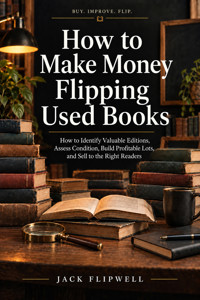
How to Make Money Flipping Used Books - How to Identify Valuable Editions, Assess Condition, Build Profitable Lots, and Sell to the Right Readers ebook
JACK FLIPWELL
Uzyskaj dostęp do tej i ponad 240000 książek od 14,99 zł miesięcznie
- Wydawca: ALL-IN Rafał Płonkowski
- Kategoria: Biznes, rozwój, prawo•Biznes, rozwój
- Język: angielski
How to Make Money Flipping Used Books is a practical guide for readers who want to turn secondhand-market knowledge into a disciplined and profitable process. The book takes the reader from sourcing and condition assessment through cost control, listing preparation, negotiation, safe delivery, and responsible scaling.
The author explains how to make decisions with numbers, reduce avoidable risk, and protect margin. Instead of promising effortless profit, the book provides concrete buying criteria, inspection routines, documentation practices, and methods for presenting an item so buyers can decide with confidence. The chapters form a repeatable system that can be adapted to different budgets, local markets, and available time.
This guide is written for first-time resellers, people building an additional income stream, and experienced operators who want a more consistent workflow. It helps readers separate a low price from a genuine opportunity, plan the work before buying, and build the credibility needed to complete sales with fewer disputes.
This publication was prepared using tools that support the creative process, including AI-based solutions. The final concept, structure, and editorial work belong to the author.
Ebooka przeczytasz w aplikacjach Legimi na:
Liczba stron: 322
Rok wydania: 2026
Odsłuch ebooka (TTS) dostepny w abonamencie „ebooki+audiobooki bez limitu” w aplikacjach Legimi na:
Podobne














INTRO
Books One Person No Longer Wants Can Be Exactly What Someone Else Is Looking For
Used books are one of the most accessible categories in the resale market. You do not need a large starting budget, specialized equipment, expensive transportation, or a dedicated warehouse to begin. Inventory can come from private collections, estate clearouts, thrift stores, charity shops, flea markets, library sales, online listings, garage sales, and boxes of books being sold for a fraction of their original retail value. At the same time, the difference between a book worth almost nothing and an edition that the right buyer will pay significantly more for can be surprisingly large.
That difference is not created simply because a book is old, thick, attractive, or expensive when new. Money is made when you can buy a specific book for less than its realistic resale value and connect it with someone who actually wants that exact product. The most important tool in this business is therefore not a bookshelf, scanner, or shipping box. It is the ability to select.
Used books also have an advantage over many other secondhand categories because they usually contain a great deal of identifying information. You may have the author, title, publisher, publication year, ISBN, language, binding, edition statement, translator, illustrator, series name, and sometimes printing information. Those details allow you to compare copies more accurately and determine whether the book in your hand is really the same version as the one that sold for a particular price.
The problem is that inexperienced sellers often compare books that look similar but are not truly comparable. The same work may exist in dozens of editions. One may be a common mass-market reprint, while another is a first edition, limited printing, illustrated edition, signed copy, discontinued textbook, or version with a scarce original dust jacket. Searching only by title can therefore create a dangerously inaccurate picture of value.
This book will teach you to look deeper. The goal is not to build a business around stories of finding a priceless first edition at the bottom of a five-dollar box. Those discoveries can happen, but they are not a repeatable business model. A repeatable model comes from examining ordinary books efficiently and deciding which ones deserve to be purchased, researched further, combined into lots, sold individually, or left exactly where you found them.
The Biggest Mistake Is Buying Books Instead of Buying Demand
A new bookseller can easily start purchasing whatever looks interesting personally. An attractive cover, famous author, old publication date, unusual subject, or large format can create the feeling that a book must have value. The market does not pay for your feeling about the book. It pays according to the interaction between demand, supply, edition, condition, completeness, price, and convenience.
A book can cost almost nothing and still be a poor purchase. If hundreds of copies are available and listings appear faster than buyers absorb them, even a very low acquisition price may lead to dead inventory. On the other hand, an unimpressive technical manual, regional history, out-of-print textbook, exhibition catalog, niche reference book, or missing volume from a popular series may sell much more efficiently if buyers are actively searching for it and supply is limited.
One of the most important changes in mindset is moving away from the question, "Is this book valuable?" A better question is, "At this purchase price, in this exact edition and condition, is there enough demand to make the resale worthwhile?" That forces you to consider fees, time, competition, storage, shipping, and realistic selling prices instead of focusing only on what the book might theoretically be worth. That is the difference between thinking like a collector and thinking like a reseller.
Old Does Not Automatically Mean Valuable
Age is one of the most overrated signals in used-book selling. An old book can certainly be scarce and desirable, but it can also be old, common, damaged, incomplete, and extremely difficult to sell. Huge numbers of books were printed in large editions, and many have survived for decades or even centuries.
More important factors include the exact edition, printing, demand for the author or subject, availability of comparable copies, completeness, condition, binding, dust jacket, illustrations, maps, inserts, signatures, and numbering where relevant. In some markets, the translator, illustrator, publisher, series design, or specific cover variant can also make a significant difference.
You do not need to become a bibliographical expert before making your first purchase. You simply need to avoid using age as a substitute for research. When you find a book you cannot classify quickly, the correct response is not, "It looks old, so I will take it." The correct response is, "I need to identify exactly what this is." That habit alone can save a great deal of money.
There Is No Single Used-Book Market
Talking about "the used-book market" as if it were one market is misleading. Popular fiction behaves differently from academic textbooks. Children's books behave differently from photography monographs. Technical manuals, comics, regional histories, out-of-print reference books, signed editions, collectible books, and complete series all attract different types of buyers.
The buyers also have different motivations. Some simply want the cheapest readable copy. Others require a specific edition for a university course. Someone may be building a complete set by one author. Another buyer needs volume seven to finish a series. A collector may want one precise first printing with the correct dust jacket, while a parent may just want a convenient box of fifteen good books for a child.
That leads to one of the central principles of this book: you are not selling books to everyone. You are selling a specific book to a specific type of buyer.
The better you understand that buyer, the easier it becomes to decide where to list the book, what information belongs in the title, which photographs matter, how much documentation is needed, and whether the product should be sold individually or as part of a lot.
Profit Starts When You Buy
In flipping, much of the financial outcome is decided before the product is ever listed. If you pay too much, a great description and beautiful photographs cannot completely repair the economics. If you buy the right book with a healthy margin of safety, you gain room to negotiate, adjust the price, choose between sales channels, and recover your capital faster.
Every purchase should therefore be analyzed backward from the expected sale. First estimate a realistic selling price. Then subtract marketplace fees, payment costs where applicable, packaging, shipping expenses you expect to absorb, transportation or sourcing costs, preparation costs, expected discounts, and any other direct costs relevant to the transaction. Only after doing that should you determine the maximum amount you can afford to pay.
This becomes especially important with very cheap books. Buying for $1 and selling for $8 does not automatically mean you made $7. You still had to find the book, inspect it, transport it, clean or prepare it, photograph it, create the listing, store it, answer questions, pack it, and complete the transaction. Low-priced books can absolutely be profitable, but only when the process is efficient enough.
Turnover Matters as Much as Margin
Beginning sellers tend to focus on the gap between purchase price and selling price. Two books producing the same dollar profit can nevertheless have completely different business value. One might sell within days, while another could sit on a shelf for more than a year.
If capital and storage space are limited, faster inventory can often be more valuable than a theoretically higher-margin item. Capital recovered quickly can be deployed again. A book that sits unsold keeps both money and shelf space unavailable.
Throughout this book, we will therefore look not only at profit per book but also at turnover. The real economics of used books come from the combination of profit, probability of sale, selling time, amount of work, and storage requirements. A good sourcing opportunity does not always produce spectacular individual books. Sometimes the stronger advantage is a reliable source of easy-to-identify inventory that moves steadily through your system.
Why Lots Can Change the Economics
One of the most powerful skills in low-priced book selling is bundling. A single copy may not justify the time required to photograph, list, store, pack, and ship it. Five or ten carefully selected books may create a much more valuable product while requiring only one transaction.
The important phrase is "carefully selected." A random box does not become more valuable merely because it contains more books. A useful lot solves a specific buyer's problem. It might contain a complete author series, books for children at a similar reading stage, a group of language-learning materials, a collection about one specialized hobby, several volumes from the same academic subject, or a coherent starter library.
In that situation, you are selling more than the sum of the individual books. You are selling convenience. The buyer does not need to locate five sellers, compare five listings, and manage several shipments.
At the same time, not every book belongs in a bundle. A scarce volume, collectible edition, signed copy, or book with strong independent demand may lose value if buried inside an inexpensive lot. Learning what to separate and what to combine will be an important part of the system.
Condition Is More Complicated Than Good or Bad
Condition seems simple until you place two copies of the same book beside each other. One may have a nearly perfect cover but extensive highlighting inside. Another may have shelf wear on the outside but a completely clean text block. Different buyers will care about those defects in very different ways.
A used-book seller needs a repeatable inspection process. That includes checking the cover, spine, corners, text block, binding, stains, odors, moisture damage, writing, highlighting, stamps, ownership inscriptions, missing pages, loose sections, and any original inserts or accessories that should still be present.
Some defects are mainly cosmetic. Others can significantly affect usefulness, collectible value, storage safety, or resale potential. Books showing obvious signs of mold, serious moisture damage, biological contamination, or active pests require particular caution. These problems should never be disguised as ordinary wear.
The principle throughout this book will be simple: never try to make the description sound better than the physical book actually is. Improve what can safely and appropriately be improved, then disclose what remains.
Adding Value Does Not Mean Restoring Every Book
In BUY. IMPROVE. FLIP., the word "improve" does not mean that every product needs repair. With books, much of the value you add comes from identification, sorting, gentle cleaning, completing sets, accurate photography, better descriptions, and matching the product with the right buyer.
Removing surface dust, arranging a series correctly, verifying that every volume is present, and creating a clear listing can improve the commercial value of the inventory without changing the book itself. Professional restoration is something completely different. Improper glue, tape, chemicals, bleaching, pressing, ink removal, or amateur repair of historic bindings can permanently reduce value.
If you discover a potentially important or collectible book, sometimes the best action is to stop touching it. A conservator, experienced antiquarian bookseller, or other qualified specialist may be better positioned to advise on a valuable object. The reseller's job is not to perform specialized conservation without the knowledge required to do it safely. Knowing when not to improve something is itself an important skill.
Data Beats Intuition
Modern sellers have access to more market information than previous generations of book dealers could easily obtain. You can often identify editions, compare listings, study completed transactions, check current availability, and analyze competing offers within minutes. The danger is assuming that any number you find online represents market value.
A seller can list a book at almost any price. That does not mean a buyer will ever pay it. Where the marketplace provides reliable information about completed transactions, actual sales are generally more informative than unsold asking prices. Even then, you need to compare equivalent editions, similar conditions, and comparable sets.
You should look for ranges and patterns rather than one perfect number. A single unusually high sale may involve a signed copy, exceptional condition, rare dust jacket, special provenance, or a completely different printing. One extreme result should not become your purchasing assumption without investigation.
Market information also changes. Marketplace fees, search systems, selling rules, shipping options, and buyer behavior evolve. Publisher reprints can suddenly change supply. Popularity can rise or disappear. The methods in this book are designed to help you work with current data rather than depend on permanently fixed price lists.
ISBN Is a Tool, Not the Answer
ISBN is one of the best starting points for identifying modern books. Scanning a barcode can dramatically increase sourcing speed when you are working through hundreds of copies. It can help separate similar editions and quickly connect a physical book to marketplace data.
But ISBN does not tell you everything. It does not describe the individual condition of your copy. It may not distinguish every collectible variation, signature, dust jacket state, or included accessory. Older books may have no ISBN at all.
The system therefore needs two levels. Common modern inventory should be identified efficiently, often with ISBN as the starting point. Potentially valuable material requires closer examination of the title page, copyright page, printing statement, binding, jacket, illustrations, inscriptions, and any other edition-specific details. Speed is useful only when it remains accurate.
You Do Not Need to Memorize the Value of Every Book
A professional reseller does not succeed by memorizing the prices of thousands of titles. The market changes too quickly, and the category is far too large. A much better skill is learning the signals that tell you, "This deserves another thirty seconds of research."
Those signals may include a specialized subject, a small publisher, an out-of-print work, a particular edition, a complete series, an academic title, a regional publication, an exhibition catalog, a notable illustrator, a signed copy, or a genuinely limited edition. None of those features guarantees value. They simply justify additional attention.
That distinction is important. A good seller does not try to know everything. A good seller builds a system that reveals when more knowledge is necessary. Over time, repeated research becomes pattern recognition. Books that initially took ten minutes to evaluate may later take twenty seconds. That accumulated knowledge is one of the strongest advantages you can build.
Inventory Sources Become Part of Your Competitive Advantage
Books can be purchased one at a time, but scale usually comes from repeatable sources. Estate clearouts, moving sales, thrift stores, library sales, flea markets, auctions, classifieds, private collections, charities, booksellers clearing excess stock, and people disposing of entire home libraries can all create different types of opportunities.
Each source requires a different strategy. An online listing gives you time to investigate but exposes you to competition. A private collection may provide exceptional unit economics, but you might have to take unwanted inventory along with the valuable books. A thrift store offers low prices but can encourage overbuying simply because everything seems cheap.
As the business develops, the question often changes from "What is this individual book worth?" to "Does the best material in this collection justify buying the whole lot?" That requires thinking about the economics of the collection rather than mentally assigning an optimistic retail price to every spine.
One useful approach is to identify the books most likely to recover the acquisition cost quickly. If a small number of stronger items can return much of the capital, the remaining inventory may carry much less cash risk. It still consumes time and storage, but the financial structure of the purchase becomes easier to control.
A Warehouse Full of Books Is Not Success
Books are deceptive because individual copies seem small. A few dozen turn into a few hundred, and a few hundred eventually become shelves, boxes, rooms, garages, and storage units. Books are also heavy. Inventory that looks harmless on a spreadsheet can become a serious physical and organizational problem.
Storage should therefore be treated as a limited business resource. Every shelf needs to justify its use. A book with minimal value and very low probability of sale is not free inventory simply because you acquired it for almost nothing. It consumes space, complicates inventory management, and creates future work.
One of the most profitable skills in this business is rejection. An experienced seller can inspect a hundred books and buy ten. An inexperienced seller often buys seventy because each individual book seems inexpensive and potentially sellable. In the long run, missing one good book is usually less damaging than building a warehouse full of bad ones.
Your Photographs Are Evidence
Photographs of a used book perform two functions. They need to make the product attractive enough to consider purchasing, but they also document what the buyer is receiving. A single front-cover image might be acceptable in a catalog of new books, but it is weak documentation for a used copy whose value depends on condition.
A buyer should be able to see the front, back, spine, important corners, edges of the text block, and any meaningful defects. Higher-value books may also require photographs of the title page, copyright page, edition statements, signatures, numbering, dust jacket, maps, inserts, or other features supporting your identification.
Do not hide damage by choosing a convenient angle. If the book has a tear, stain, dent, or damaged spine, show it clearly. The listing may look slightly less perfect, but it attracts buyers who accept the real condition and reduces the likelihood of a dispute. The best used-book presentation does not create the illusion of a new copy. It creates confidence.
The Description Should Answer Questions Before They Are Asked
A good title and description save time for both sides of the transaction. The buyer should quickly understand what the product is, which edition is being sold, what binding it has, what condition it is in, and whether any important defects or missing elements exist.
Different categories require different details. Textbooks may need edition numbers and clarification about access codes. Sets require a complete list of included volumes. Collectible books may need information about the dust jacket, printing, signature, illustrations, or provenance. The description should focus on information relevant to the exact physical copy.
Marketing adjectives are usually less useful than facts. Words such as "rare," "unique," "collectible," and "exceptional" carry little weight if you cannot explain what specifically makes the book different from the alternatives. Precision sells better than exaggeration.
Price Is Not a Wish
Used-book marketplaces are full of ambitious asking prices. Some listings remain active for months or years because the seller is waiting for a buyer who may never appear. Using the highest active listing as your primary reference is one of the easiest ways to build dead inventory.
Your price should reflect the current market, supply, recent sales where available, condition, and your own selling strategy. If you prioritize turnover, you may price more competitively. If the book is genuinely scarce and you can afford to wait, a more patient strategy may be appropriate.
Pricing should also be reviewed. A listing that made sense six months ago may now be too expensive because more copies appeared. It could also be too cheap because supply disappeared. Pricing is a process, not a one-time decision.
Different Books Belong in Different Sales Channels
There is no single platform that is best for every used book. Popular inexpensive reading copies, academic books, specialist publications, large local lots, international titles, and collectible editions can perform very differently depending on the marketplace. Each channel attracts its own type of buyer and creates its own cost structure.
Marketplace fees, payment processing, seller protections, shipping rules, listing formats, and other requirements may change over time. Always check current official terms before building a business model around a particular platform. A book that looks profitable using old fee information may not be profitable under current conditions.
The most important consideration is whether the right buyer is present. A rare specialist book listed only where customers primarily want cheap reading copies may be difficult to sell at an appropriate price. A low-value paperback handled through an expensive, labor-intensive channel may be equally inefficient. Know your inventory, but also know where your buyers are.
Shipping Looks Simple Until Something Goes Wrong
Books are relatively robust compared with many products, but they are not indestructible. Corners can be crushed, paperback covers bent, dust jackets torn, text blocks soaked, and heavy books pushed through weak packaging. One careless packing decision can destroy the margin created through every previous stage.
Packaging should therefore reflect the book's value, weight, format, and vulnerability. A cheap paperback does not necessarily require the same protection as a heavy art monograph. A collectible book with a fragile dust jacket may require additional stabilization and moisture protection.
The goal is not to create expensive presentation packaging for every order. The goal is to find the lowest-cost method that still gives the product appropriate protection. That standard should become part of your operating process. Packaging cost also needs to be included before you purchase inventory. Small recurring expenses become significant when repeated hundreds or thousands of times.
We Will Build a System, Not Hunt for Treasure
The purpose of this book is to create a process you can repeat. We will begin with the economics of used books and the selection of profitable niches. From there, we will cover sourcing, rapid screening, edition identification, condition assessment, market pricing, and purchase calculations.
We will then move into adding value through safe preparation, building profitable lots, photographing products, writing effective listings, and choosing the right sales channels. Collectible and specialist books will receive separate attention because they require greater precision, stronger documentation, and more caution.
The final part of the system will address inventory control, storage, shipping, customer service, performance measurement, and scaling. The objective is not to own more and more books. It is to become increasingly skilled at owning the right books for the shortest reasonable time between purchase and sale.
Four Decisions Build the Entire Business
Nearly every used-book flipping decision can be reduced to four questions. First, what should you buy? You need products with enough demand and enough room between the acquisition cost and realistic resale value.
Second, how can you add value? That may mean identifying the exact edition, gently improving presentation, completing a series, building a lot, creating better photographs, or writing a more accurate listing. Improvement does not have to involve physical repair.
Third, where and to whom should you sell? The correct buyer and the correct marketplace affect price, selling time, fees, and the amount of explanation required. A product shown to the wrong audience may look undesirable even when its economics are excellent elsewhere.
Fourth, when should you walk away? You need to know when not to buy, when to reduce the price, when to bundle a book, and when to remove inventory that no longer deserves the space it occupies. Many losses come from refusing to make this final decision.
Most problems in used-book flipping can be traced back to one of these four choices. The wrong item was purchased. Value was added in a way the buyer did not care about. The wrong sales channel was selected. Or an unsold book was kept for too long. Learning to manage these decisions deliberately is what turns casual reselling into a business.
Learn How Not to Lose Before Trying to Maximize Profit
Beginners naturally focus on how much money a book might make. A more useful starting point is controlling how money gets lost. Most losses do not come from one spectacular mistake. They accumulate through dozens of small decisions.
You pay slightly too much. You buy a book with no real demand. You ignore fees. You underestimate shipping. You fail to notice highlighting. You let unsold inventory occupy a shelf for two years. You take an entire collection because the unit cost appears tiny, even though most of it has no practical resale path.
This book will consistently emphasize margin of safety. You do not need every deal. You do not need to win every auction or accept every collection. You do not need to make a decision within ten seconds when the information is not sufficient. Sometimes the most profitable answer is simply no.
Your Goal Is Not to Build the Largest Library
Imagine two resellers. The first owns several thousand books and constantly adds more, but cannot tell you how many regularly sell, how much capital is tied up, or which categories actually make money. The second owns several hundred carefully selected books, knows how long major categories typically take to sell, can estimate purchase limits quickly, and regularly removes inventory that no longer performs.
The second seller may have the stronger business despite owning far fewer books. Inventory count does not determine success. The quality and productivity of the capital sitting on your shelves do.
The business becomes more professional when finding cheap books is no longer enough to excite you. The better moment is finding books that fit your criteria. Cheap inventory is everywhere. Good inventory is selected. That distinction changes everything.
BUY. IMPROVE. FLIP.
The model used throughout this book is simple. BUY means purchasing based on demand, exact edition, condition, costs, and realistic resale value. It means refusing to let excitement replace arithmetic.
IMPROVE means adding value where the buyer actually notices it. That may involve safe cleaning, accurate identification, completing a series, building a coherent lot, better photographs, stronger descriptions, or more convenient presentation.
FLIP means putting the product in front of the right buyer, in the right channel, at a rational price, and recovering your capital efficiently. This model does not guarantee profit on every book. No honest business model can do that. It does create a more disciplined, measurable, and repeatable method for making decisions.
You do not need a secret list of titles that are always worth buying. Such a list would become outdated. You need a process that lets you evaluate the next book yourself. That is the process we are going to build.
Chapter 1 - How the Used-Book Market Really Works
The used-book market looks simple because the product is easy to recognize, store, and ship. In practice, it is made up of many smaller markets with different levels of demand, selling speed, condition sensitivity, and pricing behavior. The same book may be nearly worthless to an ordinary reader but interesting to a collector if it is the right edition. Your first skill is therefore not pricing. It is understanding who buys a particular type of book and why.
One of the biggest beginner mistakes is assuming that value comes mainly from age or original retail price. The secondary market works differently. Value comes from the combination of current demand, availability, exact edition, condition, completeness, and how easily the book can be replaced by another copy. If similar books are available everywhere, even a very low purchase price may not create an attractive flip.
Asking Price Is Not Market Value
You may find the same title listed for $10, $25, $70, and $250. That does not mean the book is worth any one of those amounts. An asking price is simply what a seller hopes to receive, and it may have no connection to what buyers are actually willing to pay. A single expensive listing should never be the foundation of a purchasing decision.
Where a marketplace provides completed-sales data, examine what comparable copies actually sold for. Make sure you are comparing the same edition, similar condition, and the same included materials. With older or collectible books, one small difference can completely change value. A signed copy, first printing, original dust jacket, or complete set should not be used as a comparison for an ordinary later edition.
If completed-sale information is unavailable, study current supply and the quality of competing listings. Look at how many copies are available, how aggressively sellers are pricing them, whether prices appear to be falling, and whether a new copy is still easy to buy. This does not give certainty, but it is far better than anchoring your decision to the highest number you happen to find.
Demand Matters More Than Rarity
Rarity alone does not create value. A book can be extremely difficult to find and still have almost no buyers. For a reseller, what matters is the relationship between supply and demand. The strongest situations usually involve enough active buyers and a limited number of available copies.
You can think of the market in four broad combinations. High demand with low supply is usually the most attractive. High demand with high supply can still work if you buy cheaply and compete through condition, price, presentation, or convenience. Low demand with low supply is often a trap because the book looks rare but may wait a very long time for a buyer.
Low demand with high supply is generally the weakest combination. These are often the books found in huge boxes being sold for almost nothing. You may be able to acquire them at a tiny unit cost, but cheap inventory is not automatically good inventory. A book that occupies a shelf for a year to produce a very small return may be less useful than a more expensive book that turns quickly.
The New and Used Markets Are Connected
Before buying a used book, check whether the same or a comparable edition is still easily available new. If a new copy costs only slightly more, many buyers will choose new. The used copy must then compete through price, immediate availability, condition, or a feature the new edition does not provide. Ignoring the primary market often leads sellers to price used books far too close to new retail.
The situation can change when a title goes out of regular distribution. A lack of reprints may reduce supply and move buyers toward the secondhand market. That does not automatically raise value because demand may disappear at the same time. Demand must exist first. Limited supply matters only after that.
Also check whether a newer edition has replaced the one you are considering. In fiction, an older edition may still have collectible or aesthetic appeal. In textbooks, technical references, professional manuals, and practical guides, a newer edition may make the previous one much less useful. Always evaluate the function of the book, not just the title.
Who Actually Buys Used Books
The largest group of customers simply wants something to read at a reasonable price. For these buyers, condition needs to be acceptable, the cost should make sense, and shipping should not destroy the deal. They may not care about a specific printing if the text is essentially the same. In this segment, competition can be heavy, so sourcing cost and process efficiency matter enormously.
Another group buys for a specific practical reason. These customers may be students, professionals, teachers, parents, hobbyists, or people studying a specialized subject. They may care about the exact edition, translation, ISBN, accompanying workbook, or particular range of content. These buyers often search with more precise terms and may pay more when the book exactly matches their need.
Collectors behave differently again. They may care about a first edition, first printing, dust jacket, illustrator, publisher, binding, signature, numbering, or cover variant. Saying that a book is "old" or "rare" is not enough. You need to document the characteristics that make the particular copy desirable.
There is also a large group that is not looking for one title at all. A parent may want a box of books for a child, a reader may want several books by the same author, and a collector may want a run of volumes from one series. In these cases, your value comes partly from selection. That is why profitable lots can be so powerful.
Percentage Margin Can Be Misleading
If you buy a book for $1 and sell it for $5, the percentage gain looks impressive. Once you include fees, packaging, labor, and other costs, the actual result may be tiny. With low-priced products, the number of dollars left after the transaction often matters more than the percentage markup. You need to monitor both margin percentage and minimum profit per unit.
Suppose you believe a book can realistically sell for $30. If selling and preparation costs total $10 and you pay $15 for the book, only $5 remains before considering your time and broader business costs. If you buy the same book for $5, the transaction has a much stronger margin of safety. The selling price is identical, but the quality of the deal is completely different.
That is why you should establish minimum standards. You might use a minimum expected profit per book, a maximum purchase price, a minimum return on capital, or an acceptable expected selling period. There is no universal number because sellers have different costs, channels, storage limits, and business models. The key is deciding your threshold before you buy.
Time Is a Cost Even When It Does Not Appear on a Receipt
Many sellers count inventory cost, fees, and shipping but ignore the time spent sourcing, checking, cleaning, photographing, listing, storing, packing, and answering questions. With a high-value book, an extra fifteen minutes may not matter much. With a cheap book, it can consume most of the economic benefit.
Low-priced inventory therefore needs a highly repeatable process. Use a consistent photography setup, a standard description structure, coded storage locations, and a small number of packaging formats. The fewer decisions required for every individual copy, the more viable lower-value books become. Automation does not necessarily mean advanced software. Often it simply means a well-designed routine.
It is also useful to measure how many books you can fully prepare and list in an hour. If ten cheap books require as much time as two more valuable books, that information should influence your sourcing. Without measurement, it is easy to confuse constant activity with strong performance.
Capital Turnover Can Matter More Than a Single Big Flip
Assume you have a fixed amount of money available for inventory. You can lock it into a few high-margin books that sell occasionally, or turn it repeatedly through more predictable inventory. The second strategy may look less exciting on a per-book basis, but the same money can work multiple times. The speed at which capital returns therefore matters almost as much as the gross profit on one sale.
Fast turnover also gives you flexibility. A bad purchase locks up less of your available cash when the rest of the inventory is moving. If most of your budget is tied up in slow products, you can end up with shelves full of theoretically valuable books and no money available for new opportunities.
This does not mean avoiding everything that sells slowly. A slower book can be attractive if the expected profit compensates for the waiting time and storage space. The goal is to manage the mix deliberately. A healthy inventory can contain fast, medium, and selected long-term products rather than relying entirely on one speed.
Shelf Space Has Economic Value
Every book stored for months occupies space that could hold a better product. This becomes important quickly because books are easy to accumulate in large quantities. A few boxes do not seem serious, but inventory gradually takes over shelves, rooms, garages, and work areas. The larger the stock becomes, the more valuable strict purchasing standards become.
Treat shelf space as a limited business asset. If you have room for one thousand books, that does not mean you should immediately fill all one thousand spaces. Six hundred strong listings can be better than one thousand mediocre ones. Empty shelf space is often cheaper than dead inventory.
Create rules for aging stock. After enough time, a book may need a lower price, a new sales channel, a bundle, or complete removal from inventory. The goal is not to prove your original purchasing decision was correct. The goal is to recover cash and space.
Seasonality Is Real but Should Not Be Exaggerated
Some categories have clear periods of stronger demand. Textbooks may respond to school or academic calendars, giftable books to holiday periods, and certain hobby titles to seasonal activities. These patterns are worth tracking, but they should not be treated as guaranteed annual behavior. Curriculum changes, trends, new editions, and shifting consumer habits can alter demand.
A prepared seller builds inventory before demand peaks rather than waiting until every competitor is sourcing the same titles. At the same time, seasonal inventory can become a problem if you overbuy. When the window closes, part of the stock may sit for months before the next opportunity.
Your own sales history eventually becomes the best guide. Record the category, selling month, price, and time on market. After enough transactions, you will start seeing patterns that intuition alone cannot reveal.
Not Every Sale Is a Good Sale
A completed transaction is not automatically a success. You can sell quickly and still lose money because the purchase price or costs were miscalculated. You can also make a positive nominal profit but spend so much time on the transaction that it was a poor use of your working hours. Every sale should therefore be judged as the result of the entire process.
A simple record is enough to start. Track purchase price, selling price, marketplace fees, packaging, shipping costs you paid, purchase date, and sale date. From that information you can calculate the actual transaction result and how long the capital remained tied up. At greater scale, these numbers become more valuable than memories of a few exciting finds.
Over time, compare sources, categories, and listing types. One source may generate higher profit per book but much slower turnover. Another may produce smaller profits but supply inventory that sells consistently. Only data can tell you which source actually deserves more of your time.
The Most Useful Early Metrics
You do not need a complex analytics system from day one. A few numbers can tell you whether the model is moving in the right direction. Useful measures include average purchase price, average selling price, actual profit after direct costs, time to sale, and the proportion of purchased books that eventually sell.
Also track the number of newly listed books and the total active inventory. If inventory is growing much faster than sales, treat that as a warning. You may be buying too many weak products or failing to process acquisitions quickly enough. Both problems need attention before another stack of boxes hides the underlying economics.