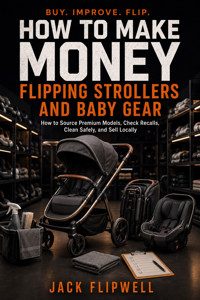
How to Make Money Flipping Strollers and Baby Gear - How to Source Premium Models, Check Recalls, Clean Safely, and Sell Locally ebook
JACK FLIPWELL
Uzyskaj dostęp do tej i ponad 240000 książek od 14,99 zł miesięcznie
- Wydawca: ALL-IN Rafał Płonkowski
- Kategoria: Biznes, rozwój, prawo•Biznes, rozwój
- Język: angielski
Can used strollers and baby gear become a repeatable flipping niche?
Yes, but only if you can tell the difference between a genuine opportunity and a cheap problem.
How to Make Money Flipping Strollers and Baby Gear is a practical JACK FLIPWELL guide for people who want to buy and resell used strollers, premium models, bassinets, pushchairs, accessories, and selected baby equipment without relying only on brand names, attractive photographs, or low asking prices.
The baby gear market creates natural resale opportunities because many products are used only during a limited stage of a child's life. Parents sell equipment when it is no longer needed, takes up too much space, or needs to be replaced by something more suitable for the next stage. At the same time, other families want quality products without paying full new-retail prices.
That creates room for a reseller who can reduce uncertainty.
This book shows you how.
You will learn how to identify models with real secondary-market demand instead of blindly buying well-known brands. You will learn how to compare generations, study used listings, check replacement-part availability, and determine whether a product leaves enough room between the purchase price and a realistic resale price.
You will learn how to find local opportunities, build targeted alerts, spot poorly described listings, and qualify products before driving across town. The book explains which questions to ask sellers, what additional photos to request, and how to reduce wasted trips.
A major part of the book focuses on product safety. You will learn how to identify the exact product, check current manufacturer information, review recalls and service actions, and use appropriate official safety sources. The book also explains why car seats, sleep products, and electrical baby equipment require stricter buying policies and should never be treated like ordinary accessories.
You will get a practical stroller inspection process covering the frame, folding mechanism, wheels, brake, handle, seat attachments, bassinet, harness, buckle, footrest, canopy, and storage basket. You will learn how to separate normal cosmetic wear from functional issues and from defects that should stop the transaction.
Cleaning receives its own detailed process. You will learn how to prepare fabrics, wheels, frames, and accessories without damaging the materials. The book explains why manufacturer instructions matter more than internet hacks, when the final stain is not worth chasing, and why mold, moisture, smoke odor, and strong contamination require greater caution.
You will also learn the economics of completeness. The book shows how to evaluate adapters, seats, bassinets, wheels, bumper bars, and other replacement parts, how to confirm compatibility, and why one missing component can destroy an otherwise attractive margin.
Financial discipline is another central theme. Purchase price is only the beginning. Travel, parts, cleaning materials, platform fees, labor, storage, and negotiation all affect the actual result. You will learn how to calculate total transaction cost and set a maximum buying price before the seller's asking price starts influencing your judgment.
The negotiation chapters show how to make clear offers, use convenience and fast collection as part of the deal, avoid FOMO, and walk away when the numbers no longer work.
On the selling side, you will learn how to photograph baby gear professionally, show defects clearly, write trustworthy listings, set prices, negotiate with buyers, and organize safe local collection. The book also covers inventory management, documentation, complaint handling, post-sale issues, and how to build repeatable sourcing channels.
Later chapters move from individual flips to systems. You will learn how to track results, compare models, measure turnover, identify your best sourcing channels, and scale without filling your storage space with slow-moving inventory.
This is not a get-rich-quick book.
There are no guaranteed returns.
No magic margins.
No promise that every stroller can be flipped.
What you get is a process.
BUY. IMPROVE. FLIP.
Find a product the market is not presenting well.
Add value through selection, safe preparation, completeness, documentation, and better presentation.
Sell it clearly and calculate the real result.
Then use your own data to make the next transaction better.
Find the Deal. Add the Value. Keep the Margin.
This publication was prepared with the assistance of tools that support the creative process, including artificial intelligence-based solutions. The final concept, structure, and editing belong to the author.
Ebooka przeczytasz w aplikacjach Legimi na:
Liczba stron: 250
Rok wydania: 2026
Odsłuch ebooka (TTS) dostepny w abonamencie „ebooki+audiobooki bez limitu” w aplikacjach Legimi na:
Podobne













INTRO
The used stroller and baby gear market has one feature that separates it from many other flipping categories. Buyers are not looking only for a good price. They are looking for a product they can trust. A stroller can look excellent in photographs, but if a wheel lock is unreliable, the frame has excessive play, the folding mechanism sticks, or the model is affected by a recall or service action, the attractive price quickly becomes irrelevant. In this category, value is created first through good selection, careful inspection, safe preparation, and transparent selling.
That is why used premium strollers, bassinets, pushchairs, high chairs, travel cribs, carriers, bouncers, accessories, and selected types of baby equipment can form an interesting resale market. Parents often buy these products for a relatively short stage of a child's life. Once the equipment is no longer needed, they may want to recover space and some of the money they spent. At the same time, another group of parents is looking for quality products without paying the full price of a new one. Between those two groups is room for a reseller who can find good equipment, evaluate it properly, and present it far better than the average used listing.
That does not mean every baby product belongs in a flipping business. Quite the opposite. In this niche, knowing when not to buy is just as important as finding a bargain. Some items are too worn, some have unclear histories, some are missing important safety components, and others show evidence of repairs that cannot be properly verified. Certain models may also be affected by current service actions, recalls, repair programs, or manufacturer instructions covering specific production batches. A good flipper does not try to sell everything that can be purchased cheaply. A good flipper buys only what can reasonably be inspected, prepared, and honestly offered to the next owner.
Trust is part of the product
With a used table, lamp, or decorative object, a small scratch may not matter very much. With equipment intended for a child, buyers see imperfections differently. They want to know whether the materials can be kept clean, whether the wheels roll properly, whether the brake works, whether the harness is complete, whether the frame has ever been damaged, and whether all mechanisms operate as intended. Even when these questions are not asked directly, they usually point toward one bigger concern: "Can I feel comfortable using this product?"
A seller who understands that psychology has an advantage. There is no need to hide a scratch on the frame or describe a several-year-old stroller as "like new." It is far more effective to show the real condition, explain what was checked, and identify known cosmetic flaws clearly. If the fabrics were cleaned according to the manufacturer's instructions, say so. If the wheels were removed, cleaned, and checked, show it. If there is something you could not verify, say that too.
Transparency does not reduce the value of a genuinely good product. Very often it increases it because it reduces the buyer's sense of risk. Someone comparing several similar listings may choose not the cheapest one, but the one where the seller has documented condition most clearly. In practice, better information is often one of the least expensive ways to increase the perceived value of an offer.
Why premium models can be especially interesting
Flipping is not about buying expensive things. It is about buying products whose resale value is high enough to leave a worthwhile margin after all costs. A stroller originally sold as a premium product may still have a strong buyer base years later if the brand is recognized, the construction is durable, replacement parts remain available, and the model has a good reputation among users. The same principle can apply to certain high chairs, carriers, ride-on boards, accessories, and modular systems.
However, a high original retail price should never be confused with strong resale value. Buyers may lose interest in a specific version, color, system, or generation. Some brands retain value well while others become difficult to sell after only a few years. Certain models have many compatible accessories, while others become troublesome as soon as one small component is lost. That is why you must analyze not only the brand but also the exact model, generation, completeness, condition, and actual demand for comparable used examples.
Bundles can be especially interesting when the original owner does not want to split them up. A frame, bassinet, seat unit, changing bag, adapters, rain cover, and spare fabrics may all be offered together at a price attractive to someone willing to collect everything. A flipper can clean the set, replace an inexpensive missing component, identify each accessory correctly, and decide whether the greater value comes from selling the full package or separating some pieces. The condition is simple: compatibility must be verified carefully. With baby gear, you should never assume that a component is correct simply because it appears to fit.
The best deal may not look impressive
Strollers are large, take up space, and quickly become inconvenient once a family no longer uses them. That creates a specific type of opportunity. A seller may value fast collection more than squeezing out the highest possible price. Photos may be taken in a garage, basement, hallway, or poorly lit storage room. Upholstery can look far worse than it really is because it is covered with ordinary dust and use-related grime. Wheels may be muddy, the basket full of small items, and the metal surfaces dull.
In situations like this, the advantage is not aggressive bargaining. The advantage is being able to distinguish removable dirt from permanent damage. A dirty fabric may sometimes be cleaned safely. A cracked structural part should not be disguised. A wheel that simply needs cleaning can be straightforward to prepare. A locking mechanism that behaves unpredictably requires much more caution and may eliminate the purchase entirely.
Over time, you will begin reading listings differently from the average buyer. Instead of judging the product only by appearance, you will ask about the model, year or generation, completeness, condition of the mechanisms, storage environment, availability of instructions, and usage history. You will try to determine which marks can be cleaned without damaging the materials and which stains are likely to remain. You will look for missing adapters, bumper bars, inserts, brackets, and other small parts that can completely change the economics of the purchase. That is the difference between random trading and a repeatable process.
Safety comes before margin
Baby gear is not a category where improvised repairs should become part of the business model. If the manufacturer designed a particular component, attachment system, or service procedure, that is what should be followed. Gluing a structural part, modifying harness straps, improvising mounting points, replacing critical parts with unverified alternatives, or altering a locking mechanism can create risks that a buyer may not be able to see during an ordinary inspection.
Throughout this book, we will clearly separate reasonable preparation work from repairs that require appropriate technical competence or an authorized service channel. Cleaning according to instructions, removing hair from an accessible wheel axle, or replacing a user-serviceable accessory specified by the manufacturer is very different from modifying the structure. If you have doubts about an element that affects safety, the correct decision may be to contact the manufacturer, use a qualified service provider, or decide that the product should not be resold for continued use.
Car seats and some other safety-critical products require even greater caution. Crash history, age, material condition, regulatory compliance, and manufacturer guidance may all matter directly. A car seat should not be treated like an ordinary accessory simply because it was sold with a stroller. If its history cannot be established with sufficient confidence, or if current requirements for safe continued use and resale cannot be met, it should not automatically be offered to another family. Manufacturer guidance and applicable local rules should always be checked at the time of the transaction.
Recalls and service actions are not paperwork
One of the most important skills in this niche is correct product identification. A commercial product name is often not enough. Depending on the category, the relevant identifier may be a model number, production date, serial number, version code, or another marking used by the manufacturer. Two products that look almost identical may belong to different generations and have different parts, instructions, or service status.
That is why checking recalls, service actions, and safety notices should become part of your routine before purchase and again before resale. Information can change. A new notice may appear long after the product was launched. It is not enough to remember that a model "used to be fine." You should use current official information from the manufacturer and from the relevant public authorities that publish product safety alerts, recalls, and corrective actions.
A service action does not always mean every affected product must be discarded. Corrective measures can vary. A manufacturer may require an inspection, supply an additional component, replace a part, specify a repair procedure, or instruct users to stop using a certain production range. The reseller should not reinterpret that notice in whatever way is most convenient for the sale. Follow the official instructions that apply to the exact product.
This protects more than the buyer. It protects your reputation. One carefully handled transaction can lead to referrals and repeat contacts. One attempt to pass along a questionable product can destroy trust much faster than it was built.
Cleaning should add value, not hide problems
One of the biggest value opportunities in this category comes from proper preparation. A stroller used daily for several years may look dramatically better after careful and safe cleaning without needing any major repair. Fabrics regain their appearance, sand disappears from hidden areas, the frame no longer looks dusty, and the wheels begin to look like part of cared-for equipment rather than something pulled directly out of a storage room.
The problem begins when a reseller uses methods that are too aggressive. Excessive heat, unsuitable chemicals, hard scrubbing, bleach, solvents, or incorrect drying can damage fabrics, coatings, foam, plastics, adhesives, and structural elements. Not every removable fabric can go into a washing machine. Not every padded insert should be soaked. A cleaner that works well on household upholstery may not be appropriate for baby equipment.
The manufacturer's instructions should be your starting point. If the documentation says hand clean, do not try to improve the process with a harsher method. If you do not recognize the material or the product, identify it before reaching for chemicals. The goal is to restore a clean and presentable condition without changing the properties of the product.
It is equally important to know when cleaning is no longer economically sensible. Spending several hours restoring a low-demand, low-value item can produce a worse result than spending thirty minutes on a strong premium model. Flipping is not only about margin per unit. The value of your time matters too.
You are not buying an object. You are buying a potential transaction
Beginners often ask, "Is this stroller cheap?" A better question is, "After all costs and all the work, does this transaction still make sense?" The purchase price is only one part of the equation. You may also have collection costs, cleaning, replacement parts, missing accessories, consumables, labor time, platform fees, payment costs, negotiation risk, and the likely time required to sell.
You can buy a stroller extremely cheaply and still make a poor purchase. If an important part is missing, the upholstery requires hours of work, the wheels are worn, and the local market is full of identical listings, the low purchase price may not help much. You can also pay more for a complete and well-kept example of a popular model and achieve a better result because preparation is quick and the resale is easier.
Throughout the book, we will therefore think in terms of total transaction cost. The difference between purchase price and listing price does not matter by itself. What matters is the amount that remains after the transaction is completed. If you pay 300 zł, spend 40 zł on travel, 30 zł on a correct replacement part, use cleaning materials, and spend several hours preparing the item, you should not automatically describe a 500 zł sale as 200 zł profit.
This series does not promise fixed returns or guaranteed income. Markets differ by city, season, platform, and product. The goal is to build a process that helps you make better decisions, reject weak deals faster, and value good ones more accurately.
Local selling is part of the advantage
Strollers and larger baby equipment are naturally suited to local resale. Shipping a frame, bassinet, or high chair can be expensive, time-consuming, and risky. Local collection allows the buyer to inspect the product, test folding, roll it a short distance, check the brake, examine the fabrics, and compare the physical item with the photographs.
Local selling gives the reseller other advantages as well. You can source within a defined radius, build an understanding of local demand, and reduce time spent packing oversized items. Over time, you may notice that certain stroller types move faster in your area, buyers prefer complete travel systems, or specific accessories are in unusually high demand.
Local does not mean informal or careless. The meeting should take place under sensible conditions, payment should be clear, and the description should be just as accurate as it would be for a shipped sale. A buyer should not travel a long distance only to discover a defect that was intentionally left out of the listing.
In many cases, it also helps to prepare a simple demonstration. Show how the stroller folds and unfolds, how manufacturer-designed adjustments work, and how the seat or bassinet attaches. Do not pretend to teach functions you do not understand yourself. If an official manual or manufacturer video exists, it is often the best reference.
Photographs can sell more effectively than a long description
In used baby gear, a rushed photograph taken in a dark basement can remove a significant amount of perceived value. The buyer cannot tell whether the stroller is merely dusty or genuinely worn out. They cannot see whether a dark mark is a shadow, stain, or abrasion. They cannot assess the wheels, basket, handle, or folding hardware.
Good photos should not hide defects. They should remove uncertainty. Photograph the full product from multiple sides, the areas most likely to show wear, model identifiers, included accessories, and all known imperfections. If the edge of the frame is scratched, show it. If the fabric is in excellent condition, give the buyer a close view.
You do not need a studio. You need a clean background, good light, and order. The product should be fully assembled and presented in the correct configuration. Loose accessories can be arranged neatly beside it. A complete-set photograph is especially effective because it immediately tells the buyer what is included.
The same principle applies to the written description. Instead of saying only "very good condition," give information that allows the buyer to judge for themselves. Model, version, included components, usage history, visible wear, and the status of functions you actually checked are much more useful than a collection of vague adjectives.
Completeness is often more valuable than perfect cosmetics
A common mistake is overvaluing appearance and undervaluing completeness. A lightly scratched frame may still be very attractive if the set contains all the important components. A beautiful-looking example can be difficult to sell if it is missing an unusual adapter, bumper bar, cover, insert, or other difficult-to-source piece.
Before purchasing, you need to know what originally belonged to the product, what was an optional accessory, and what is necessary for a particular configuration. A catalog photograph may help with identification, but it should not be your only source. Manuals, parts catalogs, and official manufacturer information are more reliable.
This does not mean you should always buy complete sets. Sometimes an incomplete product creates the best opportunity if the missing part is inexpensive and easy to find. The key difference is that the missing component must be identified and costed before purchase. Discovering it only while preparing the sales listing is the expensive version of the lesson.
Season, child stage, and use case affect demand
Baby equipment is tied to specific stages of a child's development. A bassinet serves a different purpose from a toddler seat. A lightweight city stroller meets different needs from a larger all-terrain design. A high chair enters the household at a different stage from a bedside crib. That means demand across subcategories can behave differently.
You do not need to build elaborate seasonal theories. It is safer to observe active listings, price levels, how long products remain available, and the response to your own listings. Your local market provides information that broad assumptions cannot replace.
Turnover matters too. A product with potentially higher margin but one that takes up half a room for several months may be less attractive than several faster sales at lower individual margins. The physical size of baby gear makes storage space a real business cost very quickly.
Your inventory should not become random storage
At the beginning, one or two products may be all you need. The problem starts when successful sales encourage you to buy opportunities faster than previous stock is moving. Strollers take up space, sets contain many separate pieces, and small adapters or mounting parts are easy to mix up.
From the first transactions, label your products. Record the model, purchase cost, date, included pieces, work completed, and current selling status. If you split a set, record which accessories belong to which unit. Basic organization prevents the embarrassing situation where a buyer arrives and the correct rain cover or adapter is sitting in a box assigned to another stroller.
Order matters for cleanliness and safety as well. Freshly prepared fabric should not be placed directly on a dirty garage floor. Damp textiles should not be sealed in a bag. Parts should be stored in ways that avoid deformation and accidental damage.
You do not need to become an expert on every brand
One of the biggest beginner mistakes is trying to understand the entire market at once. Hundreds of brands, dozens of stroller generations, different adapter systems, countless accessories, and products changing every few years can quickly become overwhelming. It is much easier to begin with a small group of items that you can recognize reliably.
For a while, you can simply observe a handful of popular models in your area. Watch how they are listed, which parts are commonly missing, which accessories appear in complete sets, and which listings disappear quickly. After enough observations, details that once looked insignificant will become obvious.
Specialization reduces mistakes. When you know what a complete set should look like, missing pieces stand out immediately. When you know the typical wear points, inspections become faster. When you have seen many examples of the same model, your valuation becomes more realistic. Only then should you expand into additional brands and categories.
Where the margin is created
In stroller and baby gear flipping, value rarely comes from one dramatic improvement. It is usually created through several smaller advantages working together. You buy carefully, avoid products requiring expensive corrective work, clean properly, complete the set, take better photographs, write a credible description, and offer a convenient local transaction.
Each step increases the difference between the chaotic listing of the previous owner and a product that appears ready for the next stage of use. You are not turning the stroller into something it never was. You are improving the quality of the transaction around it.
The process can be reduced to three steps: BUY - Find a product whose real resale potential is greater than the current listing suggests. IMPROVE - Clean safely, organize the set, replace appropriate missing parts, check accessible functions, and document the real condition.
FLIP - Present the product honestly, price it according to the market, reduce uncertainty for the buyer, and complete the sale professionally. The strongest result does not always come from the highest percentage margin. A repeatable sequence of calm, predictable transactions can be far more valuable than one risky purchase that looked spectacular at first.
How to use this book
The chapters that follow are designed as one complete process. We will begin by understanding the market and identifying the categories where specialization makes sense. Then we will move into premium brands and models, demand analysis, and practical ways to find listings before most competing buyers notice them. You will learn how to communicate with sellers and qualify a product before committing to an in-person inspection.
A major part of the book focuses on product identification, recalls, service actions, safety, and physical inspection of frames, wheels, brakes, folding mechanisms, harnesses, and textiles. We will also cover cleaning, drying, and preparation without using methods that can damage materials or create false confidence about product condition.
Next, we will examine completeness, parts, accessories, and compatibility. You will learn how to calculate total transaction cost and set a maximum purchase price before the emotion of finding a "deal" starts influencing your judgment. We will then move into photography, listing copy, pricing, negotiation, and safe local collection.
Later chapters shift from individual transactions to a repeatable system. We will cover inventory management, workspace organization, product documentation, common beginner mistakes, performance measurement, and ways to scale without locking money into stock that moves too slowly. The final chapters bring everything together into one operating procedure from the first seller message to completed sale and post-transaction analysis.
You do not need to do everything at once. A strong beginning may be one carefully selected stroller. Buy it only when you understand what you are buying, can evaluate the main risks, and see a realistic path to resale. Complete the entire process. Record the costs. Measure the time. See what buyers ask. Then do it again, better.
The most important rule in this niche
You can create value in used baby gear without pretending the product is better, newer, or more complete than it really is. You only need to know more than the average casual seller, prepare the product more carefully than the average listing, and give buyers information they would otherwise have to research themselves.
Your advantage may be product knowledge. It may be cleaning skill. It may be an eye for complete bundles, patience when monitoring local listings, or the ability to take excellent photographs. The strongest business model appears when several of these small advantages work together.
At the same time, there is a line that should not be crossed for the sake of margin. If a product raises legitimate safety concerns and those concerns cannot be resolved confidently, walk away. If you do not know the history of an element whose condition may be safety-critical, do not invent one. If the manufacturer specifies a service procedure, do not replace it with a home repair.
In many other flipping categories, a badly judged purchase mainly means losing money. Here, it may also mean passing a problem to a family that assumes the product is suitable for continued use. A professional reseller considers that responsibility from the first message to the seller until the transaction is fully complete.
That caution does not weaken the business. It strengthens it. Because the real advantage in this market is not that you buy the cheapest. It is that you can recognize what is worth buying, what should be left alone, and how to turn good used baby gear into an offer that the next owner can trust. Find the Deal. Add the Value. Keep the Margin.
Chapter 1 - How the Used Stroller and Baby Gear Market Works
The used baby gear market is large, but it is not uniform. A popular city stroller sells differently from a premium model, and both behave differently from a high chair, baby carrier, or bundle of accessories. Buyers care about different things in each category, and the level of risk, preparation work, and potential margin can vary significantly. Before spending money, you need to understand which segments actually make sense for resale.
One of the biggest beginner mistakes is treating the whole category as one market. Saying "baby gear sells well" is too broad to support a buying decision. A product can be useful to parents and still be unattractive as a used resale item. Some products move well between owners, some are purchased mainly new, and others carry enough uncertainty around condition or safety that they should not be treated like ordinary flipping inventory.
Why good equipment is sometimes sold below its potential value
In many resale categories, people sell because they want to upgrade. With baby gear, the reason is often simpler: the child no longer needs the product. A bassinet may be useful for only a limited stage. A travel crib may be needed for one season. A larger stroller may eventually be replaced by a lighter pushchair. Once the item is no longer useful, the seller may care more about recovering space than maximizing price.
That creates opportunity. A stroller taking up half a hallway can become annoying very quickly. Parents may accept a lower price in exchange for a fast, uncomplicated collection. For a flipper, this can be attractive, but only if the low price comes from the seller's motivation rather than from a serious problem with the product.
Learn to separate those two situations. Words such as "urgent," "collection today," "need the space," or "no longer needed" may indicate motivation, but they are not evidence of quality. You inspect the product first and use the seller's urgency only as part of the negotiation context.
Five major segments of the market
For practical flipping purposes, the used baby gear market can be divided into several broad areas. The most relevant are strollers, modular travel systems, accessories, larger household equipment, and products that require heightened caution.
The first segment is standard city strollers and pushchairs. These are relatively easy to understand, but competition is often high. Buyers compare many similar listings and quickly notice differences in condition, equipment, and price.
The second segment is premium models and modular systems. Here, the value of a single purchase may be higher, but mistakes cost more. A missing component, generation mismatch, or damaged mechanism can destroy the economics of the deal.
The third segment is accessories. Adapters, changing bags, ride-on boards, bumper bars, organizers, inserts, rain covers, and similar items can offer a surprisingly good relationship between margin and storage space. The condition is that you understand compatibility very well.
The fourth segment is larger household baby gear such as certain high chairs, travel cribs, changing stations, and selected bouncers. These can work well for local resale, but completeness and cleanliness matter heavily. Their resale value often comes from preparation rather than brand alone.
The fifth segment includes products that deserve a separate risk policy. Car seats, some sleep-related products, electrical equipment, and items with unclear histories should not be treated like ordinary used goods. A basic functional test and clean appearance may not be enough. If you cannot verify what needs to be verified, the right decision may be not to resell the item for continued use.
What usually makes a good flipping candidate
The strongest resale products tend to share several characteristics. They are identifiable. They have an active used market. They can be prepared without interfering with safety-critical construction. Parts and accessories are available.
Buyers understand the brand or model. A strong candidate might be a recognizable stroller with a sound frame and working mechanisms whose main weakness is presentation. Dirty fabrics, dusty wheels, and ordinary cosmetic wear can often be improved safely if the manufacturer allows appropriate cleaning.
Complete but poorly presented bundles can also be attractive. A seller may photograph several components together without explaining what they are. If you can identify each accessory, confirm compatibility, and present the set clearly, you can create value without repairing anything. Transport and storage matter too. A product that is physically manageable is easier to rotate. Large, low-value items can consume storage space quickly and reduce overall business efficiency.
What may look attractive but is not
An incomplete premium model is one of the most deceptive deals in the category. The brand looks desirable. The price looks low. The product seems close to complete. Then you discover that one unusual component is missing and difficult to source.
A similar problem appears with older generations of premium brands. Buyers may recognize the manufacturer but prefer newer versions. A flipper who compares an older model to current retail pricing can badly overestimate resale value.
Be especially careful with products showing signs of home modifications. An extra screw. A glued joint. A homemade bracket. A replacement strap that was never intended for the product. These things can look minor, but they may make the product unsuitable for resale as normal ready-to-use equipment. "We used it like that for years and nothing happened" is not technical documentation.
Margin and turnover are not the same thing
Beginners often focus on the largest possible spread between purchase price and sale price. A better view combines margin, labor, and turnover. Imagine two hypothetical purchases. The first is very cheap, but it needs several hours of cleaning, two separate trips for parts, and a month before a buyer appears.
The second offers a smaller margin but needs little work and sells in a few days. The second transaction may be better even if the nominal profit per unit is lower.
There is no universal turnover target for every seller. Your setup matters. Someone with a large storage unit can tolerate slower-moving stock. Someone operating from a small apartment should penalize bulky inventory much more aggressively.
How to study your local market
You can learn a great deal before buying anything. For several days or weeks, watch listings in your area. Do not record only prices. Pay attention to which listings disappear quickly, which are repeatedly renewed, and which keep falling in price.