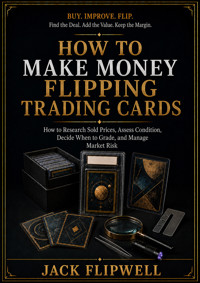
How to Make Money Flipping Trading Cards - How to Research Sold Prices, Assess Condition, Decide When to Grade, and Manage Market Risk ebook
JACK FLIPWELL
Uzyskaj dostęp do tej i ponad 240000 książek od 14,99 zł miesięcznie
- Wydawca: ALL-IN Rafał Płonkowski
- Kategoria: Biznes, rozwój, prawo•Biznes, rozwój
- Język: angielski
The trading card market can look deceptively simple. Buy a card, wait for demand, sell at a higher price. Maybe send a strong raw copy for grading, receive a high grade, and capture an even larger premium. In reality, successful card flipping depends on dozens of decisions involving product identification, real sold prices, condition, liquidity, grading economics, marketplace fees, inventory risk, and execution.
How to Make Money Flipping Trading Cards is a practical guide by JACK FLIPWELL for collectors and resellers who want to approach the market with data instead of hype. It does not promise easy profits or attempt to predict which card will become the next record-breaking sale. Instead, it shows how to build a repeatable system for finding underpriced cards, protecting margin, and reducing the cost of mistakes.
You will learn how to research completed sales rather than relying on unrealistic asking prices. The book explains how to build reliable comps, identify outliers, compare sale formats, interpret recent trends, and determine whether the market for a specific card is genuinely liquid. You will also learn why a card with a lower headline value can be a better business opportunity than a rare product that trades only a few times per year.
Accurate identification receives detailed attention because small product differences can create large pricing differences. Variations, parallels, serial numbering, language, foil treatment, promotional editions, autographs, memorabilia, reprints, grading companies, and grades can all change what the card actually is and what buyers are willing to pay.
Condition assessment is covered through a practical raw-card inspection process. You will learn how to evaluate surfaces, corners, edges, centering, dents, bends, moisture damage, production issues, and other defects that can affect resale value and grading decisions. The book clearly separates home inspection from professional grading and avoids pretending that any seller can guarantee a future grade.
Authentication is approached as a layered risk-management process. You will learn how to compare cards with reliable references, inspect product-specific characteristics, verify grading certificates, evaluate sellers, recognize misleading reprints, and reduce exposure to counterfeit cards, fake autographs, altered cards, and counterfeit slabs.
The sourcing chapters explain where profitable opportunities can appear, including large marketplaces, local classifieds, specialist communities, card shows, hobby shops, dealers, and direct collection purchases. You will see how poorly written listings, incorrect categories, bad photography, bulk sales, and motivated sellers can create opportunities for someone with stronger research and faster execution.
A full section is dedicated to buying collections and lots. You will learn why the sum of retail card prices is not the same as wholesale value, how to separate high-value cards from mid-tier inventory and bulk, how to calculate labor and liquidation risk, and how to determine the maximum price you can pay for an entire collection.
Grading receives detailed financial treatment. Instead of assuming every clean-looking raw card should be submitted, you will learn how to compare the raw sale alternative with multiple graded outcomes, calculate the full grading cost, identify the break-even grade, interpret population data, and decide whether the expected upside actually justifies the extra cost, delay, and uncertainty.
The selling section covers product photography, accurate condition descriptions, pricing strategy, negotiation, auction versus fixed-price listings, multichannel selling, packaging, shipping, insurance, transaction documentation, and ways to reduce return and dispute risk. The goal is not to hide defects or create artificial hype. It is to present the exact product clearly enough that the buyer can make an informed decision.
The book then moves beyond individual flips into inventory and capital management. You will learn how to separate cash from nominal collection value, monitor stale inventory, maintain liquidity, limit exposure to a single player or category, track cards in grading, and stress-test the business against slower sales or declining prices.
The data section explains how to measure net profit, return on cost, holding period, grading performance, sourcing quality, discount rates, return reasons, forecast error, and the difference between repeatable edge and simple luck. Over time, your own transaction history can become a competitive advantage that public sold-price databases cannot provide.
This publication was prepared with the assistance of tools that support the creative process, including artificial intelligence-based solutions. The final concept, structure, and editing belong to the author.
Ebooka przeczytasz w aplikacjach Legimi na:
Liczba stron: 319
Rok wydania: 2026
Odsłuch ebooka (TTS) dostepny w abonamencie „ebooki+audiobooki bez limitu” w aplikacjach Legimi na:
Podobne




















INTRO
The trading card market looks simple from the outside. Buy a card for less, find a buyer willing to pay more, and keep the difference. Sometimes the process appears even easier: buy a raw card, send it for professional grading, receive a strong grade, and sell it at a premium. In reality, the space between buying and selling contains dozens of decisions, and a few small mistakes can turn an attractive deal into frozen capital or a loss.
The biggest difference between collecting and flipping is the way decisions are made. A collector can buy a card because they love the player, character, artwork, set, or story behind it. A flipper has to ask different questions. Is there enough demand? What have comparable copies actually sold for? How quickly do they sell? What condition is this specific card in? What are the total costs? How much downside remains if the original assumptions are wrong?
You can collect and flip at the same time. There is nothing wrong with enjoying the products you trade. The problem begins when personal attachment replaces financial analysis. A card can be beautiful, rare, nostalgic, and still be a poor flip at the price you are being asked to pay.
This book is not a promise of easy money. There is no reliable formula that tells you which card will double, triple, or become the next headline sale. Prices are influenced by supply, collector demand, player performance, character popularity, print runs, new releases, grading populations, market cycles, social attention, and many other forces that cannot be controlled. The goal is not to predict everything. The goal is to make better decisions with the information that is available and to make mistakes small enough that they do not destroy the business.
One of the strongest advantages in card flipping is not predicting the future. It is reading the present more accurately than other participants. If you can identify the exact card, research real sold prices, assess condition, understand liquidity, calculate every cost, and determine a disciplined maximum buy price, you no longer need a dramatic market prediction to make money. That approach is less exciting than hoping for a tenfold increase. It is also far more repeatable.
Asking prices are not market prices
One of the first habits you need to develop is separating asking prices from completed sales. A seller can list a card for any amount. If you see three copies listed at $1,000, that does not mean the market values the card at $1,000. They may have been sitting unsold for months precisely because buyers are unwilling to pay that price.
The useful question is not: "What are people asking?" It is: "What have comparable copies actually sold for?" That means researching completed transactions whenever reliable data is available. You want to know the prices, dates, frequency of sales, condition of the cards, grading status, and exact variant. Two cards that look almost identical to a beginner can belong to completely different markets because of a parallel, serial number, language, printing, foil pattern, autograph, promotional stamp, grading company, or grade.
A single high sale does not define the market either. If a card normally sells around a much lower level and one transaction appears far above the others, investigate the reason. The copy may have been in exceptional condition. It may have had a desirable serial number, stronger eye appeal, an unusual patch, or another feature that made it less comparable than it first appeared. The result could also simply be an unusual auction outcome. A professional flipper looks for a pattern. Not the most optimistic number available.
The margin is usually created when you buy
Many flips are largely decided before payment is made. If you overpay, excellent photographs and a strong listing may not save the transaction. You can execute every later step correctly and still produce a weak result because the purchase price left too little room.
That is why this book will focus repeatedly on the maximum buy price. The right question is not: "Can I sell this for more than I paid?" The right question is:
"How much can I pay while still leaving enough margin after every realistic cost?" Those costs may include marketplace fees, payment processing, shipping, insurance, packaging materials, grading, transportation to and from the grading company, and other expenses directly connected to the transaction. Taxes and business obligations will depend on your jurisdiction and individual circumstances.
Fees, platform policies, grading prices, shipping rules, and tax requirements can change. Never build a business around a fee structure you read in an old guide. Check current official sources before relying on a specific rule or rate.
A good purchase model should survive realistic conditions. If the flip only works when the card achieves the highest price you have ever seen, your margin is probably too fragile.
Condition is part of the product
Trading cards are unusually sensitive to small physical differences. A minor surface scratch, soft corner, edge whitening, indentation, print line, or centering problem can significantly change the value of two otherwise identical copies. The challenge is that many of these defects are difficult to see in ordinary listing photographs.
That makes condition assessment one of the most important skills in the entire process. You will learn to inspect cards systematically instead of glancing at them and deciding that they "look clean." The process will include surfaces, corners, edges, centering, bends, dents, moisture damage, storage wear, and other characteristics relevant to the specific type of card.
You will also learn to recognize the limits of your own inspection. A raw card cannot be assigned a professional grade with certainty simply because it looks excellent under a desk lamp. Grading companies use their own standards, procedures, and scales, and these should be checked directly before submitting cards. The purpose of your inspection is not to guarantee a future grade. It is to improve the quality of your financial decision.
Condition must be represented honestly
The same standards apply when you become the seller. Do not hide defects through lighting, camera angle, filters, vague descriptions, or selective photography. A short term increase in selling price is not worth the long term cost of returns, disputes, bad feedback, and damaged reputation.
If a card has whitening, show it. If there is a surface line, describe it. If the slab has a scratch, distinguish the holder damage from the card itself. Good sellers reduce uncertainty. They do not manufacture it.
That principle will appear throughout the book because trust is not separate from profitability. Accurate listings reduce friction, improve repeat business, and make the entire selling operation easier to scale.
Grading is not an automatic value machine
One of the most expensive assumptions beginners make is that every valuable card should be graded. Professional grading can increase marketability and sometimes produce a meaningful price premium. It can also consume time and money without adding enough value to justify the process.
Grading includes cost. It also includes uncertainty. You do not know the final grade before the service is completed. Even a strong looking card may contain a defect that you missed. The resulting premium may be smaller than expected, and while the card is away, the market can change.
The economics should be calculated before submission. You need to know the realistic value of the card raw, the full cost of grading, the likely market values at several plausible grades, and the break-even point at which grading becomes more attractive than selling the card ungraded.
Suppose, only as a method example, that a card can be sold raw for amount A. Grading costs amount B. After grading, different possible outcomes would produce sale values C, D, and E.
The mistake is calculating only the best outcome. A stronger model asks what happens if the card comes back lower than expected. If the process is profitable only at the highest possible grade, you are making a very different bet than if several grades still produce acceptable economics.
Grading selection matters more than grading volume
Sending more cards does not automatically create more value. The strongest grading strategy often begins with aggressive selection. That means rejecting cards with questionable surfaces, poor centering, weak corners, edge problems, dents, or other characteristics that make the economics unattractive.
It does not mean altering the product. This book does not promote trimming, polishing, pressing, recoloring, retouching, manipulating surfaces, hiding damage, or performing other modifications designed to create a misleading impression of condition. Your job is to inspect, protect, document, and submit according to the grading company's current requirements. The value comes from selecting the right card. Not physically changing it.
Liquidity can matter more than an impressive valuation
A card can be expensive and still be a terrible product for a flipper. The issue is liquidity. If comparable copies sell only a few times per year, the headline price may look attractive, but converting the card back into cash can take months. Another card may have a lower margin per unit but sell repeatedly every week.
Those two products should not be evaluated the same way. Capital has velocity. The same $500 can sit in one rare card for six months or be used repeatedly across several faster transactions. Neither strategy is automatically right, but a flipper has to understand the difference.
That is why this book will treat inventory as a portfolio of positions with different expected holding periods, liquidity, margins, and risk. You should know why each card is being held. You should also know what would cause you to sell it.
A cheap card is not automatically an opportunity
Beginners often confuse low price with undervaluation. A card may be cheap because almost nobody wants it. It may come from a heavily supplied set, have weak collector demand, be difficult to sell, or exist in poor condition.
The distinction you need is between: cheap and underpriced Cheap only tells you the purchase amount. Underpriced means the purchase price is meaningfully below a realistic exit value after adjusting for condition, liquidity, costs, and risk. That difference is the foundation of the book. You are not looking for inexpensive cards. You are looking for mispriced cards.
Where underpricing comes from
The secondary market is not perfectly efficient. Sellers make mistakes. A card may be listed under the wrong variation. A collection may be sold as one lot because the owner does not want to spend weeks listing individual pieces. A seller may need liquidity. A valuable card may have poor photographs, an incomplete title, or the wrong category.
These situations can create opportunity. Your role is not to deceive sellers. Your advantage should come from better research, faster analysis, stronger product knowledge, better logistics, and a more efficient resale process. A seller can rationally accept less than full retail value in exchange for speed and convenience. That spread is part of normal commerce.
Authenticity is a requirement, not a bonus
The more valuable the card, the more important authentication becomes. Counterfeit cards, altered cards, fake autographs, counterfeit grading holders, copied certification numbers, misleading reprints, and other fraudulent products can appear wherever enough money is involved.
You cannot assume a card is authentic simply because the seller says so. At the same time, there is no single universal home test that reliably authenticates every trading card. Printing techniques, materials, foil patterns, security features, and manufacturing processes differ between products and eras.
Instead of relying on one trick, you need a layered process. You will learn to compare the card with reliable references, examine relevant production details, investigate the seller, verify grading certificates when applicable, evaluate provenance, and use professional authentication when the value of the transaction makes that appropriate.
If you cannot verify a high value card with enough confidence, you do not have to buy it. Walking away costs nothing. Buying a counterfeit can cost far more than the purchase price.
Your sourcing channel changes your risk
A card purchased from a long established specialist seller presents a different risk profile from a card bought through a local classified advertisement. A complete collection bought from a private seller presents a different set of challenges again.
Every sourcing channel can produce opportunity. Every sourcing channel also changes what you have to verify. Large marketplaces usually provide more data and more competition. Local listings can be less efficient but require more independent verification. Specialist communities may contain highly informed sellers, reducing obvious pricing errors but improving the quality of available information.
You will learn to evaluate sourcing channels not just by price. You will evaluate them by the combination of price, information quality, competition, payment security, authenticity risk, and resale potential.
Buying collections changes the calculation
Buying an entire collection can be one of the most attractive ways to source inventory. It can also create one of the biggest inventory problems. A seller may claim that a collection has a retail value of $20,000 because the individual card prices add up to that amount. Even if the calculation is technically correct, you may need months to realize the full value.
Each card must be identified, assessed, photographed, listed, stored, sold, packed, and shipped. Some may never be worth selling individually. That is why a collection should not be valued simply as the sum of optimistic single card prices.
You need to separate the collection into layers. High value liquid cards. Mid range cards suitable for individual sale. Lower value products suitable for lots. Bulk. Then you calculate realistic recoverable value, labor, selling costs, inventory risk, and the amount of capital that may remain tied up in the slower pieces.
Sealed products and random opening are different businesses
Opening packs can be fun. It is not the same as buying a specific card at a known price. When you buy a single card, you know what asset you are acquiring. When you open a sealed product, the value of the cards obtained depends partly on random contents.
That creates a different risk model. This book will focus on controlled flipping decisions rather than treating opening packs as a predictable sourcing strategy. Sealed products may have their own resale market, and opening can be part of other hobby or business models, but those should not be confused with a transaction where the product and entry price are known before purchase. For disciplined flipping, certainty about what you are buying has value.
Improving a card usually means improving the process
The word "improve" in BUY. IMPROVE. FLIP. does not mean physically altering the card. With collectibles, value can often be added through information and execution. You can identify the correct variant.
Research the market properly. Select a strong raw card for grading. Take better photographs. Describe the condition accurately. Choose a better marketplace. Package the item more safely. Reach a more appropriate group of buyers. None of these actions changes the card itself. They change how efficiently the market can understand and transact around it.
Better information can produce a better selling price
Many cards are poorly presented. The seller may use a dark photograph, omit the back, fail to show corners, misunderstand the parallel, or provide almost no condition information. That forces the buyer to guess.
Uncertainty reduces willingness to pay. If you can remove some of that uncertainty with better documentation, you may produce a stronger offer without doing anything physical to the card. This is one of the cleanest ways to add value. You make the product easier to evaluate.
Reputation becomes an asset
A seller who consistently represents condition accurately, packs well, ships on time, and handles problems professionally becomes easier to buy from. That has real value. A buyer deciding between two similar cards may prefer the seller who reduces perceived risk.
Reputation takes time to build. It can be damaged quickly. This book will therefore treat customer service, accurate listings, shipping, and dispute prevention as part of the economics of flipping rather than as administrative details.
Market risk cannot be eliminated
Trading cards are demand driven collectibles. Interest can rise. It can also disappear. A player can become more popular or less popular. A game can enter a strong cycle or lose attention. A new release can shift demand. Additional supply can reach the market. A grading population can increase. Collectors can move toward another product.
The strategy: "I will just hold until it goes up" is not a complete exit plan. For every meaningful position, you should know why you are buying, who the likely buyer is, how active the market is, how long you are willing to hold the card, and what information would make you reconsider the position.
Flipping and speculation are not the same thing
A flip is primarily based on an existing difference between your entry price and the current market, often combined with value added through better sales execution, selection, or grading. Speculation relies more heavily on the belief that the future market will pay more than the current one.
Both approaches can produce profits. Both can produce losses. But they have different risk structures. If you buy a card for $400 because current comparable sales support $600 and the full cost still leaves a margin, that is one type of decision. If you buy at $600 because you expect the card to reach $1,000 next season, that is another. Do not hide one strategy inside the label of the other.
Capital needs rules
Without capital rules, every attractive listing can feel like an emergency. You can quickly convert cash into boxes, binders, raw cards, and slabs while telling yourself that everything is valuable.
Eventually, you may have significant inventory and very little liquidity. That is why you need limits. How much can one card represent? How much can one player, character, set, or category represent?
How much capital can be tied up in grading? How much cash should remain available for future opportunities and operating costs? There is no single percentage appropriate for every seller. The principle is more important than the exact number. No individual mistake should be able to destroy the entire operation.
Return needs to be measured in money, percentage, and time
A transaction can look excellent in one metric and poor in another. A card bought for $20 and sold for $40 appears to produce a 100 percent gross increase. After costs and time, the actual result may be too small to matter.
A more expensive card may produce a smaller percentage return but a meaningful dollar profit with little additional work. Time matters too. A 20 percent return produced in a few weeks is economically different from a 20 percent return produced after a year of holding inventory. You do not need advanced finance to understand this. You simply need to track the numbers consistently.
Data becomes more valuable with every transaction
After enough sales, memory becomes unreliable. You remember the brilliant purchase. You remember the card that unexpectedly doubled. You may forget the five cards that sold slowly and barely produced a margin.
That is why you need records. Track purchase price, total cost, source, condition, grading decisions, listing date, sale price, fees, shipping, holding period, and final profit or loss. Over time, your own data can answer questions public market data cannot.
Which sourcing channel gives you the best inventory? Which price range turns fastest? Does grading actually improve your returns? Which cards generate the most disputes? Where are you systematically overestimating sale prices? Those answers can become a competitive advantage.
The business should learn from mistakes
Losses will happen. The important question is whether they improve the system. If you bought a raw card from weak photographs and later discovered surface damage, you can create a rule requiring angled surface images above a certain purchase value.
If you consistently overestimate the premium from grading, you can adjust your selection model. If a certain shipping method creates disproportionate problems, you can change the logistics standard. A mistake that changes the process can be expensive but useful. A mistake repeated without learning is simply expensive.
The strongest advantage is often selectivity
A professional flipper does not need to buy constantly. In fact, one sign of improving skill is often a higher rejection rate. You see more reasons not to buy. The margin is too small.
The card is too illiquid. The condition is unclear. The seller is risky. The grading case depends on a perfect outcome. The inventory exposure is already too concentrated. A good PASS decision protects capital for the next real opportunity.
How to use this book
The following twenty chapters follow the same sequence as a real trading card transaction. First, you will learn how the market actually works and how to separate listing prices from real transactional value.
Then we will build a research system for sold prices, liquidity, and demand. You will learn how to identify exact cards, variations, parallels, editions, languages, serialized copies, autographs, memorabilia, and other characteristics that can change value.
From there, we will move into condition assessment and authenticity. You will learn a repeatable inspection process for raw cards and a risk based approach to counterfeit and altered products.
Next comes sourcing. We will cover individual cards, marketplace opportunities, direct deals, lots, and full collections. Then we will build the financial model. You will learn to calculate realistic exit prices, total costs, required profit, safety margins, and maximum buy prices.
Grading receives its own dedicated section because this is where many sellers confuse potential value with expected value. You will learn how to compare raw and graded outcomes, calculate break-even grades, evaluate population data, select candidates, and avoid turning grading into a lottery.
After that, the focus shifts to selling. We will cover photography, descriptions, pricing, negotiations, marketplace selection, packaging, shipping, and transaction protection. Finally, we will move into inventory management, data, scaling, advanced strategies, and the complete operating system that connects research, buying, grading, selling, and capital management.
You do not need to know every card
One of the easiest ways to waste time is trying to know the entire hobby. There are too many products, releases, sports, games, players, characters, parallels, inserts, promos, and regional variations.
You do not need encyclopedic knowledge. You need a strong process. Then you can apply that process deeply within selected segments. A person who understands one narrow category extremely well may identify opportunities faster than someone who follows the entire market superficially. Specialization is not a limitation. It can be a competitive advantage.
Your first goal should not be maximum profit
The first goal should be executing a transaction you can explain with numbers before you buy. You should know: what the card is, what comparable copies have sold for, how liquid the market is,
what condition the card appears to be in, what the full cost will be, what the realistic sale price is, and what you will do if the expected result does not happen. If you can answer those questions, you are beginning to control the process. If you cannot, the excitement of the opportunity is probably controlling you.
Some of your best decisions will be purchases you never make
You will see cards that look attractive but fail deeper analysis. The price may be too high. The variation may be unclear. The market may be too thin. The grading upside may be overstated.
The seller may create too much counterparty risk. Walking away does not mean you missed an opportunity. Sometimes it means you avoided an expensive mistake. Discipline begins with being able to say no.
A good flipper does not need to buy every day. A good flipper needs to buy when the combination of price, condition, liquidity, information quality, and risk provides enough edge. Then the job is to convert that edge into a realized result through good execution. That is the system we will build across the next twenty chapters.
Chapter 1 - How the Trading Card Market Really Works
The trading card market combines elements of a hobby market, a collectibles market, and a speculative market. That matters because a card's price is not determined by age, appearance, or stated rarity alone. Its value depends mainly on how many people want that specific card, how difficult it is to obtain in a particular condition, and how many comparable copies are available.
Beginners often try to reduce valuation to simple rules. Older means more valuable. Rarer means more valuable. A card featuring a famous player or character must be expensive. Each of those assumptions can fail. An older card may have very little collector demand, while a much newer card may trade frequently at higher prices because far more buyers want it. The first skill in flipping is therefore not memorizing prices. It is understanding how the market is structured.
A card is worth what buyers actually pay
A useful definition of market value is the price range at which real buyers and sellers are actually completing transactions under current conditions. It is not the highest active listing you can find online.
Suppose five copies are listed at $800, but comparable cards have repeatedly sold between $450 and $520. The completed sales tell you more about market value. The $800 listings tell you what those sellers hope to receive.
Even completed sales do not produce one perfect number. Two apparently identical cards can sell at different prices because of condition, seller reputation, timing, photography, auction format, geography, or small product differences. Instead of trying to discover one exact value, build a realistic range.
If your research suggests that a card normally sells around $400 to $450, a conservative purchase model should not depend entirely on achieving $450. If the transaction works at $400 and becomes better at $450, you have more room for error.
Supply and demand matter more than rarity by itself
A card can be genuinely scarce and still be difficult to sell. Scarcity limits supply. It does not create demand. If only a few collectors care about a particular product, a tiny print run may not produce a high market price. A card with a much larger supply can trade far more actively if thousands of collectors want it.
For a flipper, predictable demand can be more useful than theoretical rarity. Think of every product along at least two dimensions: potential margin,; ability to convert the card back into cash. A rare card with a large theoretical profit but almost no trading activity may be less useful than a common but highly liquid card offering a smaller spread.
There is no single trading card market
The phrase "trading card market" hides thousands of smaller markets. Sports cards behave differently from trading card games. Modern products behave differently from vintage products. Within a single brand, one set can have strong demand while another barely trades.
Even within one set, different players, characters, parallels, inserts, grades, and price ranges can behave independently. A useful hierarchy is: category, brand or game, set, specific card, specific variant, specific condition or grade.
The closer your analysis gets to the actual product you are buying, the more useful it becomes. Statements such as "this player's cards are rising" are too broad for a serious purchase decision. You need to know what is happening with the exact card, or at least with genuinely comparable products.
Collector demand and investment demand are different
Not every buyer has the same motivation. Some buyers want the card because it completes a set, represents a favorite player, features an important character, or has personal meaning. Others buy mainly because they expect the price to rise.
These two types of demand can behave differently. A collector completing a set may continue buying during a broader market decline. A speculator may disappear quickly when momentum weakens. Cards supported by real collector demand may therefore behave differently from products whose market is driven almost entirely by resale expectations. This does not make any card safe from falling prices. It simply helps you understand why buyers are participating.
Popular does not automatically mean profitable
Highly popular cards are easy to notice. That also means they are watched by many buyers. If thousands of people are tracking the same product, obvious pricing errors tend to disappear quickly. Competition reduces the time available to analyze and buy.
Some of the better opportunities can appear in less obvious parts of the market: a less famous parallel of a popular card,; an overlooked language version,; a poorly categorized listing,; a collection containing several misidentified products,; a card with better condition than the listing suggests. The goal is not to deliberately trade obscure products. The goal is to find areas where pricing is less efficient.
Primary market and secondary market
New trading card products first enter the primary market through manufacturers, distributors, retailers, hobby shops, and other official channels. After purchase, individual cards and sealed products begin circulating in the secondary market.
A flipper should understand the difference between buying a known card and opening sealed product. When you buy a single card, you know exactly what product you are receiving. When you buy a pack or box and open it, the outcome depends on the contents you happen to pull.
That is a different risk profile. Opening products may be enjoyable and can be part of other business models, but it should not automatically be treated as predictable sourcing for flipping. If your profit depends on pulling a rare card from a randomized product, you are not controlling the asset at the moment of purchase.
Raw and graded are different markets
A raw card and a professionally graded version of the same card are not economically identical products. A graded card includes additional information and packaging associated with a specific grading company and grade.
That means a flipper cannot simply look at the price difference between raw and a high grade copy and assume that difference is available as profit. Suppose a raw card sells for $500 and a high grade example sells for $1,200.
The apparent spread is $700. But the card may not achieve that grade. Grading costs money. Shipping costs money. Capital is tied up during the process. Selling fees may be different. The market may also change before the card returns. The correct analysis uses several possible grading outcomes, not just the best one.
Grading population is part of supply
For graded cards, population data can help you understand how many copies have been evaluated by a particular grading company and how many received each grade. This can be useful.
It can also be misunderstood. A low population does not automatically mean extreme rarity. It may simply mean that few owners consider the card worth grading. A high population does not automatically mean low value. A very popular card can support strong prices despite many graded examples because demand is also large. Population should therefore be interpreted together with: transaction frequency,; price levels,; collector demand,; total visible supply. One number rarely explains the entire market.
New releases can distort early prices
Early transactions after a new set launches can be misleading. At first, very few copies may have reached the market. A card can look extremely scarce simply because only a small amount of product has been opened.
As more boxes are opened and more cards are listed, supply can increase rapidly. Early buyers may also pay unusually high prices because they want to own the product immediately.
That means first sales should be treated carefully. A flipper buying newly released cards needs to ask not only what the card sells for today, but also how much additional supply may appear in the coming days or weeks. You cannot predict the exact number. You can recognize that the supply curve is still developing.
Reprints and additional supply
In some categories, official reprints, additional print runs, later releases, or similar products can change supply conditions. In other categories, the original card may never be reprinted, but new alternatives can compete for collector attention.
Do not assume that today's scarcity will remain economically unchanged forever. If your entire purchase thesis depends on permanent limited supply, verify what is known about the product and the publisher's current practices. For anything that can change over time, use current official information rather than relying on an old forum post.
Market narratives can become disconnected from data
Collectibles are highly influenced by stories. A large public sale, a viral video, a major player performance, or a wave of social media attention can create the narrative that a certain segment is "going up."
Sometimes the narrative reflects a real increase in demand. Sometimes it simply encourages more people to repeat the same claim. If a card has risen quickly, ask: Has transaction volume increased too?; Are multiple comparable copies selling higher?; Is active supply increasing?; Are buyers still accepting the new price level?; Are the highest sales recent or already fading? These questions will not tell you exactly what happens next. They can prevent you from buying only because everyone else sounds confident.
FOMO destroys purchase discipline
Fear of missing out becomes strongest during fast price increases. You see a card that cost less a week ago and start worrying that it will become even more expensive tomorrow.
That is when many buyers abandon their maximum purchase price. Do not. Set your limit before the auction or negotiation. If the price exceeds it, allow another buyer to win. A lost auction is not automatically a lost opportunity. Sometimes it is a mistake you successfully avoided.
Sellers often adjust downward slowly
When prices rise, sellers can increase their asking prices very quickly. When prices fall, many leave old listings unchanged. This creates a wide gap between active listings and actual sales.
You may see ten copies listed at $1,000 and assume the market remains strong. Recent completed sales may be closer to $700. That is why active listings should not be treated as market value without transaction data. They show seller expectations. Completed sales show where deals are actually happening.
Thin markets require wider valuation ranges
For extremely rare cards, there may be very few transactions. One sale can then appear to establish a new market value. It may not. Perhaps two collectors happened to want the same copy at the same time.
The next sale could be much lower. In thin markets, use wider valuation ranges and larger safety margins. The less data you have, the less precise your valuation should pretend to be.
Choosing your own market segment
Beginners often want to trade everything. That forces them to restart the research process for every purchase. A better approach is gradual specialization. You might focus on: one trading card game,; one sports league,; a certain period,; specific parallels,; graded vintage,; raw modern cards.
Specialization gives you speed. You begin recognizing normal prices, common condition issues, suspicious listings, and incorrectly identified variants without repeating hours of basic research. It does not prevent you from taking opportunities elsewhere. It gives you a home market where your decisions are faster and better informed.
Three questions before doing deeper research
You can filter many listings with three basic questions: Is there a real and sufficiently active market for this card or close comparables?; Can I confidently identify the exact product and estimate its condition?; Does the current price appear capable of leaving a meaningful margin after full costs?
If the first answer is no, liquidity may be too weak. If the second answer is no, your valuation may be unreliable. If the third answer is no, further research may not be worth the time. The filter does not replace full analysis. It helps you spend detailed research effort where it matters.
What a professional flipper is really looking for
Professional flipping is not mainly about hunting for the rarest cards. It is about identifying mispricing and inefficiency. That can appear as: a misidentified parallel,; a poorly photographed raw card,; a large lot priced too simplistically,; a seller prioritizing speed,; a card listed on the wrong marketplace,; an overlooked grading candidate.
None of these situations is automatically profitable. The edge comes from knowing why the price is wrong and whether you can realize the difference. A card can be cheap because the seller made a mistake.
It can also be cheap because the market correctly sees a problem that you have not noticed yet. Learning to distinguish those two situations is one of the central skills of the business.
Chapter 2 - How to Research Sold Prices and Build a Reliable Valuation
The most important analytical tool in card flipping is not a magnifier, scanner, or collection app. It is the ability to interpret completed sales correctly. You can know a great deal about cards and still lose money if you consistently overestimate what buyers will actually pay. Another seller with narrower product knowledge can outperform you if their pricing process is more disciplined. Valuation begins with one principle: research the exact product first, then build a range from comparable transactions. Do not start with the profit you hope to make.
Identify the exact card before searching prices
You cannot build good comps until you know exactly what you are valuing. Depending on the product, important variables can include: brand or game,; year,; set,; card number,; player or character,; parallel or variation,; serial numbering,; language,; foil or surface type,; autograph,; memorabilia,; raw or graded status,; grading company,; grade,; special set-specific markings. Not every field matters in every category. The principle is universal. A valuation is only as good as the product identification behind it.
Start with exact matches
The ideal comparable sale is the same card, same variant, in a very similar condition. If your card is raw, start with raw sales. If it is graded, look for the same grading company and grade.
If it is serialized, compare the same parallel or the closest possible print run. Only when exact matches are unavailable should you widen the comparison. You might then use: neighboring grades,; similar parallels,; another language,; related cards from the same set. Once you do that, the data becomes less direct. You are no longer looking at a true comp. You are using a reference that needs interpretation.