Uzyskaj dostęp do tej i ponad 240000 książek od 14,99 zł miesięcznie
- Wydawca: Grupa Dutkon.pl Ltd.
- Kategoria: Biznes, rozwój, prawo•Biznes, rozwój
- Język: polski
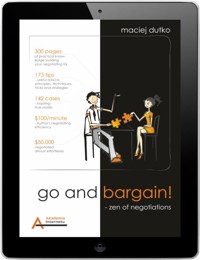
You have been negotiating your entire life: in kindergarten, at school, at work, at home, while shopping, in business… Sometimes however bargaining is accompanied by disputes, claims or even harm to one of the parties involved. Unnecessarily.
Thanks to this book, you will learn how to negotiate in a smart and conscious way, so as instead of taking the advantage and winning at all cost reach the balance and profits for each of the parties.
Probably the first book
on negotiating intelligence! (not only for businessmen!)
There are tens of books on negotiations that have been written in Poland, and hundreds (or maybe thousands) that have been written worldwide. Is this one better? I don’t know. But it’s certainly different. Apart from classic (and less classic) negotiating techniques and fighting off unwanted bargains, it presents individual, sometimes funny, sometimes bloodcurdling adventures of the author who has always had an inclination towards negotiating and not taking things for granted.
How did these – not always well-thought-of and not always strategically played – negotiations end? Read this book and find out!
Oh, and one more thing: this book is not only about business negotiations, because we actually negotiate always and anywhere. The more you realize it and the more consciously you start doing it, the more efficient yet ethical your negotiations will be.
YOU WILL LEARN:
-
· … why most people do not like (and are even afraid) to negotiate,
· what is holding you when you want to ask for a better offer,
· what aims you can reach knowing the basic rules of the game,
· what does a classic negotiating process look like,
· why not any negotiations are worth…winning,
· which techniques are the most efficient ones,
· what tips, tricks and strategies will make you an efficient negotiator,
· how to defend yourself against unethical tricks of the other party,
· what to do when negotiations end in failure,
· when it is worth passing up on bargaining and accepting the offer as it is,
· how to win in a smart, responsible, ethical and classy way,
· in what way you can learn about the motivation behind the other party, predict its behavior, anticipate its attack and avoid traps,
· why is it worth negotiating fair and in accordance with the win-win principle.
ABOUT AUTHOR:
Has been negotiating since he was a kid. In kindergarten he traded a golden watch for a pack of pellets; in elementary school he negotiated with a dishonest photographer; at university he bargained for his scholarship, but for a… change in the name of the institute as well; in business he negotiates each day.
It was not always that he would win. After bargaining with a psycho boss he lost his job; an argument used wrong blew a great opportunity of buying an apartment, wrong technique thwarted the plans of buying a dream car…
In this book, the author with shameless honesty shares his conclusions both on successful deals as well as on failures.
The owner of training (Evolu.pl), editorial (Korekto.pl) and auditing (Audite.pl) companies. The author of best-sellers (among them the “E-business bible”, “Fly in chocolate” etc.).
Recognized by WhitePress.pl as one of the 100 most inspiring people in the interactive media.
FACEBOOK: https://www.facebook.com/maciejdutko/
PRINTED BOOK: https://evolu.pl/produkt/go-and-bargain/
SEE ALSO:
„Fly in chocolate. Zen of success”
The world is an infinite buffet of possibilities. The whole art is to open your mind, see broader, make choices, and seize opportunities. Be like a fly in a sea of chocolate – wherever it flows, there’s prosperity.
Be more Free and effective! >>>
Ebooka przeczytasz w aplikacjach Legimi na:
Liczba stron: 401
Rok wydania: 2017
Odsłuch ebooka (TTS) dostepny w abonamencie „ebooki+audiobooki bez limitu” w aplikacjach Legimi na:
Podobne

![Tanio przez świat. Podróżuj [wy]godnie nawet za 1/3 ceny! - Maciej Dutko - ebook](https://files.legimi.com/images/e81a7b842c9fc475935f388ebcd9b667/w200_u90.jpg)













Are you a publisher and would like to buy exclusive rights to publish this book in your country? Send us your offer (the amount for the purchase of rights + interest on sales) and the sample agreement in English at [email protected].
Publisher: AkademiaInternetu.pl (Dutkon.pl Ltd Group)
Unit 4E Enterprise Court, Farfield Park
Rotherham, England S63 5DB
Company No.: 08664043 [email protected]
Edition I ● ISBN: 978-83-64845-50-5
Copyright © Maciej Dutko & AkademiaInternetu.pl 2018
Polish Edition © Maciej Dutko & AkademiaInternetu.pl 2015
Proofreading and typesetting: Korekto.pl
Cover design: Dominika Zakrzewska & frontDESIGN.pl
Wersja epub i mobi | Graphito studio graficzne, www.graphito.pl
Table of Contents
Why do we negotiate?
If you gave a snort of contempt while reading the title of this chapter – chalk one up for me. This means that you have yet a lot to learn. If – Why? Obvious, to buy cheaper or sell higher! – crossed your mind, you probably do not see the range of opportunities and applications of negotiations, and therefore profits from the knowledge of rules.
A smaller or greater financial gain is just one of the most absolutely trivial aims (and reasons) of negotiating. However, there are many more such aims.
But first...
Negotiations – the best business in the world
Striving for financial freedom and security, many people wonder what they can make the most money on. Some look for a well-paid job, others have their own business and some try investing. Each of these ways, if it is followed in a well-considered and consequent way, may lead straight to its destination. However, each of them is only one path to your financial freedom, and as you may well know, it is not that easy to keep your balance on one leg only...
Focusing only on the issue of how to earn more?, you might lose from your sight the other model of accumulating capital which is much more easier, efficient and practically risk-free. It just requires you to develop certain simple habits and learn its basic rules.
To explain my point, let us suppose that you are now holding an actual phrase (made from Styrofoam or an XPS board) saying:
How to earn more?
Imagine yourself now putting the phrase in front of a mental mirror which is supposed to show its opposite. What do you see in the reflection?
If you look at the right angle, you should see the following phrase:
How to spend less?
After all, it is much more easier to hold the capital that you already have than to get a new one. You will have the help of the two wise sisters, Saving and Negotiating. As far as I am concerned, it is them that you can base your economic freedom on: should you even lose your job, lose in the stock market or go bankrupt, the skills of wise saving and negotiating will allow you to survive through even the toughest crisis.
Unfortunately, I know a lot of people who are convinced that only hard and well-paid job is the key to their financial capital. As a result, they work like a horse for 60–80 hours per week, earn a dozen or so thousand zloty per month and... stay poor. Being unable to either save or negotiate, they cannot manage their capital that is trickling through their fingers.
And will continue to do so. A table standing on one leg only (earnings) has to fall; should you however equip it with two more solid ones (saving and negotiating), it will become stable[1].
But wait! In the title of this subchapter I have suggested that I think negotiating is the best business in the world. Would you like to know why do I think so?
For the last dozen or so years, I have run various business activities. Of course, some of them turned out to be a complete disaster, just to mention selling used books when I was just learning the art of selling and made various mistakes. Other ideas hit the jackpot and would have allowed to gain a certain capital, but I became bored with them quite fast (e.g. production of photos on magnets and promotional matches on magnets – these ideas are still lying fallow, waiting for someone to buy them from me and make money on them). Some other business activities (editing, auditing, training and consulting services) are still active and are doing well.
Thanks to these business activities that I consider to be good I have been able to earn from 200 zloty (being the absolute minimum) up to 4.5 thousand zloty (maximum) for an hour of efficient work. On average this is however from 400 up to 1200 zloty for selling my expert knowledge on audits and trainings and offering my assistance to companies in order to improve their business efficiency.
Do you think that earning a few hundred zloty or a few thousand zloty for an hour of quite a satisfactory job is much?
If so, it might come as a surprise to you: none, even the most well-paid sideline, has ever given me such a rate of return on the time invested as even the most trivial and quickest negotiation. In order, however, to earn from 3 up to 4.5 thousand zloty for one appearance, not only did I have to devote as MUCH as 60 minutes of my life spent on a stage, but also provide during this time the value exceeding this price. This is the value I have obtained during a dozen or so years of gaining my knowledge and experience. Essentially, these seemingly impressive amounts are not rates for an hour of time devoted, but for years of experience and sharing them with others.
It would sometimes happen that just one minute of bargaining, one sentence spoken or written without any preparation would allow to save from a few dozen of zloty up to a few thousand even. Let us take, for instance, purchase of a car the initial price of which amounted to 22 thousand.
‘A little expensive, if you ask me, my budget is merely 20...’.
‘20.5 thousand and it’s yours for the taking!’
This dialogue lasted less than 12 seconds. Efficiently, 1.5 thousand gained in 12 seconds amounts to 7.5 thousand in one minute. It would thus turn out that an hourly rate for even such primitive negotiator as I was myself at that time would amount to 450 thousand zloty. To tell you the truth, I have never ever had the chance to earn as much for an hour of any job. Have you?
I know, I know – you must now be thinking: Dude! You’re counting this wrong! The fact that you managed to take 1.5 thousand from a price in a matter of seconds doesn’t mean that you managed to earn 450 thousand!
And you are absolutely right! Shooting a single bullet and hitting bull’s eye does not make this any rule. We should rather say that even a blind squirrel finds a nut once in a while, but it will starve and die eventually since it does not know where to look for more. Converting one minute’s profit into an hourly rate with this approach is just imagining things.
All I want for you is to take your negotiating thinking to a higher level thanks to this book. From single and incidental acts of negotiating I want you to make a kind of continuity and a rule. If you scale occasional bargains into something permanent, reoccurring and conscious, you will find that the amounts negotiated will start to add up to something of a sort of an hourly rate. A rate you will never obtain inmost legal businesses, let alone in the best-paid full-time job.
Therefore, let me say it once again:
Go and Bargain! This is the best business possible.
Anyway: even if from time to time you manage to knock down a few dozen or a few hundred zloty, you will soon find out that one minute of stress-free bargain could be worth an hour or a week of hard work – this book is packed with descriptions of such stories.
And once you have felt the magic of negotiating, I assure you that it will become an exciting sport and an addiction at the same time for you.
Ask and it will be given to you. A question worth 1200 zloty
The awareness of benefits coming from negotiating and lack of anxiety to bargain can pay off sometimes.
If I told you two pages ago that there is a simple, effortless, ethical and legal way for you to make 1200 zloty in one minute, you probably would screw up your eye and frown in skepticism. Having read the story of car purchase a moment ago, your forehead should now be a little smoother and you brows raised in wonder. Is this so?
If it is not the case, here is another example proving that sometimes in reply to the offer sent all you have to do is to present your counterargument, and such ‘miracles’ will happen.
In April 2014, my Akademia Internetu received an inquiry concerning the training on e-marketing. The prices of trainings we offer are moderately high (from 2 up to 5 thousand zloty per day), therefore not every company would be able to allow themselves such luxury. However, there are no obstacles to ask for a modification of such cost.
And so it happened. I received a very short inquiry which must have taken its author not more than one minute to write:
Hello, we are a very small company. The number of people attending the training would be max. 2. Could it be possible to make the training related expenses cheaper?
And so, earlier assumptions were verified and counter offer sent, which allowed the client to reduce the cost of two-days’ training by 1200 zloty:
For instance, if we’re taking a two-days’ training into consideration (the first day dedicated to the most important and most profitable e-marketing actions, while the second one only to e-mail marketing), I’d like to have it run by two different trainers, one probably from Wrocław and the other from somewhere near Warsaw. In this case, apart from the remuneration of the trainers, we must consider trip and accommodation-related expenses, so the cost I mentioned earlier is little flexible, unfortunately (however, I think that we might manage to achieve a 10% discount).
If the e-marketing part was only one of the modules and not a whole separate day of training however, the whole training might be run by just one person, and this will provide us with considerable savings. Depending on the date of the training and the availability of our trainers, this might be one of them, however I might give a lecture on this topic myself – in the latter case I can offer you a 15% (~525 zloty) discount in the case of 1-day’s training or a 20% (~1200 zloty) discount in the case of 2-days’ training.
As you can see, my client in one short e-mail made me answer her inquiry. In consequence, instead of 6500 zloty for a two-days’ training she received an offer for 5300. In other words, in just one minute she negotiated (therefore saved and earned) twelve green banknotes with a certain nice Polish king on them.
If, taking a walk one day, you came across twelve merry Jagiełłos[2] lying on the pavement, would you care to bend and take them in? I bet you would. And this is just the same amount (close to zero) of effort that everyday negotiations require from us!
Who should negotiate?
I am sure that you already know the answer: anyone! Anyone of us has been confronting other people in their lives. It is often that either we want something from others or they want something from us. Sometimes we are however unable to get an agreement on the ‘price’ for this ‘something’. It is then that we start our bargain – usually unconsciously and without any strategy whatsoever, which in more controversial or just hard situations might cost us a lot (not only of money).
Admit it, even once in your life, after the end of talks where you wanted to knock down something from the price, you silently realized: Fuck! I blew it... Now I’d have done it differently.
Time, as we know, is a good teacher; yet it might be too late for learning sometimes once bad decisions are made. Thus, this book is a time machine for you thanks to which you will obtain strategic knowledge on what might be coming; any knowledge gained ‘after’ is too little too late. (However, even for those that are always running late, reading this book might get them there on time).
Let us go back to the question who should negotiate? Of course, what first comes to mind is people who have arguments and disputes included in the nature of their job: politicians, soldiers, mediators, diplomats, attorneys, hired agents... Yet, there is also a whole circle of representatives that come in more common ‘segments’, as follows:
Private individuals – it is from negotiating abilities that they possess that their personal capital depends on – and on this capital depends their freedom in decision-making and freedom and financial security in general, but also the standard of living of them and their family. The ability to ‘have their own way’ stays in close relation with the notion of ‘assertiveness’. This is the condition of whether we live the way we want to or the way others (family, employers, politicians, religious leaders and, finally, sellers and marketers who want to intensify our purchase decisions at any cost) want us to live.
Buyers and sellers – this does not require any comment, does it?
Small companies – because they are... small and every thousand zloty or extended due date of payment might have an effect on their liquidity and survival.
Medium-sized companies – because their ability to invest and thus develop depends on their capital, dates and terms of cooperation with contractors and employees. Or else they drop to the third division.
Large companies – since it is their obligation to generate profit for their employees and shareholders (this in particular concerns joint stock companies which pay out dividends). Moreover, large companies should negotiate... since their strength is greater in this scope (see: large chain of stores which firmly negotiate terms with their suppliers).
Incidentally, while we are talking about companies: sometimes people who do not run any business but are employed under a contract of employment, think that if someone is an employer or a member of the board of directors or is in some other high position, they are unconcerned with the problems of ordinary men. Yet, this might come to some as a huge surprise, but the problems of the ordinary people are actually the same problems that the great ones have; the difference lies merely in the scale or the way they are overcome.
As I mentioned, I have been running various business activities for a dozen or so years. One of them consists in intensive advising to other companies (i.e. auditing sales offers and trainings). I have worked with about 10 thousand entrepreneurs: tiny one-man businesses, but also stock-listed companies, greatest logistics operators, private universities, media, organizers of great business fairs, main energy conglomerates or internet tycoons (just to mention Allegro, KGHM, Gazoprojekt, DHL, Idea Bank, Poznan International Fair, Tauron, TVP, Oponeo, Business Centre Club...). Of course, I got to know some of them only superficially as a part of a one-off cooperation, others – profoundly during cooperation that lasted for even a few years.
One thing I can say: all these companies, irrespective of their size, popularity and the manner of management, profile, legal form or trade would be long gone from the face of the earth once they would stop their negotiations for just one moment. With suppliers and customers, clerks and competition, business partners and their own employees (or – what would be worse – with trade unions). Negotiations are one of the most important everyday elements in the operations of every – without any exception! – entrepreneur and enterprises (I am of course talking about the countries with free market economy or just seemingly free market economy – that is countries in the European Union). Even monopolies are coming to an end, oligopolies are unable to take the market for themselves for a longer time, and cartels... well – they operate often based on price fixing which is also a kind of pathology in negotiating terms.
In this book I have however focused on such strategies and forms of negotiating that – apart from companies – might also be used by you in your everyday reality or in your small or medium-sized company in order to boost its efficiency.
Let us however retain the proper order: before in the following chapter I answer the question how?, we must firstly realize that there are many aims to negotiating.
Different negotiating targets
I think the fact that money is not the only object of negotiations is already obvious to you. However, it is money that most frequently comes to our mind when we talk about bargains.
In the meantime, you can virtually negotiate anything. Below I included a list (incomplete of course) of the most popular objects and aims of negotiations.
Decreasing or increasing the price
This is surely the most common aim which however might be the result of various reasons. Usually, the argument is as follows: Because my budget is very limited. However, it is worth noticing that this reason not always goes along with the truth. Oh no, it almost never goes along with it! Buyers are lying in an attempt to try to make the seller reduce the price. You surely cannot get water out of a stone! – right?
I teach people participating in my sales training on how to dismiss the This is too expensive for me argument. Anyway, when I tell them not to believe fairy tales of the low budget, many of them are truly surprised that behind such phrases lies one of the most simple and oldest negotiating techniques.
Of course, upon hearing an individual crying oh come on, mister, this is way too expensive!, you can take the easy way out, take this at face value and agree for the discount. Or – worse – treat the customer as some kind of a beggar and drive them away. In this book you will find such stories that would be able to freeze alcohol in your veins, telling about incompetent sellers who lost clients worth a few dozen or even hundreds of thousand zloty, just judging by appearances or believing the message: You have to believe me, this is all I’ve got!
You can also – which is what I would recommend – assume a priori that the client is deliberately misleading you and try to find out their actual motivation and capability. Then you will be able to respond correctly, keep your opportunity, and at the same time not to be taken in by a more clever contractor.
Extra benefits
The wise will not fight for the price itself, but for the additional value. The buyer for the extra product, sample or service; the seller for the fastest decision of the client or the opportunity to sell something more (cross-selling).
Much clever clients (not meaning smart) have a certain key: they understand perfectly that the seller is unwilling to give away a part of their profit; they are more willing to sell the product at a regular price, adding something in return. This is something we refer to as extra. Or a bonus. Though economic experts would prefer the term added value, since it sounds more intelligent.
Imagine someone selling strawberries at the end of the day. Of course, you might say the following:
‘I will buy a kilo, but I can pay 8 zloty instead of 10. After all, you will soon be packing up anyway, so it would be a shame for those strawberries to go to waste’.
And I guess most sellers would go for it, since they would want to get rid of the fruit that would have to be thrown away anyhow. However, since we are able to predict the motivation behind the seller, we can play a different higher tune at the exact same string:
‘I can see you are packing up. I would buy some, but are you willing to sell one and a half kilo for the same price as one?’
If you asked for a 50% discount, I would not be so sure that the seller would agree to it so easily. If you however nicely ask for increasing the amount of products by half for the same price, and provide some nice arguments for your offer (which we will talk about in the chapter on principles of negotiating), I can bet you 5 zloty that you will get your 50% without any major sulking on the part of the seller. And maybe more.
Do you know any bank deposit or even a stock-listed company whose shares are able to provide such rate of return within minutes? I know none.
Due dates of payment
People buying on credit like to take it easy with their payments. In particular, entrepreneurs are glad to get their product and have the due payment postponed: in order to hold the money a little longer, to turn their capital a little longer, to multiply it and eventually then pay the supplier. I myself do not like and seldom turn to postponing my payments – both as the client and the contractor; however, I am aware that for many companies the so-called merchant discount is still the usual and perfectly common manner of settlements.
This is precisely why companies are equally willing to negotiate their discounts as well their due dates of payment: sellers would like them to be the shortest possible, buyers – the other way round. The other thing is that in the context of due dates cross-offers or conditional offers tend to appear, for example: Okay, you have 90 days to pay, provided that you buy not one ton but one and a half. Or in other words: Waiting for 45 days for the money is too long for us, but agreed – so be it. Should you however change your mind and pay upfront, you will get a 10% discount.
Did I mention that I do not like transactions with postponed payments? Well, I lied a little. Virtually a dozen or so days before me writing this, during the Warsaw Book Fair, I made an offer to one of the agents distributing my books. It was as follows: Do you take the “Efekt tygrysa?” 100 copies and a 50% commission, payment on the date most convenient for you. Unless you would rather have a 60% commission, but here are the terms: you take 150 copies and pay upfront.
Contractors generally like such nice dilemmas – since they can choose themselves if the greater value lies for them in the additional 10% of revenue or would they rather profit more on being able to turn the already held capital longer.
Extending the warranty
The issue is trivial – longer post-sales support service is one of the crucial elements of building the competitive advantage. If the equipment included in our offer is good, the risk that it will break in the third year of its use is only slightly higher than it being blown to bits during the first 24 months (unless a particular device is designed in such a way so as to be broken just one month following its standard warranty...).
Giving the customer a 10% discount – that just hurts; and if we operate in the low-margin products sector, such discount just would not do, since it would mean dumping which is selling below the cost of purchase. But think about this: does the fact that you do not want to or are unable to offer your client a discount mean that you have to refuse and – probably – lose them? Maybe there is something that you would be able to offer as a much cheaper alternative for you and still worth much more than the mentioned 10% discount for the client?
An extended warranty may be just the thing – for you this will be a small expense (assuming that the products you sell are of good quality and should not get broken so quickly). And this extra year of security that the client is provided with is still a very solid although maybe little measurable mental value. This is why, if the client is still hesitating, the argument: Oh very well, just to encourage you, let me offer the warranty extended by one year – may be the most important element that will tip the scales of this purchase decision.
The other thing is that all great players have long ago decided to assess this virtual value that the feeling of this additional security is. This might be seen even in the offers of large chains selling electronics which offer their clients various versions of ‘additional insurance’ on the product or purchase of an extension of the warranty period:
Source: amazon.com (accessed: 20.11.2017)
Additional support
Since we are already talking about the electronic equipment: for many buyers its installation or configuration is already a huge problem. Meanwhile, for the seller who is usually an expert in their profession, something that would cost the client 30 minutes of stress, is just a walk in the park. And if so, why not give the client this value for free, making it at the same time an additional low-cost negotiating leverage?
On the other hand: if it is you who is buying the equipment and you know that its installation will consume a lot of your time and energy, instead of mindlessly asking about the 10% discount, rather ask for the assistance in configuration or even basic training on using the device. I guarantee: you will gain more and the seller will lose less than this 10% which is just money.
Do you feel one of the principles of negotiation that might be learned from this example hanging in the air? The principle is: give the client something that would be of measurable value to them but no significant expense to you. Yet, we will talk about this later on.
Exclusiveness
This is a strong argument not only in marriage but in business as well. If you give a contractor your word that from now on only they shall have the right to... ahem... cooperate with you in some scope, you will mutually be able to make of such declaration a strong negotiating asset. Just be careful not to expose yourself to the Office of Fair Trading falling under a monopoly or the charge of price fixing; however this type of risk would rather concern major players than the medium or small ones.
More available in full version
[1] In this book I have focused on negotiating which is one of the forms of saving. If you want to learn and develop a few other good habits of wise and efficient saving as well, be sure to have a look at this absolutely perfect and very practical blog of Michał Szafrański at JakOszczedzacPieniadze.pl.
[2] Władysław II Jagiełło – King of Poland (1386-1399) alongside his wife Jadwiga, and then sole King of Poland. His image is printed on a 100 zloty banknote.
More available in full version
More available in full version
More available in full version
More available in full version
More available in full version
More available in full version
More available in full version
More available in full version
More available in full version
More available in full version
More available in full version
More available in full version
More available in full version
More available in full version