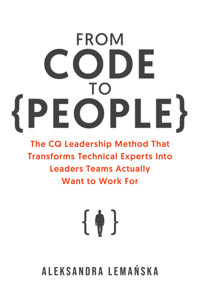
From Code to People. The CQ Leadership Method That Transforms Technical Experts Into Leaders Teams Actually Want to Work For ebook i audiobook
Aleksandra Lemańska
Uzyskaj dostęp do tej i ponad 240000 książek od 14,99 zł miesięcznie
- Wydawca: LemanSkills Aleksandra Lemańska-Czajka
- Kategoria: Biznes, rozwój, prawo•Biznes, rozwój
- Język: angielski
You were exceptional at the technical work. That's why you got promoted. Now everything has changed.
Instead of debugging code, you're navigating conflicts. Instead of writing clean architecture, you're writing performance reviews. Instead of solving problems alone, you're responsible for a team of people you weren't trained to lead.
From Code to People gives you the system that fixes this. The CQ Leadership Method combines three practical frameworks: Process Communication Model® (PCM®) for understanding people the way you understand systems, Contracting for eliminating the "I thought you meant..." conversations before they start, and the Wheel of Conflict for diagnosing and resolving team dysfunction at the root.
No theory. No MBA required. Just tools that work on Monday morning.
For technical leaders who are ready to become the kind of leader their team actually wants to work for.
Ebooka przeczytasz w aplikacjach Legimi na:
Liczba stron: 323
Rok wydania: 2026
Audiobooka posłuchasz w abonamencie „ebooki+audiobooki bez limitu” w aplikacjach Legimi na:
Podobne








From Code to People. The CQ Leadership Method That Transforms Technical Experts Into Leaders Teams Actually Want to Work For © Copyright 2026 Aleksandra Lemańska
All rights reserved. No part of this publication may be reproduced, distributed or transmitted in any form or by any means, including photocopying, recording, or other electronic or mechanical methods, without the prior written permission of the publisher, except in the case of brief quotations embodied in critical reviews and certain other noncommercial uses permitted by copyright law.
Although the author and publisher have made every effort to ensure that the information in this book was correct at press time, the author and publisher do not assume and hereby disclaim any liability to any party for any loss, damage, or disruption caused by errors or omissions, whether such errors or omissions result from negligence, accident, or any other cause.
Adherence to all applicable laws and regulations, including international, federal, state, and local governing professional licensing, business practices, advertising, and all other aspects of doing business in the US, Canada, or any other jurisdiction, is the sole responsibility of the reader and consumer.
Neither the author nor the publisher assumes any responsibility or liability whatsoever on behalf of the consumer or reader of this material. Any perceived slight of any individual or organization is purely unintentional.
The resources in this book are provided for informational purposes only and should not be used to replace the specialized training and professional judgment of a health care or mental health care professional.
Neither the author nor the publisher can be held responsible for the use of the information provided within this book. Please always consult a trained professional before making any decision regarding treatment of yourself or others.
Process Communication Model® (PCM®) Notice
Process Communication Model® and PCM® are registered trademarks and trade names owned by Kahler Communications, Inc. All rights reserved. The PCM® trademarks, logos, and related intellectual property are the exclusive property of Kahler Communications, Inc. and may not be used without prior written consent.
The Process Communication Model® was created by Dr. Taibi Kahler, clinical psychologist and founder of Kahler Communications, Inc. References to PCM® throughout this book are made solely for educational purposes, in the context of the author’s certified practice as a PCM® Practitioner.
For more information, email [email protected].
ISBN: 979-8-90057-391-5 - Ebook
ISBN: 979-8-90057-392-2 - Paperback
ISBN: 979-8-90057-393-9 - Hardcover
Get Your Free Gift!
To get the best experience with this book, I’ve found readers who download and use The Video Summary can implement faster and take the next steps needed to transform your tech leadership, from burnout to success, by using the CQ Leadership Method.
You can get it by visiting:
Contents
{Introduction}
The CQ Imperative: Why Tech Leaders Need It Now More Than EverHow Much Does it Cost?
CQ as the Missing Piece in Leadership Excellence
The CQ Leadership Method: Foundations of Effective CommunicationIntroduction to the CQ Leadership Method
The Three Core Pillars: Self-Awareness, Adaptability, and Lifelong Learning
Lifelong Learning
How to Integrate CQ into Your Daily Leadership Practices?
Understanding Yourself: The First Step to CQ MasteryUnderstanding the PCM® Framework
The 6 PCMⓇ Personality Types
Mike’s Story - Patterns Explained
Your Turn - Practical Application
Reading the Room: Understanding Others Through PCM® LensHow 6 Types of Personality Show Up Positively in Tech Teams (Superpowers)
Recognizing Distress Sequences and How to Address That (Dark Side)
Quadrant 1: OK-OK
Quadrant 2: OK-Not-OK
Quadrant 3: Not-OK-OK
Quadrant 4: Not-OK-Not-OK
3 Buckets of Distress Sequence
Building Trust by Speaking Their “Language” (and How It’s not a Manipulation)
Preventing Conflict Before It Starts: The CQ ApproachHow Stress Impacts Communication and Decision-Making?
The Wheel of Conflict
How Can We Use Conflict That Nourishes Our Team?
Using CQ to Spot Early Signs of Miscommunication in Your Team
Building High-Performing Tech Teams with CQCreating an Inclusive Culture Where Every Voice is Heard
How to Create Collaboration Across People in the Team?
Why Contracting Is the Missing Piece?
The 3 Levels of Contract with Tech Examples
Why “Is everything clear?” and “Do you have any questions?” fails?
How Contracting Prevents the Wheel of Conflict?
Leading Through Change: CQ as Your SuperpowerWhy Change is Especially Challenging in Tech Environments?
Using CQ Leadership Method in a Change: Tech Leader’s Checklist
Why Changes in Organizations Fail So Often?
Daily Practices: Making CQ AutomaticDaily Habits: The Foundation
Active Listening: Reading the Room in Real-Time
Feedback in Tech Teams: Your Daily CQ Workout
Measuring and Sustaining Your CQ GrowthYour CQ Dashboard: What to Measure?
Reflection: Your Strategic Pause
Your CQ Support System: 7 Essential People
OKRs: Making Growth Measurable
Learning That Matches Your Wiring
Burnout in IT: Is It a New Pandemic?Burnout Research
6 Categories of Burnout in Tech
What’s Your Current Burnout State?
IT Burnout Framework
The Future of Tech Leadership: A Call to ActionWhat You’ve Learned: The CQ Leadership Method
Your Role in Shaping the Future of Communication in Tech
Final Thoughts: Be Curious, Be Adaptive, Be a CQ Leader
{Acknowledgments}
{About the Author}
{Introduction}
Mike stared at his screen. 47 unread emails. 23 Slack messages. 4 team members waiting for answers. A client escalation. A production bug. And it was only 10 AM on his second week as Team Lead.
Three months ago, he was the best developer on the team. Now he felt like the worst leader in the building.
If you’ve ever felt like Mike—promoted for technical excellence but drowning in the people’s side of leadership—this book is for you.
The Problem You’re Facing
Most likely you became a tech leader because you were exceptional at technical work. You could debug the toughest issues, architect elegant solutions, and deliver when it mattered. Your code was clean. Your technical judgment was sound.
But now? The job has changed completely.
Now you’re supposed to:
Give feedback without triggering defensiveness or resistanceDelegate tasks without micromanagingMotivate team members you don’t understandNavigate conflicts you never saw comingCommunicate clearly with people who seem to speak a different languageDo all of this while staying on top of sprint planning, stakeholder meetings, and your own deliverablesAnd nobody trained you for any of it.
The data confirms what you’re experiencing:
86% of employees say poor communication causes workplace failures44% of tech professionals miss deadlines due to unclear communicationPoor communication costs $7,171 per employee annually—multiply that by your team size47% of tech leaders feel emotionally drained at work every single week22% are facing critical burnout levelsHere’s the brutal truth: Technical skills got you promoted. But people skills will determine whether you succeed or burn out.
Why Is This Happening?
The transition from expert to leader is one of the hardest career shifts you’ll ever make. You went from being evaluated on your individual output to being judged on your team’s performance. From solving technical problems to solving people’s problems. From writing code to writing performance reviews.
Most tech leaders fail this transition not because they’re incompetent, but because they’re using the wrong tools. You can’t debug a human relationship. You can’t refactor someone’s motivation. You can’t unit-test trust.
The skills that made you a great developer won’t make you a great leader.
And here’s what makes it worse: You’re time-starved, overwhelmed, and expected to figure this out while still delivering results. You don’t have months to read management theory or get an MBA. You need solutions that work on Monday morning.
What This Book Promises?
This is not another theoretical leadership book. This is a practical framework built specifically for tech leaders who need to get better at the people side—fast.
The CQ Leadership Method that I’ve created gives you three things:
A way to understand yourself and othersUsing Process Communication Model® (PCM®), you’ll learn why some behaviors of others are extremely difficult for you to cope with, why certain team members thrive while others struggle, and why the same message lands completely differently with different people. You’ll get pattern recognition for human behavior—the kind of systematic thinking you already excel at, applied to people.
A tool to prevent 90% of team conflictsThe Contracting framework shows you how to create crystal-clear agreements that eliminate the “I thought you meant...” conversations. You’ll learn how to delegate without ambiguity, set expectations without micromanaging, and align your team without endless meetings.
A system to spot and resolve the conflicts you can’t preventThe Wheel of Conflict helps you diagnose the real root cause of team dysfunction—not the surface drama—so you can fix problems once instead of fighting the same fires repeatedly.
Together, these three pillars give youa strong muscle of Communication Intelligence (CQ)—the ability to tailor your communication to each person, prevent misunderstandings before they explode, and build a team that actually wants to work with you.
What You’ll Get From This Book?
By the time you finish, you’ll be able to:
Recognize your own stress patterns and get back to calm fasterIdentify your team members’ communication styles in the first 3 sentences they speak or writeGive feedback that lands instead of triggering defensivenessDelegate effectively without micromanaging or losing controlPrevent conflicts by creating clear agreements upfrontNavigate change without your team falling apartSpot burnout early—in yourself and others—and take action before it’s too lateAnd you’ll do all of this without becoming a different person. You don’t need to fake being extroverted, pretend to love small talk, or transform into a “people person.” You need frameworks, not personality changes.
Why I Wrote This?
I know what it’s like to fail at something you were supposed to be good at.
After 14 years of violin training, I failed out of music academy—not because I lacked essential skills, but because nobody helped me understand what was really going wrong. The dean’s suggestion? “Maybe it’s time for you to quit.”
I did quit. And that failure taught me something crucial: Most people don’t fail because they’re incompetent. They fail because nobody gave them the right tools.
When I pivoted to engineering studies, then HR and started working with tech leaders, I saw the same pattern everywhere. Brilliant developers were promoted into leadership roles, struggling not because they were bad leaders, but because nobody equipped them for the job. I watched talented people burn out, great teams fall apart, and skilled professionals quit because the people’s side felt impossible.
Over the past 10+ years, I’ve worked with hundreds of tech leaders—from startup Founders to C-suite executives in global organizations. I’ve run thousands of hours of workshops and mentoring sessions. I became certified in Process Communication Model® and built frameworks specifically designed for analytical, time-starved tech leaders who need practical tools, not psychological theory.
This book is everything I wish someone had given those struggling engineers-turned-leaders. It’s the system I use with clients who go from overwhelmed and reactive to confident and strategic. It’s what worked for Mike—and what can work for you.
How to Use This Book?
This book is designed for people who don’t have time to waste:
Read it chapter by chapter to build the complete framework, or jump to the chapter addressing your biggest pain point right nowDo the exercises as you go—they take 5-15 minutes and immediately apply to your real situationsUse the tools Monday morning—every framework includes specific scripts, templates, and examples from tech teamsCome back to it as a reference—this is a field guide, not a novelEach chapter builds on the last, but you don’t need to read sequentially if you’re facing an urgent issue. Struggling with a difficult team member? Start with Chapter 4. Team in conflict? Jump to Chapter 5. Feeling burned out? Chapter 8 has your back.
Fair warning: This book will challenge you. You’ll need to examine your own patterns, admit where you’re contributing to problems, and try new approaches that feel uncomfortable at first. If you want easy solutions that let you blame everyone else, this isn’t for you.
But if you’re ready to become the leader your team actually wants to work for—the one who builds an environment people don’t quit—then let’s begin.
{Chapter 2}
The CQ Leadership Method: Foundations of Effective Communication
A couple of years ago, I was working with a manager, let’s call him Mike. Mike was a great Subject Matter Expert in the Software Engineering area, and an amazing developer who started his programming journey on his neighbor’s computer. He started to play some games on this computer, but then he wanted to get to know how those things work. He asked questions and told his parents that he would like to learn it, “as a pro.” Even if he was just a teenager, he had this curiosity that was the beginning of a huge passion.
Over the years, Mike learned, sat in front of the computer (first at the neighbor’s house, then on his own) for hours, making mistakes, looking for bugs, fixing them, testing what he’d done, and repeating it over and over again. It was his life. Then he went to the university to study computer science, and very quickly he started to work with (he was a dreamy candidate for recruiters, with 10 years of experience as a 22-year-old).
His story after that went the same as many others I know: Passionate SME, growing from Junior, into Mid, into Senior. He was the best expert in his area, so he got an offer to become a Team Lead of the team that he had been working in for years. Natural path, right? He had the full knowledge, knew how the processes worked, was a technical authority, always ready to answer any questions that the team had, so it seemed like the best choice and the next career path step. What could go wrong here?
How often do you see (or maybe even experience) that kind of story?
I see it all the time. Sometimes promoting your best experts into the leadership roles works, but 80% of the time (thank you Pareto rule, where 20% of your efforts are responsible for 80% of the results), it doesn’t. People get miserable once they start to be leaders.
Was Mike in those 80%, or was he in the minority of 20% that actually succeeded?
Mike got an offer to be a Team Lead of his current team. More money, a nice job title, a promise of bigger influence and impact on the processes, ways of working, and decisions the whole IT Hub is making. The bright future (most of those promises were true, though). He didn’t have any experience in leading anybody but himself, but he got those messages like: “You know those people, you know what they do, since you’ve done it yourself; you’ll just keep doing what you’ve been doing in the past, with some administrative tasks in HR systems”. So, Mike thought: “How hard can it be then?”, and he took the job.
I don’t think I need to tell you how surprised he was on the first day of his new position. He didn’t think it would be that new, but it was. His boss told him that he knows it all, so she’s not worried about his performance; he has all the autonomy he wants. Isn’t it great? Freedom and space to do what he thinks is best for the team to do their job.
He started his day as he always did by doing his operational tasks. But very quickly, he began to be distracted all the time—Teams’ questions, different meetings, notifications from different systems, other managers’ questions, and needs to be covered.
The weeks went by, and Mike was swamped by the number of e-mails, Teams messages, and open tickets, not to mention the things that his team needed from him to cover their job. Everybody seemed to want everything, and they all used different communication channels to get to him.
Mike experienced one of the worst things that can happen to a person who has a technical, analytical brain and is an expert in their area: He stopped being efficient and getting the job done. It had never happened before—he always knew what to do and, if not, he just took time to figure it out, with the trial and error mode on. But here? With all those tasks, projects, expectations, people, processes, different needs of other parts of the business, and clients… It was impossible. He had this thought: “I don’t want to do it anymore. I just want to come back to my previous role, do what I know how to do, and not deal with all of this crap anymore. I’m done.”
And that’s the moment of the story where an HR representative from the company where Mike worked contacted me, asking for mentorship. They didn’t want to lose him; he was a great expert with leadership potential. He was super frustrated, but he agreed to go with the 1:1 process and give this role one last chance. We agreed on the rules of the mentoring process and started to work together.
The first thing I introduced to him was the CQ Leadership Method.
Introduction to the CQ Leadership Method
The CQ (Communication Intelligence) Leadership Method is a framework that includes the Process Communication ModelⓇ (PCMⓇ) and different tools from the organizational path of the Transactional Analysis. TA is another framework describing human interactions and explaining their root causes, which is useful on the leadership path.
Everything that is included in the method is based on what I’ve implemented in my own leadership practice, but also what other leaders have learned and used in their teams and organizations. It is not a theory; it’s pure practice. The tools were (and are) used by hundreds of leaders in different countries, industries, sizes, and levels of growth. I created the Method because I believe in pattern recognition, and people are repetitive. Their thoughts, beliefs, reactions, decisions they make… It’s not about one-size-fits-all, and it’s not about labeling people to put them into boxes.
The Method is about understanding yourself (first), and others (second). It’s about the mindset, skillset, and toolset that you can use to be a leader that people want to work with. Not a lot of people are prepared to be leaders; Mike sure wasn’t. But by using the Method, you can be a better person and a better leader to others.
So how do you do it?
The CQ Leadership Method is constructed with a 3 main elements:
Process Communication ModelⓇ (PCMⓇ) — a base to understand people’s communication preferences, sequences of behavior under stress / pressure, and motivational needs they have, so you don’t need to guess them as a leader.PCMⓇ gives you ready-to-use solutions and actions to address behaviors that are not ideal, especially in the workplace, such as aggressive reactions, manipulation, withdrawal of people who we want to be more active, lack of patience, procrastination, and mismatched communication—both written and verbal.
The Contracting tool — a structure that gives you what you need to make agreements with people on what’s to be done, who’s doing what, and when, and making sure that all parties are on board, without asking the worst 2 questions of all time: “Is everything clear? Do you have any questions?”The Wheel of Conflict — a tool that consists of 5 types of conflicts that appear in teams / organizations. This is a roadmap for you as a leader to navigate the misunderstandings between people; to deal with them or to avoid them before they even appear.Throughout this book, we’re going to unpack all 3 of these elements. I’m going to use Mike as an example, as we went through the whole Method in our mentoring process, so don’t be surprised that his name is going to appear. He is a real person, and this is his real success story with the CQ Leadership Method.
CQ is a way of thinking and acting in a more tailored way to get your time back. We lose so much time on insufficient communication, misunderstandings, conflicts, and countless meetings that don’t take any action at the end. I’ve created this Method so we stop wasting time on all of it and instead focus on things that create real value—those that move the needle and actually change something. I’ve created this Method so leaders are not suffering, burned out, frustrated, and tired. Finally, I’ve created this Method so leaders don’t hate their jobs, and their team members don’t hate them as leaders.
Isn’t it better to like what you do, keep the passion alive, and create value for yourself, your loved ones, your people, and your clients?
If you answered YES to any of the questions above, I think you’re ready for the next part of the book.
The Three Core Pillars: Self-Awareness, Adaptability, and Lifelong Learning
Leadership is a complex job.
And we, as humans, are great at adding more complexity to the table. Simplifying things is one of the hardest skills to learn in our world. Why is that?