Uzyskaj dostęp do tej i ponad 240000 książek od 14,99 zł miesięcznie
- Wydawca: BoD - Books on Demand
- Kategoria: Religia i duchowość•Filozofia
- Język: angielski
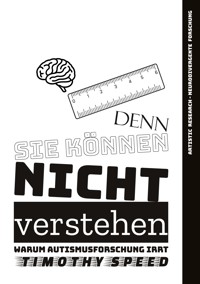
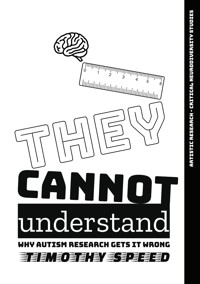
One cannot exist and be understood at the same time - with this sentence, the neurodivergent artist, researcher and activist Timothy Speed opened the field of Autistic Epistemology: a new mode of thought in which autism is not the object of knowledge, but its origin. He fuses Critical Autism Studies, Artistic Research and Systems Theory into a unified ontology of resonance. Speed is among the few thinkers who do not merely theorise posthumanism, but live it. An overlooked systems theorist of our time - speaking of resonance long before Hartmut Rosa, unfolding an understanding of reality as cyclical, embodied interaction that links economic, social and energetic processes and, like Nobel Prize-winning theorists of market and behavioural economics such as Mokyr, Aghion and Howitt, anticipated the end of linear rationality and the necessity of a relational economy. His work is not simply a contribution to autism research; it is a fundamental theory of perception, labour and existence in the age of overstimulation. It belongs to the line of paradigmatic shifts that do not speak about deviation, but generate knowledge from within it - comparable to Fanon, Haraway, Deleuze or Manning. Speed exposes the ontological gap between the neurodivergent and the neurotypical and transforms not only the Double Empathy Problem, but our understanding of masking and of reality itself. They cannot understand shows that every existence is a distortion - and that neurodivergence might be the key to recognising this fracture as a generative force.
Ebooka przeczytasz w aplikacjach Legimi na:
Liczba stron: 259
Rok wydania: 2026
Odsłuch ebooka (TTS) dostepny w abonamencie „ebooki+audiobooki bez limitu” w aplikacjach Legimi na: